Smart Scales: Is the Body-Fat Number a Lie?
A smart bathroom scale does one job superbly and one job badly, and the marketing blurs the line between them. Step on, and within a few seconds it shows your weight — accurate to a rounding error — plus a glowing dashboard of body-fat percentage, muscle mass, body water, and bone mass. The weight is real. The breakdown is a guess, run by sending a faint electric current up one foot and down the other and inferring what your tissue must be made of. That guess is good enough to follow a trend if you are careful, but the exact body-fat number it hands you can be several points off the clinical gold standard — and it swings with how much you drank, when you last ate, and what time of day it is. Here is what these scales actually measure, where the validation holds, and where the confident two-decimal number is selling a precision it does not have.
How this article was built: Primary sources: the Hummel et al. 2021 smart-scale validation against DEXA in JMIR mHealth and uHealth; the Siedler et al. 2023 fifteen-device BIA reliability and validity study in the British Journal of Nutrition; the Sbrana et al. 2022 standing-BIA-versus-DXA analysis in BMJ Nutrition, Prevention & Health; the 2024 multi-frequency BIA reliability and biological-variability study in Frontiers in Nutrition; and the Ugras 2020 hydration-status BIA study in the Libyan Journal of Medicine — all retrieved and verified through PubMed and the Consensus research database.
- Weight is gold; the body-fat % is a guess. As a weighing instrument a smart scale agrees with a clinical reference to within a few tenths of a kilogram. As a body-fat meter, its absolute number can sit several percentage points off the DEXA gold standard.1
- Trends beat absolutes. Used at the same time, in the same hydration state, day after day, the scale tracks the direction of change usefully — that is the part worth watching, not the exact figure.2
- The muscle, water, and bone breakdowns are even shakier. They are derived from the same single impedance reading, so the errors stack; treat them as the softest numbers on the screen.4
- Hydration, food, and time of day move the number. Drinking a litre of water can shift a BIA body-fat reading by several points in the wrong direction. For true body composition you still need DEXA or a BodPod.5
- What a smart scale is actually measuring
- The mechanism: current, water, and conductivity
- Weight: the part that is genuinely gold-standard
- Body fat: the number that drifts
- How far off, in real studies
- Muscle, water, bone: the softest numbers
- How to actually use it: a tiered view
- Hydration, food, time of day, and other grey areas
- Open questions
- What this article is not saying
- References
What a smart scale is actually measuring
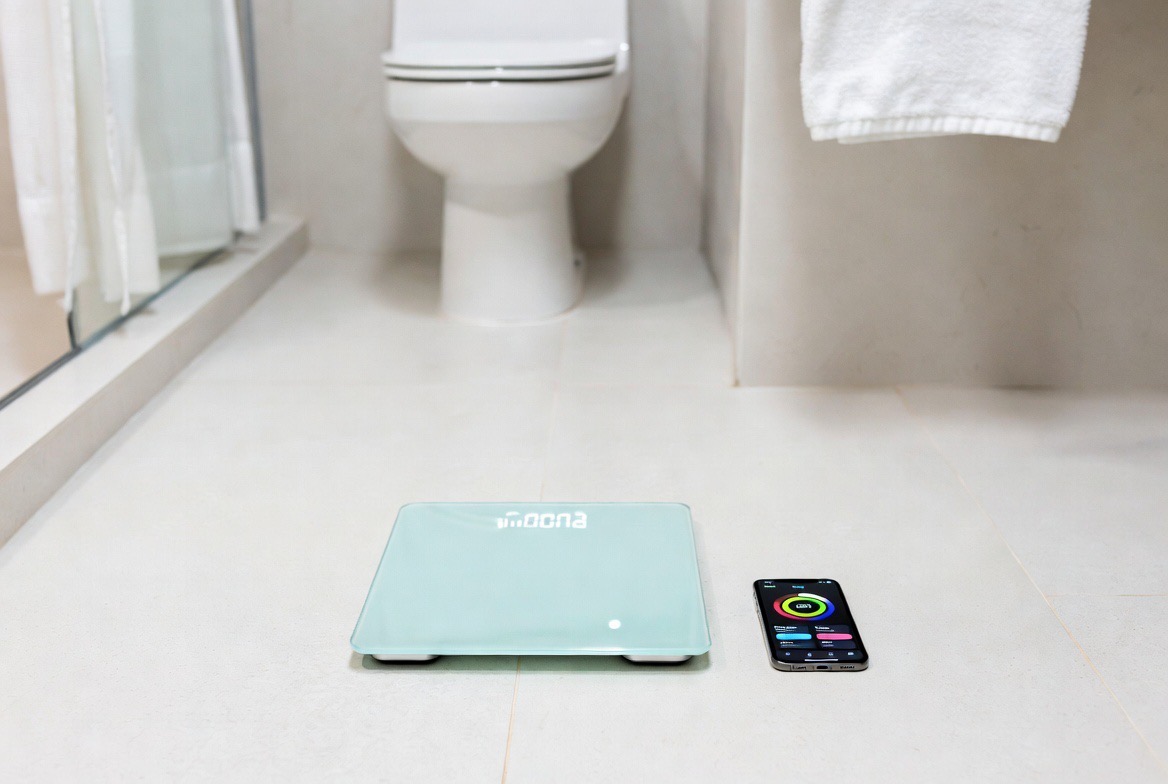
A smart scale — the Withings Body line, RENPHO, Eufy, Garmin Index, and a dozen near-identical others — is two instruments stacked into one slab of tempered glass. The first is an ordinary digital scale: four strain-gauge load cells that weigh you, and that part is excellent. The second is a body-composition estimator, and it is the reason the device costs more than a plain bathroom scale. When you stand on the metal pads barefoot, the scale sends a tiny, imperceptible electrical current up through one foot, across your lower body, and down the other. From how the current is impeded, it estimates how much of you is fat versus everything else, then splits "everything else" into muscle, water, and bone.
That is the whole trick, and the honest story of the device lives in the gap between its two halves. The weight is a direct, physical measurement. The body-fat percentage and its sub-breakdowns are derived — the output of an equation that turns one electrical reading into a roster of confident numbers. Those numbers look just as authoritative as the weight on the same screen, which is exactly the problem. This piece sits in our devices coverage because the smart scale is the clearest case study in how a consumer gadget can be precise about one thing and merely plausible about another, while presenting both with the same two decimal places.
The mechanism: current, water, and conductivity
The estimation engine is bioelectrical impedance analysis (BIA). The principle is simple physics: lean tissue is full of water and electrolytes, so it conducts electricity well; fat is largely anhydrous and conducts poorly. Send a known current through the body, measure the impedance — the opposition the current meets — and a body that resists more must hold relatively more fat. The scale never weighs your fat. It infers it from how easily a current moved through you, using a prediction equation built from a reference population.
Two design choices decide how good that inference can be. The first is the current path. A bathroom scale is foot-to-foot: the current travels up one leg and down the other and barely samples your torso, where much of your fat actually sits. Hand-to-foot devices that add grip electrodes, or the eight-electrode clinical analysers, sample the whole body and tend to do better. The second is frequency. A single-frequency device — what most cheap scales use — reads the body at one electrical frequency and cannot cleanly separate the water inside your cells from the water around them. Multi-frequency units probe at several frequencies and model that split more carefully, which is why they are generally more accurate.4 The signal a scale actually pulls toward "fat" is, at bottom, "how much your body resists a current" — and that resistance is an excellent proxy for body water and only a second-hand proxy for fat.
The scale measures your weight and your body’s resistance to a current. Everything else on the screen — fat, muscle, water, bone — is an equation’s best guess layered on top.
Weight: the part that is genuinely gold-standard
Start with what the scale does superbly, because it is easy to lose in the skepticism about everything else. As a weighing instrument, a modern smart scale is excellent. The 2021 JMIR validation that put three consumer smart scales against DEXA found weight errors on the order of a few tenths of a kilogram — a median absolute error around 0.3 kg or less.1 For tracking your actual body mass, that is functionally gold-standard. If all you want is a reliable morning weight and a clean graph of it over weeks, a smart scale delivers and the extra electronics are irrelevant to that job.
This is why the WEIGHT claim earns a STRONG grade while everything downstream of it does not. Weight is a direct physical quantity the device measures with calibrated load cells. The body-fat percentage is an inference one step removed, and an inference is only ever as good as the equation behind it and the conditions it was measured in — neither of which you control or can see.
Body fat: the number that drifts
Here is the heart of the matter. When the same JMIR study compared the scales’ body-fat estimates against DEXA, the picture changed sharply: the scales systematically underestimated fat mass, by roughly 2 to 4 kg across the three devices.1 A kilogram of fat error is not a rounding artefact — on many people it is several percentage points of body fat. The conclusion the authors reached is the one this whole article rests on: the scales were reasonably accurate for weight but not for body composition.
The most thorough modern test confirms it across the category. A 2023 study ran fifteen different BIA devices — consumer and research-grade, foot-to-foot, hand-to-hand, and full-body — against a four-compartment reference model, the most rigorous benchmark available.2 Reliability was superb: ask the same device the same question twice and it gives nearly the same answer, with precision error under half a percent. But validity — agreement with the truth — was a different story. Constant error against the reference ranged from about −3.5% to +11.7% of body fat depending on the device, with standard errors of the estimate of roughly 3 to 7.5 percentage points. Translated: a scale can confidently tell you "22.4%" while the real figure is 18% or 27%, and tell you "22.4%" again tomorrow with the same confidence.
That gap between reliability and validity is the trap. The scale is consistent, which feels like accuracy, but consistency around a biased estimate is not accuracy. Even a 2022 study of fit, active US service members — an easier population to measure — found standing BIA carried a systematic offset of several percentage points versus DXA, precise enough that the authors had to build correction factors to make the numbers usable.3 This is exactly why the "matches DEXA" claim grades WEAK: the absolute number is an estimate that can be quite wrong at the individual level, and the error is not random noise you can average away — it is a built-in lean.
How far off, in real studies
The cleanest way to hold this is to look at the error magnitudes side by side. The first column is the job; the rest is what the validation data actually shows. "Limits of agreement" is the honest version of accuracy: not the average error, but how far off any single person’s reading can land.
| What the scale reports | How it’s produced | What the evidence actually shows |
|---|---|---|
| Body weight | Direct measurement, load cells | Median error around 0.3 kg vs DEXA — effectively gold-standard.1 |
| Body-fat % | Inferred from one impedance reading | Fat mass underestimated by ~2–4 kg; device-level constant error −3.5% to +11.7%, SEE ~3–7.5%.12 |
| Repeat reading (same day) | Same equation, same conditions | Highly reliable — precision error under 0.5% — which is consistency, not accuracy.2 |
| Body fat in fit individuals | Standing BIA vs DXA | Systematic offset of several points; usable only with correction factors.3 |
| Muscle / water / bone | Derived from the same single reading | Built on the same impedance value, so errors compound; softest numbers on screen.4 |
Muscle, water, bone: the softest numbers
If the body-fat percentage is shaky, the muscle-mass, body-water, and bone-mass figures are shakier still, and the reason is structural. The scale takes one impedance measurement and partitions your whole body from it. Fat is estimated first; lean mass is essentially "everything that isn’t fat," and then muscle, water, and bone are carved out of that lean compartment by further assumptions. Every error in the original fat estimate propagates into all of them. A 2024 multi-frequency BIA analysis that examined reliability and biological variability across body-composition components found that while devices repeat themselves well, the day-to-day biological variability and the accuracy of the sub-compartments leave meaningful room for error, especially for the components beyond fat and total water.4
Bone mass is the clearest example of overreach. A foot-to-foot current cannot meaningfully assess bone mineral — that is what a DEXA scan is built to do — so the "bone mass" on your dashboard is largely a population estimate dressed up as a personal reading. The same goes for the muscle figure: it can be directionally useful when you are gaining or losing real tissue, but the exact kilogram is not something to take to the bank. The practical rule is a hierarchy of trust: weight is solid, body-fat percentage is a rough signal, and muscle, water, and bone are the numbers to treat most skeptically of all.2
How to actually use it: a tiered view
Place the scale’s outputs on a spectrum of how much weight each can carry. This is not a prescription — it is a calibration guide for what to trust.
Foundational — weight and the trend, not the absolute. For nearly everyone, the right use is your morning weight plus the multi-week direction of the body-fat line. To make even that direction trustworthy, you have to remove the confounders yourself: weigh first thing in the morning, after the bathroom and before eating or drinking, barefoot on a hard floor, in the same state every time. Under those fixed conditions the day-to-day errors at least stay consistent, so a fat percentage trending down over a month is real feedback even if the absolute number is off.2 Watch the line, not the point. If you are using the trend to guide a cut, pair it with a target you can actually anchor — our calorie and energy calculator gives you the intake side of that equation.
Research-curious — a rough directional body-fat signal. The absolute body-fat number is worth glancing at as a ballpark — "high, middling, or lean" — but not as a precise figure. Do not compare your scale’s reading to a friend’s scale, an InBody at the gym, or a DEXA result; different equations and current paths produce different answers for the same body. Treat your own device as a private, self-relative instrument only.3
Experimental — trusting the exact %, or the muscle/water/bone splits. Reading "21.3% body fat, 34.2 kg muscle, 2.9 kg bone" as literal truth is the weakest-supported use. The fat figure can be several points off, the sub-compartments compound that error, and bone in particular is barely measured at all.24 For body composition you actually need to trust — a true baseline, a medical decision, a precise lean-mass change — a DEXA scan or a BodPod is the tool, not a bathroom scale.
A smart scale is a genuinely good weighing instrument with a plausible body-composition estimator bolted on — which is exactly why it is so easy to over-trust the second half. The right question is never "what is my body-fat percentage today," it is "which way is my own line moving under identical conditions, and does that match what my training and diet should be doing?" A device that confirms the direction of real change is useful. A device whose exact number you treat as a clinical fact is misleading you with two decimal places. The Manual maps the body-composition methods against each other — what BIA, DEXA, BodPod, and skinfolds each genuinely measure, where the consumer hardware is honest and where it drifts, and how to read a trend without mistaking it for a scan. See the Manual →
Hydration, food, time of day, and other grey areas
The single most important thing to understand about a BIA scale is that it does not really measure fat — it measures body water and infers fat from it. That makes hydration the dominant confounder. A 2020 study that gave subjects water in staged amounts and re-measured by BIA found body-fat percentage rose measurably with each intake, because the extra water lowered the body’s electrical resistance and the equation read the change as a shift in composition.5 Drink a large glass of water and your "body fat" can climb a point or two within minutes — not because anything about your fat changed, but because the proxy the scale relies on moved. Dehydration pushes it the other way, making you look leaner than you are.
Food and time of day ride on the same mechanism. A recent meal adds mass and shifts fluid; a full bladder, a hard workout, alcohol, the natural fluid redistribution between morning and evening — all of them nudge the reading, sometimes by several percentage points, with zero change in your actual body. This is the entire reason the "stable regardless of conditions" claim grades WEAK: the readings are not stable, and anyone treating a post-lunch evening number as comparable to a fasted morning one is comparing two different measurements.5
Three more grey areas deserve a flag. First, edge-case bodies: athletes, the very lean, the very heavy, older adults, and people with unusual fluid distribution are exactly the populations where the prediction equations — built on average reference samples — fit worst, so the error is largest for the people most likely to care.2 Second, the single-versus-multi-frequency gap: a cheap single-frequency foot-to-foot scale is the least accurate configuration of BIA there is, and no firmware update changes the physics of its current path.4 Third, when to skip the scale entirely: if you need a true body-composition baseline — for a clinical reason, a serious physique goal, or to settle whether a change is fat or muscle — book a DEXA or a BodPod and treat the bathroom scale as the daily trend tool it is good at being.
Open questions
Several gaps keep the overall verdict mixed rather than damning. Most validation work tests a handful of specific scales against DEXA or a four-compartment model in controlled lab conditions; how a given consumer unit performs in a real bathroom, with real-world hydration swings, is far less studied. The prediction equations are proprietary and undisclosed, so two scales reading the same body can disagree by several points and you cannot see why. Longitudinal accuracy — whether a scale tracks a real change in fat mass faithfully over months, not just whether it nails a single snapshot — is the property that matters most for the trend use and the one with the thinnest evidence. And almost no consumer device publishes its limits of agreement, so the buyer never sees how wide the individual error can be. These are the questions a buyer should keep open before treating any single number as fact.
What this article is not saying
This is not "smart scales are useless." They are excellent weighing instruments — better than a plain scale for tracking weight, because the app keeps the graph for you — and a carefully used body-fat trend is real, usable feedback. Dismissing the device outright is as wrong as trusting its every digit.
This is not "the body-fat number is meaningless." As a private, self-relative, same-conditions trend, it carries genuine signal about which way your composition is heading. The error is treating an estimate — one that can be several points off and that moves with your last glass of water — as a clinical fact.
And this is not a recommendation to buy, or not buy, any particular scale. The point is calibration: trust the weight, watch the trend under fixed conditions, distrust the exact percentage, treat muscle and water and bone as the softest numbers on the screen, and reach for DEXA or a BodPod when you need composition you can actually rely on. Used that way — the way our broader read on over-read wearable data argues for every device, and our companion piece on what a sleep-tracking ring really measures argues for trends over scores — a smart scale is a genuinely useful instrument. Read as a body scan, it is selling a precision it does not have.
References
- Hummel J, Benkhadra K, et al. Accuracy of Smart Scales on Weight and Body Composition: Observational Study. JMIR Mhealth Uhealth. 2021;9(4):e22487. DOI · PMID 33929337
- Siedler MR, Rodriguez C, Stratton MT, et al. Assessing the reliability and cross-sectional and longitudinal validity of fifteen bioelectrical impedance analysis devices. Br J Nutr. 2023;130(5):827-840. DOI · PMID 36404739
- Sbrana AA, et al. High precision but systematic offset in a standing bioelectrical impedance analysis (BIA) compared with dual-energy X-ray absorptiometry (DXA). BMJ Nutr Prev Health. 2022;5(2):e000512. DOI · PMID 36619314
- Bennett JP, Liu YE, Kelly NN, et al. Reliability, biological variability, and accuracy of multi-frequency bioelectrical impedance analysis for measuring body composition components. Front Nutr. 2024;11:1491931. DOI · PMID 39691170
- Ugras S. Evaluating of altered hydration status on effectiveness of body composition analysis using bioelectric impedance analysis. Libyan J Med. 2020;15(1):1741904. DOI · PMID 32182203