CGMs for non-diabetics — what the wearable data actually tells you.
Stelo, Lingo, Levels, Veri. Over-the-counter CGMs are now a consumer category. The signal is real in some places, noisy in others, and oversold in many. What postprandial spike data actually means, where interstitial lag breaks the inference, and what the outcome evidence does and does not show.
What a CGM actually measures
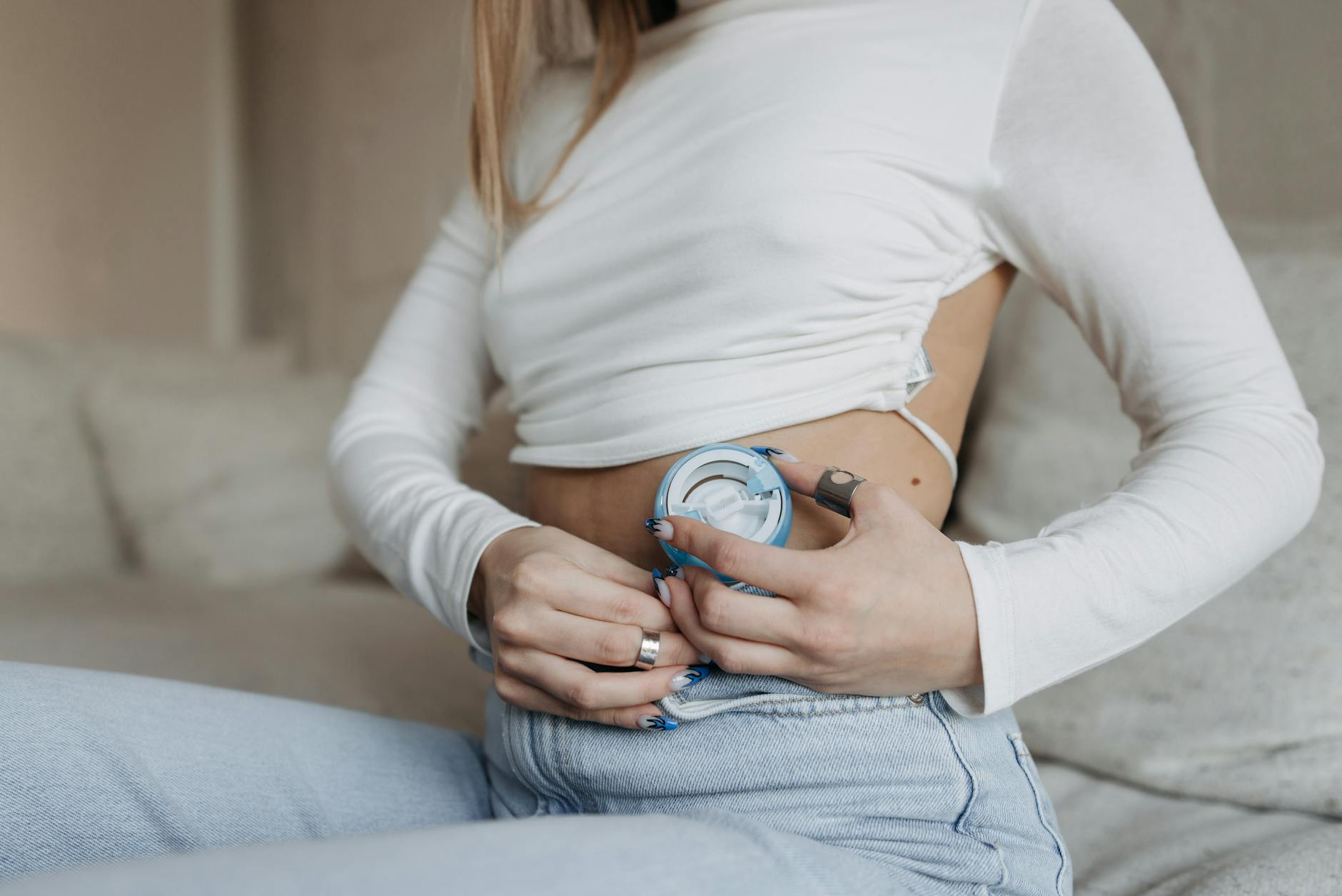
A continuous glucose monitor (CGM) is a small sensor inserted into the subcutaneous tissue, typically on the back of the upper arm or the abdomen, that measures glucose concentration in interstitial fluid (ISF) — not in capillary or venous blood. The sensor reports a glucose value every one to five minutes for the duration of its wear time, typically 10–15 days. Modern over-the-counter (OTC) devices include Dexcom's Stelo, Abbott's Libre Lingo, and the professional reskins built on the same hardware (Levels, Veri, NutriSense, January AI).
Interstitial glucose tracks blood glucose closely under steady-state conditions but with a lag of approximately 5–15 minutes during rapid changes — both rises and falls. This lag is physical, not a software defect: glucose has to diffuse from capillaries into the interstitial compartment before the sensor reads it [Cengiz 2009 lag]. The lag is small enough to be clinically usable for diabetes management with appropriate algorithms and large enough to mislead a wearer who is staring at a real-time post-meal trace and reaching causal conclusions about the food they ate twenty minutes ago.
In 2024 the U.S. FDA cleared the first OTC CGMs for use by adults without diabetes. The intended use is general glucose awareness and wellness — not diagnosis or treatment [FDA OTC CGM 2024].
Where the data is real signal
Postprandial spike magnitude. Despite the lag, the peak glucose value following a meal is meaningful when you compare the same food eaten on different days in the same person. A consistent 60–80 mg/dL spike to a particular breakfast versus a 20–30 mg/dL spike to a different breakfast tells you something real about how your physiology responds to those two meals.
Food-to-food variability. The largest dataset on non-diabetic CGM use, the PREDICT cohort, demonstrated that glycemic responses to identical meals vary enormously between individuals — and that this variability is partially predicted by gut microbiome, body composition, sleep, and meal timing [Berry 2020 PREDICT]. Two people eating the same oatmeal can produce dramatically different glucose curves. For someone trying to understand their own responses, this is a legitimate use case.
Dawn phenomenon and sleep-related patterns. The gradual rise in glucose between approximately 3:00 AM and 8:00 AM is well-described and reflects normal cortisol and growth-hormone physiology. Seeing this on a CGM trace is not abnormal. Seeing it dramatically larger than expected, or accompanied by sleep fragmentation, is a signal that connects metabolic and sleep health.
Behavioral feedback. The most defensible use of CGM in a non-diabetic is as a behavior-change tool. People who see a 70 mg/dL spike after a soda often drink fewer sodas. People who see flatter post-meal traces after a 20-minute walk often walk after meals. This is not a sophisticated metabolic insight; it is a behavioral feedback loop, and behavioral feedback loops have a real history of working.
A CGM is a behavior-change device dressed up as a diagnostic. If you treat it as the former, it's useful. If you treat it as the latter, you'll over-interpret signal that isn't there.
Where the data is noise
Sensor-to-sensor variance. Mean absolute relative difference (MARD), the standard accuracy metric, is reported between 7% and 13% for modern CGMs against venous reference in mixed diabetes-and-healthy populations. The Hanson 2024 comparison of Dexcom G7 and FreeStyle Libre 3 in adults found MARD values that diverged across wear duration — early sensor performance differed from late-sensor performance [Hanson 2024]. In a dedicated 2024 study of FreeStyle Libre 2 in healthy male adults, overall MARD was 12.9% [Pleus 2024 healthy adults] — higher than the diabetes-population figure typically advertised. Sensor accuracy in healthy adults is real but is not the same as sensor accuracy in the populations the devices were originally validated in.
The interstitial lag in fast-changing windows. The 5–15 minute lag matters most exactly when you want the data most — during the rising or falling phase of a postprandial excursion. A "spike" recorded by your CGM at minute 35 after a meal may correspond to peak blood glucose around minute 20–25. Causal attribution to the most recent thing you ate or did becomes unreliable.
Individual normal variance. A 2024–2025 study characterizing CGM time-in-range in a large non-diabetic community-based cohort found wide normal distributions of postprandial peak, mean glucose, and coefficient of variation [Sletten 2024 TIR]. The relationship between CGM metrics and HbA1c, robust in diabetes, weakened in prediabetes and disappeared in non-diabetic adults [Mass General 2024]. In plain terms: a CGM in a healthy adult is measuring real physiology, but the population reference ranges to compare against are still being built, and many of the threshold values used by consumer apps are educated estimates rather than validated cutoffs.
Pressure artifact and compression lows. Sleeping on the sensor or pressing on it can produce false low readings that resolve when pressure is relieved. Most wearers learn this after a confusing nighttime trace.
Where the marketing has gotten ahead
The consumer CGM category is a venture-funded market, and the marketing has been ambitious. Specific claims to scrutinize:
- "Personalized nutrition based on glucose response." The principle is defensible — individuals vary in postprandial response. The execution typically uses a 14-day window of data, and 14 days is barely enough to establish stable patterns against weekly behavioral and hormonal variance. Recommendations built on a short window can be overconfident.
- "Optimize your metabolic health." Glycemic variability matters in diabetes. The mortality and cardiovascular outcome data linking modest glycemic variability in non-diabetic adults to long-term outcomes is sparse. The mechanistic case is plausible. The outcome case is not yet made.
- "Flatlining is the goal." A relatively flat glucose trace is associated with metabolic health, not necessarily caused by chasing it. Aggressively chasing a flat trace can push people toward low-carbohydrate or low-volume eating that produces other problems — under-fueling for training, social friction, and disordered relationships with food.
A CGM cannot replace the basic metabolic panel. Fasting insulin, fasting glucose, HbA1c, lipid panel, and a calculated HOMA-IR (homeostatic model assessment of insulin resistance) deliver more information about long-term metabolic trajectory than a 14-day glucose trace can. We made the upstream-marker case in our insulin-resistance article; a CGM is best used as an addition to that workup, not a substitute.
The outcome-evidence gap
The cleanest summary of the evidence base for CGM in non-diabetic adults: very few outcome trials, none long enough to demonstrate durable change in metabolic risk or cardiovascular events. A 2025 systematic review of CGM in non-diabetic adults for cardiovascular prevention concluded that the existing evidence consists primarily of short-term behavioral and biomarker endpoints, with no robust long-term outcome data [Bonora 2025 CV CGM review]. Real-world evidence in insured populations has shown CGM initiation is associated with glycemic improvements in people with diabetes [JMCP 2024 RWE] — that is a different population from the consumer CGM target market.
This is not the same as saying CGMs don't work in healthy adults. It is saying the trial that would tell us they meaningfully change long-term outcomes in healthy adults has not yet been done. Reasonable people can decide that the behavioral feedback justifies the spend regardless. They should be making that decision with the evidence gap in view, not in spite of it.
A tiered framework
Frameworks, not protocols.
If basic metabolic labs are clean and body composition is healthy, the marginal information from a CGM is small. The time and attention costs of wearing one and interpreting the data are not trivial. Spend the budget on a structured training plan and an annual lab panel.
A single 14-day wear, treated as a behavioral and educational experiment rather than a diagnostic, is reasonable. Identify the meals that produce the largest excursions in your physiology. Test the effect of a post-meal walk, of pairing carbohydrate with protein, of meal sequencing. Then take what you learned and stop wearing the sensor.
For someone with clear insulin resistance, prediabetes, PCOS, reactive hypoglycemia history, or a strong family-history risk profile, repeated CGM wears at intervals paired with structured lab follow-up can be genuinely useful — ideally with a clinician who interprets CGM data routinely. This is the population where the consumer device is doing closest to what the original technology was designed for.
We will not tell you that CGM data is a substitute for HbA1c, fasting insulin, or a lipid panel. We will not tell you to chase a flat glucose line as a goal in itself. We will not tell you which consumer CGM brand to buy — the hardware is essentially two sensor platforms with different app layers on top, and the right one for any individual depends on local availability and price more than on a meaningful clinical difference.
References
- Cengiz E, Tamborlane WV. A tale of two compartments: interstitial versus blood glucose monitoring. Diabetes Technol Ther. 2009;11(Suppl 1):S11-S16.
- U.S. Food and Drug Administration. FDA clears first over-the-counter continuous glucose monitor. FDA News Release. 2024.
- Berry SE, et al. Human postprandial responses to food and potential for precision nutrition. Nature Medicine. 2020;26:964-973. (PREDICT 1).
- Hanson K, Kipnes M, Tran H. Comparison of point accuracy between two widely used continuous glucose monitoring systems. J Diabetes Sci Technol. 2024;18(4):892-901.
- Pleus S, et al. Analytical performance of the FreeStyle Libre 2 glucose sensor in healthy male adults. Sensors (Basel). 2024;24(17):5769.
- Sletten AC, et al. Defining continuous glucose monitor time in range in a large, community-based cohort without diabetes. J Clin Endocrinol Metab. 2024;110(4):1128-1137.
- Shah VN, et al. (Mass General Brigham analysis). Relationship between CGM metrics and HbA1c across the glycemic spectrum. 2024.
- Bonora BM, et al. Non-invasive continuous glucose monitoring in patients without diabetes: use in cardiovascular prevention — a systematic review. Sensors. 2025;25(1):187.
- Journal of Managed Care & Specialty Pharmacy. Initiating CGM is associated with improvements in glycemic control and reduced healthcare resource utilization in people with diabetes. JMCP. 2024.
- Battelino T, et al. Continuous glucose monitoring and metrics for clinical trials: an international consensus statement. Lancet Diabetes Endocrinol. 2023;11(1):42-57.