Oura Ring: Does the Sleep Tracker Actually Work?
A smart ring is the most credible wearable on the market — and the most over-read. The hardware genuinely captures your nightly heart rate, your beat-to-beat variation, your skin temperature, and a usable estimate of how long you slept, all from a band of titanium thinner than a wedding ring. Then the app takes those real signals, runs them through a proprietary formula, and hands you back a single confident number that claims to know whether you are “ready” today. The split runs straight down the middle of the product. The trend data is useful. The single-night precision and the recovery scores are oversold. Here is what an Oura, a Samsung Galaxy Ring, or a RingConn actually measures, where the validation holds and where it drifts, and the failure mode — sleep anxiety from over-tracking — that almost no one warns you about.
How this article was built: Primary sources: the Ghorbani et al. 2024 Oura Gen3 validation against multi-night polysomnography in Sleep Medicine; the Khan et al. 2025 Oura-versus-medical-grade systematic review and meta-analysis in OTO Open; the Chinoy et al. 2024 three-device sleep-tracking validation in Sensors; the Cao et al. 2022 Oura time- and frequency-domain HRV analysis in JMIR; the Kinnunen et al. 2020 ring-PPG-versus-ECG validation in Physiological Measurement; the Maijala et al. 2019 nocturnal-temperature menstrual-cycle pilot in BMC Women’s Health; the Goodale et al. 2025 ovulation-detection validation in JMIR; the Baron et al. 2017 orthosomnia case series in the Journal of Clinical Sleep Medicine; and the 2024 orthosomnia prevalence survey in Brain Sciences — all retrieved and verified through PubMed and the Consensus research database.
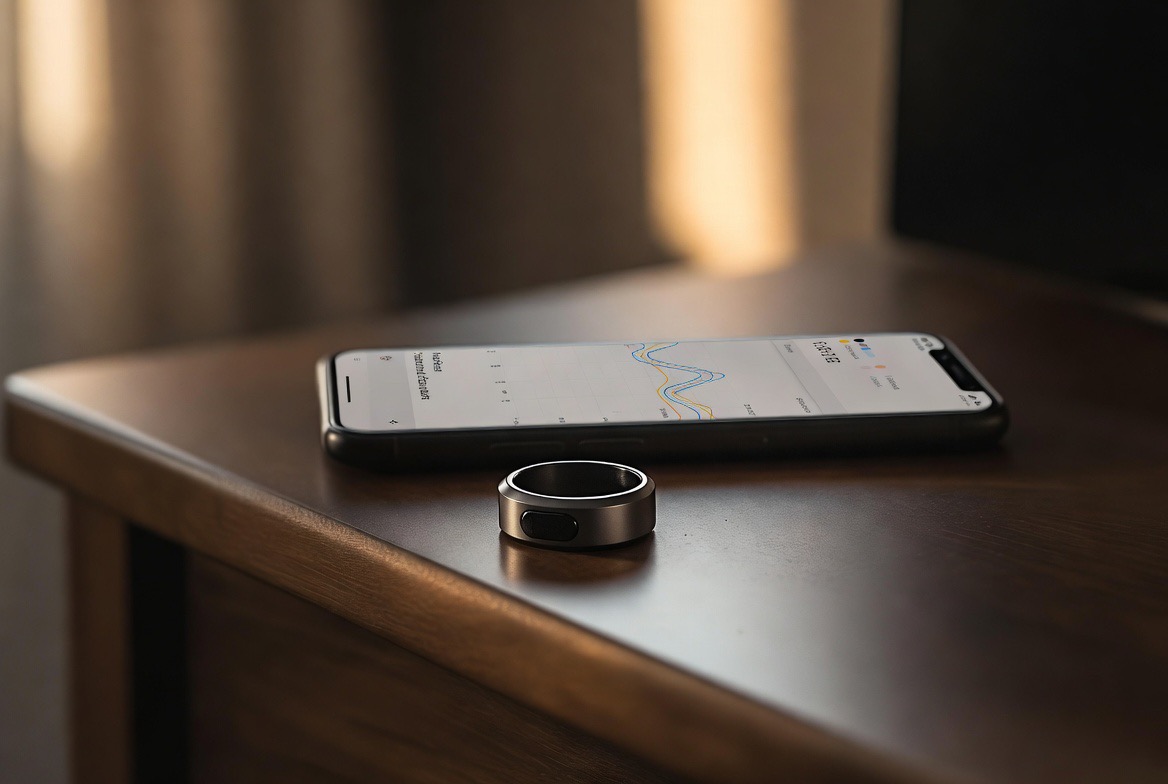
- Trends are useful; scores are oversold. The ring captures real signals — sleep duration, nightly heart rate, HRV, skin temperature — and the multi-week direction of those signals is the part worth watching. The daily “readiness” number layered on top is a proprietary black box.4
- Sleep duration is accurate; sleep stages are only fair. A meta-analysis found the Oura’s total-sleep-time estimate is statistically indistinguishable from a clinical sleep study, but labeling specific stages — light, deep, REM — lands at only moderate agreement.12
- Heart rate, HRV, and temperature trends hold up. Nightly heart rate and HRV from a ring correlate around 0.96–0.98 with medical ECG, and skin-temperature shifts reliably track the menstrual cycle — useful as trend signals, not single-night precision.56
- Over-tracking can backfire. Roughly 3–14% of regular users show signs of orthosomnia — anxiety driven by sleep data that worsens the very sleep it measures. A low score should never become the thing that ruins your morning.9
- What a smart ring is actually measuring
- The mechanism: light, pulse, and skin heat
- Sleep: duration is solid, stages are fair
- Heart rate and HRV: where the ring shines
- Temperature: the quietly useful signal
- What’s validated vs what’s proprietary
- The readiness score: a black box with a confident voice
- How to actually use the data: a tiered view
- The orthosomnia trap, and other grey areas
- Open questions
- What this article is not saying
- References
What a smart ring is actually measuring
A smart ring — the Oura that defined the category, plus the newer Samsung Galaxy Ring, RingConn, and Ultrahuman — is a wearable that swaps your wrist for your finger. That swap is not cosmetic. The finger’s arteries sit close to the surface and the digit holds still through the night, so a ring gets a cleaner optical pulse signal than a watch flopping around on a bony wrist. It also disappears: no screen to check, three-to-seven-day battery instead of nightly charging, nothing to dig into your skin when you sleep. For a device whose whole job is overnight measurement, the form factor is a genuine, not marginal, advantage over wrist wearables.
Underneath, the ring is logging four real things every night: your heart rate, your heart-rate variability (HRV) — the beat-to-beat variation in your pulse — your skin temperature, and movement. From those raw streams it builds the things you actually look at: total sleep time, a hypnogram splitting the night into light, deep, and REM stages, and the proprietary “readiness” or “recovery” score. The honest story of this device lives in the gap between the raw signals, which are well-measured, and the interpretations stacked on top, which range from solid to speculative. This piece sits in our devices coverage because the smart ring is the cleanest case study in that gap.
The mechanism: light, pulse, and skin heat
The ring’s core sensor is photoplethysmography (PPG) — green and infrared LEDs shine light into the finger, and a photodetector reads how much bounces back. Blood absorbs light, so each heartbeat’s pulse of blood produces a tiny dip in the reflected signal. Counting those dips gives heart rate; measuring the gap between them gives HRV. This is an indirect measurement: the gold standard for cardiac timing is an electrocardiogram (ECG) reading the heart’s electrical signal directly, and a ring is inferring beat timing from an optical waveform two steps removed. That distance is where error creeps in — but on a still finger overnight, the inference is surprisingly good.
A second sensor — a skin thermistor — tracks finger temperature continuously, which the app converts into a nightly deviation from your personal baseline. Sleep staging is the most inferential layer: the ring has no electrodes on your scalp, so it cannot read brain waves the way a clinical study does. Instead it feeds heart rate, HRV, temperature, and movement into a machine-learning model trained to guess which stage a clinical scorer would have labeled. The signal it pulls toward “deep sleep” is mostly a low, steady heart rate and stillness; toward REM, a rise in variability and movement suppression. It is a smart guess from peripheral signals, not a direct readout — which is exactly why duration is easier to get right than stage.
The ring measures your pulse and your skin. Everything else — the stages, the readiness number — is an inference layered on top, and the inferences are not all equally good.
Sleep: duration is solid, stages are fair
Start with the good news, because it is genuinely good. A 2025 systematic review and meta-analysis pooled six studies comparing the Oura against polysomnography or actigraphy and found no statistically significant difference in total sleep time — a mean difference of about three minutes — nor in sleep efficiency or wake-after-sleep-onset.2 For the basic question most people ask — “how long did I actually sleep?” — a modern ring is close to clinical-grade. That is a higher bar than most wrist trackers clear, since many of them systematically overestimate sleep by misreading quiet wakefulness as light sleep.
Now the caveat that the marketing soft-pedals. Stage classification is a harder problem than duration, and the data shows it. A large 2024 validation of the Oura Gen3 against multi-night polysomnography — 96 participants, over 421,000 thirty-second epochs — reported strong overall sleep/wake detection but more modest agreement when sorting the night into specific stages.1 A 2024 three-device study pitting the Oura against an Apple Watch and a Fitbit found the ring the most accurate of the three at four-stage classification, yet “most accurate” here meant a Cohen’s kappa around 0.65 — good agreement, not near-perfect.3 Translated: when your app says you got 47 minutes of deep sleep, the true figure might be 30 or 65. The shape of your night is roughly right; the precise minutes per stage are not. That mix of solid duration and fair staging is exactly why this claim grades EMERGING rather than MODERATE or higher.
Heart rate and HRV: where the ring shines
The ring’s strongest validation is in the cardiac signals, and it is the place the finger form factor pays off most. An early ring-PPG-versus-ECG study found nightly heart rate and HRV agreed with medical-grade ECG at correlations around 0.96 to 0.98, with small bias.5 A more granular 2022 analysis confirmed that the night-averaged rMSSD — the standard HRV metric — was accurate, while cautioning that any single five-minute window was much noisier and that frequency-domain measures like the LF/HF ratio carried high error.4 The pattern is consistent: the slow, averaged trend is trustworthy; the instantaneous reading is not.
This is why HRV earns a MODERATE grade rather than a glowing one. The hardware genuinely captures a validated physiological signal — we cover what that signal means, and how the readiness algorithms wrap it, in our companion piece on what your wearable HRV score actually tells you. The honest framing for a ring is the same: watch your own multi-week HRV trend, not last night’s dot, and never compare your absolute number to anyone else’s, because resting HRV varies enormously between healthy people.
Temperature: the quietly useful signal
The most underrated feature on a smart ring is the one nobody buys it for: continuous nightly skin temperature. Because the ring measures the same finger in the same conditions night after night, it builds a stable personal baseline and flags deviations from it — and those deviations carry real information. A pilot study tracking nocturnal finger temperature across the menstrual cycle found a clear, roughly 0.3°C rise in the luteal phase, with the ring detecting menstruation onset at 72–87% sensitivity.6 A 2025 validation extended this to ovulation, confirming the ring’s temperature curve can identify the fertile window with useful (if imperfect) accuracy.7
The same logic extends to illness: a sustained temperature spike above your baseline, often paired with a jump in resting heart rate and a drop in HRV, frequently precedes the conscious feeling of getting sick by a day or two. That is a real, useful early-warning signal — the body’s stress response showing up in the data before it shows up in how you feel. But the grade stays EMERGING for a reason: the temperature studies are small, several involve manufacturer collaboration, and skin temperature is a noisy proxy for core temperature that a warm room, alcohol, or a heavy blanket can all nudge. As a trend you watch, it is one of the device’s best features. As a single-night thermometer, it is not.
What’s validated vs what’s proprietary
The cleanest way to hold all of this is to separate the signals the ring measures from the scores it computes. The first column is open science you can check against ECG and polysomnography. The second is a formula the manufacturer keeps private.
| What the ring reports | How it’s built | What the evidence actually shows |
|---|---|---|
| Total sleep time | Measured + inferred from movement, HR, HRV | Statistically indistinguishable from a clinical sleep study in meta-analysis.2 |
| Sleep stages (light / deep / REM) | Machine-learning inference, no brain-wave data | Only moderate agreement with polysomnography; minutes-per-stage are rough.13 |
| Resting heart rate & HRV | Measured via PPG, night-averaged | Correlates ~0.96–0.98 with ECG; single readings noisier.45 |
| Skin-temperature deviation | Measured via thermistor, vs personal baseline | Tracks cycle phase and illness onset as a trend; small studies.67 |
| Readiness / recovery score | Proprietary algorithm blending all of the above | Not independently validated; precision implied by the number isn’t in the data.4 |
The readiness score: a black box with a confident voice
Almost nobody opens the app to read their raw rMSSD or their temperature deviation in degrees. What you see is “Readiness 71” or “Recovery 38% — in the red.” That single number is not a measurement. It is the output of a proprietary algorithm that blends HRV, resting heart rate, sleep stages, temperature, respiratory rate, and recent activity, weighted by formulas each company keeps private and tunes against its own assumptions. The inputs are partly validated; the recipe combining them is not published, and the recipe is what you are reading.
This is the part to hold most loosely, and the reason it earns a WEAK grade. One of the heaviest inputs — sleep staging — is the shakiest signal the ring produces.3 Another — single-night HRV — is the noisiest version of the HRV measurement.4 When you build a confident two-digit verdict on top of two of the device’s least precise outputs and an unpublished weighting, the certainty implied by “71” is far more than the underlying data supports. There is no independent, peer-reviewed evidence that any consumer readiness score predicts your actual performance on a given day.
None of this makes the score useless. As a rough directional nudge — “you slept short and your body is still stressed, maybe go easier today” — it is often reasonable, mostly because it re-states things you half-knew. The error is treating an 18-point drop as a precise instruction rather than a soft signal. The number has a confident voice; the science behind it speaks much more quietly.
How to actually use the data: a tiered view
Place the ring’s outputs honestly on a spectrum of how much weight each can carry. This is not a prescription — it is a calibration guide for what to trust.
Foundational — the trends, not the dots. For nearly everyone, the right use is to watch the multi-week direction of three things: sleep duration, resting heart rate, and HRV. A baseline that drifts the wrong way across a stressful fortnight is real feedback. A single bad night is mostly noise. This is the use the hardware genuinely supports, and it costs nothing but the discipline to look at the line instead of the point.2
Research-curious — temperature as an early-warning trend. If you menstruate, the ring’s temperature curve is a legitimately useful cycle and fertility-window signal.67 For anyone, a sustained temperature-and-heart-rate spike is a defensible cue to rest before you consciously feel sick. Treat it as a flag to investigate, not a diagnosis.
Experimental — chasing the daily score. Rearranging your day because the app said 62 instead of 74, or treating per-stage minutes and the LF/HF ratio as precise, is the weakest-supported use. The inputs are noisy at that resolution, the algorithm is unpublished, and the implied precision is not in the data.14
A smart ring is the most physiologically grounded wearable you can buy — which is exactly why it is so easy to over-trust. The right question is never “what does my score say today,” it’s “what are my trends doing, and do they line up with how my sleep, training, and stress actually feel?” A device that confirms what your body is already telling you is useful. A device that overrides it is a problem. The Manual maps the recovery and sleep metrics against each other — what each one’s evidence genuinely supports, where the consumer hardware is accurate and where it drifts, and how to read a trend without letting a daily number run your life. See the Manual →
The orthosomnia trap, and other grey areas
There is a failure mode worth naming directly, because it is common and it is the opposite of what these devices are for. Clinicians coined the term orthosomnia — from ortho (correct) and somnia (sleep) — in a 2017 case series describing patients whose pursuit of perfect tracker data was actively worsening their sleep.8 A bad sleep score lands before you are even out of bed, you decide the day is a write-off, the stress of seeing the number nudges your sympathetic system harder, and tomorrow’s reading drops further. The metric meant to reduce stress becomes its own stressor.
This is not a fringe risk. A 2024 general-population survey found orthosomnia in roughly 3 to 14% of people depending on how strictly it was defined, with affected users scoring consistently higher on insomnia measures.9 The defense is structural, not emotional: remember that a single night’s staging is the device’s least precise output,1 that the readiness score is a soft suggestion from a black box, and that if a ring is making you more anxious about your sleep than you were before you owned one, it is failing at its only real job. Check it weekly, not hourly — or take it off.
Two more grey areas deserve a flag. First, subscription cost: most of the interesting analytics now sit behind a recurring monthly fee on top of the hardware, so the ring is an ongoing expense, not a one-time purchase. Second, data privacy: a continuous stream of your sleep, heart, temperature, and cycle data is sensitive health information held by a private company; read the policy on how it is stored, shared, and what happens to it if the company is acquired. Neither is a reason not to use a ring, but both are part of the honest accounting.
Open questions
Several gaps keep the overall verdict at moderate rather than strong. Most validation work is on the Oura specifically; the Samsung Galaxy Ring, RingConn, and other newer entrants have far thinner independent peer-reviewed data, so “rings are accurate” is really “the most-studied ring is accurate.” Validation samples skew toward healthy adults, leaving accuracy in people with sleep apnea, arrhythmias, or shift-work schedules under-tested. No published, independent evidence shows that any readiness score predicts next-day performance better than simply asking yourself how you feel. And the algorithms are moving targets — a firmware update can change your scores overnight without notice, which quietly undermines the long-term trend the device is best at. These are the questions a buyer should keep open.
What this article is not saying
This is not “smart rings are useless.” They capture some of the best-validated physiological signals in the consumer space, in a form factor that genuinely outperforms wrist wearables for overnight measurement. Dismissing the ring outright is as wrong as worshipping the daily score.
This is not “the readiness score is worthless.” As a directional nudge that re-states what you half-knew about your sleep and stress, it is often a reasonable prompt. The error is treating a black-box number as a precise instruction rather than a soft signal.
And this is not a recommendation to buy, or not buy, any particular ring. The point is calibration: trust the trends, distrust the single night, ignore the precision the scores imply, and never let a low morning number become the thing that runs your day. Used that way — the way our broader read on over-read wearable data argues for every device — a smart ring is a genuinely useful trend instrument. Used as a daily verdict, it is selling a precision it does not have.
References
- Ghorbani S, Yazdi Z, Ramezani Tehrani F, et al. Validity and reliability of the Oura Ring Generation 3 (Gen3) with Oura sleep staging algorithm 2.0 (OSSA 2.0) when compared to multi-night ambulatory polysomnography: A validation study of 96 participants and 421,045 epochs. Sleep Med. 2024;116:79-86. DOI · PMID 38382312
- Khan S, Ibrahim AF, Vasudevan SS, Quatela OE, Nanu DP, Carr MM. The Oura Ring Versus Medical-Grade Sleep Studies: A Systematic Review and Meta-Analysis. OTO Open. 2025;9(4):e70181. DOI · PMID 41230431
- Chinoy ED, Cuellar JA, Jameson JT, Markwald RR. Accuracy of Three Commercial Wearable Devices for Sleep Tracking in Healthy Adults. Sensors (Basel). 2024;24(20):6532. DOI · PMID 39460013
- Cao R, Azimi I, Sarhaddi F, Niela-Vilen H, et al. Accuracy Assessment of Oura Ring Nocturnal Heart Rate and Heart Rate Variability in Comparison With Electrocardiography in Time and Frequency Domains: Comprehensive Analysis. J Med Internet Res. 2022;24(1):e27487. DOI · PMID 35040799
- Kinnunen H, Rantanen A, Kenttä T, Koskimäki H. Feasible assessment of recovery and cardiovascular health: accuracy of nocturnal HR and HRV assessed via ring PPG in comparison to medical grade ECG. Physiol Meas. 2020;41(4):04NT01. DOI · PMID 32217820
- Maijala A, Kinnunen H, Koskimäki H, Jämsä T, Kangas M. Nocturnal finger skin temperature in menstrual cycle tracking: ambulatory pilot study using a wearable Oura ring. BMC Womens Health. 2019;19(1):150. DOI · PMID 31783840
- Goodale BM, Shilaih M, Falco L, Dammeier F, et al. Oura Ring as a Tool for Ovulation Detection: Validation Analysis. J Med Internet Res. 2025;27:e60667. DOI · PMID 39888664
- Baron KG, Abbott S, Jao N, Manalo N, Mullen R. Orthosomnia: Are Some Patients Taking the Quantified Self Too Far? J Clin Sleep Med. 2017;13(2):351-354. DOI · PMID 27855740
- Richards A, Wojtaszek J, Salaberrios J, et al. Prevalence of Orthosomnia in a General Population Sample: A Cross-Sectional Study. Brain Sci. 2024;14(11):1123. DOI · PMID 39595886