Compression boots: real recovery tech, or an expensive leg massage?
Zip a pair of Normatec-style boots over your legs and the squeeze feels like something is working — and in one narrow sense, it is. Pneumatic compression reliably makes legs feel more recovered, and it modestly trims the soreness that shows up a day or two after a hard session. What it almost certainly doesn’t do is the louder half of the pitch: it won’t speed your real performance recovery, won’t make you stronger or faster, and it can’t “flush lactic acid” out of tired muscle. This is the honest, cited read on what you’re paying for — and how much of it is the feel.
How this article was built: Primary sources, retrieved and verified against PubMed-indexed records via web: Maia et al. 2024, a systematic review and meta-analysis of lower-limb intermittent pneumatic compression in Biology of Sport; and Wiecha et al. 2021, a double-blind randomized controlled trial of pneumatic compression versus sham in BMC Sports Science, Medicine and Rehabilitation. Where a claim rests on mechanism rather than trial data, we say so. Research-database MCP tools were offline for this build, so every citation was checked manually against its source record.
- The best-supported use is feel. A meta-analysis of 17 studies found compression boots produce a moderate cut in perceived soreness at 48 hours — the point where you ache most.1
- The catch: the same review found only trivial, non-significant effects on actual muscle function, and a double-blind trial found no advantage over a fake-compression sham at all.12
- “Flushes lactic acid” is a myth. Lactate clears on its own within an hour of stopping — long before soreness even arrives.
- Who it’s for: anyone who wants a pleasant, low-risk way to feel more recovered and unwind after training — not someone buying a faster comeback or a performance edge.
- What a compression boot actually is
- The mechanism: the signal it pulls
- Soreness and the feel of recovery: the best case
- Range of motion: a smaller, softer finding
- Real recovery and performance: where it falls down
- The lactic-acid myth
- Safety: who should be careful
- Where it fits: a tiered view
- Grey areas and open questions
- What this article is not saying
- References
What a compression boot actually is
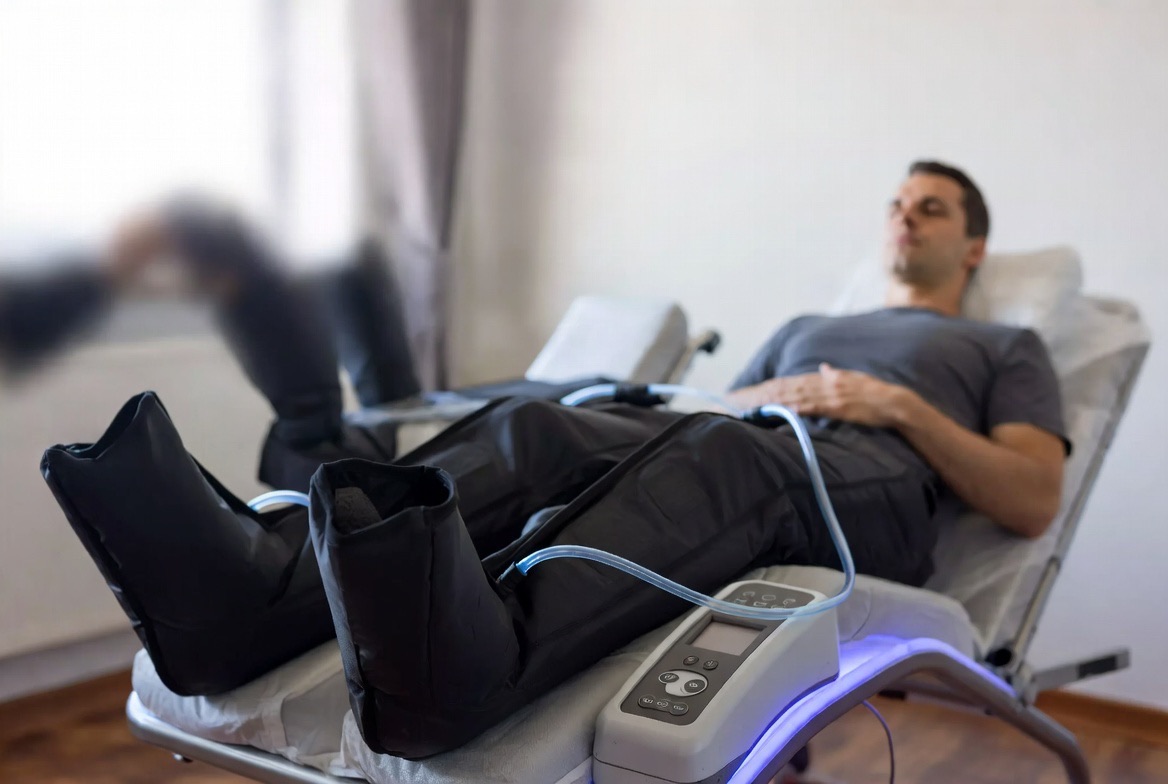
Underneath the brand names — Normatec, Therabody, RecoveryAir, and the cheaper clones — a compression boot is a straightforward machine. A pump inflates a set of overlapping air chambers inside a sleeve that wraps the leg from foot to hip, squeezing in a wave that usually moves from the ankle upward. You lie down, the chambers fill and release in sequence for twenty or thirty minutes, and the leg gets a firm, rhythmic hug. The clinical name for the technique is intermittent pneumatic compression (IPC), and the honest one-line description is a programmable air-massage for the legs.
That framing matters because the marketing has quietly promoted the category from “relaxing leg massage” to “recovery system,” and those are very different claims with very different evidence behind them. The IPC technique itself is old and well-established — in hospitals the same idea is used to keep blood moving in immobile patients and lower clot risk. The athletic-recovery boot borrows that hardware and points it at soreness and performance. So the right move is the one we make across the whole devices hub: separate the uses that have been put through real trials from the ones where the box copy is doing the heavy lifting.
The mechanism: the signal it pulls
The honest mechanistic story is “plausible, partly mapped, and routinely overstated.” The squeeze does two things that are easy to measure. Mechanically, the wave of pressure pushes blood and lymph fluid up and out of the leg and toward the heart — the same venous-return assist that makes IPC useful in a hospital bed. And neurologically, that broad, rhythmic pressure floods the limb’s touch and pressure sensors with input, which is the signal the boot really pulls: it competes with pain traffic heading to the brain and briefly lowers the muscle’s sense of tension. That is why a tired leg feels lighter and looser the moment the boots come off.
That is a real, traceable signal — and it is also a modest and short-lived one. The leap the marketing makes is to take a pleasant pressure-and-circulation effect and stretch it into a story about clearing metabolic waste, repairing tissue faster, and upgrading athletic output. Moving fluid out of a limb is not the same as accelerating the cellular repair that actual recovery requires, and feeling looser is not the same as being functionally recovered. The signal is real. Most of the story built on top of it is not.
A compression boot pulls a genuine signal — it moves fluid and quiets the leg’s pressure sensors. The problem is everything the marketing stacks on top of that small, pleasant effect.
Soreness and the feel of recovery: the best case
Start with the claim that holds up best, because it is the reason most people climb into the boots: easing the ache that shows up a day or two after a hard session, known as delayed onset muscle soreness (DOMS), and feeling more ready to train. Here the data genuinely leans positive. A 2024 systematic review and meta-analysis pooled 17 studies covering 319 participants and found that lower-limb IPC produced a small-to-moderate benefit on perceptions of pain and soreness — the effect was strongest at 48 hours, right at the soreness peak, where it reached a moderate size.1 The reviewers’ own summary is blunt about where the value sits: IPC provides, at best, moderate beneficial effects on perceived pain and soreness.1
Read it honestly, though, and the same review hands you the caveat. The authors note that the subjective measures were the most benefited — and that subjective measures are exactly the ones most vulnerable to the placebo effect, because only 6 of the 17 studies used any kind of sham or placebo condition.1 A treatment you can obviously feel, applied while you lie still and rest, is almost designed to make you report feeling better. That doesn’t make the relief fake — feeling recovered has real value for mood, stress, and whether you actually show up to your next session — but it does mean we can’t fully separate the device’s effect from the ritual around it. That mix of a real signal, a positive meta-analysis, and a heavy placebo question is exactly why perceived soreness earns an EMERGING grade rather than a stronger one. Useful, real, modest — not settled.
Range of motion: a smaller, softer finding
A second, quieter claim is that a session in the boots leaves the leg moving through a slightly larger range — the same warm-up-grade looseness you get from light massage. There is some support for a short-term flexibility bump, and it fits the mechanism cleanly: drop the muscle’s resting tension for a while and the joint moves a little more freely right after.1 But this is the softest of the device’s effects — smaller, briefer, and far less studied than the soreness finding, with the same blinding problem hanging over it. It is an EMERGING effect: real enough to mention, not robust enough to lean on, and gone within an hour. If a usable range-of-motion gain is what you’re after, an active warm-up or light mobility work does the same job for free.
2024 meta-analysis
319 participants
peaks — a moderate effect
on perception, not function
placebo or sham control
the rest can’t rule out placebo
Real recovery and performance: where it falls down
Now the half of the pitch that pays for the advertising: the idea that compression boots speed your actual recovery — that you bounce back stronger, sooner, and perform better the next day. Here the verdict is much weaker. The same 2024 meta-analysis that found the soreness benefit found only trivial-to-small, non-significant effects on the recovery of muscle mechanical function — the objective stuff like jump height, strength, and force output simply didn’t move in a way that reached significance, and the effect on muscle-damage markers in the blood was highly variable.1 In plain terms: the legs feel better, but the muscle isn’t measurably more recovered.
The hardest test makes the gap even clearer. A 2021 double-blind randomized controlled trial put 45 healthy men through muscle-damaging exercise, then compared real pneumatic compression against a convincing sham — the strongest design in this field, because neither the participants nor the assessors knew who got the real treatment. The result: real compression offered no advantage over the sham on any measure of strength recovery, on perceived soreness, or on serum markers of muscle damage like creatine kinase. Only time, not the treatment, changed the numbers.2 When you remove the part the person can feel, the benefit largely goes with it. That single sham-controlled null is why objective performance and strength recovery earns a flat WEAK grade. If you want a faster, stronger comeback, the boots are theatre at best; the work, the sleep, and the food are still doing the recovering.
The lactic-acid myth
One claim gets repeated so often it deserves naming directly, because it is wrong in a way that matters: the idea that compression boots “flush lactic acid” or squeeze toxins out of tired muscle. It doesn’t, and it can’t, for a simple reason of timing. Lactate is not a waste toxin that pools in the muscle and causes next-day soreness in the first place — it is a normal fuel that the body clears on its own within roughly an hour of stopping exercise, long before DOMS even appears. By the time you’re sore enough to want the boots, there is no lactic acid left to flush. The boots arrive a day late to a job that finished itself.
What the squeeze actually does is the modest, traceable thing described above — move some fluid and quiet the leg’s pressure sensors, which feels like something being purged without anything toxic being removed. The “flush” and “detox” framing isn’t a subtle overstatement of a real effect; it describes a mechanism that isn’t happening. That earns a flat HYPE grade. The same logic, and the same myth, shows up around massage guns — another recovery device sold on a waste-clearing story the body already handles by itself.
Safety: who should be careful
The good news is that for the narrow job it does well, a compression boot is a low-risk tool — which is most of why it is worth owning if you enjoy it. The trials report it as well tolerated, you are lying down resting while it runs, and the pressures involved are modest. That low-risk profile is real, and it earns a MODERATE grade with one firm condition: the squeeze acts directly on your veins, so a few people should clear it with a clinician first.
Specifically, anyone with a history of deep vein thrombosis (DVT, a blood clot in a deep vein) or a known clotting disorder should not start compressing a leg without medical guidance — mechanically pushing on a vein that may harbour a clot is a genuinely bad idea. The same caution applies to peripheral artery disease and other circulatory conditions, to severe neuropathy where you can’t reliably feel pressure or pain, to any acute leg injury, fracture, open wound, or active infection in the limb, and to pregnancy. None of this makes the device dangerous in normal, healthy use — it makes it a tool with an obvious lane, and the risk comes from using it over a vascular problem it was never meant to treat.
Where it fits: a tiered view
It helps to place the compression boot honestly on a spectrum of what to expect.
Foundational — the genuine use. As a pleasant, low-risk way to wind down after training and take the edge off soreness over the next day or two, the boots do a real job.1 Twenty to thirty minutes is the dose the studies used; more isn’t obviously better. If lying still with your legs elevated and squeezed helps you relax and recover psychologically, that benefit is real even if it’s mostly in the feel.
Research-curious — the recovery add-on. Used alongside the things that actually drive recovery — sleep, food, and easy movement — a compression boot is a reasonable, low-harm extra. Expect a comfort effect, not a transformation, and don’t let it crowd out the basics. The same honest lens applies to other recovery rituals, like cold-water immersion, where the feel and the function don’t always line up.
Hype — the reasons it’s oversold. Buying compression boots to recover measurably faster, perform better, or “flush” waste is buying the marketing.12 None of that is what the device reliably does. And the price is steep — a good set runs many hundreds of dollars, while a free active cooldown, leg elevation, and a walk capture much of the same perceived benefit. Spend on the boots for the comfort and the ritual, eyes open, or put the money toward sleep and training instead.
A compression boot is a real, narrow tool — and the worst mistake is treating any single gadget as the answer to recovery on its own. The right question is rarely “boots: yes or no,” it’s “what actually moves recovery, and where does an air-massage rank against sleep, protein, easy movement, and training load?” The Manual maps the recovery tools against each other — what each one’s evidence genuinely supports, the dose windows, who benefits and who’s wasting money, and how to combine them without fooling yourself. See the Manual →
Grey areas and open questions
The sham problem. The single biggest weakness in this literature is that you can feel a compression boot inflate — which makes it nearly impossible to blind. Only a minority of trials managed a convincing fake, and the one strong double-blind study found the benefit largely vanished against sham.12 Until more sham-controlled work exists, a real share of the reported relief is plausibly the placebo that any powerful, pleasant sensation carries.
Narrow samples. Most of the trials are small, short, and run in young, healthy, often male participants around a single bout of exercise.2 What the boots do for older adults, for women across the cycle, for clinical conditions, or over months of regular use is largely unstudied. The honest read is “modest perceptual effect in fit young people,” not “proven for everyone.”
Protocol is loosely standardized. Pressure, cycle pattern, and time vary between studies and between devices. The pooled work points to roughly 20–30 minutes around 80 mmHg as the most-used window,1 but that is a common default, not a validated prescription, and it is built almost entirely on perceived rather than functional outcomes.
What this article is not saying
This is not “compression boots are a scam.” They do a real thing — modestly ease perceived soreness and reliably make legs feel more recovered — at low risk, and for a lot of people that comfort and wind-down ritual is a legitimate reason to own a pair.1 Dismissing the whole category is as wrong as overselling it.
This is not “the boots will make you recover faster or perform better.” The objective-recovery, performance, and lactic-acid claims are the part that doesn’t survive contact with the data — the meta-analysis found no significant functional benefit, and the strongest trial found no advantage over a sham.12 A feel-good tool that feels great is still just a feel-good tool.
And this is not a treatment protocol or medical advice. Compression acts on your circulation, so the vascular cautions above are not optional, and a sudden, swollen, or painful leg deserves a clinician — not a recovery boot. The point here is to draw the line clearly between the narrow, pleasant device and the wide marketing pitch, so your expectations — and your spending — can be honest ones.
References
- Maia F, Nakamura FY, Sarmento H, Marcelino R, Ribeiro J. Effects of lower-limb intermittent pneumatic compression on sports recovery: a systematic review and meta-analysis. Biol Sport. 2024;41(4):263-275. DOI · PMID 39416507
- Wiecha S, Jarocka M, Wiśniowski P, Cieśliński M, Price S, Makaruk B, Kotowska J, Drabarek D, Cieśliński I, Sacewicz T. The efficacy of intermittent pneumatic compression and negative pressure therapy on muscle function, soreness and serum indices of muscle damage: a randomized controlled trial. BMC Sports Sci Med Rehabil. 2021;13(1):144. DOI · PMID 34774089