TENS units for pain: what the evidence really supports
Most pain gadgets fall apart the moment you read the trials. TENS is the rare one that mostly survives — just not the way the box promises. A TENS unit (transcutaneous electrical nerve stimulation) runs a low-voltage current through sticky skin pads to quiet the pain signal, and across hundreds of randomized trials it produces a real but modest, short-term drop in pain for some conditions, at very low risk. The honest catch: it never fixes what’s causing the pain, the best-quality reviews still rate their own certainty as low, and a lot of the “TENS doesn’t work” trials simply used too weak a dose. This is the fair, cited read — what it does, where it helps, and where the hype runs ahead of the data.
How this article was built: Primary sources: the Johnson et al. 2022 “meta-TENS” systematic review and meta-analysis of 381 randomized trials in BMJ Open; the Gibson et al. 2019 Cochrane overview of TENS for chronic pain; the Gibson et al. 2017 Cochrane review of TENS for neuropathic pain; the Wu et al. 2021 knee-osteoarthritis meta-analysis in Clinical Rehabilitation; the Reichenbach et al. 2021 ETRELKA randomized placebo-controlled trial in Osteoarthritis and Cartilage; the Amer-Cuenca et al. 2023 dose-response meta-analysis in Pain; and Sluka & Walsh’s 2003 mechanism review in The Journal of Pain — all retrieved and verified through PubMed and the Consensus research database.
- It’s real, but modest. Across 381 randomized trials, TENS lowered pain more than a fake (sham) device during or right after treatment — a moderate effect the reviewers rated as moderate-certainty.1
- Dose is the hidden variable. Strong (but comfortable) intensity, a sensible frequency, and pads near the pain site beat weak, “barely-on” settings — and many failed trials were simply underdosed.6
- It does not fix the cause. TENS quiets the pain signal for a window of time; it doesn’t heal a joint, a disc, or a nerve. Relief tends to fade after you switch it off.
- Who it’s for: someone with musculoskeletal or nerve pain who wants a cheap, drug-free add-on to try alongside the real fix — movement, rehab, or medical care — not as a replacement for it.
- What a TENS unit actually is
- The mechanism: gating the signal and the opioid angle
- The headline evidence: real, modest, short-term
- Dose: why so many trials “failed”
- Nerve pain and diabetic neuropathy
- What TENS does not do
- Safety, cautions, and who should not use it
- Where it fits: a tiered view
- Grey areas and open questions
- What this article is not saying
- References
What a TENS unit actually is
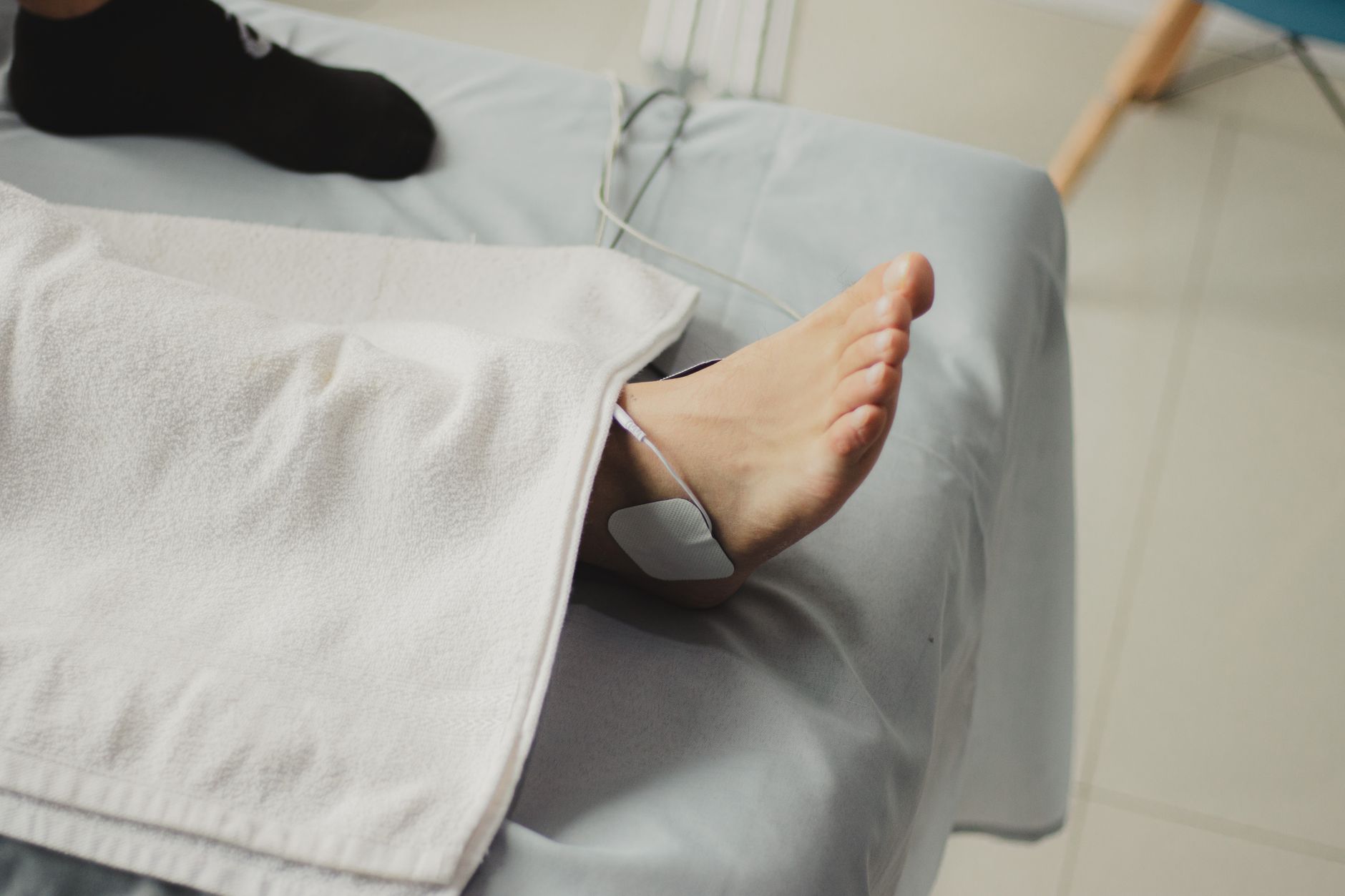
Strip the branding and a TENS unit is a small battery-powered pulse generator wired to two or four self-adhesive pads you stick on your skin. TENS stands for transcutaneous electrical nerve stimulation — “transcutaneous” just means through the skin. You place the pads over or around the painful area, turn up the intensity until you feel a strong but comfortable buzzing or tingling, and run it for, typically, 20 to 60 minutes. That’s the whole device. There’s no heat, no drug, and nothing entering the body — only a gentle electrical current passing between the pads.
That simplicity is exactly why TENS is worth taking seriously when so many wellness gadgets aren’t. It’s cheap, it’s drug-free, the downside is small, and — unlike most of what gets sold for pain — it has a plausible, mapped mechanism and a very large body of human trials behind it. Whether those trials say what the marketing implies is the real question, and it’s the lens we bring to the whole devices hub: which gadgets earn their place and which are theatre. TENS lands closer to the “earns it, within limits” end than almost any other consumer pain device.
The mechanism: gating the signal and the opioid angle
TENS has two complementary explanations, and they map onto how you set the dial. The first is the classic gate-control theory of pain: stimulating large, fast sensory nerve fibres (the ones that carry touch and vibration) appears to “close a gate” in the spinal cord, dampening the slower traffic that carries the pain signal upward.7 In plain terms, the buzzing you feel competes with the pain for the same channel, and the signal that reaches the brain is partly drowned out. This is the model behind high-frequency, conventional TENS — the comfortable, tingly setting most people use.
The second is the body’s own pain-killing chemistry. Low-frequency, stronger TENS appears to trigger the release of endogenous opioids — the body’s natural pain-relieving molecules — and the analgesia it produces can be blocked by opioid-blocking drugs in animal models, which is strong evidence the pathway is real.7 The mechanistic work even separates the two: high-frequency relief leans on one family of opioid receptors and low-frequency on another.7 The honest caveat is that much of this precise wiring was mapped in animals; the human outcome trials rarely measure the pathway directly. But for a consumer device, having any mapped mechanism puts TENS in rare company.
TENS doesn’t reach the source of the pain. It works upstream of your awareness — crowding the signal in the spinal cord and nudging the body’s own pain chemistry — which is exactly why the relief is real while it’s running, and why it fades once you switch it off.
The headline evidence: real, modest, short-term
Here is where the fairness matters, because the literature genuinely cuts both ways and a good writer doesn’t hide that. The single largest synthesis is the 2022 “meta-TENS” study, which pooled 381 randomized controlled trials covering 24,532 participants.1 Its core finding: pain intensity was clearly lower during or immediately after TENS than with a placebo (sham) device, a standardized mean difference of −0.96 — a moderate-to-large effect — and the reviewers rated this as moderate-certainty evidence, with no serious adverse events.1 Importantly, the effect held regardless of the type of pain (acute or chronic) or the diagnosis. That is a real result, and it’s the strongest single argument in TENS’s favour.
Now the counterweight. When the Cochrane collaboration looked specifically at chronic pain in its 2019 overview of reviews, it found the underlying studies were consistently small (most with fewer than 50 people per group) and at high risk of bias, and it rated the evidence as very low quality — meaning it could not confidently conclude that TENS is beneficial or harmful for chronic pain.2 Both things are true at once: a huge pooled analysis finds a real short-term effect, and the most rigorous certainty-grading says the trial quality is too uneven to be sure how big or how durable that effect is. Anyone who tells you TENS is “proven” or “debunked” is flattening a genuinely mixed picture.
Knee osteoarthritis is a useful case study in that tension. A 2021 meta-analysis found active TENS improved pain on the visual analogue scale more than sham, and that combining it with exercise beat exercise alone.4 Yet a well-designed, double-blind, placebo-controlled trial the same year — ETRELKA, with 220 patients — found no difference between real and sham TENS on knee pain at the end of three weeks.5 The discrepancy is the whole story of this field: pooled signals say “something is there,” while the cleanest single trials sometimes say “not for this, not at this dose.” For joint pain specifically, our read on curcumin for osteoarthritis runs the same evidence lens across a very different tool.
in the largest review
24,532 participants
vs sham
moderate certainty
in most trials
why certainty stays low
Dose: why so many trials “failed”
If you take one practical thing from this article, take this: TENS is dose-dependent, and a lot of the disappointing trials simply underdosed it. A 2023 meta-analysis in fibromyalgia made the point cleanly. Pooled across all studies, TENS showed no overall effect on pain — the kind of flat result that gets quoted as “TENS doesn’t work.” But when the authors separated trials by how the device was used, three dosing variables predicted whether it helped: the number of sessions, the frequency, and the intensity.6 TENS reduced pain when it was delivered at high or mixed frequencies, at high intensity, or across ten or more sessions — and did little when it wasn’t.6
This matters because older trials frequently set the intensity to a faint, “just-perceptible” tingle to keep patients comfortable, which is almost certainly subtherapeutic. The signal the nerves need to pull is a strong (still non-painful) sensation, and it needs to be maintained — nerves accommodate to a constant buzz, so the dial often has to creep up over a session. The same arithmetic of intensity-over-time that governs any dose-over-a-window problem is the logic our exposure-and-decay calculator handles for time-based dosing: define the dose up front, deliver it properly, and don’t mistake “I turned it on” for “I dosed it.” Used at a real intensity, near the pain, for enough sessions, TENS performs measurably better than the underdosed version that fills the negative-trial column.
Nerve pain and diabetic neuropathy
Neuropathic pain — pain from nerve damage itself, as in diabetic peripheral neuropathy (DPN), the burning, tingling foot pain that complicates long-standing diabetes — is where TENS is most often reached for outside the clinic, and where the evidence is genuinely thinner. The 2017 Cochrane review pooled the available randomized trials and found a mean improvement favouring TENS over sham of −1.58 points on a pain scale — which would be clinically meaningful — but graded the evidence as very low quality because the trials were few, small, and at high risk of bias.3 The reviewers were explicit that they could not confidently say whether TENS works for nerve pain; the true effect could be substantially different from that estimate.
Narrative reviews of diabetic neuropathy reach a similar verdict: TENS is recognized as a safe, non-invasive, inexpensive option that’s reasonable to try, but the controlled evidence is mixed, partly because the devices and settings vary so widely between studies. That’s why this claim earns an EMERGING grade rather than MODERATE — the direction of effect is encouraging and the safety profile is friendly, but the trial base isn’t strong enough to promise relief. If you have diabetic nerve pain, TENS is a low-risk thing to trial alongside proper glucose management and a clinician’s pain plan, not a substitute for either.
What TENS does not do
Now the part the marketing tends to blur. TENS does not fix the cause of your pain. It modulates the pain signal — gating it in the spinal cord, leaning on your own opioid chemistry — for a window of time. It does not heal a worn joint, repair a disc, regrow a nerve, or resolve the inflammation underneath. When the current stops, the input that was generating the pain is still there, which is why the relief is best documented during or immediately after treatment and tends to fade afterward.1 That isn’t a knock on the device; symptom relief is genuinely useful. It’s a knock on framing TENS as a treatment for the problem rather than a treatment for the pain.
So I’ll grade the “TENS heals the underlying problem” idea exactly what it is: HYPE. There is no credible evidence that running current through skin pads cures osteoarthritis, repairs nerve damage, or addresses any structural cause of pain. The honest pitch — a cheap, low-risk way to turn the volume down on the pain signal while you do the things that actually move the cause — is a perfectly good pitch. It just doesn’t sell as many units as “drug-free pain cure.” The same gap between a narrow real use and an oversold consumer device shows up with PEMF therapy mats, the electromagnetic cousin of TENS.
Safety, cautions, and who should not use it
The case for trying TENS rests heavily on how little it can go wrong. Across the large reviews, adverse events were poorly reported but consistently mild — most commonly skin irritation or redness under the pads — and not meaningfully different from the comparison groups; the meta-TENS review specifically noted no serious adverse events.13 Rotating pad placement, keeping the skin clean and dry, and using fresh, well-stuck electrodes handles most of the irritation issue. That low-harm profile is most of why TENS is a reasonable thing to try at all: the cost of a failed trial is a few dollars and a faint skin mark, not a drug side-effect.
But “low-risk” is not “no-risk,” and the cautions are specific. Do not place pads over the front of the neck (risk to blood pressure and airway reflexes) or across the eyes. People with a pacemaker or other implanted electrical device should not use TENS across the chest without explicit clearance, because the current can interfere with the implant. Avoid broken, infected, or numb skin — if you can’t feel the area, you can’t judge the intensity safely. And in pregnancy, TENS is used in labour but should not be placed over the abdomen or lower back earlier on without a clinician’s guidance. Those caveats are why the safety claim is graded MODERATE rather than STRONG: it’s genuinely safe for most people, conditional on respecting where and on whom it’s used.
Where it fits: a tiered view
It helps to place TENS honestly on a spectrum of who it’s for and what to expect.
Foundational — the reasonable trial. If you have musculoskeletal pain (back, knee, neck, muscular) and want a cheap, drug-free add-on, TENS is a sensible thing to test for a few weeks at a real intensity, near the pain, for enough sessions.16 Judge it honestly: if it reliably takes the edge off while it’s running and helps you move or sleep, it’s earning its keep, even though it isn’t fixing anything.
Research-curious — the nerve-pain experiment. For diabetic or other neuropathic pain, TENS is a low-risk experiment worth running alongside — never instead of — medical management, with the clear understanding that the controlled evidence is weak and your mileage may vary.3
Hype — the reasons it’s oversold. Buying TENS expecting it to cure arthritis, repair a disc, or deliver dramatic, lasting pain relief is buying the marketing. The effect is modest and short-lived by design; treat it as a volume knob, not a repair.
A TENS unit is a real, narrow tool — and the worst mistake is treating any single gadget as the answer to pain on its own. The right question is rarely “TENS: yes or no,” it’s “what actually moves this pain, and where does a pad-and-current device rank against loading the tissue, rehab, sleep, and medical care?” The Manual maps the recovery and pain tools against each other — what each one’s evidence genuinely supports, the dose windows, who benefits and who’s wasting money, and how to combine them without fooling yourself. See the Manual →
Grey areas and open questions
The certainty problem. The biggest weakness across the whole field is trial quality, not direction of effect. Most TENS studies are small, briefly run, and hard to blind — patients can usually tell whether the device is buzzing — which is precisely why the largest reviews keep landing on “likely helps, low certainty.”2 Bigger, properly powered, adequately dosed trials would resolve a lot of this, and the reviewers have been calling for exactly that for years.
The funding footprint. Fairness cuts the other way too: the single most positive synthesis — the 381-trial meta-TENS review whose moderate-certainty result anchors the optimistic read here — was funded by a TENS-device-maker’s parent company, and its lead author discloses ties to several stimulation-device firms.1 That doesn’t invalidate a transparent, pre-registered meta-analysis, and the effect estimate is consistent with the independent Cochrane work’s direction. But it’s the reason the grade is MODERATE rather than STRONG: when the most favourable number carries an industry footprint, you weight it carefully rather than at face value.
Durability. The cleanest evidence is for relief during and immediately after use. How much carries over hours or days later, and whether regular use changes a chronic pain trajectory at all, is far less settled. Plan around short-term relief, and treat any longer carry-over as a bonus rather than the expectation.
Who responds. There’s no reliable way yet to predict who gets meaningful relief and who gets little — which, given the low cost and low risk, is an argument for a short personal trial rather than ruling it in or out from the averages. The dosing data suggests the responders skew toward people who use it at a real intensity and stick with it, not the once-on-a-low-setting crowd.6
What this article is not saying
This is not “TENS doesn’t work.” The largest synthesis of randomized trials found a real, moderate-certainty short-term reduction in pain versus a fake device, at very low risk — better evidence than most of what gets sold for pain.1 Dismissing it outright is as wrong as overselling it.
This is not “a TENS unit will fix your pain.” It modulates the signal for a window of time; it does not heal the joint, disc, or nerve underneath, and the most rigorous certainty-grading still rates the chronic-pain and nerve-pain evidence as low.23 A modest, short-term, drug-free volume knob is exactly what the data supports — and exactly what the marketing inflates.
And this is not a treatment protocol or medical advice. New, severe, or unexplained pain — and any progressive nerve pain — deserves a clinician, not a gadget, and the placement and pacemaker/pregnancy cautions above are not optional. The point here is to tell you what the trials show and where they stop, so your expectations, and your spending, can be honest ones.
References
- Johnson MI, Paley CA, Jones G, Mulvey MR, Wittkopf PG. Efficacy and safety of transcutaneous electrical nerve stimulation (TENS) for acute and chronic pain in adults: a systematic review and meta-analysis of 381 studies (the meta-TENS study). BMJ Open. 2022;12(2):e051073. DOI · PMID 35144946
- Gibson W, Wand BM, Meads C, Catley MJ, O’Connell NE. Transcutaneous electrical nerve stimulation (TENS) for chronic pain — an overview of Cochrane Reviews. Cochrane Database Syst Rev. 2019;4(4):CD011890. DOI · PMID 30941745
- Gibson W, Wand BM, O’Connell NE. Transcutaneous electrical nerve stimulation (TENS) for neuropathic pain in adults. Cochrane Database Syst Rev. 2017;9(9):CD011976. DOI · PMID 28905362
- Wu Y, Zhu F, Chen W, Zhang M. Effects of transcutaneous electrical nerve stimulation (TENS) in people with knee osteoarthritis: a systematic review and meta-analysis. Clin Rehabil. 2022;36(4):472-485. DOI · PMID 34616264
- Reichenbach S, Jüni P, Hincapié CA, Schneider C, Meli DN, Schürch R, et al. Effect of transcutaneous electrical nerve stimulation (TENS) on knee pain and physical function in patients with symptomatic knee osteoarthritis: the ETRELKA randomized clinical trial. Osteoarthritis Cartilage. 2022;30(3):426-435. DOI · PMID 34600121
- Amer-Cuenca JJ, Pecos-Martín D, Martínez-Merinero P, Lluch Girbés E, Nijs J, Meeus M, et al. The dose-dependent effects of transcutaneous electrical nerve stimulation for pain relief in individuals with fibromyalgia: a systematic review and meta-analysis. Pain. 2023;164(8):1645-1657. DOI · PMID 37326674
- Sluka KA, Walsh D. Transcutaneous electrical nerve stimulation: basic science mechanisms and clinical effectiveness. J Pain. 2003;4(3):109-121. DOI · PMID 14622708