Massage guns: what percussion therapy actually does for recovery
Strip the marketing off a Theragun or Hypervolt and you’re holding a targeted vibration tool — pleasant, low-risk, and genuinely useful for two narrow things. It modestly eases muscle soreness, and it gives you a real, short-lived bump in range of motion, like a warm-up in your hand. What it doesn’t do is the louder half of the pitch: it won’t build strength, won’t make you faster, won’t “break up fascia,” and won’t flush lactic acid out of your legs. This is the honest, cited read on where the percussion ends and the wishful thinking begins.
How this article was built: Primary sources: Sams et al. 2023 systematic review of percussive therapy in the International Journal of Sports Physical Therapy; Ferreira et al. 2023 systematic review of massage guns on performance and recovery in the Journal of Functional Morphology and Kinesiology; Li et al. 2025 randomized controlled trial of percussion massage for DOMS recovery in Frontiers in Public Health; and Guo et al. 2017 systematic review and meta-analysis on massage and muscle soreness in Frontiers in Physiology — each retrieved and verified against PubMed-indexed records via web.
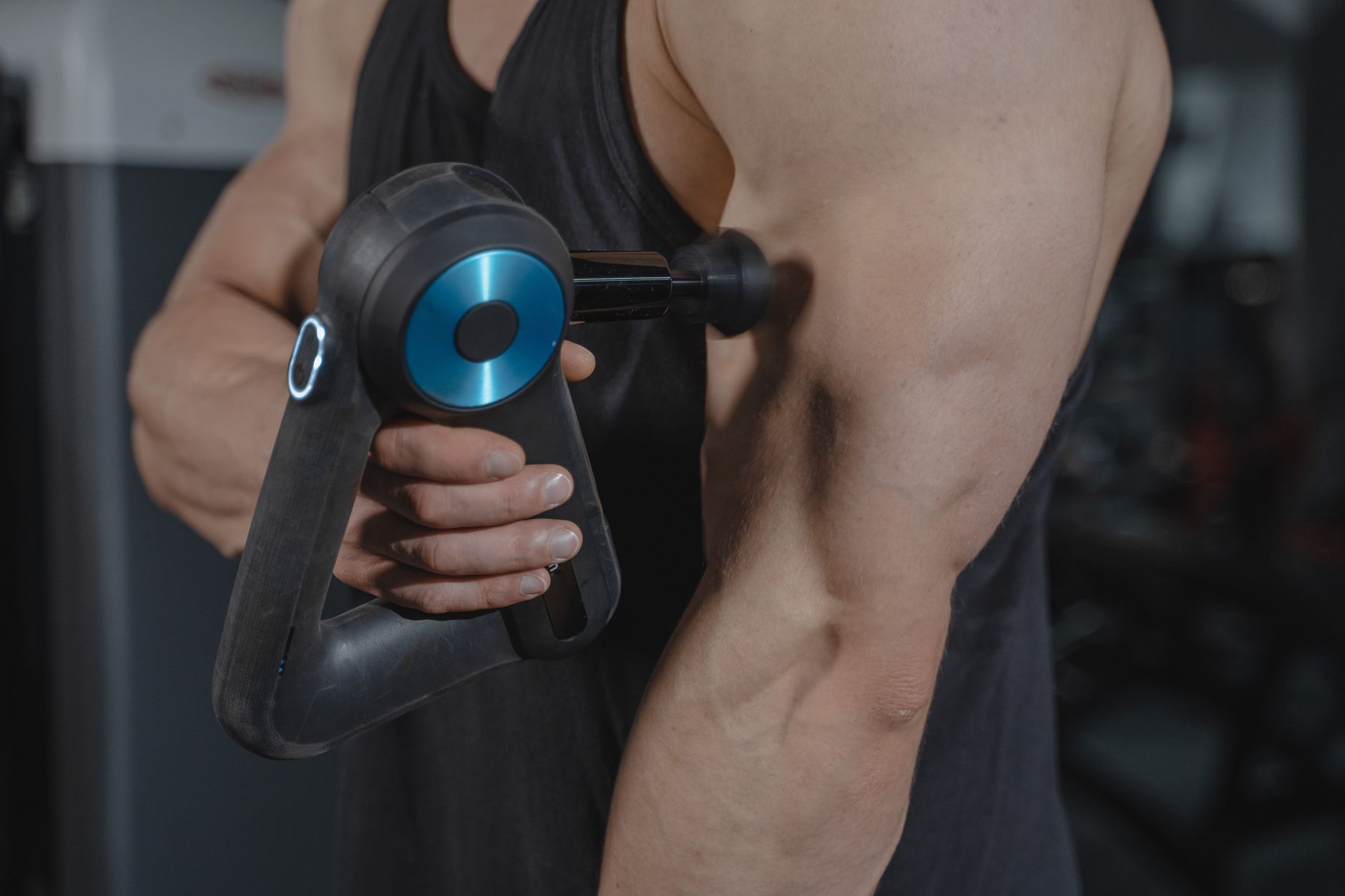
- The best-supported use is soreness. Small trials and reviews show percussion therapy modestly cuts delayed onset muscle soreness and improves how recovered you feel.3
- The cleanest finding is a warm-up effect: a couple of minutes on a muscle gives a real, short-lived bump in range of motion — without dulling strength.1
- The big claims collapse. Reviews find massage guns are ineffective for building strength or explosive performance, and one study even saw jump height drop right after use.2
- Who it’s for: anyone who wants a pleasant, low-risk way to loosen up before training or take the edge off soreness after — not someone buying a performance upgrade.
- What a massage gun actually is
- The mechanism: the signal it pulls
- Soreness: the best-supported use
- Range of motion: the cleanest finding
- Strength and performance: where it falls down
- Fascia and lactic acid: the two myths
- Safety: where not to point it
- Where it fits: a tiered view
- Grey areas and open questions
- What this article is not saying
- References
What a massage gun actually is
Underneath the brand names — Theragun, Hypervolt, and the dozens of cheaper clones — a massage gun is a simple machine. A small motor drives a padded head back and forth, fast, so it taps the muscle somewhere between roughly 20 and 50 times a second. That’s the whole device: targeted, rapid, mechanical tapping you can aim at one muscle at a time. The industry name for it is percussive therapy (sometimes percussion massage therapy, or PMT), and the honest one-line description is a handheld vibration tool that delivers a deep-feeling massage without a massage therapist.
That framing matters because the marketing has quietly upgraded the category from “convenient massage” to “recovery and performance system,” and those are very different claims with very different evidence behind them. So the right move is the one we make across the whole devices hub: separate the uses where percussion has been put through real trials from the ones where the box copy is doing the heavy lifting. A massage gun turns out to be genuinely useful for a narrow job — and badly oversold for the wider one.
The mechanism: the signal it pulls
The honest mechanistic story is “plausible, partly mapped, and routinely overstated.” The signal a massage gun pulls is a neuromuscular one. Rapid tapping floods the muscle’s stretch and pressure sensors — the muscle spindles and mechanoreceptors — with a stream of input. That input does two useful things in the short term: it competes with pain signals heading to the brain, which is why a sore muscle feels better for a while, and it briefly lowers the muscle’s resting tension, which is why the limb moves through a slightly larger range right after. The same vibration also nudges local blood flow.
That is a real, traceable signal — and it’s also a short one. The reviewers who have pooled this literature are candid that the wiring isn’t fully understood: one 2023 synthesis concluded plainly that the physiological mechanisms responsible for massage-gun effects are not completely understood, even while the device clearly does something measurable.2 The leap the marketing makes is to take that modest, mostly-neural, mostly-temporary signal and stretch it into a story about rebuilding tissue, clearing waste, and upgrading athletic output. The signal is real. The story built on top of it is mostly not.
A massage gun pulls a genuine signal — it quiets pain sensors and briefly drops muscle tension. The problem is everything the marketing stacks on top of that small, short-lived effect.
Soreness: the best-supported use
Start with the claim that holds up best, because it’s the reason most people reach for the device: easing the ache that shows up a day or two after a hard session, known as delayed onset muscle soreness (DOMS). Here the foundation is solid. A 2017 systematic review and meta-analysis pooled 11 studies covering 504 participants and found that massage after strenuous exercise produced statistically significant reductions in soreness at 24, 48, and 72 hours, alongside lower markers of muscle damage.4 That’s manual massage, not a gun — but it establishes that massage-type input genuinely moves soreness, which is the ceiling percussion is reaching for.
The percussion-specific trials point the same way. A 2025 randomized controlled trial put 30 physically active young men through a squat protocol to induce soreness, then compared static stretching against two doses of percussion massage. The longer percussion sessions came out ahead: at 48 hours the percussion group reported significantly lower pain scores and recovered jump height better than the stretching group.3 Read it honestly, though — this is a small, young, all-male sample, and the comparison is against stretching, not a true sham. That’s exactly why soreness relief earns an EMERGING grade rather than a stronger one: the direction is consistent and the mechanism fits, but the trials are small and the field is still short of large, sham-controlled work. Useful, real, modest — not settled.
Range of motion: the cleanest finding
If one effect has the cleanest data, it’s the one people notice least: a brief, measurable increase in how far a joint moves right after you use the device. A 2023 systematic review of percussive therapy concluded that a single application produces an acute increase in flexibility and range of motion.1 A separate 2023 review agreed, reporting that short two-to-three-minute applications improved ankle dorsiflexion and posterior-chain flexibility.2 The key word in both is acute — this is a warm-up-grade effect that fades within minutes to an hour, not a lasting change in how flexible you are.
What makes the finding genuinely useful is what doesn’t come with it. Static stretching can blunt strength and power for a short window afterward, which is why coaches moved away from long pre-workout stretching. Percussion appears to buy you the range-of-motion bump without that strength cost — the reviews report the flexibility gain alongside preserved, sometimes acutely improved, force output.1 That combination — loosen the muscle, keep the power — is the strongest case for a massage gun as a warm-up tool, and it’s why this claim earns a MODERATE grade. Aimed at the muscle you’re about to train, for a couple of minutes, it does a real job.
massage-and-soreness
meta-analysis
the range-of-motion bump
a warm-up-grade effect
strength or explosive power
one study saw a drop
Strength and performance: where it falls down
Now the half of the pitch that pays for the advertising: the idea that a massage gun makes you stronger, more explosive, or a better athlete. Here the verdict is blunt. The 2023 review that looked specifically at performance concluded that, for strength and explosive activities, massage guns are overall ineffective at improving strength — and in some tests they did nothing or made things slightly worse, with one study recording a drop in jump height immediately after a percussion application.2 Across strength, balance, acceleration, agility, and power, the device simply didn’t deliver an edge.
It’s worth being precise, because there’s a real nuance the marketing exploits. One review did note that a single session can acutely raise measured muscle strength in the moments right after use1 — a short-term readiness effect, the same family as the range-of-motion bump. That is not the same thing as building strength or improving competitive performance, and conflating the two is the move to watch for. A device that briefly primes a muscle is not a device that makes the muscle bigger or the athlete faster over a season. There is no good evidence a massage gun builds muscle or lifts athletic output, which is why the performance claim earns a WEAK grade. If you want strength, the percussion is a warm-up at best; the work is still the work.
Fascia and lactic acid: the two myths
Two claims get repeated so often they deserve naming directly, because both are wrong in a way that matters. The first is that percussion “breaks up fascia” or dissolves scar tissue and adhesions. It doesn’t. Fascia is tough connective tissue; the forces a handheld vibrating head delivers don’t tear it apart or remodel scar tissue, and there’s no controlled evidence that they do. What the device actually does is the modest, temporary thing described above — quiet the sensors and briefly lower tension, which feels like something releasing without anything structural being broken.
The second myth is that a massage gun “flushes lactic acid” out of tired muscle. This one fails on two counts. Lactate isn’t a waste toxin that sits in the muscle causing next-day soreness in the first place — it clears on its own within an hour or so of stopping exercise, long before DOMS even appears, so there’s nothing left to flush by the time you’re sore. And when researchers actually measured it, percussion didn’t move the needle: the 2023 performance review found no significant change in blood lactate concentration after massage-gun use.2 Both claims earn a flat HYPE grade. They’re not subtle overstatements of a real effect — they describe mechanisms that aren’t happening.
Safety: where not to point it
The good news is that for the narrow jobs it does well, a massage gun is a low-risk tool — which is most of why it’s worth owning. The trials report it as well tolerated, and the warm-up and soreness uses carry little downside. That low-risk profile is real, and it’s a genuine point in the device’s favour, earning a MODERATE grade with one firm condition: placement.
Keep the head on muscle belly, and keep it off the places where percussion can do harm. That means avoiding bones and bony prominences, joints, and the spine; the front and sides of the neck and the throat, where the device sits over major vessels and the airway; areas of fresh injury, bruising, strains, or suspected fracture; and varicose veins or any area with known clots, where pounding on a vein is a genuinely bad idea. People who are pregnant, on blood thinners, or managing a circulatory or nerve condition should clear it with a clinician before making it a habit. None of this makes the device dangerous in normal use — it makes it a tool with an obvious lane, and the harm comes from leaving that lane.
Where it fits: a tiered view
It helps to place the massage gun honestly on a spectrum of what to expect.
Foundational — the genuine uses. As a pre-training warm-up for the muscle you’re about to load, and as a way to take the edge off soreness afterward, percussion does a real job at low risk.13 A couple of minutes per muscle is the dose the studies used; more isn’t obviously better.
Research-curious — the recovery add-on. Used alongside the things that actually drive recovery — sleep, food, and easy movement — a massage gun is a reasonable, low-harm extra. Expect a modest comfort effect, not a transformation, and don’t let it crowd out the basics. The same lens applies to other recovery devices, like cold-water immersion.
Hype — the reasons it’s oversold. Buying a massage gun to get stronger, jump higher, run faster, “break up” tissue, or flush waste is buying the marketing.2 None of that is what the device does. Spend on it for the warm-up and the comfort, or don’t spend on it at all.
A massage gun is a real, narrow tool — and the worst mistake is treating any single gadget as the answer to recovery on its own. The right question is rarely “massage gun: yes or no,” it’s “what actually moves recovery, and where does a vibration device rank against sleep, protein, easy movement, and training load?” The Manual maps the recovery tools against each other — what each one’s evidence genuinely supports, the dose windows, who benefits and who’s wasting money, and how to combine them without fooling yourself. See the Manual →
Grey areas and open questions
The sham problem. The single biggest weakness in this literature is that you can feel a massage gun — which makes it nearly impossible to blind. A device you obviously feel produces part of its benefit through expectation, and few trials have managed a convincing fake. Until more sham-controlled work exists, some of the reported soreness relief is plausibly the placebo a powerful, pleasant sensation always carries.
Tiny, narrow samples. Most of the percussion-specific trials are small, short, and run in young, healthy, mostly male participants right around a single workout.3 What the device does for older adults, for women across the cycle, for clinical pain conditions, or over months of regular use is largely unstudied. The honest read is “modest acute effect in fit young people,” not “proven for everyone.”
Dose is a guess. Frequency, head shape, pressure, and time-per-muscle vary wildly between studies and between devices, and almost none of it is standardized. “There are studies on percussion” doesn’t cleanly translate to “this is how long you should run this gun on this muscle.” The two-to-three-minute window is a reasonable default, not a validated prescription.
What this article is not saying
This is not “massage guns are a scam.” They do two real things — ease soreness modestly and give an acute, strength-sparing bump in range of motion — at low risk, and that’s a legitimate reason to own one.13 Dismissing the whole category is as wrong as overselling it.
This is not “a massage gun will make you a better athlete.” The performance, fascia, and lactic-acid claims are the part that doesn’t survive contact with the data — reviews find no strength or power benefit, and the waste-flushing and tissue-breaking mechanisms aren’t real.2 A warm-up tool that feels great is still just a warm-up tool.
And this is not a treatment protocol or medical advice. Pain that’s new, severe, or unexplained deserves a clinician steering the plan, and the placement cautions above are not optional. The point here is to draw the line clearly between the narrow, useful device and the wide marketing pitch, so your expectations — and your spending — can be honest ones.
References
- Sams L, Langdown BL, Simons J, Vseteckova J. The effect of percussive therapy on musculoskeletal performance and experiences of pain: a systematic literature review. Int J Sports Phys Ther. 2023;18(2):309-327. DOI · PMID 37020441
- Ferreira RM, Silva R, Vigário P, Martins PN, Casanova F, Fernandes RJ, Sampaio AR. The effects of massage guns on performance and recovery: a systematic review. J Funct Morphol Kinesiol. 2023;8(3):138. DOI · PMID 37754971
- Li H, Luo L, Zhang J, Cheng P, Wu Q, Wen X. The effect of percussion massage therapy on the recovery of delayed onset muscle soreness in physically active young men—a randomized controlled trial. Front Public Health. 2025;13:1561970. DOI · PMID 40206177
- Guo J, Li L, Gong Y, Zhu R, Xu J, Zou J, Chen X. Massage alleviates delayed onset muscle soreness after strenuous exercise: a systematic review and meta-analysis. Front Physiol. 2017;8:747. DOI · PMID 29021762