EMS: can a gadget build or recover muscle?
Electrical muscle stimulation sells two very different stories under one acronym, and the honest answer depends entirely on which one you mean. As a clinic tool that keeps an immobilized leg from wasting after surgery, EMS is the real thing — with trial evidence to match. As a $40 ab belt promising a six-pack from the couch, it is mostly marketing wearing a lab coat. This is the cited, use-case-by-use-case grading: where the current actually does something, where it is a small extra edge, and where it is selling you a feeling of effort instead of the outcome.
How this article was built: Primary sources: the Kemmler et al. 2021 WB-EMS meta-analysis in Frontiers in Physiology, the de Oliveira et al. 2022 older-adults WB-EMS meta-analysis in Journal of Bodywork and Movement Therapies, the Šarabon et al. 2020 RT-vs-EMS-vs-vibration meta-analysis in Journal of Clinical Medicine, the Bao et al. 2022 ICU randomized controlled trial in BMC Musculoskeletal Disorders, the Reischl et al. 2024 immobilization scoping review and the Ulupınar et al. 2025 20-week comparison, the Porcari et al. 2005 ab-stimulator trial in the Journal of Sports Science and Medicine, and the Stöllberger & Finsterer 2019 safety viewpoint in BMJ Open Sport & Exercise Medicine — all retrieved and verified through PubMed and the Consensus research database.
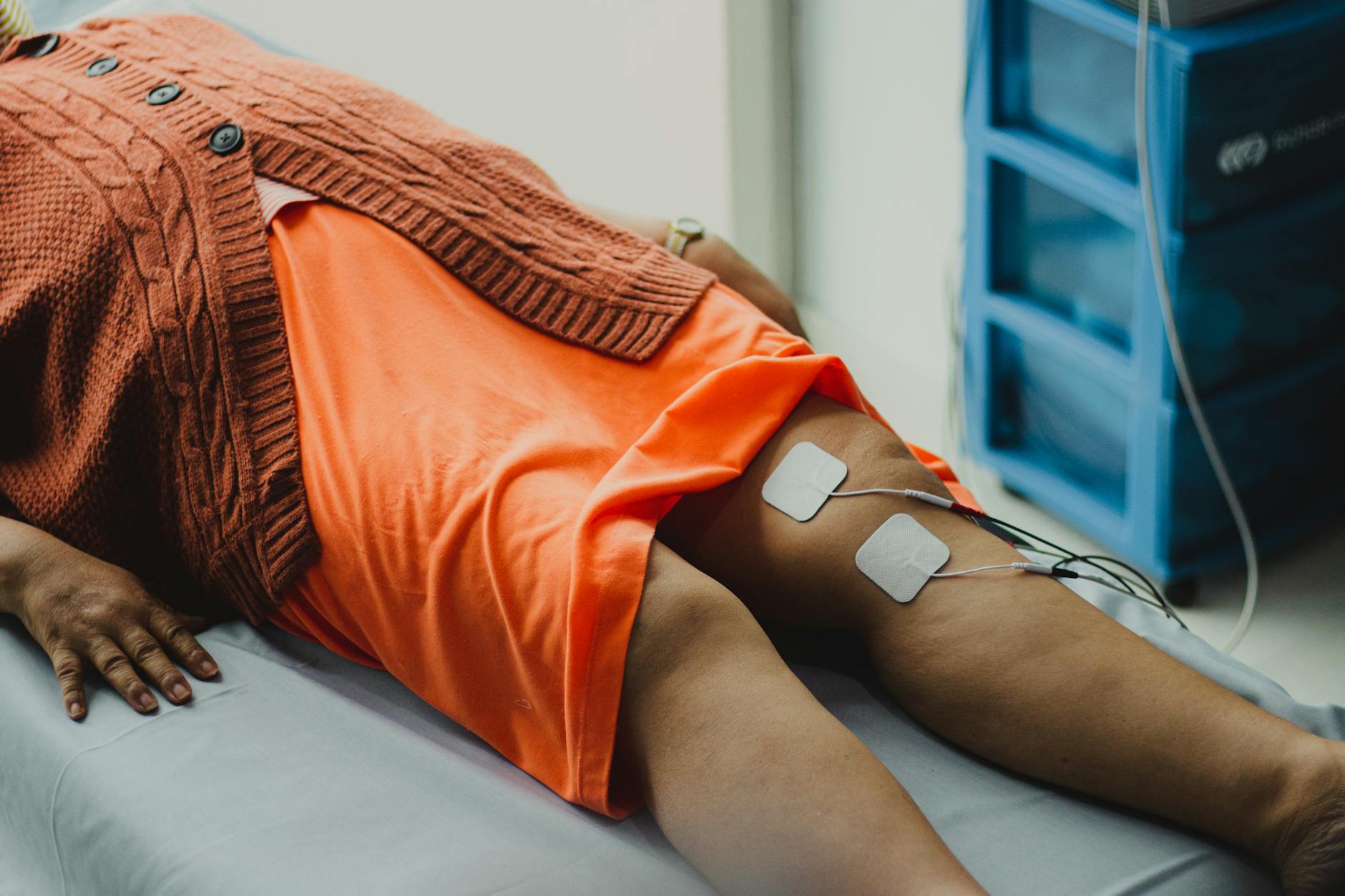
- Rehab is the real use. Clinical NMES helps preserve muscle when someone can’t move — post-surgery, in a cast, in the ICU — and that’s where the randomized evidence is genuinely solid.45
- Studio WB-EMS has a small, noisy signal. Whole-body EMS shows strength and body-composition gains in deconditioned and older adults, but the trials are small, short, and often industry-linked — promising, not proven.12
- Ab belts are the weak end. Passive abdominal stimulation can shave a couple of centimetres off waist measurement and make muscles tighter to the touch — but it does not build a six-pack or burn meaningful fat.6
- Who it’s for: someone in rehab who can’t load a muscle yet, or a time-poor person using studio EMS as a supplement — not a healthy person hoping a gadget replaces the gym.
- What EMS actually is — three different gadgets
- The mechanism: borrowing the nerve’s job
- Rehab and atrophy: the strongest case
- Whole-body EMS studios: the small, noisy signal
- Ab belts: the weak end of the catalogue
- Can it replace the gym?
- The safety caveat nobody markets
- Where it fits: a tiered view
- Grey areas and open questions
- What this article is not saying
- References
What EMS actually is — three different gadgets
Here is the trick the marketing relies on: “EMS” describes one physical idea but at least three completely different products, and they do not share an evidence base. Electrical muscle stimulation (EMS) means using an external electrical current, delivered through skin electrodes, to make a muscle contract without you choosing to fire it. The clinical literature usually calls the medical version neuromuscular electrical stimulation (NMES) — same physics, more rigour. Lump them together and you get a mess; separate them by use-case and the picture gets honest fast.
The first category is the cheap at-home ab belt — a strap of electrodes you wear on the couch that promises abs while you watch TV. The second is the whole-body EMS (WB-EMS) studio suit, a vest-and-strap rig wired across most major muscle groups, used in 20-minute supervised sessions sold as a time-efficient workout. The third is clinical NMES, the physio-grade pads-and-unit setup used to re-activate a muscle that injury or surgery has shut down. Across the devices hub we grade gadgets one job at a time, and EMS is the clearest case yet of why that matters: the same current earns a different grade in each setting.
The mechanism: borrowing the nerve’s job
Normally, a muscle contracts because your brain sends a signal down a motor nerve, the nerve releases its chemical messenger, and the muscle fibres fire. EMS short-circuits the front end of that chain: an electrode on the skin pushes a current strong enough to depolarize the motor nerve directly, and the muscle contracts because the nerve was triggered from outside rather than from above. The signal it pulls is the same contraction signal — it just skips the decision to move.
Two facts about that borrowed signal explain everything downstream. First, surface EMS recruits motor units in a different, more synchronous order than voluntary effort, and it fatigues a muscle faster — which is useful for forcing a contraction in a limb someone can’t consciously activate, but inefficient compared with lifting a real weight. Second, the current spreads through tissue and reaches only what it can reach; depth, electrode placement and how much current you can tolerate all cap the dose. That ceiling is exactly why a passive belt and a clinician’s targeted pads produce such different results — and why “it makes the muscle twitch” is not the same claim as “it builds the muscle.”
Rehab and atrophy: the strongest case
Start where EMS earns its keep. When a muscle can’t be loaded — a leg locked in a brace after knee surgery, a patient sedated and ventilated in intensive care — it wastes fast, and that is precisely the gap NMES fills. In a randomized controlled trial, Bao and colleagues applied NMES to the lower-leg muscles of ICU patients without nerve injury and found that, while everyone lost some muscle, the stimulated groups lost significantly less gastrocnemius strength, ankle range of motion and muscle cross-sectional area than the control group on standard rehabilitation alone.4 The signal kept the muscle partly switched on when the patient couldn’t.
That isn’t a one-off. A 2024 scoping review of NMES applied during limb immobilization — stimulation delivered through holes cut in casts after ACL repair or tibia fracture — found that four of the included studies showed improved quadriceps atrophy and strength outcomes, though the authors were honest that the literature is thin and dominated by old protocols.5 The direction of effect is consistent: when voluntary contraction is off the table, electrically driving the muscle preserves more of it than doing nothing. I grade clinical NMES for atrophy and rehab a MODERATE — real, replicated, and the best-supported use of the whole category, held back from STRONG only by small trials and wide protocol variation.
The nuance worth stating plainly: NMES in rehab is a bridge, not a destination. It slows the loss and helps re-establish the mind-muscle connection so that, once someone can train again, they start from a better place. It is not building an athlete’s physique; it is stopping a vulnerable one from collapsing. That distinction is the whole article in miniature.
Whole-body EMS studios: the small, noisy signal
Now the category that has exploded commercially: the 20-minute WB-EMS studio session in a wired suit. Here the evidence is genuinely more interesting than the skeptic in me expected — and genuinely shakier than the studios imply. A 2021 meta-analysis by Kemmler and colleagues pooled 16 controlled trials of WB-EMS in non-athletic adults and reported large effect sizes for gains in muscle mass and in leg and trunk strength — though, tellingly, not for body-fat reduction, which did not reach significance.1 A separate 2022 meta-analysis in older adults found moderate-to-large improvements in muscle mass, leg strength, grip strength and gait speed, with WB-EMS reducing a sarcopenia score.2
So why only EMERGING? Because the same literature that reports those numbers also reports its own weaknesses. The trials are small, the intervention lengths and stimulation protocols vary wildly between studies, the heterogeneity is high, and — the quiet part — a meaningful share of WB-EMS research carries the fingerprints of the people who sell WB-EMS. Step outside that bubble and the picture cools: a broad 2020 meta-analysis comparing resistance training, whole-body vibration and EMS in older adults concluded that conventional resistance training is the reliable way to build strength, and that the effects of EMS remain debated, partly because so few EMS trials qualified for inclusion.3
WB-EMS isn’t snake oil and it isn’t a shortcut. It’s a small, real, expensive edge for people who otherwise wouldn’t train — graded on trials that too often were run by the studios themselves.
The honest read: for a deconditioned, older, or genuinely time-poor person who would not otherwise do resistance work, supervised WB-EMS appears to deliver a real strength and muscle-mass stimulus. For body fat, the marketing claim outruns the data. And for a healthy person who could simply lift, it is an expensive way to buy a smaller version of what a barbell gives for free.
under one acronym
belt, suit, clinical pads
WB-EMS meta-analysis
strength up, fat unchanged
after WB-EMS
the caveat nobody sells
Ab belts: the weak end of the catalogue
Then there is the product most people picture when they hear “EMS”: the abdominal stimulator belt sold on the promise of effortless abs. The cleanest test of that promise is an old, blunt one. Porcari and colleagues ran a controlled trial of an abdominal EMS stimulator and found that, after weeks of use, the stimulation group showed no significant change in body weight, body-mass index, or skinfold thickness compared with controls — and no meaningful gain in the kind of strength or appearance the ads sell.6 Participants felt their abdominals working, and some reported their stomachs felt firmer, but the measurable body-composition needle did not move.
Two honest caveats keep this from being a flat zero. Some sham-controlled trials of abdominal EMS do report a small reduction in waist circumference — a couple of centimetres — but that is a measurement change, plausibly from transient muscle tone, not fat loss; visceral fat in those studies didn’t significantly budge. And EMS can genuinely make a muscle contract, which is why it works in rehab. But “contracts the muscle” and “reveals a six-pack” are separated by the one thing a belt can’t touch: the layer of fat on top, which is governed by your overall energy balance, not by stimulating the muscle underneath. I grade the build-muscle / six-pack belt claim WEAK, and the “burns significant fat” claim flatly HYPE — there is no credible trial showing passive stimulation creates a calorie deficit large enough to matter.
Can it replace the gym?
This is the question the whole category is really selling against, so let’s answer it head-on. The fairest comparison comes from studies that put EMS and real training side by side. A 2025 trial pitting 25-minute WB-EMS against 90-minute full-body resistance training over 20 weeks found both groups improved — but traditional training produced greater strength gains across bench press, leg press and shoulder press, and greater fat-percentage reduction; EMS won only on body-weight and BMI change.8 Translation: when the goal is strength or a leaner physique, the barbell wins; EMS is the runner-up you reach for when the barbell isn’t an option.
Where EMS does something the gym alone doesn’t is as an add-on. Meta-analytic data show that superimposing electrical stimulation on top of voluntary resistance training produces modestly greater gains in strength and muscle mass than training alone — a small additive effect, not a replacement.3 If you’re building a protein-and-training base first, our protein-target calculator sets the g/kg floor that any stimulation strategy sits on top of; the current is the garnish, not the meal. I grade “EMS replaces resistance training” WEAK: defensible only for people who cannot train conventionally, and even then a substitute rather than an equal.
The safety caveat nobody markets
Here is the part the suit studios don’t put on the poster, and the reason I won’t wave WB-EMS through as harmless. Because EMS forces a contraction harder and more synchronously than your own effort would, an overzealous session in someone unaccustomed to it can drive muscle breakdown to a dangerous degree — exertional rhabdomyolysis, where damaged muscle dumps its contents into the blood and, at the extreme, threatens the kidneys. A 2019 safety viewpoint by Stöllberger and Finsterer catalogued seven published cases of rhabdomyolysis after WB-EMS, flagged that creatine-kinase spikes after sessions can be large and variable, and argued that operators should be properly trained and users screened before starting.7
Keep this in proportion: seven case reports against a fast-growing user base is a rare event, not an epidemic, and controlled trials in frail older adults have run WB-EMS without anyone crossing the dangerous threshold.7 But “rare” is not “impossible,” and the risk concentrates exactly where the marketing pushes hardest — a first-timer going maximal in a 20-minute “equivalent to hours in the gym” session. Ramp intensity slowly, hydrate, never let an untrained operator crank the dials, and treat severe soreness with dark urine as an emergency, not a badge of a good workout.
Where it fits: a tiered view
It helps to place EMS honestly on a spectrum of how settled the evidence is and who it’s actually for.
Foundational — the clinical use. If a muscle can’t be loaded because of injury, surgery, or critical illness, clinician-supervised NMES is a legitimate, evidence-backed tool for slowing atrophy and re-activating the muscle.45 This is EMS doing the one job it’s best at, under the supervision it requires.
Research-curious — the studio supplement. For a deconditioned, older, or time-pressed person who otherwise wouldn’t train, supervised WB-EMS is a defensible experiment with a real but modest, industry-tinged evidence base — best treated as a supplement to movement, screened for risk, ramped slowly.12
Hype — the couch six-pack. Buying a belt to build abs or melt fat without training is buying the sensation of effort, not the result. The muscle twitches; the body composition doesn’t meaningfully follow.6
EMS is a narrow, real tool that gets sold as a broad one. The mistake is treating any single gadget as the answer to strength, fat, or aging at once — the better question is always “what actually moves this outcome, and where does a current-driven contraction rank against training, protein, and recovery?” That’s the lens we take across the recovery and devices toolkit: the basics first, the gadget last, and an honest grade on each.
Grey areas and open questions
The industry-funding problem. The single biggest weakness in the WB-EMS literature is that a large share of the positive trials are linked to the commercial interests selling the suits.1 Independent, adequately powered, long-duration trials are scarce, and until there are more of them, the large effect sizes deserve a skeptical asterisk rather than a victory lap.
Protocol chaos. “EMS” isn’t one dose — frequency, pulse width, electrode placement, session length and intensity vary enormously between studies and devices, which makes pooling results genuinely hard and makes any single device’s claim hard to verify against the trial it cites.3
Population gaps. There’s limited long-term data on years of regular WB-EMS use, little on younger trained athletes (where the ceiling effect likely shrinks any benefit), and the safety screening that should precede high-intensity sessions is not yet standardized across the studios offering them.7
What this article is not saying
This is not “EMS is a scam.” In rehabilitation, clinician-guided NMES has real randomized evidence for preserving muscle when someone can’t train, and that’s a genuinely valuable medical tool.45 Dismissing the whole category misses the one place it clearly works.
This is not “a suit will get you fit on the couch.” The studio evidence is real but small, short, and often industry-linked; the belt evidence is weaker still; and the “passive fat-burning” pitch has no credible trial behind it.16 For strength and a leaner body, voluntary training out-performs EMS head to head.8
And this is not a treatment or training protocol. If you’re recovering from an injury or surgery, clinical stimulation belongs with your physiotherapist, not a gadget you bought online — and if you try WB-EMS, screen for the risk factors first and ramp the intensity slowly. The point here is to separate the three EMS gadgets that share a name so your expectations, and your spending, can be honest ones.
References
- Kemmler W, Shojaa M, Steele J, Berger J, Fröhlich M, Schoene D, von Stengel S, Kleinöder H, Kohl M. Efficacy of whole-body electromyostimulation (WB-EMS) on body composition and muscle strength in non-athletic adults. A systematic review and meta-analysis. Front Physiol. 2021;12:640657. DOI · PMID 33716787
- de Oliveira TMD, Felicio DC, Filho JE, et al. Effects of whole-body electromyostimulation on health indicators of older people: systematic review and meta-analysis of randomized trials. J Bodyw Mov Ther. 2022;31:134-145. DOI · PMID 35710211
- Šarabon N, Ložnjak J, Kozinc Ž. Resistance exercise, electrical muscle stimulation, and whole-body vibration in older adults: systematic review and meta-analysis of randomized controlled trials. J Clin Med. 2020;9(9):2902. DOI · PMID 32911822
- Bao W, Yang J, Li M, Chen K, Ma Z, Bai Y, Xu Y. Prevention of muscle atrophy in ICU patients without nerve injury by neuromuscular electrical stimulation: a randomized controlled study. BMC Musculoskelet Disord. 2022;23(1):780. DOI · PMID 35974369
- Reischl S, et al. Application of neuromuscular electrical stimulation during immobilization of extremities for musculoskeletal conditions: a scoping review. J Bodyw Mov Ther. 2024;40:1555-1560. DOI · PMID 39593489
- Porcari JP, Miller J, Cornwell K, Foster C, Gibson M, McLean K, Kernozek T. The effects of neuromuscular electrical stimulation training on abdominal strength, endurance, and selected anthropometric measures. J Sports Sci Med. 2005;4(1):66-75. PMID 24431963
- Stöllberger C, Finsterer J. Side effects of and contraindications for whole-body electro-myo-stimulation: a viewpoint. BMJ Open Sport Exerc Med. 2019;5(1):e000619. DOI · PMID 31908835
- Ulupınar S, Çavušoğlu C, Özdal M, et al. Comparing the effects of 25-minute electrical muscle stimulation vs. 90-minute full-body resistance training on body composition and strength: a 20-week intervention. J Exerc Sci Fit. 2025;23(4):349-359. DOI · PMID 40761504