Vibration plates: do the viral shaking machines actually work?
Stand on the buzzing platform, the caption promises, and the fat falls off while you barely move. That part is fiction — the plate is not a weight-loss machine, and it will not build a physique the way a barbell does. But dismissing the whole category is also wrong. Whole-body vibration carries a genuine, narrow signal in places the TikToks never mention: bone density in postmenopausal women, balance and fall risk in older adults, and modest circulation effects. This is the honest, cited read on which claims survive the literature and which ones are pure marketing.
How this article was built: Primary sources retrieved and verified against PubMed-indexed records: Oliveira et al. 2016, a systematic review and meta-analysis of whole-body vibration and bone mineral density in Osteoporosis International; a 2023 network meta-analysis of vibration frequency and balance in Frontiers in Physiology; Marín-Cascales-class strength evidence in Journal of Clinical Medicine (2023); and Gou et al. 2025, a meta-analysis of vibration training and body mass in the International Journal of Obesity. Where a claim rests on mechanism rather than trial data, we say so.
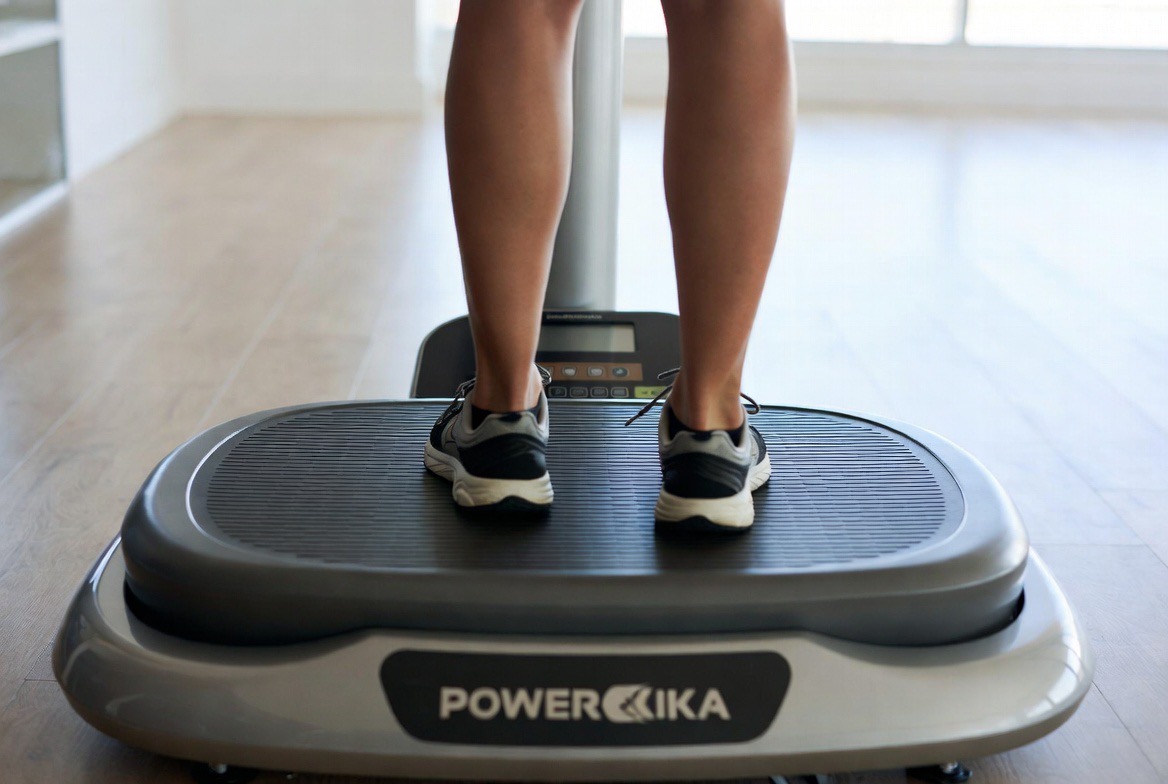
- It is not a weight-loss machine. A 2025 meta-analysis found vibration training on its own did not meaningfully reduce body mass, BMI, or fat mass — the viral “shake off fat” pitch is the weakest claim in the whole category.4
- The strongest real signal is bone. Meta-analyses show modest but significant gains in hip and spine bone density in postmenopausal women, especially on side-alternating plates.1
- For older adults, vibration improves balance and lower-body strength — a meaningful fall-risk lever for a population that can’t always train hard.23
- Who it’s for: someone managing bone loss or balance with clinician input, not someone buying a shortcut around lifting weights or a calorie deficit.
- What a vibration plate actually is
- The mechanism: the signal it pulls
- Bone density: the strongest case
- Balance and falls: the most useful case
- Muscle and strength: real, but not a barbell
- Weight and fat loss: where the hype lives
- The claims at a glance
- Where it fits: a tiered view
- Grey areas and open questions
- What this article is not saying
- References
What a vibration plate actually is
Underneath the brand names — Power Plate, and the flood of cheaper clones now selling for under a hundred dollars — the machine is simple. A motor drives a platform to oscillate rapidly, somewhere between roughly 20 and 50 times per second, while you stand, squat, or hold a plank on top of it. The clinical name is whole-body vibration (WBV), and there are two mechanical flavours that matter: synchronous plates that move the whole surface up and down together, and side-alternating plates that seesaw around a central axis like a rapid teeter-totter. That distinction is not trivia — it changes the results, and we’ll come back to it.
The framing matters because the marketing has quietly promoted the device from “passive therapy tool” to “ten minutes equals an hour at the gym.” Those are radically different claims with radically different evidence behind them. The technology is genuinely old — it traces back to research on countering bone and muscle loss in immobilized and even astronaut populations — and that lineage is exactly why a real signal exists. The right move is the one we make across the whole devices hub: separate the uses that have survived real trials from the ones where the caption is doing all the work.
The mechanism: the signal it pulls
The honest mechanistic story is “plausible, partly mapped, and routinely overstated.” When the platform oscillates underneath you, it forces tiny, fast changes in muscle length. Your nervous system answers with a reflex called the tonic vibration reflex — rapid-fire involuntary contractions as the muscle spindles fire to keep you stable. So even standing still, the leg muscles are firing far more often than they would on solid ground. That is the signal the plate really pulls: a high-frequency stream of low-force contractions, plus a mechanical loading pulse that travels up through bone.
Both halves are biologically real. Bone is a living tissue that remodels in response to mechanical strain — load it and osteoblasts lay down more bone — and a vibration plate is, fundamentally, a strain-delivery device. The reflex firing, meanwhile, genuinely trains the neuromuscular pathways that govern balance and reaction time. The leap the marketing makes is to take this low-force reflex signal and stretch it into a story about melting fat, replacing strength training, and burning the calories of a real workout. A stream of small contractions is not the same as the heavy mechanical tension that drives muscle growth, and it is nowhere near the energy cost of actually moving your body weight through space. The signal is real. Most of the story stacked on top of it is not.
A vibration plate pulls a genuine signal — it loads bone and floods the legs with reflex firing. The problem is everything the marketing builds on top of that small, low-force effect.
Bone density: the strongest case
Start with the claim that holds up best, because it is also the one the viral videos never bother to mention: bone. For postmenopausal women losing density as estrogen falls, mechanical loading is one of the few non-drug levers that helps, and a vibration plate delivers loading without the joint stress of jumping or heavy lifting. A systematic review and meta-analysis pooled the randomized trials and found that whole-body vibration produced significant improvements in bone mineral density at the hip and spine compared with no intervention — the two sites that matter most for fracture risk.1
Read it honestly, though, and two caveats come with the finding. First, the effect is modest and the mechanical details decide whether you see it at all: the same body of work found side-alternating plates outperformed synchronous ones, and that oscillations needed to clear a meaningful intensity threshold — roughly above 3g of acceleration — to move bone.1 A low-amplitude clone running at the wrong settings may pull no bone signal whatsoever. Second, vibration added on top of an existing exercise program produced negligible extra benefit; the gains showed up mainly against doing nothing.1 That mix — a real, replicated, but modest and condition-dependent effect — is exactly why bone density earns an EMERGING grade rather than a stronger one. It is the best reason to consider a plate, and still not a slam dunk.
Balance and falls: the most useful case
The most practically valuable signal is balance. Falls are the leading cause of injury in older adults, and the reflex firing a plate provokes is, in effect, balance training the user barely has to work for. A 2023 network meta-analysis examined vibration across frequencies and found that whole-body vibration training improved balance ability in older adults, with frequency emerging as the key parameter that determined whether the intervention worked.2 Because vibration places far less stress on the joints, heart, and lungs than conventional balance exercise, it is also more tolerable for exactly the frail population most at risk — the people who can’t always do a standing single-leg program.
That balance benefit is reinforced by the strength data in older adults, since stronger legs are part of how you stay upright. A 2023 systematic review and meta-analysis in older populations reported significant gains in lower-extremity strength, with a moderate pooled effect.3 The honest framing is that vibration is a credible supplementary tool for fall prevention in older or deconditioned adults — not a replacement for progressive strength and balance work, but a genuinely useful add-on for people who struggle with the conventional version. That combination of replicated balance and strength signal in the at-risk group is why this claim earns a MODERATE grade, the highest in the article.
showed up in postmenopausal
women vs. no intervention
bone signal needed to clear
low-amplitude clones may do nothing
alone — not clinically
significant for weight loss
Muscle and strength: real, but not a barbell
Here the picture gets more nuanced, and the nuance is where people get fooled. Vibration does produce measurable strength gains — the older-adult meta-analysis above found a moderate effect on lower-limb strength.3 But context decides everything. In deconditioned, older, or untrained people, almost any novel stimulus improves strength off a low baseline, and the plate clears that bar. In trained adults chasing hypertrophy or serious strength, the reflex stimulus is simply too low-force to compete with progressive resistance training. Muscle growth is driven by mechanical tension you have to fight against; a buzzing platform doesn’t supply it.
So the honest verdict splits by audience. As a strength supplement for frail or sedentary populations, vibration is legitimate. As a claim that standing on a plate builds muscle the way lifting does — the framing the marketing leans on — it does not hold up, and that version of the claim earns a flat WEAK grade. If your goal is to build a physique, the plate is a distraction from the work; the same honest lens applies to other passive-recovery gadgets like massage guns, sold on a story that runs well ahead of the mechanism.
Weight and fat loss: where the hype lives
Now the claim that drives the viral videos and pays for the advertising: stand on the plate and the fat shakes off. This is the weakest claim in the entire category, and the evidence is blunt about it. A 2025 systematic review and meta-analysis in the International Journal of Obesity pooled the randomized trials and found that whole-body vibration training, on its own, did not meaningfully reduce body mass, BMI, or fat mass.4 Where a fat-mass change appeared at all in the broader literature, it landed around a single kilogram — a number the reviewers flag as not clinically significant.
The physics explains why. Fat loss requires an energy deficit, and a low-force reflex stimulus burns a trivial number of calories compared with actually moving your body weight. The plate does not change the calorie math, and it does not override a diet. The honest read is that any “weight-loss” results you see in testimonials come from the diet and the other movement happening alongside the plate, not the plate itself. That earns a flat HYPE grade. The exception worth noting: vibration training has shown a real reduction in blood pressure in overweight populations — a cardiometabolic benefit that is genuine, but is a completely different thing from the fat-loss promise being sold.
The claims at a glance
| Claim | Grade | What the evidence actually shows |
|---|---|---|
| Improves bone density (postmenopausal women) | EMERGING | Significant hip and spine gains vs. no intervention; modest, and only with side-alternating plates above an intensity threshold.1 |
| Improves balance & cuts fall risk (older adults) | MODERATE | Replicated balance and lower-limb strength gains; low joint stress makes it usable for the frail at-risk group.23 |
| Builds muscle like resistance training | WEAK | Real gains off a low baseline in untrained people; too low-force to compete with lifting for trained adults.3 |
| Causes meaningful weight / fat loss | HYPE | No significant effect on body mass, BMI, or fat mass from vibration alone. Doesn’t change the calorie math.4 |
Where it fits: a tiered view
It helps to place the vibration plate honestly on a spectrum of what to expect. These are ways of thinking about the device, not clinical prescriptions — bone and balance work in at-risk populations belongs under a clinician’s eye.
Foundational — the genuine use. For an older or postmenopausal person managing bone loss or fall risk, a side-alternating plate run at adequate intensity is a low-stress way to add mechanical loading and balance training that conventional exercise might be too punishing to deliver.12 Used this way, with medical input, the device does a real job.
Research-curious — the supplement. Layered on top of the things that actually drive results — resistance training, protein, walking, sleep — vibration is a reasonable, low-harm add-on for circulation, warm-up, or recovery feel. Expect a supporting role, not a transformation, and don’t let it crowd out the basics. The same honest lens applies to other recovery rituals like compression boots, where the feel and the function don’t always line up.
Experimental — the reasons it’s oversold. Buying a plate to lose weight, melt fat, or replace your strength training is buying the marketing.34 None of that is what the device reliably does. If fat loss is the goal, the deficit and the movement do the work; if a stronger body is the goal, the barbell does. Spend on the plate for bone and balance, eyes open — or put the money toward training and food.
A vibration plate is a real, narrow tool — and the worst mistake is treating any single gadget as the answer to bone, strength, or weight on its own. The right question is rarely “plate: yes or no,” it’s “what actually moves the outcome I care about, and where does vibration rank against loading, protein, and progressive training?” The Manual maps these tools against each other — what each one’s evidence genuinely supports, the dose windows, who benefits and who’s wasting money, and how to combine them without fooling yourself. See the Manual →
Grey areas and open questions
Settings are wildly unstandardized. Frequency, amplitude, plate type, posture, and session length vary enormously between studies and between the devices people actually buy.2 A finding from a research-grade side-alternating plate at high acceleration may simply not transfer to a budget clone — and most consumer units never publish the numbers that decide whether the bone signal exists at all.
Vibration alone vs. vibration plus exercise. The bone evidence suggests the plate’s edge largely disappears when it is added on top of an existing exercise program — the gains showed up mainly against doing nothing.1 Whether the device adds anything for an already-active person is genuinely unsettled, and the honest answer is probably “not much.”
Hard fall-rate outcomes are still thin. Vibration reliably improves balance metrics and leg strength, which are proxies for fall risk.23 Large trials measuring actual fall and fracture rates over years — the outcome that ultimately matters — remain limited, so the strongest claim the data supports is “improves the things that predict falls,” not “proven to prevent them.”
What this article is not saying
This is not “vibration plates are a scam.” They do real things — modest bone-density gains in postmenopausal women, meaningful balance and leg-strength improvement in older adults — at low joint stress, and for the right person those are legitimate reasons to use one.12 Dismissing the whole category is as wrong as overselling it.
This is not “the plate will help you lose weight or replace the gym.” The fat-loss and muscle-building claims are the part that doesn’t survive contact with the data — the meta-analysis found no significant effect on body mass or fat, and the strength signal is a low-baseline effect, not a barbell substitute.34 A device with a narrow real benefit is still narrow.
And this is not a treatment protocol or medical advice. The bone and balance uses that matter most apply to populations — postmenopausal, older, deconditioned — who should be working with a clinician, and there are real contraindications. The point here is to draw the line clearly between the narrow, genuinely useful device and the wide viral pitch, so your expectations — and your spending — can be honest ones.
References
- Fischer M, Vialleron T, Laffaye G, et al.; Oliveira LC, Oliveira RG, Pires-Oliveira DAA. Effects of whole body vibration on bone mineral density in postmenopausal women: a systematic review and meta-analysis. Osteoporos Int. 2016;27(10):2913-2933. DOI · PMID 27145947
- Yang J, Seo D, et al. Effects of whole-body vibration training with different frequencies on the balance ability of the older adults: a network meta-analysis. Front Physiol. 2023;14:1153163. DOI · PMC10140584
- Wadsworth D, Lark S, et al. Impacts of whole-body vibration on muscle strength, power, and endurance in older adults: a systematic review and meta-analysis. J Clin Med. 2023;12(13):4467. DOI · PMID 37445502
- Gou P, Zhou S, Liu S, et al. Effectiveness of whole-body vibration training on body mass reduction: a systematic review and meta-analysis. Int J Obes (Lond). 2025;49(12):2140-2155. DOI · PMID 40847071