Resistant starch: what it actually does for your gut and blood sugar
It feeds your gut bacteria, raises butyrate, and nudges blood sugar in the right direction — most clearly if you already run high. What it is not: a weight-loss hack, and the cooled-rice calorie trick is real but oversold.
- Resistant starch is a fermentable fiber that feeds your gut bacteria and reliably raises short-chain fatty acids, especially butyrate — the strongest, best-supported thing it does.
- It modestly improves fasting glucose and insulin, mostly in people with prediabetes or type 2 diabetes; in already-healthy people the metabolic effect is small.
- It is not a weight-loss drug — pooled trials show no meaningful change in body weight or BMI, and the cooled-rice "calorie trick" is real but oversold.
- Best for: people who want a cheap, food-first prebiotic and anyone managing blood sugar — start with ~15–30 g/day and ramp slowly, because gas and bloating are common.
What resistant starch is, and why it is trending
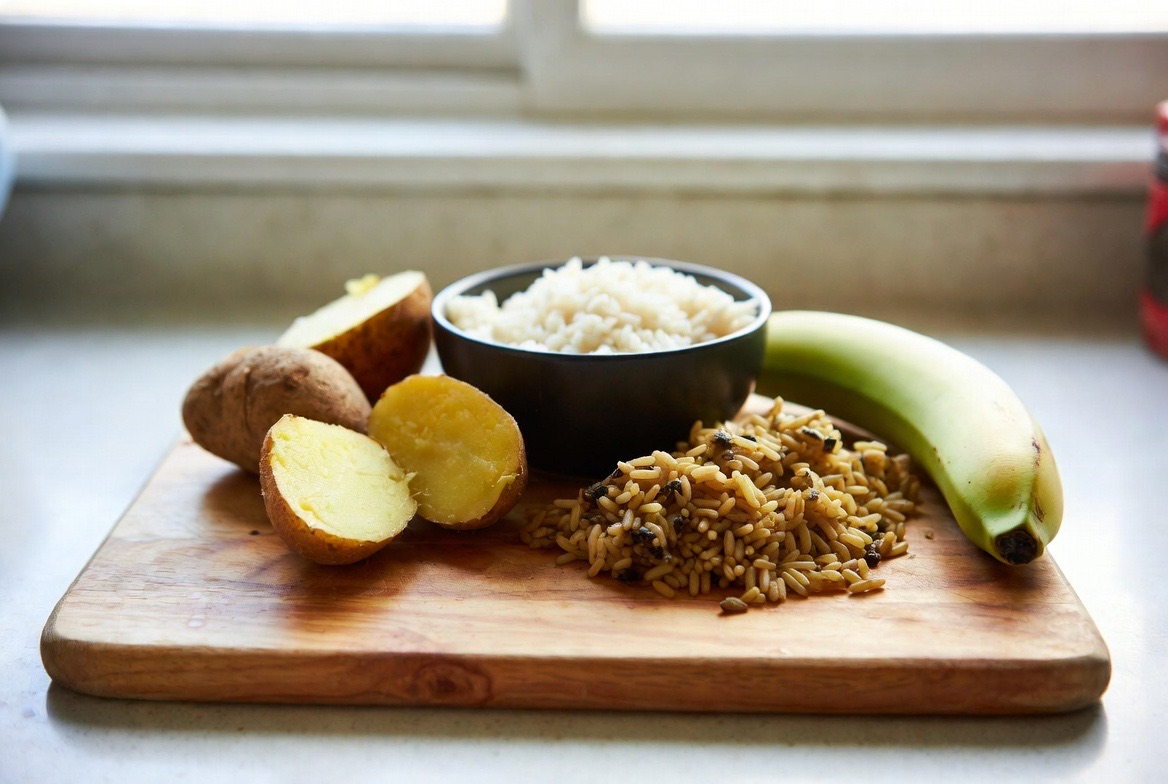
Resistant starch (RS) is starch that resists digestion in your small intestine. Ordinary starch gets broken down into glucose and absorbed before it reaches your colon. Resistant starch survives that trip — it behaves less like a starch and more like a fiber, arriving in the colon largely intact, where your gut bacteria ferment it. You get it from everyday foods: cooked-and-cooled potatoes, rice, and pasta; green (under-ripe) bananas; legumes; oats; and from supplements such as raw potato starch or high-amylose maize starch.
The interest is easy to understand. One ingredient that promises better gut health, steadier blood sugar, and easier weight control sounds like the rare wellness trend that might actually be load-bearing. Some of that holds up. Some of it does not. The honest read is that resistant starch is a genuinely evidence-supported prebiotic fiber with real but modest benefits — and that the most viral claim attached to it, the cooled-rice calorie trick, is the weakest part of the story.
Mechanism: the signal it pulls in your gut
The core action is fermentation. Because resistant starch is not absorbed in the small intestine, it reaches the colon and becomes food for your resident microbes. When those bacteria ferment it, they release short-chain fatty acids (SCFAs) — small molecules, chiefly acetate, propionate, and butyrate, that the body uses as fuel and signals. This is the signal resistant starch pulls: a fermentation signal that shifts the microbial community toward butyrate producers and raises the supply of butyrate at the colon wall.1
Butyrate matters because it is the preferred energy source for the cells lining your colon (colonocytes) and supports the integrity of the gut barrier — the single layer of cells that decides what passes from your gut into your bloodstream. Feeding those cells their preferred fuel is a plausible, mechanistically clean reason a fermentable fiber would support colon-cell health. Resistant starch also slows the rate at which the rest of a meal turns into blood glucose, which is the lever behind its effect on post-meal blood sugar.
Resistant starch is best understood not as a starch you eat but as a fiber you feed your microbes — and butyrate is the message they send back.
The evidence, claim by claim
Gut and SCFA — the strongest case
The prebiotic effect is the best-supported thing resistant starch does. A 2022 systematic review in the American Journal of Clinical Nutrition pooled 39 randomized controlled studies covering 2,263 participants and found that resistant starch supplementation increased SCFA production in most of the included studies, and was well tolerated in both healthy people and those with an underlying condition.1 That is a large, consistent evidence base pointing the same direction, which is why this claim earns a MODERATE grade rather than something weaker.
The honest caveat that keeps it from STRONG: most trials measured SCFAs in stool, not in the bloodstream or at the colon wall. Higher fecal butyrate can reflect more production — or, less helpfully, less absorption. The direction of the prebiotic signal is solid; the precise downstream health payoff is still being mapped. If you want the broader picture of how fermentation by-products are studied, our review of postbiotics and gut health covers the same SCFA machinery from the other end.
Blood sugar — real, and clearest in dysglycemia
On glycemic markers, the data are good but population-dependent. A 2023 systematic review and meta-analysis in Frontiers in Nutrition analyzed 36 randomized controlled trials (982 participants) in people with type 2 diabetes or prediabetes. Type-2 resistant starch (the kind in raw potato starch and high-amylose maize) lowered fasting glucose (standardized mean difference −0.39) and fasting insulin (−0.40), and both RS types reduced post-meal glucose.2 A separate 2019 meta-analysis of 13 trials in overweight and obese adults found reductions in fasting glucose, fasting insulin, and HbA1c, with the largest effects in the diabetic sub-groups.3
Two things keep this honest. First, the benefit concentrates in people who are already dysglycemic — if your blood sugar runs normal, the effect is smaller. Second, both meta-analyses found that HOMA-IR, a composite index of insulin resistance, did not move significantly even when fasting glucose and insulin individually improved.23 That mixed picture is exactly why this is MODERATE, not STRONG. For the upstream condition these trials are really targeting, our explainer on insulin resistance is the companion read.
Appetite and satiety — promising but thin
Resistant starch can blunt appetite in the hours after a meal, partly by nudging satiety hormones such as GLP-1 and peptide YY. A 2021 meta-analysis in Clinical Nutrition ESPEN found lower self-reported appetite with resistant starch versus control.4 The reason this is graded EMERGING rather than higher: the pooled analysis rested on only four eligible randomized trials, the outcome was acute and subjective, and short-term appetite scores do not reliably translate into how much people actually eat over weeks.
A practical framework: how much, what form
We do not write prescriptions here — we describe what the trial populations did and what that translates to for everyday eating. Across the studies above, doses clustered in the range of roughly 15–30 g of resistant starch per day, with the clearest metabolic and lipid signals at the higher end (≥30 g/day) sustained for 8 weeks or more.3
- Food first. Cooked-and-cooled potatoes and rice, legumes, oats, and green bananas deliver resistant starch inside a whole-food matrix. This is the foundational tier and where most people should start.
- Supplements as a top-up. Raw potato starch and high-amylose maize starch are the forms most studied; a tablespoon stirred into a cool (not hot) drink is a common way to add a measured dose. This is the research-curious tier.
- Ramp slowly. Go low and build over one to two weeks. Gas and bloating are common as your microbes adjust — they fermented all that new fiber, and the by-products have to go somewhere. Tolerability improved across the trials over time.1
If you are pairing resistant starch with other gut interventions, it slots in alongside soluble fibers — our review of psyllium for cholesterol and gut health and our look at digestive enzyme supplements cover where each one actually earns its place.
Grey areas: weight, and the cooled-rice myth
Here is where the marketing outruns the data. A 2025 systematic review and meta-analysis in Frontiers in Nutrition pooled 19 trials (1,073 participants) in adults with metabolic-syndrome risk factors. Resistant starch produced no significant change in body weight (mean difference −1.33 kg) or BMI (−0.52 kg/m²), though it did modestly trim waist and hip circumference and improve cholesterol.5 That is why "resistant starch causes meaningful weight loss" is graded WEAK. It is a metabolic-support fiber, not a weight-loss agent.
The cooled-rice claim deserves the same scrutiny. The first half is real: cooling cooked starch lets the molecules re-crystallize into a form enzymes cannot easily break down, a process called retrogradation. In a 2022 randomized crossover trial in 32 people with type 1 diabetes, chilling cooked rice for 24 hours raised its resistant starch from about 7.5 to 12 g per 100 g (roughly a 59% jump) and significantly lowered the post-meal glucose rise.6 So cooling genuinely increases resistant starch and can flatten a glucose spike. The leap that does not follow is the part the trend sells — that the trick meaningfully cuts the calories in your dinner or drives weight loss. The shift in digestible starch is small relative to a whole meal, and no trial has shown cooled rice producing weight loss. Worth noting from that same study: the lower glucose response actually raised the number of hypoglycemic episodes in insulin-pump users who did not adjust their dosing — a reminder that "flatter glucose" is not automatically "better" for everyone.6
Resistant starch is one of the better-supported functional fibers you can add to a normal diet — clearly prebiotic, modestly glucose-lowering in the people who need it most, and cheap. It is not a weight-loss hack, and the cooled-rice trick is a real but minor lever, not a calorie cheat code.
What we don't know yet
The gaps are specific. The SCFA evidence is built largely on fecal measurements, so we cannot yet say how much of the butyrate signal reaches systemic circulation or translates into hard clinical outcomes. There is no large, long-term RCT showing that resistant starch prevents or reverses disease end-points the way the surrogate markers hint it might. The glycemic benefit is well-documented in prediabetes and type 2 diabetes but under-studied in metabolically healthy adults, where it appears smaller. And the appetite data rest on a handful of short, acute trials — there is no convincing long-term trial linking resistant starch's satiety effect to durable changes in how much people eat. For the broader question of whether seeding the gut with products or microbes earns its keep, our review of microbiome supplements maps the same evidence terrain.
References
- Sobh M, Montroy J, Daham Z, et al. Tolerability and SCFA production after resistant starch supplementation in humans: a systematic review of randomized controlled studies. Am J Clin Nutr. 2022;115(3):608-618. DOI · PMID 34871343
- Pugh JE, Cai M, Altieri N, Frost G. A comparison of the effects of resistant starch types on glycemic response in individuals with type 2 diabetes or prediabetes: a systematic review and meta-analysis. Front Nutr. 2023;10:1118229. DOI · PMID 37051127
- Wang Y, Chen J, Song Y-H, et al. Effects of the resistant starch on glucose, insulin, insulin resistance, and lipid parameters in overweight or obese adults: a systematic review and meta-analysis. Nutr Diabetes. 2019;9(1):19. DOI · PMID 31168050
- Amini S, Mansoori A, Maghsumi-Norouzabad L. The effect of acute consumption of resistant starch on appetite in healthy adults: a systematic review and meta-analysis of the controlled clinical trials. Clin Nutr ESPEN. 2021;41:42-48. PMID 33487300
- Wang Y, et al. Effects of resistant starch consumption on anthropometric and serum parameters in adults with metabolic syndrome-related risks: a systematic review and meta-analysis. Front Nutr. 2025;12:1655664. DOI · PMID 41080169
- Strozyk S, Rogowicz-Frontczak A, Pilacinski S, et al. Influence of resistant starch resulting from the cooling of rice on postprandial glycemia in type 1 diabetes. Nutr Diabetes. 2022;12(1):21. DOI · PMID 35429987