Kanna (Sceletium tortuosum) for mood and anxiety: what the early evidence shows
Most botanicals sold as “natural mood-lifters” have nothing behind them but a marketing page and a vague tradition. Kanna is the rare exception that has both a tradition and a mechanism worth taking seriously — its alkaloids do something pharmacologically real, and a handful of small human trials have actually measured it. But “real mechanism” and “proven treatment” are not the same thing, and the gap between them is exactly where kanna lives right now. Here is the honest read on what the dual serotonin–PDE4 mechanism actually buys you, what the small trials showed, and the one interaction that turns this plant from interesting into dangerous.
How this article was built: Primary sources retrieved and verified directly on PubMed and the publishers’ pages: the Harvey et al. 2011 mechanism paper in the Journal of Ethnopharmacology, the Terburg et al. 2013 amygdala fMRI study in Neuropsychopharmacology, the Nell et al. 2013 safety trial and Chiu et al. 2014 cognition trial, the Reay et al. 2020 experimental-anxiety trial, the Coetzee et al. 2016 monoamine-release study, and the Olatunji et al. 2022 review. Where the evidence is small, industry-linked, or mixed, we say so.
- The mechanism is genuinely interesting. Kanna’s alkaloids hit two targets at once — they slow serotonin reuptake (the same broad lever antidepressants pull) and block an enzyme called PDE4. That dual action is better characterized than most botanicals can claim.1
- The human evidence is early and small. The strongest single study is a brain-imaging trial in just 16 people showing a single 25 mg dose calmed the brain’s threat response; the rest are small trials, several funded or co-authored by the extract’s makers. Promising, not proven.2
- This is not an antidepressant. There is no real trial showing kanna treats clinical depression, and it is not a reason to stop or replace a prescribed medication.
- The interaction matters most. Because kanna is serotonergic, combining it with an SSRI, SNRI, or MAOI carries a theoretical serotonin-syndrome risk. That is a clinician conversation, never a DIY stack.7
What kanna actually is
Kanna is Sceletium tortuosum, a low-growing succulent native to the semi-arid regions of South Africa. Indigenous San and Khoikhoi communities have used the plant for centuries, traditionally fermenting the harvested material and then chewing it to ease hunger, thirst, fatigue, and tension. That long history of human use is what put it on the radar of modern researchers — and unlike a lot of folk remedies, the tradition pointed at something the lab could later measure.
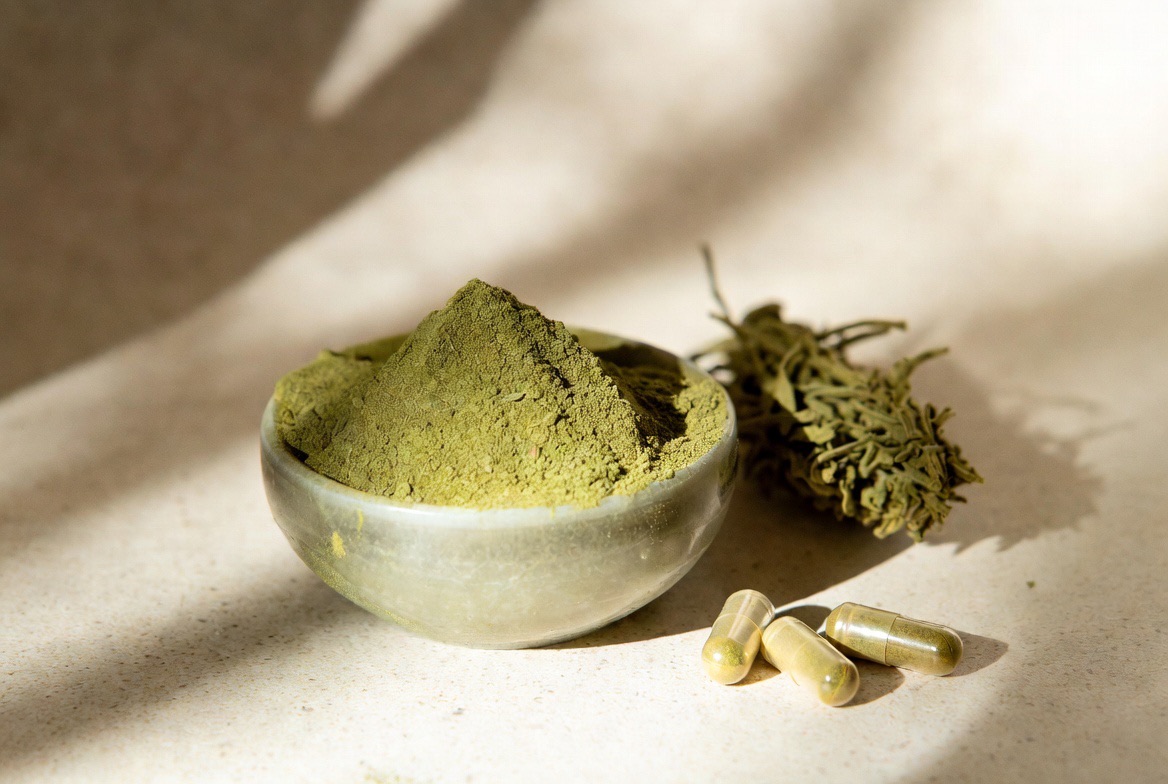
Today it reaches the supplement shelf in two very different forms. One is raw dried plant material or loosely standardized powder. The other is Zembrin, a patented extract standardized to a defined alkaloid profile and dosed at 25 mg in nearly every published trial. This distinction is the single most important practical fact in this article: essentially all of the human data is on Zembrin, not on the generic powder, and the two are not interchangeable. A standardized extract studied at a fixed dose is a known quantity; a bag of unstandardized kanna is a guess.7
The mechanism: two levers at once
Here is where kanna earns the attention. Its activity is carried by a group of mesembrine-type alkaloids — mesembrine, mesembrenone, and relatives. What makes them interesting is that they pull two signals at the same time, and both are biologically plausible routes to a calmer, brighter mood.
The first signal is serotonin. Mesembrine is a potent serotonin-reuptake inhibitor — an SRI, the same broad class of action that prescription SSRIs (selective serotonin reuptake inhibitors) use to keep more serotonin available in the gaps between neurons. In binding assays, mesembrine blocks the serotonin transporter at very low concentrations.1 That is a recognizably antidepressant-style lever, and it is why kanna gets compared to pharmaceutical mood drugs in the first place.
The second signal is the more unusual one. Mesembrenone also inhibits phosphodiesterase-4 (PDE4), an enzyme that breaks down a cellular messenger involved in mood, memory, and inflammation. PDE4 inhibition is a target the pharmaceutical industry has chased deliberately for depression and cognition. Having a single plant extract that nudges both the serotonin lever and the PDE4 lever is genuinely uncommon, and it is the reason kanna’s mechanism sits a clear notch above the “plausible hand-waving” that passes for mechanism in most of the mood-supplement aisle.17
One honest complication: the “clean dual SRI plus PDE4” story comes mostly from a standardized, balanced-alkaloid extract. A separate study of a high-mesembrine extract found it behaved more like a broader monoamine-releasing agent than a tidy, selective serotonin-reuptake blocker.5 In plain terms: the exact signal kanna pulls depends on which alkaloids dominate the product in your hand, which is one more reason standardization is not a marketing nicety here — it is the difference between a characterized compound and an unknown one.
The interesting thing isn’t that a succulent might calm you down. It’s that this one appears to pull two recognized, drug-grade levers at once — and that someone then put it in a scanner to watch it happen.
The human evidence — small but real
The headline finding, and the one most worth understanding, is a brain-imaging study. Terburg and colleagues, publishing in Neuropsychopharmacology in 2013, gave 16 healthy adults a single 25 mg dose of standardized kanna or placebo in a double-blind, crossover design and scanned their brains with functional MRI while showing them fearful faces. A single dose reduced reactivity in the amygdala — the brain’s threat-detection hub — and loosened the coupling between the amygdala and the hypothalamus, the relay that fires the body’s stress response.2
That is a striking result, because it is a direct, objective measurement of the calming signal rather than a self-report questionnaire. But hold the enthusiasm in proportion: it is sixteen people, a single dose, and an acute brain-activity readout — not a clinical outcome in anyone with an anxiety disorder. It shows the mechanism reaches the human brain in the expected direction. It does not show that kanna treats anxiety.
The behavioral anxiety data is thinner and more mixed. Reay and colleagues (2020) ran an experimental-stress study in 20 healthy volunteers across two experiments. The first showed no effect; the second found subjective anxiety significantly lower in the kanna group before a stress task, with a signal on heart rate. The authors’ own framing was appropriately cautious — they called it the “first tentative behavioral evidence” for an anxiolytic effect.6 Tentative is the right word.
On cognition, Chiu and colleagues (2014) ran a small randomized, placebo-controlled crossover trial in 21 cognitively healthy adults taking 25 mg daily for three weeks. Kanna significantly improved two specific domains — cognitive set flexibility and executive function — while notably not moving the overall composite cognitive score or a depression rating scale.4 A real but narrow signal, in a very small sample.
The safety backbone comes from Nell and colleagues (2013), a three-month randomized, double-blind, placebo-controlled trial in 37 healthy adults at 8 mg and 25 mg daily. Standardized kanna was well tolerated over the study window, with no clinically meaningful adverse pattern at these doses.3 Useful — but “well tolerated in 37 healthy adults for three months” is a long way from a characterized long-term safety profile.
brain-imaging study
Terburg 2013 — single dose
used in nearly every trial
Zembrin, not raw powder
depression
healthy volunteers only
The trial-quality caveats
Now the part the supplement copy leaves out. The kanna evidence base has a consistent set of limitations, and they all push in the direction of caution.
The trials are tiny. Sixteen, twenty, twenty-one, thirty-seven. These are proof-of-concept and safety-signal sample sizes, adequate to detect a large acute effect but nowhere near enough to characterize who responds, how durable the effect is, or how it performs against an active comparator over months.
They are concentrated on one proprietary extract, with industry links. Almost the entire human literature is on Zembrin, and several of the key studies were funded by, or co-authored with, people connected to the extract’s development. That is common in botanical research and is a reason for caution rather than dismissal — but it means independent replication by unaffiliated groups is exactly what is missing, and it is thin.7
They are mostly in healthy volunteers. The studies enrolled healthy adults, not people with diagnosed anxiety or depression. A signal that calms a healthy brain’s acute threat response is suggestive, but it does not transfer automatically to a clinical population, where the bar — and the placebo response — is much higher.
Where it fits: a tiered view
We don’t hand out prescriptive protocols here, but it helps to place kanna honestly on a spectrum of how settled the evidence is and who it is — and isn’t — for. If anxiety is the actual target, it is worth seeing how kanna stacks against better-trodden options like ashwagandha, L-theanine, or the more heavily trialed kava.
The clearest case for kanna is a healthy adult interested in occasional, acute stress or situational tension, using a standardized extract at the studied 25 mg, ideally cleared with a clinician. This is the population and the dose the trials actually studied, and the acute calming signal is real even if it is early.
The cognition and mood signals are promising but rest on a single small trial each, in healthy people. Treat any trial of kanna here as an experiment on yourself, not an evidence-backed protocol — and only with a standardized product whose alkaloid content you can verify.
Kanna has not been tested in diagnosed depression or clinical anxiety, and there is no trial supporting it as a treatment for either. Using it to taper, replace, or layer onto a prescribed antidepressant is the weakest-supported and highest-risk use of all — and because of the serotonergic overlap, it is the one to refuse outright without a prescriber in the loop.
Grey areas and the SSRI problem
The serotonergic interaction is the headline risk. The same serotonin-reuptake activity that makes kanna interesting is exactly why it cannot be casually layered onto a serotonergic drug. SSRIs, SNRIs, MAOIs, certain migraine and pain medications, and other serotonergic agents already push serotonin signaling; adding a second serotonergic compound raises the theoretical risk of serotonin syndrome — a potentially serious state of serotonergic overload. The 2022 review flags exactly this drug-interaction concern as the most pressing open safety question.7 If you take any serotonergic medication, kanna is a conversation for your prescriber, full stop.
Mood is a weaker claim than the marketing implies. Kanna is sold heavily as a mood-lifter, but the actual data does not support a clean “treats low mood” claim: the cognition trial that measured a depression scale found no effect on it, and there is no trial in diagnosed depression at all.4 The plausible serotonergic mechanism is real; the human mood outcomes to back it up are not yet there.
Product quality is the silent variable. Because the signal a kanna product pulls depends on its alkaloid balance, an unstandardized powder is a coin flip on whether you are getting the characterized compound the trials used — or a high-mesembrine extract that behaves differently.5 The only version of this evidence that transfers to you is a genuinely standardized extract with verifiable alkaloid content.
What we don’t know yet
Does it work in people who actually have anxiety? Every anxiety signal so far is in healthy volunteers or an acute brain-imaging readout. There is no published trial in a diagnosed anxiety-disorder population, which is the population that matters most.
Does the effect last? The longest controlled exposure is three months, and that was a safety study, not an efficacy one. Durability, tolerance, and any rebound on stopping are simply uncharacterized.
What is the real long-term safety picture? Short trials in small healthy samples cannot rule out rarer or slower harms, and the interaction profile with common medications is under-studied. Pregnancy, breastfeeding, and use alongside other CNS-active drugs have essentially no data.
Will anyone outside the extract’s makers replicate it? The most valuable next step is a larger, independent, multi-site trial in a clinical population, run by groups with no commercial stake. Until that exists, “promising” is the ceiling.
What this article is not saying
This is not “kanna doesn’t do anything.” For a botanical, it has an unusually well-characterized dual mechanism and a brain-imaging study showing that mechanism reaching the human threat circuit. Dismissing it outright would be as wrong as overselling it.
This is not “kanna is a natural antidepressant, so use it for low mood.” The trials are tiny, mostly industry-linked, run in healthy volunteers, and absent entirely in diagnosed depression. The serotonergic mechanism is interesting; it is not a treatment claim.
And this is emphatically not a green light to combine kanna with a prescribed serotonergic medication, or to swap one out for it. That is the single use where “interesting mechanism” turns into “real risk,” and it belongs to a clinician, not a supplement label.
References
- Harvey AL, Young LC, Viljoen AM, Gericke NP. Pharmacological actions of the South African medicinal and functional food plant Sceletium tortuosum and its principal alkaloids. J Ethnopharmacol. 2011;137(3):1124-1129. DOI: 10.1016/j.jep.2011.07.035. PMID: 21798331.
- Terburg D, Syal S, Rosenberger LA, et al. Acute effects of Sceletium tortuosum (Zembrin), a dual 5-HT reuptake and PDE4 inhibitor, in the human amygdala and its connection to the hypothalamus. Neuropsychopharmacology. 2013;38(13):2708-2716. DOI: 10.1038/npp.2013.183. PMID: 23903032.
- Nell H, Siebert M, Chellan P, Gericke N. A randomized, double-blind, parallel-group, placebo-controlled trial of Extract Sceletium tortuosum (Zembrin) in healthy adults. J Altern Complement Med. 2013;19(11):898-904. DOI: 10.1089/acm.2012.0185. PMID: 23441963.
- Chiu S, Gericke N, Farina-Woodbury M, et al. Proof-of-concept randomized controlled study of cognition effects of the proprietary extract Sceletium tortuosum (Zembrin) targeting phosphodiesterase-4 in cognitively healthy subjects: implications for Alzheimer’s dementia. Evid Based Complement Alternat Med. 2014;2014:682014. DOI: 10.1155/2014/682014. PMID: 25389443.
- Coetzee DD, López V, Smith C. High-mesembrine Sceletium extract (Trimesemine) is a monoamine releasing agent, rather than only a selective serotonin reuptake inhibitor. J Ethnopharmacol. 2016;177:111-116. DOI: 10.1016/j.jep.2015.11.034. PMID: 26615766.
- Reay J, Wetherell MA, Morton E, Lillis J, Badmaev V. Sceletium tortuosum (Zembrin) ameliorates experimentally induced anxiety in healthy volunteers. Hum Psychopharmacol. 2020;35(6):e2753. DOI: 10.1002/hup.2753. PMID: 32761980.
- Olatunji TL, Siebert F, Adetunji AE, et al. Sceletium tortuosum: a review on its phytochemistry, pharmacokinetics, biological, pre-clinical and clinical activities. J Ethnopharmacol. 2022;287:114711. DOI: 10.1016/j.jep.2021.114711. PMID: 34758918.