Saffron for depression and mood: what the clinical evidence actually shows
Most “mood support” herbs collapse the moment you ask for a randomized trial. Saffron is the conspicuous exception. The world’s most expensive spice has, over two decades, been run head-to-head against placebo, against fluoxetine, and against imipramine in double-blind trials — and it keeps holding its own. Meta-analyses report large effects versus placebo and statistical dead heats versus standard antidepressants for mild-to-moderate depression. That is a genuinely surprising result for a kitchen spice, and it deserves to be taken seriously. It also deserves the caveats said out loud: the trials are mostly small, many run out of a single region, some are industry-linked, the supplement aisle is riddled with adulteration, and none of this makes saffron a treatment for severe depression. Here is the honest read.
How this article was built: Primary sources: the Hausenblas et al. 2013 meta-analysis in the Journal of Integrative Medicine, the Tóth et al. 2019 meta-analysis in Planta Medica, the Marx et al. 2019 depression-and-anxiety meta-analysis in Nutrition Reviews, the Shafiee et al. 2025 saffron-versus-SSRI meta-analysis in Nutrition Reviews, and the original Akhondzadeh, Noorbala and Moshiri randomized trials comparing saffron with imipramine, fluoxetine, and placebo — all retrieved and verified through PubMed and the Consensus research database.
- For a kitchen spice, the evidence is unusually strong. Across multiple meta-analyses of randomized trials, standardized saffron (about 30 mg/day) beats placebo for mild-to-moderate depression with large reported effect sizes — and runs roughly even with fluoxetine and imipramine in head-to-head trials.5711
- The caveats are real and matter. Most trials are small (often ~40 people), many came out of a single region (Iran), some are industry-linked, and at least one large review found clear signs of publication bias. Treat “as good as an SSRI” as “non-inferior in small short trials,” not as a settled equivalence.9
- It is for mild-to-moderate, not severe. Saffron is not a treatment for severe, treatment-resistant, bipolar, or suicidal depression, and it is not a reason to stop a prescribed antidepressant. The serotonergic overlap means combining it with an SSRI is a clinician conversation, not a DIY stack.
- What you buy is the weak link. Saffron is among the most adulterated supplements on the market; analytical surveys find a majority of products mislabel their content. If you can’t verify a standardized extract with stated crocin/safranal levels, you may be buying dyed marigold.12
- What saffron actually is
- The mechanism: crocin, safranal, and serotonin
- The evidence vs placebo
- The evidence vs SSRIs and imipramine
- The trial-quality caveats
- Anxiety, PMS, and other signals
- Dose and the standardization problem
- Where it fits: a tiered view
- Grey areas and open questions
- What this article is not saying
- References
What saffron actually is
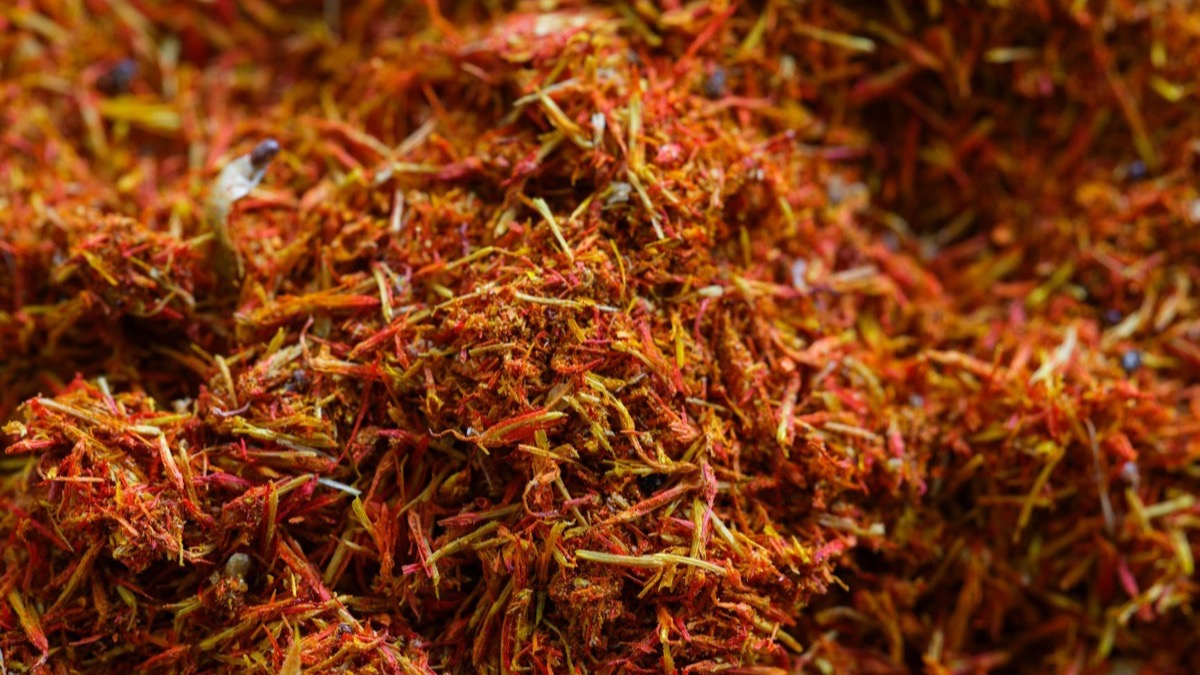
Saffron is the dried red stigma of the Crocus sativus flower — the threads themselves, hand-harvested, with roughly 150 flowers needed for a single gram. That scarcity is why it is the most expensive spice on earth, and it turns out to be the single most important fact about its use as a supplement, because expense breeds fraud. We will come back to that.
Its use for low mood is not a modern marketing invention. Saffron appears in Persian traditional medicine as a remedy for melancholy, and that history is what prompted the first formal trials out of Tehran in the early 2000s.12 What separates saffron from the rest of the “mood support” shelf is that someone then did the unglamorous work of putting that tradition through double-blind, placebo- and drug-controlled trials — and the results did not embarrass the hypothesis.
The mechanism: crocin, safranal, and serotonin
Saffron’s biology is carried by a handful of named compounds, and two get the most attention. Crocin is the carotenoid pigment that gives saffron its red-gold color; safranal is the volatile compound behind its aroma. These are the constituents trials try to standardize to, and they are the plausible active fraction.
The leading mechanistic story is serotonergic. Preclinical work suggests saffron’s constituents inhibit the reuptake of serotonin — the same broad lever SSRIs pull — which would explain why it lines up against fluoxetine so consistently in the human data.4 Layered on top is an anti-inflammatory and antioxidant angle: saffron compounds dampen oxidative stress and inflammatory signaling, and because a subset of depression appears to be inflammation-linked, that pathway is biologically attractive.8 Honesty check, though: in the human trials, saffron did not reliably move C-reactive protein, a standard inflammation marker, so the anti-inflammatory mechanism is more “plausible and partial” than “demonstrated in people.”10
The interesting thing isn’t that an herb might lift mood. It’s that this one appears to pull a recognizably antidepressant lever — serotonin reuptake — and then survived being measured against the drug that pulls the same lever.
The evidence vs placebo
Start with the cleanest question: does saffron beat a sugar pill? The trials say yes, fairly clearly. The foundational placebo trial came from Moshiri and colleagues in 2006: forty outpatients with mild-to-moderate major depression, six weeks, Crocus sativus 30 mg/day versus placebo, and saffron produced a significantly better outcome on the Hamilton Depression Rating Scale (p < 0.001).3 Small, but unambiguous in direction.
The meta-analyses pooled that signal and found it held. Hausenblas and colleagues’ 2013 analysis — notable for being led from outside Iran — reported a large effect size for saffron versus placebo (mean effect size 1.62, p < 0.001) across the placebo-controlled trials, while rating the included studies as high methodological quality on the Jadad scale.5 Tóth and colleagues’ 2019 meta-analysis, pooling nine trials, likewise found saffron significantly more effective than placebo (Hedges’ g = 0.89; 95% CI 0.37–1.41, p = 0.001).7 Marx and colleagues, in the same year, reported a large positive effect on depressive symptoms versus placebo (g = 0.99, p < 0.001), and a similarly large effect when saffron was added on top of an antidepressant (g = 1.23).9
Three independent meta-analyses, three large effect sizes in the same direction. By the standards of the herbal-supplement world, that is about as good as the placebo question gets.
(Hedges’ g)
Tóth 2019 — “large”
(SMD, n.s.)
Shafiee 2025 — a dead heat
most-studied
mild-to-moderate only
The evidence vs SSRIs and imipramine
This is the claim that turns heads, so it needs the most care. The original head-to-head trials are remarkably consistent. Akhondzadeh and colleagues (2004) compared saffron 30 mg/day with the tricyclic imipramine 100 mg/day over six weeks and found saffron similarly effective to imipramine — with fewer anticholinergic side effects like dry mouth and sedation.1 Noorbala and colleagues (2005) compared saffron 30 mg/day with fluoxetine 20 mg/day and again found no significant difference in antidepressant effect.2 A later trial using saffron petal versus fluoxetine reached the same verdict,4 as did a 2014 trial in post–cardiac-stent patients with depression, where saffron and fluoxetine were statistically indistinguishable on the Hamilton scale.6
The meta-analyses confirm the pattern. Hausenblas found a null effect size between saffron and the antidepressant comparison groups (mean ES = −0.15), meaning both reduced symptoms about equally.5 Tóth reported saffron non-inferior to the tested antidepressants (g = −0.25; 95% CI −0.50 to 0.004, p = 0.053).7 Khaksarian’s 2019 review put the saffron-versus-fluoxetine difference at a trivial SMD of 0.11.8 And the most recent and most targeted analysis — Shafiee and colleagues, 2025, pooling eight depression trials — found no significant difference between saffron and SSRIs (SMD = 0.10; 95% CI −0.09 to 0.29), with the added wrinkle that the saffron groups reported fewer adverse events.11
Read that carefully, because the wording matters. “No significant difference” in a set of small, short trials is a statement about failure to detect a gap, not proof of true equivalence — small studies are underpowered to find modest differences. The defensible claim is: at the doses and durations tested, in mild-to-moderate depression, saffron performed in the same ballpark as an SSRI, with a gentler side-effect profile. That is a strong and useful finding. It is not “saffron equals Prozac.”
The trial-quality caveats
Now the part the supplement ads leave out. The saffron literature has a consistent set of limitations, and the meta-analysts themselves flag them.
The trials are small and short. The classic RCTs enrolled around 30–40 people for six to eight weeks. That is enough to detect a large effect but not to characterize durability, relapse, or rarer harms, and it inflates the apparent precision of any single result.
They cluster by region. A large share of the trials — and nearly all the early landmark ones — came from Iranian research groups, several from the same center. Hausenblas explicitly called for trials “conducted by research teams outside of Iran” before firm conclusions,5 and Marx flagged a “lack of regional diversity” as a limiting factor.9 Regional concentration is not an accusation of bad faith; it is a reason to want independent replication, which is starting to arrive but is still thin.
Funding and publication bias. Some trials are linked to saffron producers or extract manufacturers, which is common in supplement research and a reason for caution rather than dismissal. More pointedly, Marx’s meta-analysis found statistical evidence of publication bias via Egger’s test — meaning small negative trials may be missing from the record, which would inflate the pooled effect.9 The true effect is therefore probably real but somewhat smaller than the headline numbers suggest.
Scale inconsistencies. One meta-analysis found saffron significantly reduced depression and anxiety on self-rated scales (the Beck inventories) but not on the clinician-rated Hamilton scales — a discrepancy that should temper certainty about the size of the real-world effect.10 None of this erases the signal. It right-sizes it.
Anxiety, PMS, and other signals
Depression is the best-evidenced use, but it is not the only one with data. Saffron has a real, if thinner, anxiety signal: Marx’s meta-analysis reported a large effect on anxiety symptoms versus placebo (g = 0.95, p < 0.006), and Ghaderi’s analysis found saffron significantly reduced Beck Anxiety Inventory scores.910 The most recent SSRI comparison also found saffron and SSRIs statistically indistinguishable on anxiety outcomes across the (few) trials that measured it.11 The honest framing is “emerging”: promising and directionally consistent, but built on fewer and smaller trials than the depression base, which is why our evidence rating for anxiety sits a notch below the depression rating. If anxiety is your primary target, it is worth seeing how saffron stacks against better-trodden options like kava or ashwagandha.
There are additional scattered signals — for premenstrual symptoms, for SSRI-induced sexual dysfunction (where small placebo-controlled trials found saffron improved arousal and erectile function as an add-on), and for sleep quality, where one meta-analysis found a reduction in Pittsburgh Sleep Quality Index scores.10 These are early and should be read as leads, not conclusions.
Dose and the standardization problem
The dose question is the easy part. Across nearly the entire trial literature, the studied dose is 30 mg/day of a standardized saffron extract, usually split into two doses, over six to eight weeks.37 That consistency is one of the underrated strengths of this evidence base — researchers largely converged on one dose, so the meta-analyses are comparing like with like rather than averaging across a chaotic dose range.
The hard part is what “standardized” means in your hand. Trials use extracts standardized to a defined content of crocin and safranal — the active markers. The retail shelf is a different world. Because real saffron is so valuable, it is one of the most adulterated products in the entire spice and supplement trade: cut with dyed corn silk, marigold, safflower, or simply mislabeled for potency. A 2023 analytical study using combined gas and liquid chromatography to evaluate seventeen saffron-based supplements found discrepancies with the declared content in 65% of cases, plus undeclared additives and non-saffron plant material in some products.12
Sit with that number. It means the most likely reason a saffron supplement “doesn’t work” is not that saffron doesn’t work — it’s that the capsule didn’t contain what the label claimed. The practical implication: the only version of this evidence that transfers to you is a genuinely standardized extract with verifiable crocin/safranal content, ideally one used in published trials. Generic “saffron 30 mg” with no standardization data is a coin flip on whether you’re buying the studied compound at all.
Where it fits: a tiered view
We don’t hand out prescriptive protocols here, but it helps to place saffron honestly on a spectrum of how settled the evidence is and who it is — and isn’t — for.
Best-evidenced — mild-to-moderate low mood, with a clinician in the loop. The strongest case for saffron is an adult with mild-to-moderate depressive symptoms, using a standardized 30 mg/day extract, ideally discussed with a clinician — especially if any prescribed medication is involved.57 This is the population the trials actually studied, and the evidence here is real.
Research-curious — anxiety, PMS, sleep, and add-on use. The anxiety and adjunctive-to-antidepressant signals are promising but thinner, and the add-on case in particular should never be a solo decision because of the serotonergic interaction risk.9 Worth watching; not yet a confident recommendation.
Off the table — severe depression and unsupervised drug-swapping. Saffron has not been tested in, and is not appropriate for, severe, suicidal, bipolar, or treatment-resistant depression — a category where the live research is on psychedelics like psilocybin, not botanicals — and the trials say nothing about using it to taper or replace an existing antidepressant. That is the weakest-supported, highest-risk use of all, and it is the one to refuse outright.
Saffron is a genuinely well-evidenced option for low mood — but it sits inside a much larger toolkit, and the worst move is treating any single compound as the answer to depression. The real question is rarely “saffron: yes or no,” it’s “what actually moves mood for someone in my situation, and how does saffron rank against therapy, exercise, sleep, light, prescribed medication, and the other studied botanicals?” The Manual maps the anxiety-and-mood compounds against each other — what each one’s evidence genuinely supports, the dose and standardization windows, who benefits, who is wasting their money, and which combinations are interaction risks rather than synergies. See the Manual →
Grey areas and open questions
The serotonergic interaction. The same serotonin-reuptake mechanism that makes saffron interesting is also why it can’t be casually layered onto an SSRI, SNRI, MAOI, or other serotonergic drug. Stacking serotonergic agents raises the theoretical risk of excess serotonergic load. Add-on trials exist and were generally well tolerated, but “tolerated in a monitored trial” is not “safe to combine at home.” This belongs to a prescriber.
Pregnancy. High-dose saffron is a traditional and pharmacological uterine stimulant, which is why it is contraindicated in pregnancy. The mood trials excluded pregnant participants, so there is simply no evidence base here — and the mechanism points the wrong way.
Durability and severity ceiling. Almost all trials run six to eight weeks. Whether the benefit holds at six months, whether it prevents relapse, and where exactly the severity ceiling sits are genuinely open questions the current literature can’t answer.
How big is the “real” effect? Given the publication-bias signal and the self-rated-versus-clinician-rated discrepancy, the true average effect is probably smaller than the largest pooled estimates — real, but more modest than “effect size 1.6” implies.910 Larger, independent, multi-region trials are the thing that would settle it.
What this article is not saying
This is not “saffron doesn’t work.” For a botanical, the evidence is unusually good: replicated placebo superiority, repeated head-to-head parity with SSRIs and a tricyclic, a coherent serotonergic mechanism, and a consistent dose. Dismissing saffron outright is as wrong as overselling it.
This is not “saffron is as good as an antidepressant, so switch.” The trials are small, short, regionally concentrated, sometimes industry-linked, and show signs of publication bias; “no detectable difference” is not proven equivalence; and none of this applies to severe depression. It is also not a green light to combine saffron with a prescribed serotonergic drug, or to stop one.
And this is not a treatment plan. Depression is a medical condition that deserves real clinical care. The point of this piece is to tell you what the trials show and where they stop — so that if saffron comes up in a conversation with your clinician, you can have an honest, evidence-anchored version of it, and so you know that the bottle on the shelf may not contain what the trials actually tested.
References
- Akhondzadeh S, Fallah-Pour H, Afkham K, Jamshidi AH, Khalighi-Cigaroudi F. Comparison of Crocus sativus L. and imipramine in the treatment of mild to moderate depression: a pilot double-blind randomized trial. BMC Complement Altern Med. 2004;4:12. DOI: 10.1186/1472-6882-4-12. PMID: 15341662.
- Noorbala AA, Akhondzadeh S, Tahmacebi-Pour N, Jamshidi AH. Hydro-alcoholic extract of Crocus sativus L. versus fluoxetine in the treatment of mild to moderate depression: a double-blind, randomized pilot trial. J Ethnopharmacol. 2005;97(2):281-284. DOI: 10.1016/j.jep.2004.11.004. PMID: 15707766.
- Moshiri E, Basti AA, Noorbala AA, Jamshidi AH, Hesameddin Abbasi S, Akhondzadeh S. Crocus sativus L. (petal) in the treatment of mild-to-moderate depression: a double-blind, randomized and placebo-controlled trial. Phytomedicine. 2006;13(9-10):607-611. DOI: 10.1016/j.phymed.2006.08.006. PMID: 16979327.
- Akhondzadeh Basti A, Moshiri E, Noorbala AA, Jamshidi AH, Abbasi SH, Akhondzadeh S. Comparison of petal of Crocus sativus L. and fluoxetine in the treatment of depressed outpatients: a pilot double-blind randomized trial. Prog Neuropsychopharmacol Biol Psychiatry. 2007;31(2):439-442. DOI: 10.1016/j.pnpbp.2006.11.010. PMID: 17174460.
- Hausenblas HA, Saha D, Dubyak PJ, Anton SD. Saffron (Crocus sativus L.) and major depressive disorder: a meta-analysis of randomized clinical trials. J Integr Med. 2013;11(6):377-383. DOI: 10.3736/jintegrmed2013056. PMID: 24299602.
- Shahmansouri N, Farokhnia M, Abbasi SH, et al. A randomized, double-blind, clinical trial comparing the efficacy and safety of Crocus sativus L. with fluoxetine for improving mild to moderate depression in post percutaneous coronary intervention patients. J Affect Disord. 2014;155:216-222. DOI: 10.1016/j.jad.2013.11.003. PMID: 24289892.
- Tóth B, Hegyi P, Lantos T, et al. The efficacy of saffron in the treatment of mild to moderate depression: a meta-analysis. Planta Med. 2019;85(1):24-31. DOI: 10.1055/a-0660-9565. PMID: 30036891.
- Khaksarian M, Behzadifar M, Behzadifar M, et al. The efficacy of Crocus sativus (Saffron) versus placebo and fluoxetine in treating depression: a systematic review and meta-analysis. Psychol Res Behav Manag. 2019;12:297-305. DOI: 10.2147/PRBM.S199343. PMID: 31118846.
- Marx W, Lane M, Rocks T, et al. Effect of saffron supplementation on symptoms of depression and anxiety: a systematic review and meta-analysis. Nutr Rev. 2019;77(8):557-571. DOI: 10.1093/nutrit/nuz023. PMID: 31135916.
- Ghaderi A, Asbaghi O, Reiner Ž, et al. The effects of saffron (Crocus sativus L.) on mental health parameters and C-reactive protein: a meta-analysis of randomized clinical trials. Complement Ther Med. 2020;48:102250. DOI: 10.1016/j.ctim.2019.102250. PMID: 31987241.
- Shafiee A, Jafarabady K, Seighali N, et al. Effect of saffron versus selective serotonin reuptake inhibitors (SSRIs) in treatment of depression and anxiety: a meta-analysis of randomized controlled trials. Nutr Rev. 2025;83(3):e751-e761. DOI: 10.1093/nutrit/nuae076. PMID: 38913392.
- Mena-García A, Sanz ML, Díez-Municio M, Ruiz-Matute AI. A combined gas and liquid chromatographic approach for quality evaluation of saffron-based food supplements. Foods. 2023;12(22):4071. DOI: 10.3390/foods12224071. PMID: 38002129.