Hyperbaric oxygen and the reverse-aging pitch: what the chamber can and can’t do
A pressurized chamber and 100% oxygen is one of the oldest pieces of established medicine on the longevity shelf — and one of the most oversold. It genuinely heals wounds that won’t close and saves divers from the bends. Then a 2020 Israeli study reported it lengthened telomeres and cleared senescent cells, and the “reverse aging” marketing took off at a sprint the data never authorized. Here is the honest split: where HBOT is real medicine, where it is a genuinely interesting early signal, and where it is hype wearing a lab coat.
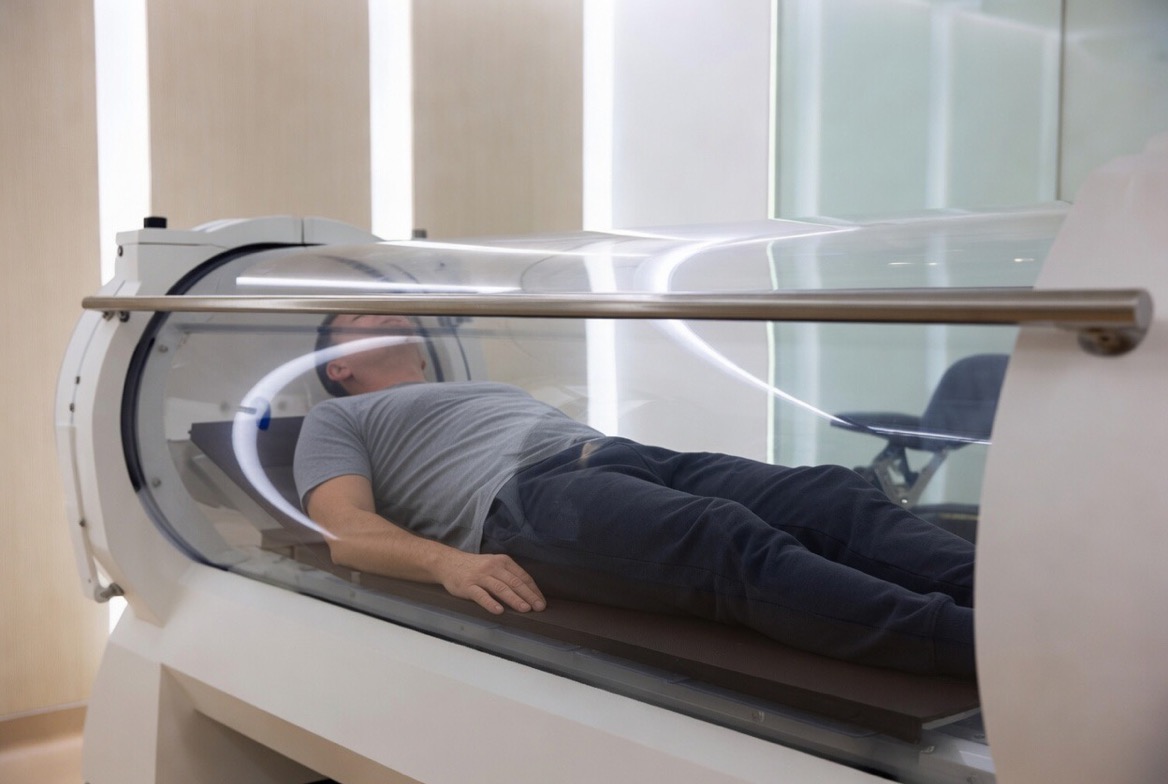
- Two different products share one name. “HBOT” means both established hospital medicine — diabetic wounds, the bends, carbon monoxide, radiation injury — and a viral anti-aging biohack. The first is solid. The second is mostly riding on the first’s reputation.
- The telomere study is real but thin. A 2020 trial reported telomeres lengthening over 20% and senescent cells dropping — but it was 35 people, one group, no control arm, one lab, and nobody independent has reproduced it.
- The cognition signal is the most interesting part. Randomized trials in older adults, chronic stroke, and long COVID show real improvements — but they are small, and almost all trace back to a single Israeli research group.
- The cost and the soft-chamber gap are the catches. A real protocol is 40-plus sessions of an hour-plus each, and the cheap inflatable chambers sold for home use don’t reach the pressure the studies used.
Two products, one name
Here is the thing you have to hold in your head to read hyperbaric oxygen therapy honestly: the same three letters describe two completely different things, and the marketing depends on you blurring them. On one side, HBOT is established, boring, life-saving hospital medicine — it has been used for decades to heal diabetic foot wounds that won’t close, to pull nitrogen bubbles out of injured divers, to displace carbon monoxide after a poisoning, and to repair tissue scarred by radiation. That HBOT works, and the evidence for it is decades deep. On the other side, HBOT is a viral longevity biohack sold with phrases like “reverse your biological age” and a $40,000 home chamber. That HBOT is built on a much, much thinner stack of paper.
The whole game is that the second product borrows the credibility of the first. A clinic that legitimately treats wounds can hang a longevity shingle on the exact same chamber, and the reader assumes the same weight of evidence stands behind both uses. It does not. So this is a hype-check, and I am going to do it fairly — I will give the real medicine full credit, treat the longevity research as the genuinely interesting early signal it is, and name the marketing for what it is where it runs past the data. For the wider shelf of self-experiment longevity tools graded the same way, see the Biohacking hub.
The mechanism: hyperoxia and the hypoxic paradox
This is the mechanism section, so the jargon earns its place here and nowhere else. HBOT does two things at once: it raises ambient pressure to roughly 2–2.5 atmospheres absolute (ATA), and it has you breathe 100% oxygen. Under that pressure, far more oxygen physically dissolves into the blood plasma than hemoglobin alone could ever carry — a state called hyperoxia. That dissolved oxygen can reach tissue that starved blood vessels cannot, which is exactly why it heals wounds: it floods an oxygen-starved injury with the fuel it needs to rebuild.
The more interesting idea — and the one the longevity research leans on — is the hyperoxic-hypoxic paradox. The claim is that the body reads the sharp drop in oxygen between a session and ordinary air as if it were genuine oxygen deprivation, and fires off the same repair programs that real low-oxygen stress triggers: stabilizing hypoxia-inducible factor (HIF), driving angiogenesis (new blood-vessel growth), mobilizing stem cells, and ramping up antioxidant defenses. In other words, the signal HBOT is supposed to pull isn’t just “more oxygen” — it’s tricking the cell into a regenerative response without the damage real hypoxia would cause. It is a genuinely elegant hypothesis. It is also where the inferential leap to “therefore it reverses aging” quietly happens, and that leap is bigger than it looks.
The mechanism is real and elegant. “Therefore it reverses aging” is a leap the mechanism doesn’t earn on its own — that has to come from trials, and the trials are thin.
The real medicine: HBOT’s approved indications
Start where the ground is solid, because it matters that you know this part is not in dispute. The Undersea and Hyperbaric Medical Society maintains a list of indications for which HBOT is an accepted, evidence-backed standard of care, and many of these are reimbursed by insurers precisely because the data holds up7. The headline ones:
- Decompression sickness (“the bends”). This is HBOT’s founding use. Recompression under pressure shrinks and clears the nitrogen bubbles that form when a diver surfaces too fast. It is not optional or alternative — it is the treatment.
- Carbon monoxide poisoning. A landmark double-blind randomized trial found that three hyperbaric oxygen sessions reduced the rate of lingering cognitive problems after acute CO poisoning compared with normal-pressure oxygen5. The role is debated at the margins, but the strongest trial favors it.
- Non-healing diabetic foot wounds. A 2021 systematic review and meta-analysis of controlled trials found HBOT significantly increased the healing rate of diabetic foot ulcers and reduced major complications such as amputation6 — though even here the evidence is not unanimous, and it is reserved for serious, non-healing cases, not routine wounds.
- Delayed radiation tissue injury. For tissue damaged by cancer radiotherapy — jaw bone, bladder, soft tissue — HBOT’s ability to drive new blood-vessel growth into scarred, poorly perfused tissue is a recognized indication.
That is the real medicine, and it is a strong hand. Note what it shares: every one of these is about rescuing tissue that is starved of oxygen or blood supply. That is the lane where the mechanism is least speculative and the evidence is deepest. Keep that frame, because it is exactly what the longevity pitch stretches.
Grading the approved indications STRONG is not an endorsement of the longevity use. It is the opposite — it is the baseline that makes the gap visible. The medicine earned its reputation healing wounds and treating divers. The anti-aging pitch is spending that reputation faster than it’s being earned.
The longevity studies, read honestly
Now the part everyone actually came for — and I’m going to walk it carefully, because the studies are genuinely interesting and genuinely limited, and both halves of that sentence are true at once.
The study that lit the fuse came out of Israel in 2020. Researchers gave 35 healthy older adults a course of 60 daily HBOT sessions and measured telomere length and senescent-cell percentages in isolated blood cells before and after. The result was striking: telomere length in several immune cell types rose by over 20%, with B cells climbing as much as 37%, while the percentage of senescent T cells dropped meaningfully1. Telomeres are the protective caps on chromosomes that shorten with age; senescent cells are worn-out cells that accumulate and drive inflammation. Both moving in the “younger” direction is why the headlines screamed “reverse aging.”
Here is what those headlines left out, and it is the whole ballgame. The study was 35 people. One group. No control or placebo arm — everyone got HBOT, so there is no comparison to anyone who didn’t. The biomarkers were measured in isolated blood cells, not whole-body aging. And it came from a single lab whose founder is closely tied to the commercialization of the protocol. None of that makes the result fake — it is a real, published, peer-reviewed finding and a legitimately provocative one. But a single small uncontrolled study from one interested lab is the start of an evidence trail, not the end of one. The signal it pulls is “worth replicating,” not “proven.”
The cognition research is the more credible cousin, and it’s where I’d actually point a curious reader. Here the same group did run controlled trials:
| Study | Design & size | What it found | The catch |
|---|---|---|---|
| Telomeres / senescence, 20201 | n=35, single-group, no control | Telomeres up >20%; senescent T cells down | No control arm; blood cells only; one lab |
| Cognition in older adults, 20202 | RCT, n=63, controlled | Gains in attention, processing speed; matched brain blood-flow changes | Small; single research group |
| Chronic post-stroke, 20134 | RCT, n=74, crossover | Neurological gains; imaging showed reactivated brain regions | Small; same lab; chronic phase only |
| Long COVID, 20223 | RCT, n=73, sham-controlled | Improved cognition, attention, executive function vs. sham | Small; same group; short follow-up |
Read that table fairly and you get the honest verdict on the longevity side. The cognition work is better than the telomere study — it includes randomized, even sham-controlled designs, which is real rigor. A 2020 RCT in 63 healthy older adults found genuine gains in attention and processing speed, with matching changes in cerebral blood flow2. A 2022 sham-controlled trial in long-COVID patients found cognitive improvement over placebo3. A 2013 trial in chronic stroke patients reported neurological recovery with imaging to back it4. That is a real, repeated signal — EMERGING, not nothing.
But notice the column that never changes: small, and the same lab. Nearly the entire longevity-and-cognition evidence base traces back to one Israeli research center, often with the same senior investigators, who also have commercial stakes in the protocol. That is not an accusation of fraud — it is the single most important caveat in the whole field. Until large, independent groups outside that orbit reproduce these results, the right word is “promising and unreplicated,” not “proven.” If you want the sharper version of how to read a single-source longevity claim, our breakdown of the Bryan Johnson Blueprint protocol walks the same trap from a different angle.
Approved use vs. what the longevity market chases
We don’t write protocols on this site — we write frameworks you take to a clinician. With HBOT that line matters more than usual, because the chamber that’s legitimate medicine in one room is a speculative longevity bet in the next. So here is the map, not a prescription.
Decompression sickness, carbon monoxide poisoning, non-healing diabetic wounds, radiation tissue injury, and the rest of the UHMS-recognized list7. Delivered in medical-grade hard chambers, prescribed and supervised. This is where the chamber has earned its reputation.
Cognition in older adults, chronic post-stroke recovery, long-COVID neurocognitive symptoms234. Promising controlled trials — but small and single-lab. A reasonable thing to watch and discuss with a clinician, not a settled treatment.
“Reverse your biological age,” the telomere pitch, the $40k home-chamber lifestyle sell. Built on one small uncontrolled study1. Genuinely interesting science; nowhere near the certainty the price tag implies.
We won’t tell you to buy a chamber, book a longevity course of 60 sessions, or treat HBOT as a proven anti-aging therapy — the evidence isn’t there, and HBOT carries real risks (ear barotrauma, sinus injury, oxygen toxicity, and rare seizures) that demand medical supervision. If a wound or a diagnosed condition is the reason, that’s a conversation with a physician. If “reverse aging” is the reason, the honest answer is: the science is early, and your money is buying a bet, not a result.
The grey areas: cost, soft chambers, and one lab
Four practical things the longevity sell tends to skip. First, the cost and time are brutal. The studies that show anything used courses of 40 to 60 daily sessions, each running an hour or more. Out of pocket, off-label, that runs into many thousands of dollars and weeks of your calendar. This is not a supplement you try for a month; it is a serious commitment of money and time for an unproven longevity payoff.
Second, and this one’s a genuine bait-and-switch, soft chambers are not the studied product. The portable inflatable chambers marketed for home use typically pressurize to only about 1.3 ATA on room air, while every longevity study cited here used high-pressure hard chambers delivering 100% oxygen at 2 ATA or more1. Whatever you think of the telomere data, it does not transfer to a soft chamber — the dose isn’t the same dose. Buying a soft chamber and expecting the trial results is a category error the sellers are happy to let you make.
Third, the single-lab problem, again, because it’s that central. A whole research program from one center, with commercial ties to the protocol, is how exciting fields start — and also how fields that later don’t replicate looked at the beginning. Independent reproduction is the test HBOT longevity hasn’t passed yet.
Fourth, “reverse aging” is a marketing phrase, not a measured outcome. Two biomarkers in blood cells shifting in one uncontrolled study is not the same as a slower, longer, healthier life — nobody has shown HBOT extends lifespan or healthspan in humans, and the leap from “telomeres lengthened in a blood draw” to “you are biologically younger” is exactly the kind of overclaim that should make you tighten your grip on your wallet. For the same pattern in an injectable form, our read on the NAD+ IV drip covers a longevity biohack sold well past its evidence.
So the verdict, plainly. HBOT is real, valuable, evidence-backed medicine for its approved indications — full stop, no asterisk. The longevity research is the most interesting thing on the speculative end of the longevity shelf, and the cognition trials in particular are worth taking seriously as an early signal. But the “reverse aging” pitch rests on one small, uncontrolled, single-lab study, the protocols are expensive and time-devouring, and the cheap home chambers don’t even deliver the studied dose. If you have a wound or a condition, talk to a doctor about real HBOT. If you’re chasing a younger biological age, know that you’re funding a hypothesis, not buying a proven result. If you’re weighing other heat-and-pressure longevity tools, our read on sauna heat therapy and longevity grades a cheaper neighbor on the same shelf.
What we still don’t know
Three honest gaps. First, nobody independent has replicated the telomere result. The 2020 study1 is provocative, but until a large, controlled trial run by a group with no commercial stake reproduces the telomere and senescence findings, it stays a hypothesis. That replication is the single experiment that would move this from EMERGING toward something stronger — or quietly bury it. Second, there is no human lifespan or healthspan data: every longevity claim rests on short-term biomarkers and cognitive scores, not on anyone living longer or healthier, and the distance between those is enormous. Third, the durability and dose-response are unmapped — we don’t know how long any of the reported gains last after the chamber sessions stop, whether they need endless maintenance courses, or what the minimum effective protocol actually is. None of that makes HBOT fake. It makes the longevity use a real, narrow, early-stage research signal sold as a finished anti-aging product — and that gap is the whole story.
References
- Hachmo Y, Hadanny A, Abu Hamed R, Daniel-Kotovsky M, Catalogna M, Fishlev G, et al. Hyperbaric oxygen therapy increases telomere length and decreases immunosenescence in isolated blood cells: a prospective trial. Aging (Albany NY). 2020;12(22):22445-22456. DOI. (n=35 healthy older adults; single-group, no control arm; 60 daily sessions; telomere length up >20% in several immune cell types, B cells up to ~37%; senescent T cells reduced. The foundational “reverse aging” study — small, uncontrolled, single lab, unreplicated.)
- Hadanny A, Daniel-Kotovsky M, Suzin G, Boussi-Gross R, Catalogna M, Dagan K, et al. Cognitive enhancement of healthy older adults using hyperbaric oxygen: a randomized controlled trial. Aging (Albany NY). 2020;12(13):13740-13761. DOI. (RCT, n=63 healthy adults >64, HBOT vs. control over 3 months; significant gains in global cognition, attention and processing speed, correlated with increased cerebral blood flow on perfusion MRI. Small, single research group.)
- Zilberman-Itskovich S, Catalogna M, Sasson E, Boussi-Gross R, Zang E, Supé M, et al. Hyperbaric oxygen therapy improves neurocognitive functions and symptoms of post-COVID condition: randomized controlled trial. Sci Rep. 2022;12:11252. DOI. (Randomized, sham-controlled, double-blind; n=73 post-COVID patients, 40 sessions HBOT vs. sham; significant group-by-time gains in global cognition, attention and executive function. Real rigor but small and single-group.)
- Efrati S, Fishlev G, Bechor Y, Volkov O, Bergan J, Kliakhandler K, et al. Hyperbaric oxygen induces late neuroplasticity in post stroke patients — randomized, prospective trial. PLoS One. 2013;8(1):e53716. DOI · PMID 23308226. (RCT, n=74 chronic post-stroke patients 6–36 months out; 40 sessions at 2 ATA; significant neurological improvement with SPECT imaging showing reactivated dormant brain regions. Same research orbit; chronic-phase only.)
- Weaver LK, Hopkins RO, Chan KJ, Churchill S, Elliott CG, Clemmer TP, et al. Hyperbaric oxygen for acute carbon monoxide poisoning. N Engl J Med. 2002;347(14):1057-1067. DOI · PMID 12362006. (Double-blind RCT; three HBOT sessions reduced cognitive sequelae after acute CO poisoning vs. normobaric oxygen — the landmark trial behind the approved CO indication.)
- Sharma R, Sharma SK, Mudgal SK, Jelly P, Thakur K. Efficacy of hyperbaric oxygen therapy for diabetic foot ulcer, a systematic review and meta-analysis of controlled clinical trials. Sci Rep. 2021;11:2189. DOI. (Meta-analysis of controlled trials; HBOT significantly increased diabetic-foot-ulcer healing (OR 0.29 for non-healing) and reduced major amputation (RR 0.60). Evidence supports use in serious non-healing cases, not routine wounds.)
- Undersea and Hyperbaric Medical Society. Hyperbaric Oxygen Therapy Indications (14th Edition). UHMS; 2020. (Authoritative list of accepted, evidence-backed HBOT indications: decompression sickness, carbon monoxide poisoning, diabetic and other problem wounds, delayed radiation injury, gas gangrene, necrotizing infections, and others — the defining boundary of established HBOT medicine.)