Bovine colostrum: superfood, or 2026’s most over-promised supplement?
It is the first milk a cow produces after giving birth, it is genuinely loaded with bioactive compounds, and right now it is being sold for everything from “leaky gut” to glowing skin to bulletproof immunity. Most of that is marketing. But not all of it — underneath the cure-all packaging sits a narrow, real evidence base that is worth taking seriously. Here is the honest split between what the human trials actually support, where the claims run miles ahead of the data, and who, if anyone, has a reason to spend the money.
How this article was built: Primary sources: the Marchbank et al. 2011 exercise gut-permeability crossover trial in the American Journal of Physiology — Gastrointestinal and Liver Physiology, the Davison et al. 2016 zinc-carnosine-plus-colostrum permeability trial in the American Journal of Clinical Nutrition, the Jones et al. 2014 upper-respiratory-illness trial in Brain, Behavior, and Immunity, the Brinkworth & Buckley 2003 URTI trial in the European Journal of Nutrition, the Hajihashemi et al. 2024 systematic review in Systematic Reviews, the Canbolat et al. 2024 pediatric review in Nutrients, and the Riaz et al. 2026 composition review in Food Science of Animal Resources — all retrieved and verified through PubMed and the Europe PMC research database.
- The bioactives are real. Colostrum genuinely contains immunoglobulins (IgG, IgA, IgM), lactoferrin, and growth factors including IGF-1 — this part is not marketing, it is well-characterized dairy chemistry.7
- The strongest human data is narrow. The cleanest finding is that colostrum blunts the rise in gut permeability caused by hard exercise — in one crossover trial it cut the exercise-induced increase by about 80%.1 There is also reasonable evidence it lowers the number of infection days, especially in athletes and children.35
- The cure-all framing is hype. “Heals leaky gut,” anti-aging, glowing skin, and bulletproof general immunity in healthy adults are not supported by the human trials. Most studies are small, short, and a good share are industry-funded.5
- Who it’s actually for: hard-training endurance athletes with gut-distress or frequent winter infections have the best case. Dairy-allergic people must avoid it entirely. For the average healthy adult chasing “gut health,” the evidence is thin and the product is expensive.
- What bovine colostrum actually is
- What’s inside it: the bioactives
- The strongest evidence: the athlete gut
- The infection-days finding
- Dose and form: what the trials used
- Where it fits: a tiered view
- Grey areas: hype, IGF-1, and bioavailability
- Common questions
- What this article is not saying
- References
What bovine colostrum actually is
Colostrum is the first milk a mammal produces in the day or two after giving birth, before regular milk comes in. It is biologically different from ordinary milk: thicker, yellower, and far denser in immune and growth compounds, because its entire evolutionary job is to hand a newborn calf a working immune system and a sealed-up gut lining in the first hours of life. A calf is born essentially defenceless — it gets almost no antibodies across the placenta — so colostrum is its single shot at passive immunity. That is the real reason the stuff is loaded with bioactive molecules, and it is the kernel of truth the supplement industry has built an entire category on top of.
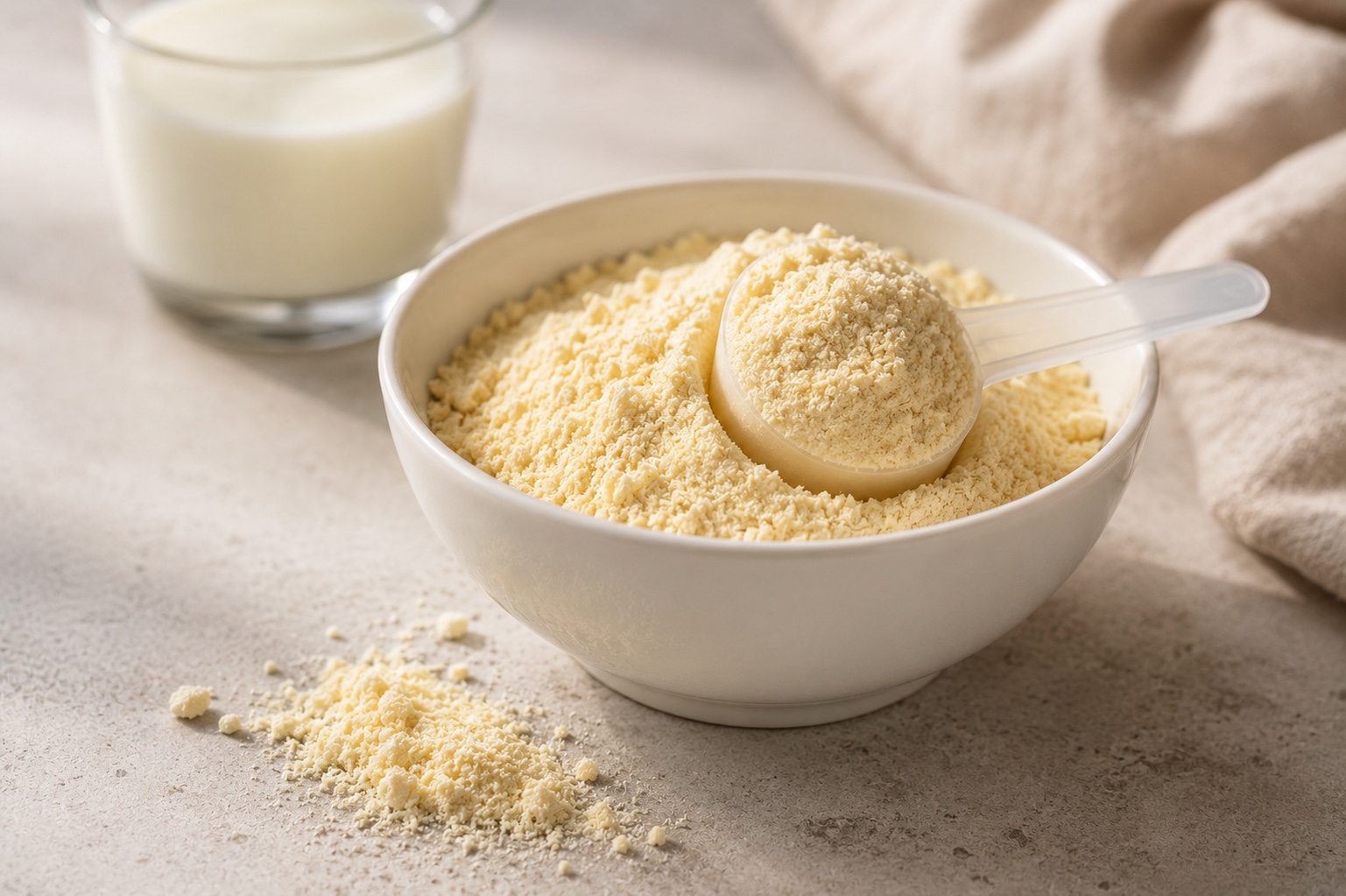
Bovine colostrum — colostrum from cows — is collected from dairy herds, pasteurized, and spray-dried into a powder. It has been used in human nutrition for decades, and you will see it sold as a standalone powder, in capsules, and increasingly blended into protein and “gut health” formulas. In 2026 it is having a genuine moment: it is one of the most-searched supplements of the year, promoted for gut repair, immunity, skin, and athletic recovery. The interesting question is not whether colostrum contains useful compounds — it demonstrably does — but whether eating those compounds, as an adult, does what the label says. For a broader map of how supplement claims hold up under scrutiny, our supplements coverage runs the same evidence-first filter across the category.
What’s inside it: the bioactives
This is where colostrum earns its “superfood” reputation honestly, because the composition is genuinely impressive. Reviews of bovine colostrum consistently describe three families of active compounds.7 The first is immunoglobulins — antibodies, mainly IgG with smaller amounts of IgA and IgM. (An immunoglobulin, or Ig, is simply an antibody protein the immune system uses to recognize and tag pathogens; the letter after it denotes the class.) IgG dominates bovine colostrum, and it is the molecule most often credited with its immune effects.6
The second is lactoferrin, an iron-binding protein with antimicrobial activity — it can starve bacteria of the iron they need and disrupt some viruses and fungi directly. The third is a set of growth factors, most notably insulin-like growth factor 1 (IGF-1) and transforming growth factor beta (TGF-β), which in the newborn calf drive the rapid maturation and sealing of the gut lining.7 Layered on top are bioactive peptides, oligosaccharides that feed beneficial gut bacteria, and various antimicrobial proteins. On paper, it is one of the most bioactive single foods you can name.
The signal colostrum is built to pull is a developmental one: prime the gut barrier and prime passive immunity. The mechanistic logic for an adult is that some of those same molecules — the antibodies, the lactoferrin, the growth factors — might act locally in the gut to reinforce the lining and tilt the local immune environment. That is biologically plausible. But “plausible mechanism” and “proven outcome” are different categories, and the honest work of this article is keeping them apart. Composition tells you what colostrum could do; only the human trials tell you what it does.
Colostrum is real bioactive food, not snake oil. The problem is the gap between an impressive ingredient list and a thin stack of human outcome trials — and that gap is exactly where the marketing lives.
The strongest evidence: the athlete gut
If you want to know what colostrum is genuinely good for, start with hard exercise. Intense, prolonged exertion — think distance running or heavy training in the heat — transiently shunts blood away from the gut and measurably increases intestinal permeability: the gut lining loosens and lets through molecules it normally wouldn’t. This is the closest thing to a real, measurable version of “leaky gut,” and it is the outcome where colostrum has its cleanest data.
The anchor study is Marchbank and colleagues’ 2011 trial. Twelve volunteers completed a double-blind, placebo-controlled crossover protocol with two weeks of bovine colostrum. In the placebo condition, heavy exercise raised gut permeability about 2.5-fold; colostrum truncated that rise by roughly 80%.1 In parallel laboratory work the same study found colostrum increased heat-shock protein 70 (a cellular stress-protection protein) and cut temperature-induced gut-cell death by about 60% — a coherent mechanism for the barrier-protecting effect.1
A 2016 follow-up from an overlapping research group tested colostrum against zinc carnosine, alone and together. Heavy exercise tripled gut permeability without treatment; the combination of colostrum plus zinc carnosine cut that increase by about 70% after two weeks, and the two ingredients appeared to add to each other.2 Two independent-ish trials, same direction, with a plausible mechanism behind them — that is why the gut-permeability claim earns a MODERATE grade rather than EMERGING.
Now the honesty. Both trials are small — twelve and eight completers respectively — and they share authors and a measurement approach, so this is not the same as two fully independent labs converging. The effect is also specific: it is about blunting an exercise-induced spike in permeability in athletes, not about “sealing a leaky gut” in a sedentary adult with bloating. That distinction matters, and the marketing erases it constantly.
induced permeability rise
Marchbank 2011, N=12
episodes vs placebo
20 g/day, 12 weeks
less diarrhea frequency
duration mostly unchanged
The infection-days finding
The second-strongest claim is immune: that colostrum lowers the number of days you spend sick, particularly with upper-respiratory infections. Here the evidence is broader but messier. In a 12-week trial in 53 active men, 20 grams of colostrum daily produced a significantly lower proportion of upper-respiratory-illness days and fewer illness episodes than placebo, alongside a measurable effect on the bacterial load in saliva.3 An earlier, larger trial in 174 adult men found that 60 grams daily for eight weeks cut the share of men reporting upper-respiratory symptoms from 48% on the whey control to 32% — though, tellingly, it did not shorten how long symptoms lasted once they started.4
That last detail is the pattern across the literature: colostrum seems better at reducing the frequency of infection than its duration. A 2024 systematic review of colostrum across gastrointestinal conditions found that among 20 interventional arms looking at diarrhea, frequency dropped with colostrum in 15 of them — but most studies reported no change in how long the diarrhea lasted, and the authors explicitly called the overall evidence limited and mixed, calling for more rigorous trials.5 The most clinically meaningful infection data sits in children and infants, where reviews describe colostrum’s immunoglobulins binding pathogens in the gut and supporting immune development — an application that makes mechanistic sense and has some supportive data, though it is a different population from the wellness-shopper buying a tub of powder.6
Add it up and the infection claim lands at EMERGING: a real, repeated signal toward fewer sick days, undercut by small samples, inconsistent dosing, mixed duration effects, and a candid “evidence is limited” verdict from the people who pooled it. Promising. Not settled.
Dose and form: what the trials used
We don’t hand out prescriptive doses, but it is worth stating plainly what the studies administered, because it reveals an awkward truth about the supplement aisle. The gut-permeability trials used colostrum preparations standardized in the lab; the infection trials used 20 grams a day in active men3 and as much as 60 grams a day in the larger URTI study.4 Those are substantial amounts — well above the gram-or-two serving many retail products suggest, and a real cost consideration given colostrum’s price.
Form matters too, and it is poorly regulated. Immunoglobulin content varies widely between brands depending on the source herd, the collection window, and how gently the colostrum was processed — heat-heavy pasteurization can denature the very antibodies you are paying for.7 Two tubs labelled “bovine colostrum” are not necessarily delivering the same active dose, and the label rarely tells you the IgG concentration. If you are going to spend the money, the IgG percentage — not just the gram weight — is the number that matters. For where colostrum sits alongside other gut-and-immune supplements, our supplements reference tracks doses and evidence side by side.
Where it fits: a tiered view
It helps to place colostrum honestly on a spectrum of who has a real reason to use it.
Foundational — fix the inputs first. No powder out-performs the basics of gut and immune health: adequate protein and fiber, enough sleep, managing training load, and not getting sick from the obvious things. Colostrum is not a substitute for any of that, and if your diet and recovery are a mess, that is the higher-yield lever every time.
Research-curious — the targeted trial-of-one. The clearest real-world case is a hard-training endurance athlete who gets exercise-related gut distress, or who catches every winter bug. That is the population the best trials actually studied, the mechanism is coherent, and colostrum is well tolerated.13 Expect a meaningful-but-modest edge on gut symptoms and sick-day frequency — not a transformation — and judge it over weeks, with a product that discloses its IgG content.
Experimental — colostrum as a general gut-and-immunity cure-all. Buying it as a healthy adult to “heal leaky gut,” reverse aging, fix your skin, or armor a normal immune system is the weakest-supported use. There is no robust human trial base for those outcomes in healthy people, the studied populations are narrow, and you would be paying a premium for a hopeful extrapolation.5
Colostrum is a real, well-tolerated bioactive with a genuinely narrow evidence base — and the worst mistake is treating any single supplement as the fix for “gut health.” The right question is rarely “colostrum: yes or no,” it’s “what actually moves my gut and immune resilience, and where does colostrum rank against fiber, fermented foods, sleep, and training load?” The Manual maps the gut-and-immune supplements against each other — what each one’s evidence genuinely supports, the dose and form that matter, who benefits and who is wasting money, and how to stack them without fooling yourself. See the Manual →
Grey areas: hype, IGF-1, and bioavailability
The cure-all problem. The single biggest gap between colostrum’s reputation and its evidence is the leap from “truncates an exercise-induced permeability spike in athletes” to “heals leaky gut and fixes your immune system.” The systematic review that pooled the gastrointestinal data called the evidence limited and mixed in plain language.5 The anti-aging, skin-glow, and general-immunity-for-healthy-adults claims are weaker still — they ride on composition and mechanism, not on outcome trials in healthy people. That is why those claims sit at HYPE and WEAK on our Evidence Radar, even though the underlying product is legitimate.
The bioavailability question. Here is the inconvenient mechanistic wrinkle: immunoglobulins and growth factors are proteins, and the adult digestive tract is built to break proteins down. A meaningful fraction of the IgG and IGF-1 you swallow is likely digested before it can act systemically. This is exactly why the most defensible effects are local — in the gut lining itself, where the molecules can act before being fully broken down — and why claims of colostrum boosting whole-body IGF-1 or circulating antibody levels in adults deserve skepticism. The barrier-protective and gut-immune effects are the ones that survive this objection; the systemic ones largely don’t.
The IGF-1 caveat. The same growth factor that makes colostrum interesting also warrants caution. IGF-1 signaling is implicated in the growth of some hormone-sensitive cancers, so although dietary colostrum’s systemic IGF-1 contribution is probably small, anyone with a personal or strong family history of those cancers — and anyone pregnant — should treat colostrum as a clinician conversation, not a casual buy.
The dairy and quality caveats. Colostrum is a milk product. People with a true cow’s-milk allergy must avoid it entirely, and the lactose-intolerant may react to it. And because immunoglobulin content is unregulated and varies with sourcing and processing, product quality is genuinely uneven — a real risk of paying superfood prices for a denatured, low-IgG powder.7
The funding tilt. As with much of the supplement literature, a meaningful share of colostrum trials are small and carry industry involvement, and several of the strongest gut studies come from overlapping research groups. None of that makes the results wrong — small and industry-linked is not the same as fraudulent — but it does mean independent, larger replication is the missing ingredient, and the appropriate posture is interested skepticism, not conviction.5
Common questions
Does bovine colostrum cure leaky gut? No. The honest version is narrower: in athletes, it blunts the temporary rise in gut permeability caused by hard exercise.1 “Leaky gut” as a standalone diagnosis driving fatigue and chronic symptoms in otherwise healthy adults is not an established condition, and colostrum is not a validated treatment for it.
Will it stop me getting sick? It may reduce how often you get upper-respiratory or GI infections, especially if you train hard, but the trials generally show it doesn’t shorten an infection once it has started.45 Think fewer episodes, not a force field.
Is it safe to take every day? For most people without a dairy allergy it is well tolerated in trials lasting weeks to a few months. Long-term daily-use safety data specifically as a supplement is thin, and the IGF-1 and dairy caveats above apply.
Is it worth the money? For a hard-training athlete with gut or frequent-infection problems, plausibly. For the average healthy adult buying it for general “gut health” or skin, the evidence doesn’t justify the premium — basic diet, fiber, and sleep will do more for less.
What this article is not saying
This is not “colostrum is a scam.” It is a genuinely bioactive food, the athlete gut-permeability data are clean and mechanistically coherent, and the reduced-infection-frequency signal is real if modest. For the right person — a hard-training athlete with gut distress or frequent infections — it is a defensible, well-tolerated choice. Dismissing it outright is as wrong as overselling it.
This is not “colostrum will fix your gut and immune system.” The cure-all framing — leaky-gut healing, anti-aging, glowing skin, bulletproof immunity for healthy adults — runs far ahead of a small, often industry-linked evidence base, and a chunk of the most marketed compounds are probably digested before they can act systemically. A narrow, real benefit in specific people is exactly what the evidence supports, and exactly what the packaging inflates into everything.
And this is not a dosing prescription or a green light for everyone. If you have a dairy allergy, it is off the table; if you are pregnant or have a hormone-sensitive cancer history, it is a clinician conversation; and if you buy it, the IgG content on the label matters more than the brand on the tub. The point of this piece is to tell you what the trials show and where they stop, so your expectations — and your spending — can be honest ones.
References
- Marchbank T, Davison G, Oakes JR, Ghatei MA, Patterson M, Moyer MP, Playford RJ. The nutriceutical bovine colostrum truncates the increase in gut permeability caused by heavy exercise in athletes. Am J Physiol Gastrointest Liver Physiol. 2011;300(3):G477-84. DOI: 10.1152/ajpgi.00281.2010. PMID 21148400.
- Davison G, Marchbank T, March DS, Thatcher R, Playford RJ. Zinc carnosine works with bovine colostrum in truncating heavy exercise-induced increase in gut permeability in healthy volunteers. Am J Clin Nutr. 2016;104(2):526-36. DOI: 10.3945/ajcn.116.134403. PMID 27357095.
- Jones AW, Cameron SJS, Thatcher R, Beecroft MS, Mur LAJ, Davison G. Effects of bovine colostrum supplementation on upper respiratory illness in active males. Brain Behav Immun. 2014;39:194-203. DOI: 10.1016/j.bbi.2013.10.032. PMID 24200515.
- Brinkworth GD, Buckley JD. Concentrated bovine colostrum protein supplementation reduces the incidence of self-reported symptoms of upper respiratory tract infection in adult males. Eur J Nutr. 2003;42(4):228-32. DOI: 10.1007/s00394-003-0410-x. PMID 12923655.
- Hajihashemi P, Haghighatdoost F, Kassaian N, Rahim Khorasani M, Hoveida L, Nili H, Tamizifar B, Adibi P. Therapeutic effects of bovine colostrum applications on gastrointestinal diseases: a systematic review. Syst Rev. 2024;13(1):76. DOI: 10.1186/s13643-024-02489-1. PMID 38409162.
- Canbolat AA, Lombardo M, Mondragon ADC, Miranda López JM, Bechelany M, Karav S. Bovine colostrum in pediatric nutrition and health. Nutrients. 2024;16(24):4305. DOI: 10.3390/nu16244305. PMID 39770926.
- Riaz S, Imran A, Rasheed M, Amjad A, Shankar A, Chauhan G, Basharat Z, Islam F, Naeem U, Ndagire CT. Health benefits and value addition of bovine colostrum: a comprehensive review of its nutritional and functional potential. Food Sci Anim Resour. 2026;46(1):55. DOI: 10.1007/s44463-026-00057-w. PMID 41925999.