Sea moss: superfood or just hype? The honest read
Sea moss exploded on social media as a near-magical cure-all, anchored by one sticky claim: that it delivers “92 of the 102 minerals your body needs.” That number is fabricated — the human body does not need 102 minerals, and sea moss does not supply meaningful amounts of most of them. Strip the myth away and what remains is a perfectly real, perfectly ordinary edible red seaweed: some fiber, some iodine, a few trace minerals, and a handful of plausible-but-untested compounds. The trouble is that “ordinary edible seaweed” comes with two genuine risks the hype skips entirely — wildly variable iodine that can harm the thyroid, and heavy metals it pulls from the water. Here is the dietitian’s read on what sea moss actually is, what the evidence does and doesn’t support, and who should be careful.
How this article was built: Primary sources: the Teas et al. 2004 seaweed iodine-variability analysis in Thyroid, the Farebrother et al. 2019 excess-iodine review in the Annals of the New York Academy of Sciences, the Crawford et al. 2010 seaweed iodine-toxicity case report in the Medical Journal of Australia, the Khan et al. 2015 seaweed arsenic-speciation study in Food Chemistry, the EFSA 2023 seaweed heavy-metal and iodine exposure assessment in the EFSA Journal, the Čmíková et al. 2024 Chondrus crispus composition study in Life, and two carrageenan reviews (Guo et al. 2023 in Carbohydrate Polymers; Tahiri et al. 2023 in Critical Reviews in Toxicology) — all retrieved and verified through PubMed.
- The famous “92 of 102 minerals” claim is a myth. The body doesn’t need 102 minerals, and sea moss doesn’t deliver meaningful amounts of most — it’s a marketing line, not a measurement.
- What’s actually real: sea moss is an edible red seaweed (Chondrus crispus and Gracilaria) with some fiber, iodine, trace minerals, and antioxidant compounds.6 A fine whole food — not a superfood, and with no human trials behind its marketed health claims.
- The genuine risks the hype skips: iodine in seaweed is wildly variable and can hit harmful levels that cause thyroid dysfunction,13 and seaweed bioaccumulates arsenic, cadmium, and lead from the water it grows in.45
- Who should be careful: anyone with a thyroid condition or on thyroid medication, anyone pregnant, and anyone using unregulated “sea moss gel” without a tested source. Moderation, not megadosing.
The “92 minerals” myth, debunked
Start with the claim that built the trend, because almost everything else is downstream of it. You have seen it: sea moss contains “92 of the 102 minerals your body needs.” It is repeated so confidently, so often, that it reads like settled nutrition science. It is not. It is a number with no scientific basis, and it falls apart the moment you press on it.
First, the premise is wrong. The human body does not “need” 102 minerals. Nutrition science recognizes a much shorter list of essential minerals — on the order of roughly 16 that have established dietary requirements (think calcium, iron, magnesium, zinc, iodine, selenium, potassium, and a handful of others). The figure of “102 minerals” appears to be a loose misreading of the number of chemical elements, not a list of nutrients the body requires. You cannot supply 92 of 102 needed minerals when the body does not need anything close to 102 in the first place.
Second, even where sea moss does contain a given element, it usually contains a trace — a few micrograms in a typical serving — not a nutritionally meaningful dose. Compositional analyses of Chondrus crispus confirm it carries calcium, iron, and some other minerals, and in fact one 2024 analysis found it had the highest calcium and iron of the three seaweeds it tested.6 But “present” and “present in an amount that matters for your day’s requirement” are very different things, and the hype trades on collapsing that distinction.
State the pattern plainly: the “92 minerals” line is a viral marketing hook that took on the appearance of fact through sheer repetition. It is the central myth of the sea moss trend, and once it goes, the “cure-all” framing built on top of it goes with it.
Sea moss isn’t fake. The “92 minerals” claim attached to it is. Separate the seaweed from the slogan and you get a much more honest — and much smaller — story.
What sea moss actually is
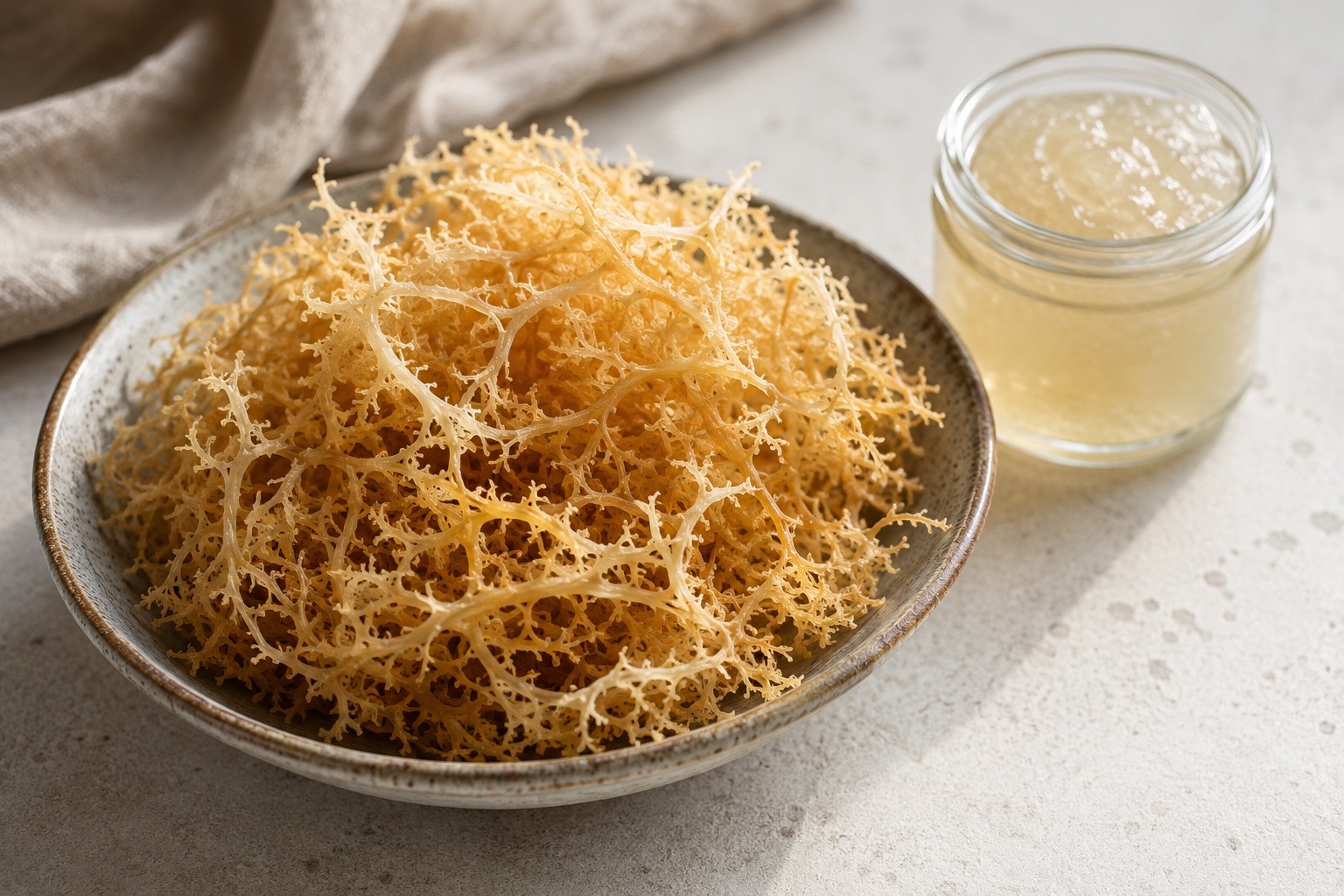
Sea moss is a common name for a few species of edible red seaweed — most often Chondrus crispus (true Irish moss, harvested in the cold North Atlantic) and various Gracilaria species (warmer-water seaweeds often sold under the “sea moss” label, especially the golden Caribbean type). It is typically sold dried, then soaked and blended into the thick “sea moss gel” you have seen stirred into smoothies. It is a real food with a long culinary history, particularly in Irish and Caribbean cooking, where it has been used as a natural thickener for generations.
Nutritionally, here is the honest inventory. Sea moss provides a modest amount of fiber, largely in the form of carrageenan-type polysaccharides — the same gelling sulfated sugars that make the gel set, and the same family of compounds added to processed foods as the thickener E407, where their gut effects remain debated.8 It supplies iodine, sometimes a useful amount, sometimes far too much (more on that below). It carries trace minerals — calcium, iron, magnesium, potassium — in small quantities, plus some antioxidant compounds and polyphenols that show activity in lab assays.6 As a whole food eaten occasionally, it is not nothing. It is a reasonable, low-calorie addition to a varied diet, in the same broad category as eating nori, kombu, or wakame.
What it is not is a concentrated source of anything special. The mineral amounts are small, the fiber is modest, and none of the “active” compounds are present at the doses studied in the lab work that gets cited to sell it. The signal the marketing pulls — nutrient density bordering on medicinal — is far stronger than the actual nutrient profile supports. It is food. Good food, even. But food.
What the evidence does — and doesn’t — show
This is the part the trend is built to make you skip, so it is worth being precise. There are essentially no good human randomized controlled trials of sea moss supplementation for any of the outcomes it is marketed for — not thyroid, not immunity, not weight, not skin, not libido, not “detox.” The marketed claims do not rest on trials of sea moss in people. They rest on one of two weaker foundations.
The first foundation is composition data: “sea moss contains compound X, and compound X is good for you.” The compositional analyses are real — Chondrus crispus genuinely contains minerals, polysaccharides, and polyphenols.6 But containing a nutrient is not the same as delivering a clinical effect at the amounts you would actually eat. Spinach contains iron; that does not make a spinach smoothie a treatment for anemia.
The second foundation is in-vitro and animal data on isolated seaweed compounds. Extracts of various red and brown seaweeds show antioxidant, antimicrobial, and even anti-cancer activity against cells in a dish, and some show effects in rodents.6 That work is genuinely interesting at the basic-science level. It is also a long, long way from “drinking sea moss gel will boost your immune system.” Effects seen in a test tube, with a purified extract at a concentration you could never reach by eating the whole food, are mechanism-plausible leads — not proof of benefit in humans. Treat every “studies show sea moss…” headline as almost certainly describing one of these two foundations, not a human trial of the gel itself.
The thyroid trap: iodine cuts both ways
The single most popular sea moss health claim — that it “supports thyroid function” because it is rich in iodine — is also the one most likely to backfire, and that is not a small irony. It is the central safety story of this whole topic.
Yes, iodine is essential, and the thyroid needs it to make thyroid hormone. But the relationship between iodine and thyroid health is U-shaped: both too little and too much cause dysfunction. Excess iodine intake can precipitate hyperthyroidism, hypothyroidism, goiter, and thyroid autoimmunity, and people with a pre-existing thyroid condition are the most vulnerable — the iodine-induced hyperthyroidism it can trigger is occasionally life-threatening.2 The “more iodine equals better thyroid” intuition the marketing leans on is simply wrong past a fairly low threshold.
Now layer in the seaweed problem. The iodine content of edible seaweed is not just high — it is wildly, unpredictably variable. When researchers measured iodine across common commercial seaweeds, levels ranged from about 16 micrograms per gram in nori to over 8,000 micrograms per gram in processed kelp granules — a 500-fold spread, swinging with species, harvest waters, and processing.1 The tolerable upper intake for iodine in adults is around 1,100 micrograms per day; a single careless serving of a high-iodine seaweed product can blow past that several times over.1 This is not theoretical: published case reports document serious thyroid dysfunction — including in a breastfed infant — traced to seaweed-driven iodine excess.3
Put it together and the “thyroid support” pitch inverts. An unregulated sea moss gel with an unknown, potentially enormous iodine load is, for someone with a thyroid condition, closer to a hazard than a tonic. If you have any thyroid history, or take thyroid medication, this is the line to take seriously: the iodine claim is the reason to be cautious, not the reason to buy.
Three concrete cautions worth stating directly. Iodine excess: seaweed iodine is unpredictable and can reach harmful levels — if you have a thyroid condition, are pregnant or breastfeeding, this alone is reason to avoid uncharacterized sea moss products.12 Heavy metals: seaweed bioaccumulates arsenic (including inorganic arsenic), cadmium, and lead from its growing waters; unregulated products may carry meaningful loads.45 Interactions: the iodine can interfere with thyroid medication (levothyroxine), and seaweed’s vitamin K and other constituents can matter for people on blood thinners — talk to your prescriber before adding it. This is not a substitute for medical advice.
Heavy metals and the unregulated-gel problem
Iodine is the first contamination risk; heavy metals are the second, and they share a root cause. Seaweed is a sponge. It pulls minerals from the water it grows in — which is exactly why it accumulates iodine, and also exactly why it accumulates toxic elements when the water carries them. The same biology that makes it “mineral-rich” makes it a heavy-metal accumulator.
Surveys of edible seaweed consistently find arsenic, cadmium, lead, and mercury present, with arsenic the standout concern — and some of it in the more toxic inorganic form rather than the relatively benign organic arsenic.4 A European Food Safety Authority assessment found that seaweed consumption can contribute a real share of total dietary exposure to these metals: cadmium intake from seaweed was on par with whole-diet estimates, and inorganic arsenic and lead from seaweed represented something like 10–30% of typical total dietary exposure.5 The reassuring caveat is that in well-characterized commercial seaweeds, levels often sit below international safety limits.4 The unreassuring caveat is the word “well-characterized.”
That is the real problem with the sea moss gel trend specifically: most of it is unregulated. Dried seaweed of uncertain origin, sold by uncertain sellers, soaked at home with no testing, dosed by the spoonful with no idea how much iodine or arsenic is in the jar. You are not buying a standardized supplement; you are buying a wild-harvested marine plant whose contaminant load depends entirely on where it grew and how it was handled. The fix is not complicated — buy from a source that publishes third-party heavy-metal and iodine testing, and do not megadose — but it is the opposite of how the trend tells you to use it.
across seaweeds
nori vs. kelp granules
daily upper limit
easy to exceed
sea moss for
its marketed claims
Immunity, weight, skin, libido, “detox”
The rest of the sea moss claim stack — immune-boosting, weight loss, glowing skin, libido, “detoxing” the body — can be handled together, because they share a fate: none has human-trial support behind it for sea moss specifically. Each one traces back to the composition-or-test-tube pattern described above. Sea moss contains antioxidants, therefore (the logic goes) it must boost immunity and skin. It contains fiber, therefore it must aid weight loss. It is “mineral-rich,” therefore it must do everything.
The honest grades: these are weak-to-absent claims. The fiber could plausibly contribute, modestly, to satiety and gut health — though even there, the carrageenan that makes up much of sea moss’s fiber has its own unsettled debate about effects on the intestinal lining in animal and cell models, so “more sea moss gel equals better gut” is far from settled.7 It is mechanism-reasonable, not sea-moss-proven. The antioxidant-and-skin and immunity stories are extrapolations from lab assays of seaweed extracts, not trials of people drinking gel.6 The libido claim has essentially no credible basis at all. And “detox” is not a real physiological category for a food to act on — your liver and kidneys do that job, and no seaweed upgrades them. When a single food is sold as helping with everything from immunity to libido to skin to weight, that breadth is itself the tell. Foods that genuinely did all of that would not need a fabricated mineral count to sell them.
Common questions
Does sea moss help your thyroid? This is the claim to be most careful with. Iodine is a double-edged sword: too much causes thyroid dysfunction, not less, and seaweed iodine is so variable that you cannot know your dose.12 For someone with a healthy thyroid and a tested, moderate product it is probably fine; for anyone with a thyroid condition or on thyroid medication it is a reason for caution, not a “support” supplement. Debunk the framing: more iodine is not better.
Does it boost immunity, help weight, or improve skin? There is no human evidence that sea moss does any of these. The fiber may modestly aid satiety and gut health; everything else is extrapolation from lab data on isolated compounds.6 Eat it because you like it, not because you expect those outcomes.
Is the gel safe, and how much should I take? The two real hazards are dose-uncontrolled iodine and heavy-metal contamination, both of which are worse in unregulated products.145 If you use it: choose a source that publishes third-party iodine and heavy-metal testing, treat it as an occasional food rather than a daily megadose, and avoid it entirely if you are pregnant, breastfeeding, or managing a thyroid condition without clinician input.
Is it at least a good fiber and mineral whole food? Modestly, yes — if it is sourced well. As an occasional edible seaweed it offers some fiber, iodine, and trace minerals, much like other sea vegetables. That is a legitimate, ordinary nutritional role. It is just not a superfood, and it does not replace a varied diet of vegetables, legumes, and whole grains for fiber and minerals.
The dietitian’s verdict
Sea moss is a legitimate-but-ordinary edible seaweed that got wildly oversold by a fabricated “92 minerals” claim. The slogan is the product. Strip it away and you are left with a fine sea vegetable that offers modest fiber, some iodine, and trace minerals — and that carries two real risks the hype never mentions: unpredictable, sometimes harmful iodine, and heavy metals it bioaccumulates from the water.15
So here is the bottom line, stated directly. It is not a superfood and not a cure-all. It is not a thyroid tonic — the iodine claim is the reason for caution, not the reason to buy. There are no human trials supporting its marketed health claims. If you enjoy it, eat it as an occasional whole food, from a source that tests for heavy metals and iodine, and do not megadose. If you have a thyroid condition, are pregnant, or take thyroid medication, the prudent move is to skip the unregulated gel and talk to a clinician first. Want the broader map of which supplements actually earn their reputation? Our supplements coverage and the supplements reference grade them the same honest way.
Sea moss is a textbook case of how a single sticky number can turn an ordinary food into a viral “miracle.” The right question is never “is this the superfood?” — it’s “what does the actual evidence support, and what does it cost me in risk?” The Manual maps the supplement landscape the same way: what each compound’s evidence genuinely shows, the dose and safety windows, who benefits and who is wasting money, and which viral claims fall apart under scrutiny. See the Manual →
References
- Teas J, Pino S, Critchley A, Braverman LE. Variability of iodine content in common commercially available edible seaweeds. Thyroid. 2004;14(10):836-841. DOI · PMID 15588380
- Farebrother J, Zimmermann MB, Andersson M. Excess iodine intake: sources, assessment, and effects on thyroid function. Ann N Y Acad Sci. 2019;1446(1):44-65. DOI · PMID 30891786
- Crawford BA, Cowell CT, Emder PJ, Learoyd DL, Chua EL, Sinn J, Jack MM. Iodine toxicity from soy milk and seaweed ingestion is associated with serious thyroid dysfunction. Med J Aust. 2010;193(7):413-415. DOI · PMID 20919974
- Khan N, Ryu KY, Choi JY, Nho EY, Habte G, Choi H, Kim MH, Park KS, Kim KS. Determination of toxic heavy metals and speciation of arsenic in seaweeds from South Korea. Food Chem. 2015;169:464-470. DOI · PMID 25236252
- European Food Safety Authority (EFSA), Dujardin B, Ferreira de Sousa R, Gómez Ruiz JÁ. Dietary exposure to heavy metals and iodine intake via consumption of seaweeds and halophytes in the European population. EFSA J. 2023;21(1):e07798. DOI · PMID 36742462
- Čmíková N, Kowalczewski PŁ, Kmiecik D, et al. Seaweed nutritional value and bioactive properties: insights from Ascophyllum nodosum, Palmaria palmata, and Chondrus crispus. Life (Basel). 2024;14(11):1522. DOI · PMID 39598320
- Guo J, Shang X, Chen P, Huang X. How does carrageenan cause colitis? A review. Carbohydr Polym. 2023;302:120374. DOI · PMID 36604052
- Tahiri M, Johnsrud C, Steffensen IL. Evidence and hypotheses on adverse effects of the food additives carrageenan (E 407)/processed Eucheuma seaweed (E 407a) and carboxymethylcellulose (E 466) on the intestines: a scoping review. Crit Rev Toxicol. 2023;53(9):521-571. DOI · PMID 38032203