Is bee pollen really nature's multivitamin?
Bee pollen gets sold as “nature’s most complete superfood” — a whole food so nutrient-dense it can stand in for your vitamin pill. I’ve looked at what’s actually in it and what the human trials show, and here’s my honest position: the nutrient density is real and genuinely impressive on paper, but the “replaces a multivitamin” pitch is marketing. The doses people actually take don’t come close to your daily targets, the product is wildly unstandardized, and the allergy risk is the part the wellness copy quietly skips. It’s a nice antioxidant-rich addition to a smoothie. It is not a vitamin strategy.
How this article was built: Primary sources: the Komosinska-Vassev et al. 2015 composition review in Evidence-Based Complementary and Alternative Medicine, the Khalifa et al. 2021 status review in Nutrients, the El Ghouizi et al. 2023 functional-food review in Antioxidants, the Denisow & Denisow-Pietrzyk 2016 review in the Journal of the Science of Food and Agriculture, the Winther et al. 2005 fermented-pollen-extract hot-flush trial in Climacteric, the Maughan & Evans 1982 swimmer-performance trial in the British Journal of Sports Medicine, the Williams 1992 ergogenics review in Medicine & Science in Sports & Exercise, the Choi et al. 2015 anaphylaxis case report in Allergy, Asthma & Immunology Research, the De Jesus Inacio et al. 2021 pyrrolizidine-alkaloid contamination analysis in Food Research International, and the Hurren & Lewis 2010 warfarin-interaction case report in the American Journal of Health-System Pharmacy — all retrieved and verified through PubMed.
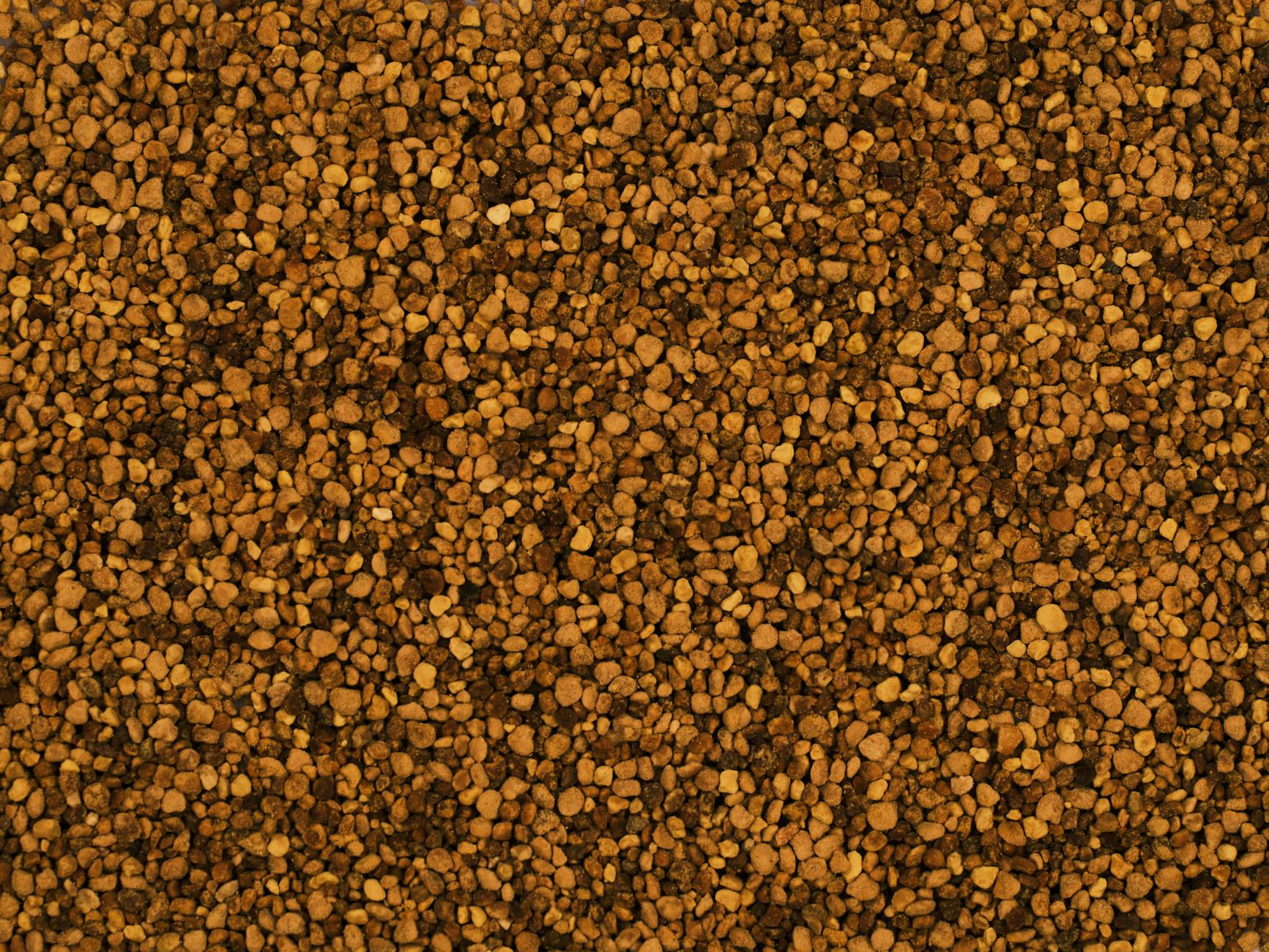
- What it is: flower pollen packed by honeybees with nectar and enzymes — a genuinely dense whole food with roughly 20–25% protein, all essential amino acids, B-vitamins, minerals, and a heavy load of polyphenols.1
- Can it replace a multivitamin? No. A realistic 1–2 teaspoon serving delivers only small fractions of most vitamin and mineral RDAs, composition swings wildly by flower and region, and a tough outer shell limits absorption. Impressive food, unreliable pill substitute.
- The safety line you can’t skip: bee pollen is a documented cause of allergic reactions up to and including anaphylaxis — especially in anyone with pollen or bee-product allergy.8
- Who it’s actually for: a non-allergic person who wants a polyphenol-rich whole-food add-on to an already solid diet — not someone trying to cover real nutrient gaps or treat hay fever.
What bee pollen actually is
Start with the thing itself, because the marketing blurs it. Bee pollen is not honey, not royal jelly, and not propolis. It’s the pollen of flowering plants — the male reproductive dust — that foraging honeybees gather, moisten with nectar and their own salivary secretions and enzymes, and pack into dense little granules on their hind legs to carry back to the hive. Beekeepers collect a portion of it with a screen at the hive entrance, and that’s what gets dried and sold as those multicolored pellets.2
And here’s where I’ll give the “complete food” crowd their due: the composition is legitimately impressive. Across the compositional reviews, bee pollen runs roughly 20–25% protein by weight and contains all of the essential amino acids, which is rare for a plant-derived material.1 It carries B-complex vitamins, some vitamin C, vitamin E and carotenoids, a spread of minerals, fatty acids including essential ones, and — the part that genuinely interests me — a heavy load of polyphenols and flavonoids like rutin, quercetin and kaempferol.13 That’s a real matrix. On a per-gram, on-paper basis, the “nature’s multivitamin” nickname has a kernel of truth: the density of micronutrients and plant compounds is the kind of thing a synthetic pill can’t fully imitate, because the pill doesn’t come wrapped in a food matrix of co-factors and antioxidants.
So I’m not going to pretend bee pollen is empty. The honest problem isn’t the granule — it’s the leap from “dense matrix” to “swap your multivitamin for a spoonful.” That leap is where the wellness copy stops being accurate.
The “better than a multivitamin?” question
This is the hook everyone actually wants answered, so let me answer it straight. In form, a whole food like bee pollen is arguably more interesting than a synthetic multivitamin: you’re getting micronutrients alongside polyphenols, enzymes and fatty acids, in a package your body evolved to handle, rather than isolated USP vitamins pressed into a tablet. If your only question were “food-form nutrients or synthetic ones?”, bee pollen would have a real argument.
But that’s not the real question. The real question is whether it can reliably stand in for a designed multivitamin — and on that, my answer is no, for three concrete reasons.
One: the dose is too small to hit your targets. People take bee pollen by the teaspoon — call it one to two teaspoons, a handful of grams, a day. A multivitamin is engineered so that one pill delivers something close to 100% of the recommended daily intake for a long list of vitamins and minerals. A few grams of bee pollen, even at its impressive density, delivers only small fractions of most of those RDAs. The compositional reviews describe a nutrient-rich material, but they describe it per 100 grams — and nobody eats 100 grams of bee pollen.1 Scale the numbers to a real serving and the “covers your vitamins” claim collapses. It is a seasoning-sized dose of a nutritious food, not a calibrated nutrient delivery system.
Two: you don’t actually know what you’re getting. A multivitamin’s entire point is standardization: the label is the dose. Bee pollen’s composition swings dramatically with the floral source the bees visited, the region, the season, and how it was harvested and stored.3 Two jars from two suppliers — or two batches from the same supplier in different months — can carry meaningfully different profiles. You can’t build a vitamin strategy on an input that changes batch to batch, because the number you’re relying on isn’t pinned to anything.
Three: a lot of it may pass straight through you. Each pollen grain is wrapped in an exine — a tough outer shell built to survive in the environment, which is exactly why it resists digestion. The reviews note that this wall limits how much of the inner nutrition is actually liberated and absorbed unless the pollen is broken down, which is part of why processing steps like crushing or fermentation are used to improve bioavailability.3 So the gap between “what’s in the granule” and “what you absorb from the granule” is real, and it cuts further against the already-too-small dose.
Bee pollen isn’t a fake. It’s a genuinely dense whole food asked to do a job — reliably covering your daily vitamins — that the spoonful you eat simply can’t do.
Put those three together and the verdict writes itself: as a whole-food source of polyphenols and trace nutrients, bee pollen is a perfectly nice thing to add to an already-good diet. As a dependable replacement for a multivitamin, it doesn’t hold up. If you’re actually trying to close nutrient gaps, a designed multivitamin — or, better, food and targeted testing — is the honest tool. We’ve made the broader case for and against the daily pill in our look at whether a multivitamin earns its place, and the same standard applies here.
What the evidence actually shows
Now the part that separates this from supplement copy: what have humans actually been shown, in trials, to get from bee pollen? The honest summary is a strong laboratory-and-animal story attached to a thin human-outcome story. I’ll take the claims one at a time and label them the way they deserve.
Antioxidant activity — real in the lab, EMERGING in you. This is bee pollen’s best-supported mechanism. Its polyphenol and flavonoid load gives it measurable free-radical-scavenging and antioxidant capacity in in-vitro assays, and the composition reviews consistently flag this radical-scavenging potential as the headline bioactivity.13 That’s genuinely promising, and it’s mechanism-plausible. But “scavenges radicals in a test tube” is not the same as “changes a health outcome in a person,” and the leap from antioxidant assay to clinical benefit is one the field hasn’t made yet for bee pollen. I grade it EMERGING, not STRONG, on purpose.
Menopausal hot flushes — one decent trial, of an extract, not the raw granule. The single most credible human-outcome result doesn’t use bee pollen pellets at all. Winther and colleagues ran a randomized, placebo-controlled trial of a purified, fermented pollen extract (the product marketed as Femal) in menopausal women: 64 enrolled, 54 completed, three months of treatment.5 The extract beat placebo — 65% of the extract group responded with reduced hot flushes versus 38% on placebo, with diary-recorded flushes and quality-of-life scores improving significantly.5 That’s a real, statistically significant signal, and I’ll credit it. But read the fine print: it’s a single small trial of a specifically processed extract designed to be allergen-reduced, not the bag of granules at the health store. It tells you a pollen extract may help vasomotor symptoms; it does not tell you bee pollen is a hot-flush remedy. EMERGING.
Athletic performance — this one’s basically settled, and it’s a no. Bee pollen had a long run as an endurance “ergogenic,” and the controlled data never backed it. Maughan and Evans gave a pollen extract to 20 adolescent swimmers across a training season: maximal oxygen uptake rose in both the pollen and placebo groups with no difference between them — no performance benefit.6 (Curiously, the pollen group lost fewer training days to upper-respiratory infections, an immune-side footnote, not a performance result.) Williams’ broader review of ergogenic substances later listed bee pollen plainly among the ones “shown to be ineffective.”7 The performance pitch is old, and it didn’t hold. WEAK — bordering on debunked.
Everything else — antimicrobial, hepatoprotective, anti-inflammatory, anticancer. The reviews catalog a long list of these activities, and they’re scientifically interesting — but read where they come from. They are overwhelmingly in-vitro and animal findings.24 The 2016 review is refreshingly blunt about it: the promising antioxidant, anti-inflammatory, hepatoprotective and immune-enhancing reports “require long-term and large cohort clinical studies,” and “extensive research is required before bee pollen can be used in therapy.”4 When the reviewers themselves are telling you the human data isn’t there, believe them. Treat the cell and rodent work as a reason for curiosity, not as a health claim about your body.
Does it help allergies?
This is the claim I want to push back on hardest, because it’s both popular and backwards. The folk theory is that eating local pollen “exposes” you to the local allergens and desensitizes you, like a food-based allergy shot. It sounds plausible. It mostly isn’t.
The mechanics don’t line up. The pollen that triggers hay fever is wind-borne (anemophilous) pollen — light, dry grains from grasses, trees and weeds like ragweed that drift through the air into your airways. Bee pollen is mostly insect-carried (entomophilous) flower pollen, the heavier, sticky kind bees collect from blooms. They’re largely different material, so “eat the bee pollen to train yourself against the airborne stuff” is built on a category error from the start. There’s no good randomized trial showing bee pollen relieves seasonal allergic rhinitis, and the burden of proof for “it desensitizes you” hasn’t been met. I grade that HYPE.
Worse, it can run the other direction. Bee pollen samples can and do contain windborne allergens by contamination — the anaphylaxis case I cite below involved pollen that turned out to carry ragweed, chrysanthemum and other Compositae-family material, in a patient with autumn hay fever.8 So the very people most drawn to the “cures my allergies” pitch — seasonal allergy sufferers — are the ones most likely to react badly to it. That’s not a fringe risk; it’s the central irony of this whole claim.
Is it safe? The allergy and contamination story
Bee pollen is a documented cause of allergic reactions, including anaphylaxis — a rapid, potentially life-threatening reaction. In one published case, a patient went into anaphylaxis after ingesting bee pollen that contained ragweed and other Compositae pollens.8 If you have any history of pollen allergy, hay fever, bee or bee-product allergy, or asthma, do not start bee pollen without talking to an allergist first — and never take a “first dose” alone or far from help. Stop immediately and seek emergency care for any swelling of the lips, tongue or throat, difficulty breathing, hives, or faintness.
The safety conversation is where I get least patient with the marketing, because “it’s natural’’ is doing a lot of dishonest work. Natural and safe are not synonyms, and bee pollen is a clean illustration of why.
Allergy is the headline risk. Because bee pollen is, by definition, concentrated pollen plus bee secretions, it’s a plausible allergen on two fronts at once: the plant pollen and the bee proteins. Reactions range from mild itching and GI upset up to full anaphylaxis, and the published case literature documents the severe end.8 This is the single most important thing to take from the article, and it’s exactly what the “most complete superfood” copy never mentions.
Contamination is the quieter risk. As an unregulated whole agricultural product, bee pollen can carry what the bees and the environment hand it: pesticide residues from sprayed crops, and pyrrolizidine alkaloids — plant toxins from certain flowers that are a recognized liver and carcinogenicity concern in bee products. This isn’t hypothetical: in one analysis of commercial bee pollen, 67% of samples carried pyrrolizidine alkaloids, at a mean of 339 µg/kg.9 Because nothing about the granules is standardized, neither is their contaminant load.
Drug interactions and pregnancy. There is a published case of bee pollen interacting with warfarin: a stably anticoagulated 71-year-old’s INR climbed to 7.1 within a month of starting a teaspoon twice daily, a “probable” interaction by the Drug Interaction Probability Scale — reason enough for anyone on an anticoagulant to leave it alone without medical sign-off.10 And given the allergy potential and the lack of safety data, pregnancy and breastfeeding are a sensible “not without your clinician” zone. None of this makes bee pollen uniquely dangerous; it makes it an ordinary food product that deserves ordinary caution — which the superfood framing actively discourages.
Energy, immunity, weight loss: the marketing claims
The remaining pitches — “boosts energy,” “supercharges immunity,” “aids weight loss” — are where I’ll be bluntest, because there’s the least under them. The energy and immunity claims lean on the nutrient-density story (B-vitamins, amino acids, antioxidants) plus the animal immune work, but there’s no solid human-outcome evidence that a teaspoon of bee pollen meaningfully raises energy or fortifies immune function in a healthy person.4 The swimmer trial’s fewer sick days is the closest thread, and it’s a single secondary observation, not a demonstrated immune benefit.6 Weight loss has essentially nothing credible behind it. These are inference-from-composition claims dressed up as proven effects — the exact move this site exists to call out.
How people take it
I don’t give dosing prescriptions, but here’s the honest practical picture, because the mechanics matter more than any number. People typically use bee pollen as granules — a teaspoon or two stirred into yogurt, oatmeal or a smoothie — and that’s genuinely the most sensible way to treat it: as a food topping, not a supplement you’re counting on for nutrients. Two things follow from the science above. First, if you crush, blend or buy it broken down, you’re working around the exine problem and likely absorbing more of what’s inside.3 Second — and this is the only “protocol” advice I’ll stand behind — the genuinely important step is the allergy test-dose: if you and your clinician decide it’s reasonable to try, start with a tiny amount, not a full serving, and not when you’re alone. The granule that does nothing for most people can put a pollen-allergic person in the emergency room. For where bee pollen sits among better-evidenced options, our supplements reference is the more useful map than any superfood label.
My verdict
Here’s my position, stated plainly. Bee pollen is a real, nutrient-dense, polyphenol-rich whole food. Adding a spoonful to a smoothie is pleasant, contributes some genuinely useful plant compounds, and probably does a little antioxidant good. I have no problem with anyone non-allergic using it that way, and I won’t pretend it’s snake oil — the composition is the most legitimate thing about it.1
But the headline pitch — “nature’s multivitamin, better than a pill” — is marketing, and I’ll say so without hedging. The serving you actually eat covers only fractions of your daily vitamin and mineral needs, the product is unstandardized batch to batch, and a tough outer shell limits how much you absorb. Don’t lean on it to close nutrient gaps; that’s the job it can’t do. Do respect the allergy risk, which is real enough to land people in anaphylaxis.8 And go in knowing you’re buying an unstandardized agricultural product, not a calibrated one.
Intriguing food, oversold supplement. That’s the whole story. If you want micronutrients you can count on, a designed multivitamin or a smarter diet wins; if you want the mineral-absorption angle done properly, our breakdown of which forms actually get absorbed is the kind of rigor bee pollen marketing skips. Bee pollen earns a spot in the second tier — a nice-to-have whole food — not the first.
What we still don’t know
No human nutrient-adequacy data at realistic doses. Nobody has run the obvious study: take real people on real teaspoon-sized servings and measure whether it moves their vitamin or mineral status at all. Until that exists, “replaces a multivitamin” is an assertion, not a finding.
The standardization gap is structural. Because composition tracks the flowers, season and region, a generalizable “bee pollen does X” claim is hard to make honestly — what was in the jar studied may not be what’s in yours. The field needs characterized, standardized products before clinical claims can firm up.3
The human-outcome cupboard is mostly bare. Outside the menopausal-extract trial, there’s little large, independent, randomized human data on hard outcomes — the reviewers themselves keep calling for long-term, large-cohort studies.4 The lab and animal work is rich; the “does it actually change anything in a person” work is thin. That asymmetry is the honest center of gravity for bee pollen, and no amount of superfood branding changes it.
References
- Komosinska-Vassev K, Olczyk P, Kaźmierczak J, Mencner L, Olczyk K. Bee pollen: chemical composition and therapeutic application. Evid Based Complement Alternat Med. 2015;2015:297425. DOI · PMID 25861358
- Khalifa SAM, Elashal MH, Yosri N, et al. Bee Pollen: Current Status and Therapeutic Potential. Nutrients. 2021;13(6):1876. DOI · PMID 34072636
- El Ghouizi A, Bakour M, Laaroussi H, et al. Bee Pollen as Functional Food: Insights into Its Composition and Therapeutic Properties. Antioxidants (Basel). 2023;12(3):557. DOI · PMID 36978805
- Denisow B, Denisow-Pietrzyk M. Biological and therapeutic properties of bee pollen: a review. J Sci Food Agric. 2016;96(13):4303-4309. DOI · PMID 27013064
- Winther K, Rein E, Hedman C. Femal, a herbal remedy made from pollen extracts, reduces hot flushes and improves quality of life in menopausal women: a randomized, placebo-controlled, parallel study. Climacteric. 2005;8(2):162-170. DOI · PMID 16096172
- Maughan RJ, Evans SP. Effects of pollen extract upon adolescent swimmers. Br J Sports Med. 1982;16(3):142-145. DOI · PMID 7139223
- Williams MH. Ergogenic and ergolytic substances. Med Sci Sports Exerc. 1992;24(9 Suppl):S344-S348. PMID 1328803
- Choi JH, Jang YS, Oh JW, Kim CH, Hyun IG. Bee Pollen-Induced Anaphylaxis: A Case Report and Literature Review. Allergy Asthma Immunol Res. 2015;7(5):513-517. DOI · PMID 25749764
- De Jesus Inacio L, Merlanti R, Lucatello L, et al. Natural contaminants in bee pollen: DNA metabarcoding as a tool to identify floral sources of pyrrolizidine alkaloids and fungal diversity. Food Res Int. 2021;146:110438. DOI · PMID 34119245
- Hurren KM, Lewis CL. Probable interaction between warfarin and bee pollen. Am J Health Syst Pharm. 2010;67(23):2034-2037. DOI · PMID 21098375