Desiccated beef liver and organ supplements: real ancestral superfood, or carnivore hype?
Freeze-dried liver and "organ complex" capsules are everywhere in the ancestral-health space, sold as nature's multivitamin. The honest read: the food is genuinely one of the most nutrient-dense things you can eat — but the capsule doses are small, the "heals everything" claims are hype, and the preformed vitamin A is a real overdose and pregnancy risk.
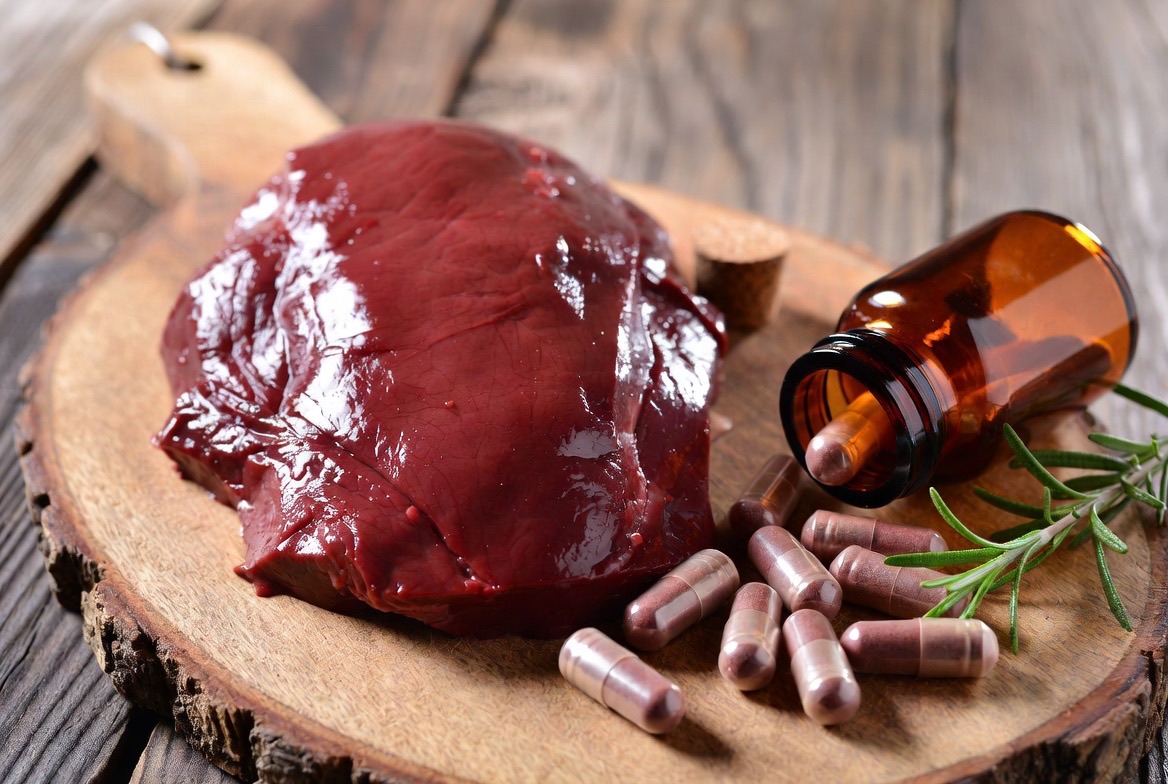
- The nutrition is genuinely real. Beef liver is one of the most nutrient-dense foods on earth — about 59–70 mcg of B12 (over 2,400% of the daily value) and roughly 5,000–9,400 mcg of preformed vitamin A per 100 g, plus highly absorbable heme iron, copper, folate, and choline.1
- But capsules are small doses. A typical 500–1,000 mg capsule is roughly one-sixth of one cooked serving; about 3 g of freeze-dried powder — a common daily dose — carries the nutrients of only ~14 g (half an ounce) of fresh liver.2 “Nature’s multivitamin in a pill” is overstated against just eating liver.
- The real caution the hype skips: liver is so high in preformed vitamin A that stacking it can exceed the 3,000 mcg / 10,000 IU daily ceiling, and high intake is teratogenic — one large study found a 4.8× higher birth-defect rate above ~10,000 IU/day.56
- Who it’s actually for: people with low iron/B12 or a poor diet who want a real whole-food source. Not pregnant women, not people already taking vitamin A, and not anyone expecting an organ to be “healed” by the matching organ in a capsule.
- Why liver is back — and what the marketing promises
- What liver actually does in the body
- The nutrition is real: what the numbers say
- The capsule problem: small doses, big claims
- The ancestral and organ-specific claims
- The vitamin A risk — the part the hype skips
- A tiered way to think about it
- What we don't know yet
- References
Why liver is back — and what the marketing promises
Liver fell off the Western plate decades ago, and now it is back — not on the dinner table, but in a capsule. The ancestral- and carnivore-health movements have rebranded desiccated (freeze-dried) beef liver and "organ complex" blends as the ultimate whole-food supplement: nature's multivitamin, marketed for energy, iron, vitamin A, B12, "hormone support," hair, skin, and the whole nose-to-tail idea that we should be eating the parts of the animal our ancestors did.
Here is the honest frame before we get into the data. The trend gets the food right and the pill wrong. Beef liver is, by almost any measure, one of the most nutrient-dense foods a human can eat — that part is not marketing, it is biochemistry.1 What the marketing oversells is the leap from "liver is incredibly nutritious" to "therefore a few capsules of dried liver will fix your health." Those are two different claims, and only the first one holds up. For the bigger picture of where single foods sit in a real diet, our lifestyle desk keeps coming back to the same rule: nutrient density is real, but dose and context decide whether it matters.
What liver actually does in the body
Liver is dense for a simple reason: it is a storage and processing organ. It concentrates the fat-soluble vitamins (A, and to a lesser extent D, E, and K), it stores B12 and folate, and it holds large amounts of iron and copper because those are exactly the minerals an animal's metabolism stockpiles. When you eat liver, you are eating a pre-loaded reservoir.
The two nutrients worth understanding by mechanism are iron and vitamin A, because they explain both the benefit and the risk. Iron in liver is mostly heme iron — iron bound inside the heme ring of hemoglobin and myoglobin. Your gut absorbs heme iron through a dedicated pathway at roughly 15–35%, far better than the 2–20% typical of the non-heme iron in plants and most supplements, and that absorption is less blunted by phytates, tannins, and calcium.3 That is the real signal liver pulls for iron status: not just more iron, but iron your body can actually take up.
Vitamin A is the other side of the coin. Liver carries preformed vitamin A — retinol and retinyl esters, the ready-to-use form — not the beta-carotene found in carrots and sweet potatoes. The distinction is the whole story for safety. Your body converts beta-carotene to retinol on demand and throttles that conversion when it has enough, so plant sources essentially cannot cause toxicity. Preformed retinol has no such brake: it is absorbed efficiently, it is fat-soluble, and it accumulates.4 That accumulation is the mechanism behind both liver's potency and its danger.
The nutrition is real: what the numbers say
Start with the food, because this is the part the hype actually gets right. Per 100 grams (about 3.5 ounces) of beef liver, the USDA and NIH figures land roughly here:14
- Vitamin B12: ~59–70 mcg — over 2,400% of the daily value, the highest of any common food.
- Preformed vitamin A (retinol): ~5,000–9,400 mcg — 550% to over 1,000% of the daily value.
- Copper: ~10 mg — roughly ten times the daily value.
- Folate: ~290 mcg — about 70% of the daily value.
- Choline, riboflavin, B6, selenium, and zinc: all present at "best source" levels.
- Protein: ~27 g, with only ~4 g of fat.
- Iron: several milligrams, mostly the bioavailable heme form discussed above.
That profile is why dietitians have called liver a genuine whole-food source for centuries of clinical practice, long before "ancestral" was a hashtag. For someone with low iron or B12, a poor diet, or a recovery situation where appetite for plain meals is low, a serving of liver once or twice a week is a legitimately good way to raise both heme iron and B12 status.3 The same logic underpins why a conventional daily multivitamin exists in the first place — to cover gaps — except liver does it with food the body recognizes rather than isolated synthetic forms.
So grade one is settled. As a nutrient-dense, bioavailable whole food, beef liver earns a STRONG. As a tool to correct genuine iron or B12 shortfalls, it earns a MODERATE — strong on plausibility and nutrient content, held back only because few controlled trials test liver itself as the intervention versus fortified food or supplements.
The capsule problem: small doses, big claims
Now the part the marketing quietly skips. Everything above describes a serving of liver — 100 grams of the actual food. The product most people are buying is not that. It is a bottle of capsules, and the dose math changes the story.
A typical desiccated-liver capsule contains 500 to 1,000 mg of freeze-dried powder, which works out to roughly half a gram to a gram of fresh-liver equivalent per capsule. Most labels suggest two to six capsules a day. So a common daily dose of around 3 grams of freeze-dried powder carries about the nutrient load of 14 grams — half an ounce — of fresh liver, roughly one-seventh of a single cooked serving.2 Six capsules approximate one portion; two or three capsules approximate a bite.
The food is a multivitamin. A few capsules of it are a fraction of one. The label rarely makes that math obvious.
Freeze-drying itself is fine — it preserves B12, iron, and vitamin A better than heat-based drying, so the powder is not degraded. The issue is simply quantity. At capsule doses, you are getting a meaningful top-up of B12 and copper and a real but modest amount of iron and vitamin A — not the dramatic, plate-sized nutrient hit the "nature's multivitamin" framing implies. That is why the claim that a handful of capsules replaces a balanced diet or a multivitamin grades WEAK: for most nutrients the capsule simply does not deliver enough to do the job a full serving — or a formulated multivitamin — would.
There is also a quality wrinkle. Organ-supplement potency varies by sourcing, and these products are not third-party standardized the way a USP-verified multivitamin can be, so the actual nutrient content of any given bottle is harder to pin down than the label suggests.
The ancestral and organ-specific claims
The weakest claims in the whole category are the ones that sell the hardest: that eating an organ "supports" or "heals" the matching organ in you, that organ blends restore hormones, and that nose-to-tail eating carries some special healing power beyond its nutrient content. "Eat heart for your heart, eat liver for your liver, eat thymus for your immune system" is an appealing story with no mechanism and no controlled human evidence behind it.
When you eat any tissue, your digestion breaks it down into amino acids, fats, vitamins, and minerals. The body does not route a capsule of dried bovine spleen preferentially to your spleen; it absorbs the constituent nutrients and uses them wherever they are needed. Any benefit an organ supplement provides is fully explained by the nutrients it contains — the iron, the B12, the vitamin A, the peptides broken down to amino acids. There is no separate ancestral "organ signal" that survives digestion intact and finds its way home. That whole tier of claims grades HYPE: not because organ meats are worthless, but because the specific mechanism being sold does not exist.
None of this means the food is a gimmick. It means the marketing story is the gimmick, draped over a food that genuinely is dense in nutrients. The honest version doesn't need the ancestral mysticism — the nutrition stands on its own.
The vitamin A risk — the part the hype skips
This is the most important honesty point in the article, and it is the one the trend almost never mentions. The same preformed vitamin A that makes liver impressive on a label is also a genuine overdose hazard, because retinol is fat-soluble and accumulates.
The tolerable upper intake level for adults is 3,000 mcg RAE (10,000 IU) of preformed vitamin A per day.48 A single 100-gram serving of liver can carry 5,000 to over 9,000 mcg — meaning one serving can land at or above the daily ceiling on its own. Now stack a daily liver capsule on top of a multivitamin that also contains retinyl palmitate, plus the occasional liver dinner, and chronic intake above the limit becomes easy to reach without noticing. Chronic hypervitaminosis A is not theoretical: it produces headaches, dry and cracked skin, hair loss, bone and joint pain, and at the liver itself, steatosis and fibrosis that can progress.7
The non-negotiable caution is pregnancy. High intake of preformed vitamin A is teratogenic — it causes birth defects. In a prospective study of more than 22,000 pregnancies, women consuming more than 10,000 IU/day of supplemental vitamin A had a 4.8-fold higher rate of birth defects in cranial-neural-crest tissues than women consuming 5,000 IU or less, with an apparent threshold near 10,000 IU/day and the risk concentrated before the seventh week of gestation.56 This is precisely why obstetric guidance has long warned pregnant women away from liver and high-dose vitamin A. It is also why we flag this clearly rather than softly: a pregnant woman taking a liver supplement marketed as a wholesome "ancestral" prenatal is doing the one thing the evidence most directly cautions against.
Skip preformed-vitamin-A organ supplements and high-liver intake entirely, and get your vitamin A from beta-carotene-rich plants, which carry no teratogenic risk. Talk to your clinician about a prenatal formulated to keep preformed vitamin A under the limit. This is the single firmest line in this article.
So the safety claim — that high preformed-vitamin-A intake from liver can cause toxicity and is teratogenic — grades STRONG. It is not fearmongering; it is one of the better-documented nutrient toxicities in the literature.
A tiered way to think about it
We don't write prescriptions on this site. We write frameworks you can take to a clinician or a dietitian. With that said, here is how the risk-benefit actually sorts out.
If you tolerate it, a modest serving of real liver every week or two is the most honest way to capture its nutrition — full doses of heme iron, B12, and copper from food the body recognizes. Watch the vitamin A ceiling: one serving can hit the daily limit, so don't pair it with a high-retinol multivitamin on the same day.
If you won't eat liver, capsules are a reasonable small top-up for B12 and copper — just hold realistic expectations. A few capsules are a fraction of a serving, not a meal in a pill, and not a substitute for a balanced diet or a formulated multivitamin. Total your preformed vitamin A across every source.
Buying spleen, thymus, or "glandular" complexes to heal a matching organ, restore hormones, or treat a condition is paying for a story with no mechanism. If you have a real deficiency or symptom, that is a workup-and-labs conversation, not a nose-to-tail capsule stack.
What we don't know yet
The gaps here are real and worth naming. There is no published controlled trial testing desiccated-liver capsules as an intervention for iron or B12 status against either a standard supplement or fortified food — the nutrient content is well-characterized, but the clinical effect of the small capsule dose is inferred, not trial-tested. There is no standardized labeling for organ-supplement potency, so bottle-to-bottle and brand-to-brand nutrient content is unverified outside the few products that volunteer third-party testing. And while the upper end of vitamin A toxicity is well-defined, the lower edge — how much chronic, modest over-intake from food-plus-supplement stacking it takes to cause harm in otherwise healthy adults — is less precisely mapped than the acute and pregnancy data. Until those gaps close, the conservative read holds: treat liver as the genuinely excellent food it is, treat the capsules as a small top-up, and treat the "heals everything" claims as the marketing they are.
References
- U.S. Department of Agriculture, Agricultural Research Service. FoodData Central: Beef, variety meats and by-products, liver, cooked. USDA, 2024. fdc.nal.usda.gov
- Composition and serving-equivalence of freeze-dried (desiccated) beef liver capsules versus fresh liver, manufacturer labeling and nutrient-density analyses, 2024.
- Hurrell R, Egli I. Iron bioavailability and dietary reference values. Am J Clin Nutr. 2010;91(5):1461S-1467S. DOI · PMID 20200263
- National Institutes of Health, Office of Dietary Supplements. Vitamin A and Carotenoids — Health Professional Fact Sheet. NIH ODS, 2024. ods.od.nih.gov
- Rothman KJ, Moore LL, Singer MR, et al. Teratogenicity of High Vitamin A Intake. N Engl J Med. 1995;333(21):1369-1373. DOI · PMID 7477116
- World Health Organization. Guideline: Vitamin A supplementation in pregnant women. WHO, Geneva, 2011.
- Olson JM, Ameer MA, Goyal A. Vitamin A Toxicity. StatPearls. NCBI Bookshelf, 2024. NBK532916
- Institute of Medicine. Dietary Reference Intakes for Vitamin A — Tolerable Upper Intake Levels. National Academies Press, 2001.