Walking pads and under-desk treadmills: do they actually improve your health — or just make sitting feel less guilty?
The pitch is seductive and, on its face, sensible: you already spend eight hours a day chained to a desk, so slide a slim treadmill underneath it and turn all that dead sitting time into a slow, steady stream of steps. No gym, no sweat, no schedule — just health accumulating quietly while you answer email. Walking pads (compact, low-speed treadmills designed to sit under a standing desk) have become one of the fastest-growing wellness gadgets, sold on the promise that they solve the sedentary-office problem by harvesting NEAT — non-exercise activity thermogenesis, the calories you burn through everyday movement that isn’t formal exercise. The honest version of the story is more interesting than either the marketing or the backlash. The trials show walking pads genuinely do what they claim on one axis: they cut sitting time and add light activity, with small but real metabolic upside. They also show, just as clearly, that low-speed walking is not exercise, the calorie burn is modest, and no cuff-and-belt device is going to make you fit or lean on its own. Here is the cited, evidence-graded read on what a walking pad actually does — and what it can’t.
How this article was built: Primary sources: the Oye-Somefun et al. 2021 systematic review and meta-analysis of treadmill desks in BMC Public Health; the MacEwen, MacDonald & Burr 2015 systematic review of standing and treadmill desks in Preventive Medicine; the Ben-Ner et al. 2014 twelve-month treadmill-workstation field study in PLoS One; the Larson et al. 2015 simultaneous cognition-and-typing experiment in PLoS One; the Levine & Miller 2007 walk-and-work energy-expenditure study in the British Journal of Sports Medicine; the Dunstan et al. 2012 breaking-up-sitting glucose trial in Diabetes Care; and the Ekelund et al. 2016 harmonised sitting-and-mortality meta-analysis in The Lancet — all retrieved and verified through PubMed and the Consensus research database.
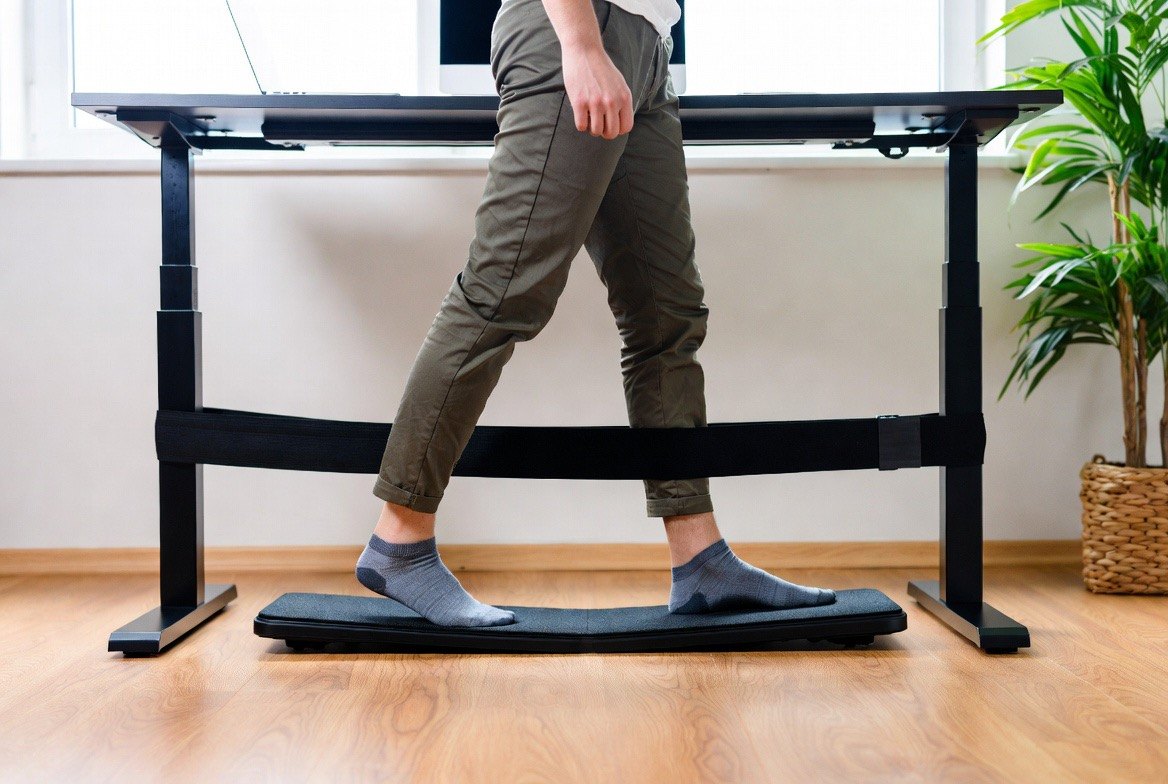
- They do reduce sitting. Treadmill desks and walking pads reliably cut daily sitting time and add steps and light-intensity movement — the outcome the evidence most consistently supports, and a genuinely worthwhile one given how much of the day office work steals sitting still.12
- The metabolic upside is real but modest. Walking while working nudges some cardiometabolic markers — notably postprandial glucose (blood sugar after a meal) — and burns more energy than sitting, but the gains are small and come from moving instead of sitting, not from the device being special.56
- There’s a small productivity trade-off. Typing accuracy and fine-motor tasks dip slightly while you walk; attention and higher-order cognitive tasks are only modestly affected, and pooled data suggest little net cognitive cost. Honest nuance, not a dealbreaker.34
- It is not exercise. Walking-pad speeds are deliberately low, which means low intensity. This tool addresses sedentary time — a real risk — but it does not replace structured moderate-to-vigorous or zone-2 training, and it is not a meaningful weight-loss device on its own.27
- The premise: harvesting NEAT from the sedentary office
- What the trials show: less sitting, modest metabolic gains
- The productivity trade-off: typing vs thinking
- Who actually benefits
- The honest limits: low intensity is not exercise
- The hype: the walking pad as a weight-loss machine
- The verdict
- References
The premise: harvesting NEAT from the sedentary office
To judge a walking pad fairly, you have to be clear about the problem it’s designed to solve — because it’s a different problem from the one most people think exercise addresses. Modern desk work has made prolonged sitting the default state of the working day. That matters on its own terms: sedentary time is associated with worse cardiometabolic health and higher mortality risk, and the association is only partly explained by whether you also exercise. We covered the underlying science in detail in our companion piece on whether sitting is really the new smoking — the short version is that sitting is a genuine, measurable risk factor, distinct from being unfit, and worth reducing in its own right.
The concept the walking pad is built on is NEAT — non-exercise activity thermogenesis, a term popularized by James Levine and colleagues at the Mayo Clinic. NEAT is the energy you burn through all the movement that isn’t sleeping, eating, or deliberate exercise: fidgeting, standing, walking to the printer, pacing on a phone call. It is the most variable component of daily energy expenditure between people, and the theory is that a sedentary office job systematically strips it out. You sit for the meeting, sit for the email, sit for lunch, then sit in the car home. Replace even part of that sitting with slow walking and you claw back NEAT that the desk had eliminated.
This is the honest, defensible case for the device, and it’s worth stating plainly because it’s different from the fitness pitch. A walking pad is not trying to make you sprint or lift; it’s trying to break up sitting and restore a baseline of light, all-day movement that human bodies are built to have and office jobs have taken away. Whether it succeeds at that — and whether restoring that movement actually improves health markers — is an empirical question the research can answer. Whether it makes you fit is a different question entirely, and one the device was never really designed to answer.
What the trials show: less sitting, modest metabolic gains
The most useful way to read this literature is to separate two claims the marketing tends to blur together: does a walking pad reduce sitting and add movement (yes, fairly clearly), and does that movement meaningfully improve health markers (a little, modestly). Both are supported, but they carry very different weight.
Reducing sitting and adding activity — the strongest finding. This is what the evidence most consistently shows. Oye-Somefun and colleagues’ 2021 systematic review and meta-analysis in BMC Public Health pooled thirteen studies of treadmill-desk interventions and found, in workplace studies, a significant reduction in sitting time — on the order of well over an hour of standing-or-moving time reclaimed across a day when the reductions are extrapolated across working hours.1 MacEwen, MacDonald and Burr’s 2015 systematic review in Preventive Medicine, an earlier and broader synthesis of standing and treadmill desks, reached the same qualitative conclusion: treadmill desks increase energy expenditure and reduce sitting relative to a conventional workstation.2 In plain terms: put a treadmill under a desk and people sit less and move more. That is the core promise, and it holds up.
The cardiometabolic markers — real, but modest. Here the honest word is “emerging.” The same reviews report improvements in some cardiometabolic measures — MacEwen and colleagues singled out postprandial glucose (blood sugar in the hours after eating), high-density lipoprotein (HDL, the “good” cholesterol), and some body-composition measures as the outcomes that improved most with treadmill desks.2 But the studies are small, short, and heterogeneous, and the effects are correspondingly modest. The mechanistic plausibility is strong: Dunstan and colleagues’ elegant 2012 crossover trial in Diabetes Care showed that interrupting prolonged sitting with brief bouts of even light-intensity walking meaningfully lowered postprandial glucose and insulin responses in overweight adults.6 A walking pad is essentially a machine for doing exactly that — converting a solid block of sitting into frequent light movement — so the postprandial-glucose signal is both biologically sensible and the marker most worth watching.
Energy expenditure — more than sitting, far less than exercise. Walking while working does burn more calories than sitting. Levine and Miller’s 2007 study in the British Journal of Sports Medicine measured energy expenditure in participants with obesity and found that seated office work burned about 72 kcal/hour, while walking at a self-selected pace of roughly 1.1 mph at a walk-and-work desk burned about 191 kcal/hour — a difference of roughly 119 kcal for each hour of walking substituted for sitting.5 The 2021 meta-analysis put the pooled laboratory increase at around 105 kcal/hour over sitting.1 That’s a genuine bump — but notice the framing. In MET terms — the metabolic equivalent, where one MET is your resting metabolic rate — slow treadmill-desk walking sits at roughly 2 METs, squarely in the “light activity” band. It is not MVPA (moderate-to-vigorous physical activity, the intensity that drives cardiorespiratory fitness), and it doesn’t come close to the intensity that meaningfully raises VO2 (oxygen uptake, the standard measure of aerobic fitness).
vs sitting, walking at a desk
pooled lab estimate, 2021 meta-analysis
— light, not moderate
below the MVPA threshold
pooled in the 2021 review
sitting fell; markers moved modestly
A walking pad is a superb machine for not sitting, and a mediocre machine for getting fit. The trouble is that the ads sell it as the second thing while the science only backs the first.
Read the two claims together and the picture is coherent. Walking pads deliver their promised behavioral change — less sitting, more light movement — and that change nudges the markers you’d expect a reduction in sitting to nudge, most reliably postprandial glucose. The gains are real. They are also modest, and — crucially — they come from the movement, not from anything magical about the belt. A stroll around the block every hour would do much of the same job; the walking pad’s advantage is convenience and consistency, not a special metabolic effect.
The productivity trade-off: typing vs thinking
A fair assessment has to address the obvious objection: can you actually work while walking, or does the movement wreck your output? The research here is unusually clean, and the answer is nuanced in a way worth getting right, because both the boosters and the skeptics overstate it.
Fine-motor tasks take a small hit. Larson and colleagues’ 2015 study in PLoS One measured cognition and typing simultaneously while participants either walked slowly on a treadmill desk or sat — a cleaner design than comparing separate sessions.4 Typing speed and accuracy were modestly worse while walking. This is intuitive: hitting precise keys is a fine-motor task, and doing it on a gently moving platform introduces small perturbations. Anyone who has tried to write a careful email while walking on a pad has felt this. It’s real, and it’s the strongest reason not to walk during precision-heavy work.
Higher-order cognition is only modestly affected. The picture is more nuanced than the boosters claim. In the Larson trial, slow walking did produce small but statistically significant dips on a verbal-learning measure and an attention task, though delayed-recall memory was unaffected — the authors judged those declines modest enough that they “may not outweigh” the activity gains.4 Pooled across the broader literature the reassurance is stronger: a 2020 meta-analysis of treadmill and cycle desks found no effect on selective attention and even a small improvement in recall, concluding that any productivity cost is not driven by impaired cognition. The plausible mechanism is that light movement raises arousal and cerebral blood flow enough to offset much of the distraction cost on tasks that don’t depend on fine motor precision. So the trade-off is task-specific, not global: your reading, thinking, listening and problem-solving hold up reasonably well on a walking pad; your typing accuracy and mouse precision take the clearest hit.
The field-study evidence backs the practical takeaway. Ben-Ner and colleagues’ 2014 study in PLoS One followed office employees at a financial-services company for twelve months after they received treadmill workstations and found that, using within-person comparisons, overall work performance — the quality and quantity of work, and interactions with coworkers — actually improved after adoption once people adapted.3 The sensible read across all of this: match the task to the tool. Walk during calls, reading, brainstorming and routine email; step off — or slow the belt further — for spreadsheet precision, detailed writing, or anything requiring fine mouse control. Used that way, the productivity cost is small and manageable, and the field data suggest it can wash out entirely over time.
Who actually benefits
Like most tools, a walking pad is valuable in some hands and pointless in others, and matching it to the situation is most of the game.
High-sitting desk workers are the clear beneficiaries. If your job keeps you seated for six, eight, ten hours a day, the walking pad targets exactly your risk: it breaks up sitting and reintroduces light movement, which the evidence supports as valuable independent of formal exercise.16 For this group it’s a legitimate, low-friction way to move the needle on sedentary time — the metric it’s genuinely good at changing. People whose work is dominated by calls, reading, and video meetings get the most, because those tasks tolerate walking best. And for anyone rebuilding a movement habit, a walking pad lowers the barrier to entry to near zero: no changing clothes, no commute to a gym, no carved-out hour.
Who benefits least? People who already accumulate plenty of daily movement and structured exercise — for them the marginal sedentary-time reduction is small, and the money is better spent elsewhere. People whose work is almost entirely fine-motor precision, where the typing penalty bites hardest. And anyone buying it as a fitness or weight-loss solution, who is likely to be disappointed for reasons we’ll get to. There’s also a real adherence-and-novelty problem worth naming honestly: walking pads have a well-earned reputation for ending up folded under the bed after the first enthusiastic month. The device only helps on the days you actually use it, and the low intensity that makes it easy to sustain also makes it easy to skip. If you know yourself to be a gadget-abandoner, factor that into the purchase.
The honest limits: low intensity is not exercise
This is the section the marketing skips, and it’s the most important one. Everything good about a walking pad flows from the fact that it’s low-intensity and sustainable while you work. That same low intensity is precisely why it cannot do the jobs that structured exercise does.
It does not build fitness. Cardiorespiratory fitness — the capacity that shows up as higher VO2 and drives much of exercise’s longevity benefit — is built by working at moderate-to-vigorous intensities: brisk walking that leaves you slightly breathless, zone-2 cardio held long enough to challenge the aerobic system, intervals, resistance training. Walking-pad speeds sit below that threshold by design; you can’t type at a jog. So a walking pad is not a substitute for the MVPA or zone-2 work that improves fitness, and it is not a substitute for the resistance training that preserves muscle and, as we’ve written in our piece on grip strength and longevity, tracks so strongly with healthy aging. Sedentary-time reduction and cardiorespiratory fitness are two distinct health levers. A walking pad pulls the first one well and the second one barely at all.
The calorie burn is modest. Yes, walking burns more than sitting — roughly 100–120 kcal extra per hour of walking.5 But do the arithmetic honestly. Even two solid hours of desk walking a day is a few hundred extra calories, easily erased by a single snack, and weight loss is governed overwhelmingly by total energy balance and diet, not by a light-activity gadget. Treating a walking pad as a weight-loss machine sets you up to under-eat the effort and over-count the burn. It can be a small, helpful contributor to an active lifestyle; it is not, by itself, a fat-loss strategy.
The evidence base itself is thin. Most treadmill-desk studies are small, short, and measured surrogate markers — sitting time, steps, glucose, energy expenditure — rather than long-term hard outcomes like cardiovascular events or mortality. The behavioral and short-term metabolic findings are believable; the leap to decades-long health benefit is inferred from the broader sedentary-behaviour and physical-activity literature, not proven for walking pads specifically. And that broader literature carries its own crucial caveat: Ekelund and colleagues’ 2016 harmonised meta-analysis of over a million people in The Lancet found that high levels of moderate-intensity activity — roughly 60–75 minutes a day — could largely offset the mortality risk of prolonged sitting, but lower-intensity movement did not fully erase it.7 Read carefully, that finding both supports and bounds the walking pad: reducing sitting is worthwhile, but light desk-walking is not the moderate-intensity activity that did the heavy lifting in the data. You still need the real thing.
The single most useful reframe here: reducing sedentary time and building fitness are separate goals, and they need separate tools. A walking pad is a strong answer to the first — it breaks up sitting, restores NEAT, and nudges markers like postprandial glucose. It is a weak answer to the second — it won’t raise your VO2 or build muscle, because it’s deliberately too gentle to. The mistake isn’t buying one; it’s buying one instead of structured exercise and expecting it to cover both jobs. Pair the pad with real training and you get the whole picture. The Manual maps these levers against each other — what moves fitness, what moves metabolic health, what moves neither — with the evidence graded and the device hype stripped out. See the Manual →
The hype: the walking pad as a weight-loss machine
Now the inversion the marketing runs on. Because “walking pads improve health markers” is technically true, an entire category of content sells them as transformational fitness and fat-loss devices: melt pounds while you work, get fit without the gym, 10,000 steps without leaving your desk. This is where a modest, honest benefit gets stretched into a claim the evidence flatly does not support — the HYPE grade in this article’s Evidence Radar.
The trials are consistent and unambiguous on the mechanism. The benefits come from replacing sitting with light movement, at roughly 2 METs, burning a modest surplus of calories.5 Nothing in the treadmill-desk literature shows the kind of body-composition transformation or fitness gain the hype promises, because the intensity isn’t there to produce it, and the calorie math is too small to drive meaningful fat loss against ordinary eating.4 A fancier walking pad with a better app doesn’t change this; a well-designed step counter that graphs your day is still just measuring light activity, not manufacturing fitness. The steps are real. The “so you don’t need to exercise” conclusion is not.
There’s a subtler harm in the oversell, too: it can license less of the exercise that actually matters. If you believe the pad has your fitness covered, you may skip the brisk walk, the weights, the zone-2 session — trading a high-value activity for a low-value one and coming out behind. Sold honestly, a walking pad is an add-on to an active life. Sold as a substitute for it, it’s a downgrade wearing the costume of an upgrade.
The verdict
A walking pad is a legitimately useful tool, judged by what it actually does. For a desk worker with high sitting time, it reduces sedentary time, adds daily steps and light movement, and delivers modest but real metabolic upside — most reliably a blunting of postprandial glucose — with only a small, manageable productivity trade-off that’s confined mostly to fine-motor tasks and tends to fade with practice.136 On the specific problem it was built to solve — the sedentary office — it works, and reducing sitting is a goal worth taking seriously in its own right.
It is oversold the moment it’s framed as a substitute for real exercise or a serious weight-loss device. The intensity is too low to build fitness, the calorie burn is too modest to drive fat loss on its own, and the strongest mortality data point to moderate-intensity activity — not light desk-walking — as the movement that carries the heaviest protective weight.27 The clean way to hold both truths at once: buy it to sit less, not to get fit. Wire it into a workday that still includes structured training, treat the steps as a bonus rather than a substitute, and be honest with yourself about the folded-under-the-bed adherence risk. Do that, and a walking pad earns its place. Expect it to replace the gym, and it will quietly let you down while you congratulate yourself on the step count.
References
- Oye-Somefun A, Azizi Z, Ardern CI, Rotondi MA. A systematic review and meta-analysis of the effect of treadmill desks on energy expenditure, sitting time and cardiometabolic health in adults. BMC Public Health. 2021;21(1):2082. DOI · PMID 34774020
- MacEwen BT, MacDonald DJ, Burr JF. A systematic review of standing and treadmill desks in the workplace. Prev Med. 2015;70:50-58. DOI · PMID 25448843
- Ben-Ner A, Hamann DJ, Koepp G, Manohar CU, Levine J. Treadmill Workstations: The Effects of Walking while Working on Physical Activity and Work Performance. PLoS One. 2014;9(2):e88620. DOI · PMID 24586359
- Larson MJ, LeCheminant JD, Hill K, Carbine K, Masterson T, Christenson E. Cognitive and Typing Outcomes Measured Simultaneously with Slow Treadmill Walking or Sitting: Implications for Treadmill Desks. PLoS One. 2015;10(4):e0121309. DOI · PMID 25874910
- Levine JA, Miller JM. The energy expenditure of using a "walk-and-work" desk for office workers with obesity. Br J Sports Med. 2007;41(9):558-561. DOI · PMID 17504789
- Dunstan DW, Kingwell BA, Larsen R, Healy GN, et al. Breaking Up Prolonged Sitting Reduces Postprandial Glucose and Insulin Responses. Diabetes Care. 2012;35(5):976-983. DOI · PMID 22374636
- Ekelund U, Steene-Johannessen J, Brown WJ, Fagerland MW, et al. Does physical activity attenuate, or even eliminate, the detrimental association of sitting time with mortality? A harmonised meta-analysis of data from more than 1 million men and women. Lancet. 2016;388(10051):1302-1310. DOI · PMID 27475271