Home blood pressure monitoring: does measuring your own actually improve control — or just your anxiety?
A blood pressure reading taken in a doctor’s office is one of the most consequential numbers in your medical record — and one of the least reliable snapshots of your actual blood pressure. It rises when you’re nervous, sits low if your true problem hides between visits, and rests on a single measurement taken in the worst possible setting for calm. Home blood pressure monitoring (HBPM — measuring your own blood pressure with a cuff device outside the clinic) fixes much of that, and it’s cheap, fast, and available at any pharmacy. But there is a catch the marketing never mentions, and it is the whole point of this article. Owning a monitor and taking readings, on its own, barely moves your blood pressure. What moves it — meaningfully, in randomized trials — is home monitoring wired into a plan: adjusting medication from those numbers, telemonitoring, or structured feedback from a clinician or pharmacist. The device is a tool that works when it’s paired with action, not a passive fix. Here is the honest, cited read.
How this article was built: Primary sources: the McManus et al. 2010 TASMINH2 self-management trial and the McManus et al. 2018 TASMINH4 self-monitoring and telemonitoring trial, both in The Lancet; the Tucker et al. 2017 individual patient data meta-analysis in PLoS Medicine; the Uhlig et al. 2013 systematic review and meta-analysis in Annals of Internal Medicine; the Bray et al. 2010 meta-analysis with meta-regression in Annals of Medicine; the 2017 ACC/AHA hypertension guideline (Whelton et al.) in Hypertension; and the Fagard & Cornelissen 2007 meta-analysis of out-of-office phenotypes in the Journal of Hypertension — all retrieved and verified through PubMed and the Consensus research database.
- Clinic readings mislead. Up to a fifth of people flagged as hypertensive in the office have white-coat hypertension (high in clinic, normal at home), and a similar share have masked hypertension (normal in clinic, high at home) — a phenotype that carries roughly the same elevated risk as sustained hypertension yet is invisible without out-of-office readings.7
- Monitoring alone is a weak lever. Across randomized trials, self-monitoring by itself lowers systolic blood pressure by only a few mmHg (millimeters of mercury, the unit of blood pressure), and the effect fades past a year.45
- Monitoring plus a plan is the real lever. When home readings drive medication changes — patient self-titration or clinician-led titration, with or without telemonitoring — systolic blood pressure drops meaningfully more than usual care.12
- Technique and the device decide the number. A validated upper-arm oscillometric cuff (not a wrist device), correct cuff size, a seated and rested protocol, and an average of several readings over days — that’s what makes home numbers trustworthy. Home targets run about 5 mmHg lower than clinic (e.g. home <135/85).6
Why in-office readings mislead
Start with the problem home monitoring exists to solve. Blood pressure is not a fixed property like your height; it swings minute to minute with stress, posture, caffeine, conversation, and a full bladder. A clinic visit captures one or two readings in a setting engineered to raise them — a rushed appointment, a stranger with a cuff, the low-grade dread of being measured. The result is that a single office number is a noisy, biased sample of a moving target.
Two named phenomena make this concrete. White-coat hypertension is high blood pressure in the clinic that normalizes at home — the office setting itself inflates the reading. Roughly one in five people labeled hypertensive on office readings fall into this bucket, and treating them as if they had sustained disease risks over-medication, side effects, and needless anxiety. The mirror image is more dangerous: masked hypertension, where clinic readings look reassuringly normal but out-of-office blood pressure is genuinely high. These people are told they’re fine while their cardiovascular risk quietly compounds.
The prognosis data are what make this matter rather than a curiosity. In Fagard and Cornelissen’s meta-analysis of out-of-office blood pressure phenotypes, the cardiovascular event rate in white-coat hypertension was not significantly different from true normotension — but in masked hypertension it was substantially elevated, close to the risk of sustained hypertension.7 In other words, the phenotype you cannot see in the office is the one that hurts you. Out-of-office measurement — whether by HBPM or by ambulatory blood pressure monitoring (ABPM, a wearable device that takes readings automatically over 24 hours) — is the only way to tell these phenotypes apart, and modern hypertension guidelines now recommend confirming a diagnosis with out-of-office readings before committing someone to lifelong treatment.6
This is the first, and least controversial, case for home monitoring: not as a treatment, but as a diagnostic. A validated home cuff used correctly gives a truer picture of your usual blood pressure than the office ever can, and that better picture prevents both over-treatment and under-treatment. On the diagnostic value, the evidence is strong. The question that follows — does watching your own numbers actually lower them — is where the story gets more honest.
What the trials show: monitoring alone vs monitoring with a plan
Here is the single most important idea in this article, and the one the wellness and device marketing consistently gets wrong. Self-monitoring is not one intervention; it is two very different things depending on what you do with the numbers, and the evidence for each is night and day.
Self-monitoring alone — the weak version. Take a validated cuff, measure faithfully, and simply know your numbers, with no structured change to how your care is run. The randomized-trial evidence says this produces a real but small effect. Bray and colleagues’ 2010 meta-analysis with meta-regression found that self-monitoring reduced clinic systolic blood pressure by roughly 3–4 mmHg on average versus usual care — a genuine signal, but modest, and heavily dependent on what accompanied the monitoring.5 Uhlig and colleagues’ 2013 systematic review in Annals of Internal Medicine, pooling 52 comparative studies, reached the same verdict with a crucial time dimension: self-measured monitoring lowered blood pressure modestly compared with usual care in the first six months, but the effect was not clearly sustained beyond twelve months, and the benefit was largest when monitoring came bundled with additional support rather than delivered alone.4 The honest reading: monitoring by itself is a MODERATE lever — it nudges, it doesn’t transform, and the nudge tends to fade as the novelty of the new gadget wears off.
Self-monitoring plus a management pathway — the strong version. Now wire those home numbers to action, and the picture changes. The landmark work here is the TASMINH program from Richard McManus and colleagues at Oxford. In the 2010 TASMINH2 trial in The Lancet, patients with poorly controlled hypertension were randomized to usual care or to self-titration — adjusting their own antihypertensive medication according to a pre-agreed plan built with their doctor, guided by their home readings — supported by telemonitoring. At twelve months, the self-management group had systolic blood pressure roughly 5.4 mmHg lower than usual care.1 Crucially, the intervention here was not the cuff. It was the permission and the protocol to act on the cuff.
TASMINH4, published in The Lancet in 2018, sharpened the point by separating the components. It randomized more than a thousand patients with poorly controlled hypertension across 142 UK general practices into three arms: usual clinic-guided care, self-monitoring used by the GP to titrate medication, and self-monitoring plus telemonitoring. Both self-monitoring arms beat usual care. At twelve months, systolic blood pressure was about 3.5 mmHg lower with self-monitoring and about 4.7 mmHg lower with self-monitoring plus telemonitoring compared with clinic-guided titration.2 The mechanism is intuitive: when a doctor titrates against a scatter of home readings rather than one anxious office measurement, they catch under-treatment earlier and push doses to target more confidently.
The tie-breaker is Tucker and colleagues’ 2017 individual patient data meta-analysis in PLoS Medicine, which pooled raw data from 25 randomized trials — the most rigorous synthesis available, because it re-analyzes individual patients rather than published summaries. Its conclusion is the throughline of this whole article: self-monitoring lowered blood pressure over and above usual care, but the size of the benefit depended almost entirely on the co-intervention. Self-monitoring delivered with intensive support — medication titration, counseling, education, telemonitoring — produced clinically meaningful reductions; self-monitoring delivered with little or no support produced little.3 The monitor is not the medicine. The management pathway is.
monitoring alone
modest, fades past 12 months
when wired to titration
TASMINH2 / TASMINH4
in the IPD meta-analysis
benefit tracked the co-intervention
The monitor doesn’t lower your blood pressure any more than a bathroom scale lowers your weight. What lowers it is the decision the number triggers — and someone empowered to make it.
Why does a 5 mmHg systolic reduction deserve the word “meaningful”? Because at population scale it isn’t cosmetic. Across the blood-pressure-lowering trial literature, a sustained systolic reduction of that order is associated with materially lower rates of stroke and heart disease. A few millimeters, held for years, is exactly the kind of unglamorous, compounding gain that moves hard outcomes — which is why the distinction between the weak and strong versions of self-monitoring is not academic. One gets you there; the other mostly gets you a drawer full of readings.
How to measure correctly
None of the trial evidence applies if your readings are garbage, and home readings are easy to get wrong. Technique is not a footnote here; it is the difference between a number your doctor can titrate against and noise that misleads you both. The protocol that underlies the research and the guidelines is specific.6
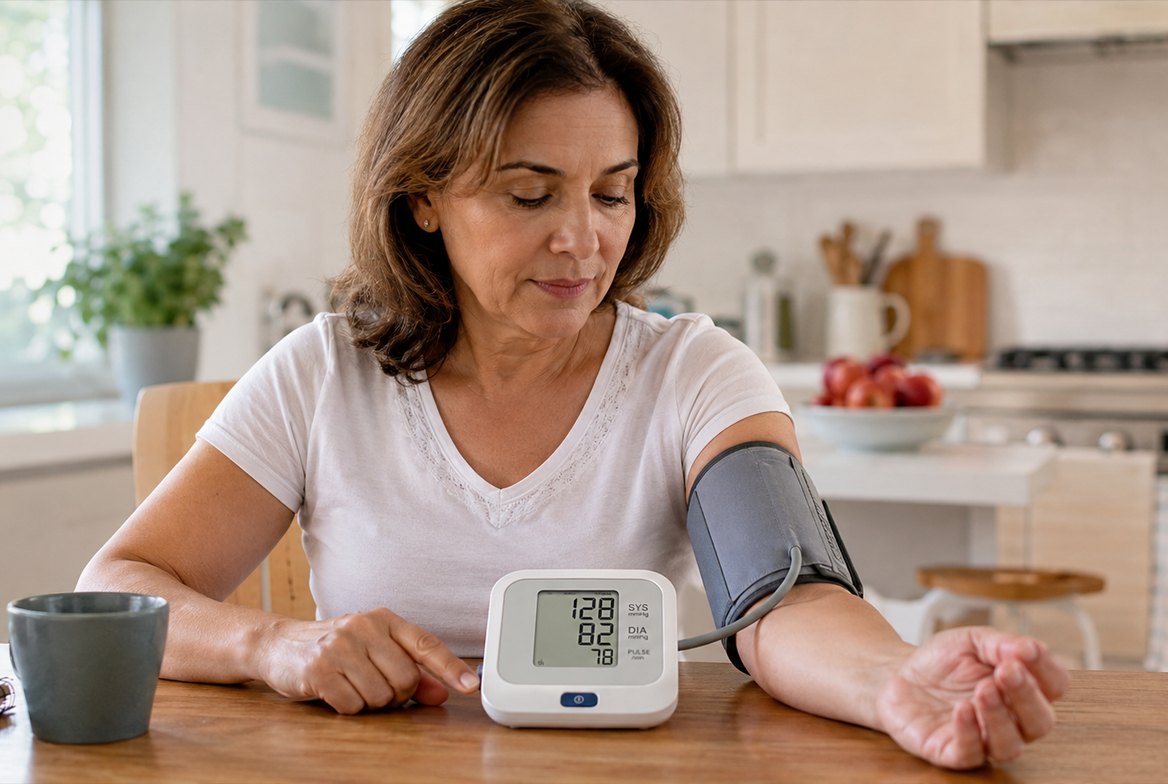
Use a validated upper-arm oscillometric cuff, not a wrist device. Oscillometric means the device estimates blood pressure from the pulsations it detects as the cuff deflates — the standard for home monitors. Upper-arm placement is the point: wrist and finger devices are notoriously position-sensitive and less accurate, because the wrist sits far from the heart and small angle changes swing the reading. Unless a clinician has specifically recommended a wrist device because an arm cuff won’t fit, choose the arm.
Get the cuff size right. A cuff that’s too small reads falsely high; too large, falsely low. This is one of the most common and most consequential errors, especially for larger arms. Measure your arm circumference and match it to the manufacturer’s sizing chart, and buy a larger cuff if you’re between sizes.
Follow the seated, rested protocol. Sit still for five minutes before the first reading. Back supported, feet flat on the floor (not crossed), the cuffed arm bare and resting on a table so the cuff sits at heart level. Don’t talk, don’t scroll your phone, don’t measure right after coffee, a cigarette, or exercise, and empty your bladder first — a full one can add several mmHg.
Average multiple readings over multiple days. A single reading is nearly meaningless. The standard approach that mirrors the trials: take two readings a minute apart, morning and evening, for several consecutive days — typically a week — then average them, often discarding the very first day. Your home blood pressure is that average, not the scariest or the friendliest single number you can find. Log everything, ideally with time stamps, so a clinician sees the pattern rather than a cherry-picked snapshot.
Do this and your home readings become genuinely informative. Skip it — a wrist cuff, mid-conversation, one reading after climbing the stairs — and you’ve built a machine for generating false alarms and false reassurance.
What the numbers mean: home vs clinic targets
A near-universal source of confusion: home readings and clinic readings are not measured against the same threshold. Home blood pressure runs lower than clinic blood pressure in the same person, because the office effect that inflates clinic readings is absent at home. So the thresholds shift down by roughly 5 mmHg systolic.
The widely used equivalence is that a clinic reading of 140/90 mmHg corresponds to a home average of about 135/85 mmHg.6 Guidelines that set a lower clinic goal shift the home target down correspondingly — the 2017 ACC/AHA guideline, which redefined hypertension at 130/80 mmHg in the clinic, pairs that with a home threshold in the same 130/80 range.6 The exact target that applies to you depends on your age, your cardiovascular risk, and which guideline your clinician follows — this is a conversation to have with them, not a line to draw yourself. The general principle, though, is stable and worth internalizing: don’t judge a home reading against a clinic number. A home average of 138/88 is not “normal because it’s under 140” — against the home threshold, it’s elevated.
This cuts both ways emotionally. Some people panic at a 132 systolic that’s actually fine for a clinic goal; others relax at a 136 home reading that’s over the home line. The number only means something once it’s measured against the right yardstick — and interpreted as an average, in context, by someone who knows your risk profile.
Buying a device that’s actually accurate
A blood pressure monitor is a medical instrument, and — uncomfortably — the majority of consumer models on the market have never passed an independent accuracy validation study. A device can be popular, well-reviewed, and cheap while quietly reading several mmHg off, which is enough to misclassify your blood pressure. “It has good ratings” is not the same as “it has been validated.”
The fix is to buy from an independently maintained list of validated devices. Two widely used registries let you check a specific make and model before you buy: ValidateBP.org (run under the auspices of the American Medical Association) and STRIDE BP (an international scientific initiative endorsed by major hypertension societies). Both publish lists of home monitors that have passed a recognized accuracy protocol against a reference standard. Look up the exact model number — validation is model-specific, so a validated line can include unvalidated variants — and if it isn’t on a list, choose one that is. This single step, at no extra cost, is often the difference between data your clinician trusts and data they have to discount.
It’s also worth periodically sanity-checking your device against a clinic reading taken at the same visit; a validated cuff should track closely. If your home monitor and a professionally taken reading disagree by a lot, the device, the cuff size, or your technique is the likely culprit — and that’s worth sorting out before you or your doctor act on the numbers.
Who benefits most
Home monitoring is not equally valuable for everyone, and matching it to the right situation is part of using it well.
People being worked up for a diagnosis benefit enormously, because HBPM separates white-coat and masked hypertension from the real thing and can prevent both unnecessary lifelong treatment and dangerous under-treatment.7 People with poorly controlled hypertension who are actively titrating medication are where the strong-version evidence lives — this is the TASMINH population, and pairing their home readings with a self-titration or clinician-feedback plan is where the meaningful reductions show up.12 Groups where clinic readings are especially unreliable — pregnancy, chronic kidney disease, diabetes, and older adults with variable pressure — also gain, though these are precisely the situations where clinician oversight matters most.
Who benefits least? Someone with well-controlled, stable blood pressure and no management decision pending, for whom daily readings mostly generate anxiety and the occasional false alarm without changing anything. And anyone who buys a monitor, watches the numbers, and never connects them to a plan — the largest and least-served group of all. If your readings never reach a clinician and never trigger an adjustment, you’ve bought the weak version of the intervention and should not expect the strong version’s results.
The hype: the monitor as a passive fix
Now the part the marketing inverts. Because “home monitoring lowers blood pressure” is technically true, an entire category of devices — smart cuffs, app-connected monitors, wearables promising continuous blood pressure — is sold on the implication that owning and using one is itself the treatment. Track your pressure, the pitch goes, and it will come down. This is where the association-versus-mechanism gap becomes a wallet-emptying, outcome-costing error.
The trials are unambiguous that the cuff is not the active ingredient. Tucker’s individual patient data meta-analysis showed the benefit scaled with the co-intervention, not the monitoring; Uhlig’s review showed the effect of monitoring alone was modest and faded.34 Buying a fancier monitor doesn’t change that — a beautifully designed app that graphs your numbers and does nothing else is still just a thermometer with better packaging. The reductions that move stroke and heart-disease risk come from what the readings trigger: a medication change, a titration decision, a clinician or pharmacist who sees the data and acts, or a structured plan you’ve agreed to follow. Break that link — measure endlessly, act never — and you keep the readings without the result. That’s the HYPE claim in plain terms: the device as a passive fix is not supported by a single trial, and never has been.
There’s a second, quieter failure mode worth naming: monitoring that drives up anxiety without driving any action. Some people measure compulsively, catch a normal high reading after a stressful moment, spiral, and re-measure — which raises the next reading further. Used without a plan and without perspective, a monitor can manufacture the very stress it’s supposed to help manage. The tool is only as good as the framework you wrap around it.
The whole home-monitoring story rewards one habit of mind: a measurement only matters if it changes a decision. Home blood pressure monitoring is a genuinely useful, genuinely cheap tool — and a genuinely weak stand-alone intervention. The right question is not “which monitor should I buy,” it’s “what plan will I connect these numbers to, and who is empowered to act on them.” That reframe — pair the measurement with a management pathway, or don’t expect it to work — is the throughline of everything we publish on cardiometabolic risk. The Manual maps the actual levers of blood pressure and cardiovascular health against each other, with the evidence graded and the device hype stripped out. See the Manual →
The honest limits
This is not “home monitoring is pointless.” The opposite: for diagnosis it is close to indispensable, and for people actively titrating medication it is the backbone of a strategy that beats clinic-guided care in randomized trials.12 Dismissing HBPM is as wrong as overselling it. The point is to use it for what it’s good at.
This is also not medical advice, and the boundary matters more here than in most of what we cover, because home readings can tempt people into self-doctoring. Deciding whether you have hypertension, what your target should be, and whether to start, stop, or adjust a medication are clinical decisions that belong with a professional who knows your full history. Self-titration works in the trials because it is structured — a pre-agreed plan built with a clinician, not a patient improvising doses from a home reading. Do not confuse the two. And a home monitor does not replace the periodic professional assessment that catches what a cuff can’t.
Finally, the evidence itself has limits. The blood-pressure reductions from monitoring-plus-management are real and repeatedly replicated, but most trials measured blood pressure, not decades-long stroke and death rates directly, so the hard-outcome benefit is inferred from the well-established link between lower blood pressure and fewer events rather than proven end-to-end in these specific programs. The effect also depends on adherence, on device accuracy, and on a health system able to receive and act on the readings — none of which are guaranteed. Read your home numbers for what they are: a truer picture of your blood pressure than the office gives, and a powerful input to a plan — but only ever as good as the plan you connect them to.
References
- McManus RJ, Mant J, Bray EP, Holder R, et al. Telemonitoring and self-management in the control of hypertension (TASMINH2): a randomised controlled trial. Lancet. 2010;376(9736):163-172. DOI · PMID 20619448
- McManus RJ, Mant J, Franssen M, Nickless A, et al. Efficacy of self-monitored blood pressure, with or without telemonitoring, for titration of antihypertensive medication (TASMINH4): an unmasked randomised controlled trial. Lancet. 2018;391(10124):949-959. DOI · PMID 29499873
- Tucker KL, Sheppard JP, Stevens R, Bosworth HB, et al. Self-monitoring of blood pressure in hypertension: A systematic review and individual patient data meta-analysis. PLoS Med. 2017;14(9):e1002389. DOI · PMID 28926573
- Uhlig K, Patel K, Ip S, Kitsios GD, Balk EM. Self-Measured Blood Pressure Monitoring in the Management of Hypertension: A Systematic Review and Meta-analysis. Ann Intern Med. 2013;159(3):185-194. DOI · PMID 23922064
- Bray EP, Holder R, Mant J, McManus RJ. Does self-monitoring reduce blood pressure? Meta-analysis with meta-regression of randomized controlled trials. Ann Med. 2010;42(5):371-386. DOI · PMID 20504241
- Whelton PK, Carey RM, Aronow WS, Casey DE Jr, et al. 2017 ACC/AHA/AAPA/ABC/ACPM/AGS/APhA/ASH/ASPC/NMA/PCNA Guideline for the Prevention, Detection, Evaluation, and Management of High Blood Pressure in Adults. Hypertension. 2018;71(6):e13-e115. DOI · PMID 29133356
- Fagard RH, Cornelissen VA. Incidence of cardiovascular events in white-coat, masked and sustained hypertension versus true normotension: a meta-analysis. J Hypertens. 2007;25(11):2193-2198. DOI · PMID 17921809