Grip strength and longevity: is it a biomarker of aging, or a lever you can pull?
Few numbers in medicine punch above their weight like grip strength. A cheap spring gauge you squeeze for a couple of seconds turns out to forecast your risk of dying — from anything, and from heart disease specifically — across studies spanning seventeen countries and half a million people. In some analyses it out-predicts systolic blood pressure. That has made it a research darling and, inevitably, a wellness-marketing darling: buy a hand-gripper, train your grip, live longer. But the studies say something more careful and more useful. Grip strength is one of the best prognostic markers we have precisely because it is a proxy for so much else — total-body strength, muscle mass, nutrition, and the absence of frailty. It is a thermometer, not a thermostat. Here is the honest read on what the big cohorts actually show, the crucial gap between association and causation, and where the real longevity lever lives.
How this article was built: Primary sources: the Leong et al. 2015 Prospective Urban Rural Epidemiology (PURE) grip-strength analysis in The Lancet, the Celis-Morales et al. 2018 UK Biobank cohort study in The BMJ, the Celis-Morales et al. 2017 physical-activity-and-grip analysis in the European Heart Journal, the García-Hermoso et al. 2018 systematic review and meta-analysis in Archives of Physical Medicine and Rehabilitation, the Volaklis et al. 2015 narrative review in the European Journal of Internal Medicine, the Bohannon 2019 biomarker review in Clinical Interventions in Aging, and the Fragala et al. 2019 resistance-training position statement in the Journal of Strength and Conditioning Research — all retrieved and verified through PubMed and the Consensus research database.
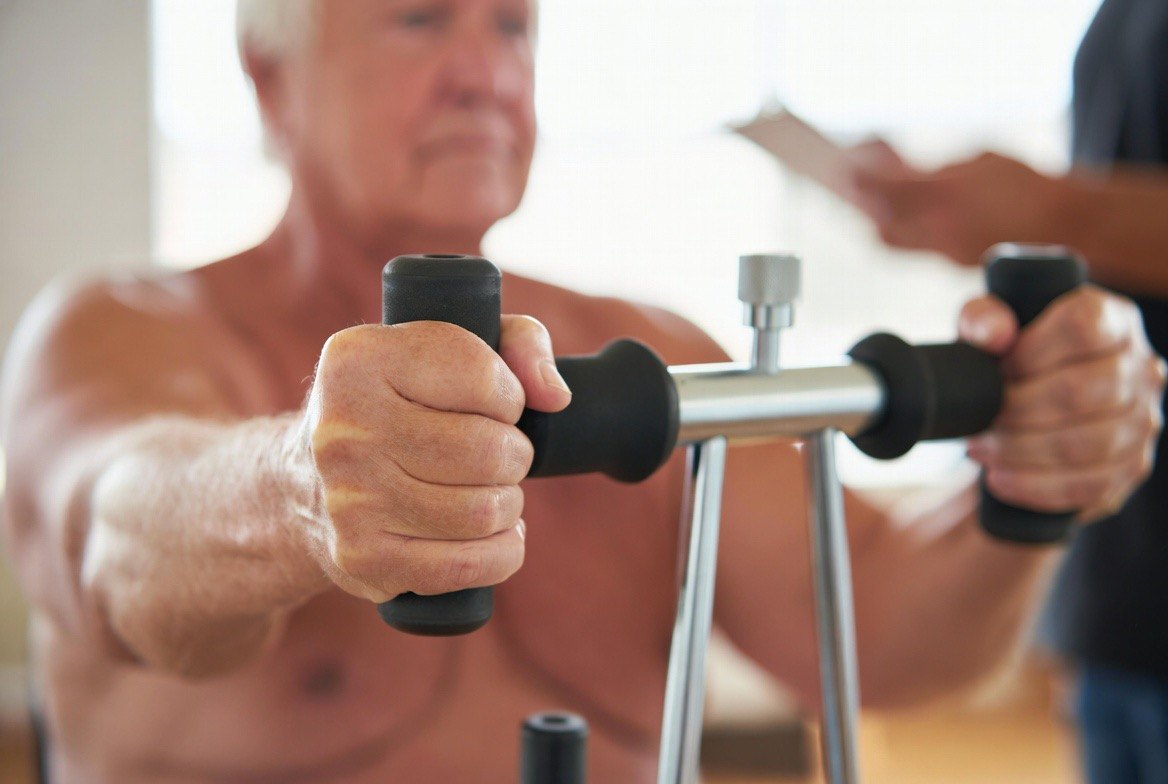
- The association is real and huge. In the PURE study across 17 countries, each roughly 5 kg drop in grip strength was linked to a 16% higher risk of all-cause death and a 17% higher risk of cardiovascular death.1 UK Biobank replicated it in half a million people.2
- It is a marker, not a mechanism. Grip strength forecasts mortality because it stands in for total-body strength, muscle mass, nutrition, and the absence of frailty — not because your hands drive your lifespan.6
- The lever is whole-body training. Progressive resistance training and adequate protein build the strength and muscle that grip reflects; that’s the intervention with a plausible causal story.7
- The gripper is not the answer. Squeezing a hand-gripper improves your grip number without touching the systemic health it was standing in for. Don’t train the thermometer.4
- Why grip strength became a research darling
- What the big cohorts show: PURE and UK Biobank
- Association vs causation: the whole ballgame
- Sarcopenia and the aging body
- What actually moves the needle
- How to measure and read your grip
- The hype: grippers and single-test thinking
- Who should care — and how to act
- Where it fits: a tiered view
- What this article is not saying
- References
Why grip strength became a research darling
Epidemiologists love grip strength for a boring, powerful reason: it is almost absurdly easy to measure well. You hand someone a dynamometer — a handheld device that reads the force of a squeeze in kilograms (kg), the standard unit for these measurements — ask them to crush it, and read the number. It takes seconds, costs almost nothing, needs no lab, no blood draw, and no radiation, and it is highly reproducible: the same person tested twice gives nearly the same reading, and different testers agree closely.6 In a field where most useful measurements are expensive, invasive, or noisy, a cheap and reliable one is gold.
But cheap and reliable would be worthless if the number were meaningless. What earned grip strength its research status is that the number keeps predicting things it has no obvious business predicting. Richard Bohannon’s 2019 review, aptly titled “Grip Strength: An Indispensable Biomarker for Older Adults,” catalogued how a single squeeze reading tracks with concurrent overall body strength, bone density, nutritional status, cognitive function, depression, multimorbidity, and quality of life — and predicts future mortality, disability, fractures, and hospital complications.6 A number that correlates with that many things is not measuring your hands. It is measuring something much larger, showing through your hands.
That is the correct frame from the outset. Grip strength is a window. Its value is not intrinsic to grip; it is that grip happens to be a clean, unbiased readout of whole-body strength and vitality — the kind of thing that is otherwise hard to capture in a single number.
What the big cohorts show: PURE and UK Biobank
The study that put grip strength on the map for cardiovascular medicine is the Prospective Urban Rural Epidemiology (PURE) study, reported by Darryl Leong and colleagues in The Lancet in 2015. PURE followed nearly 140,000 adults across 17 countries spanning high-, middle-, and low-income economies, measured their grip strength once with a standardized dynamometer, and tracked who died. The headline finding was striking in its consistency: each roughly 5 kg lower grip strength was associated with a 16% higher risk of all-cause death (hazard ratio [HR] 1.16 — a hazard ratio is the relative risk between groups; above 1.0 means higher risk), a 17% higher risk of cardiovascular death, and higher risk of heart attack and stroke.1 The relationship held across countries and income levels, which is exactly the kind of robustness that makes epidemiologists sit up.
The line that launched a thousand headlines was that in PURE’s analysis, grip strength was a stronger predictor of all-cause and cardiovascular mortality than systolic blood pressure — the top number on a blood-pressure reading and one of the most established risk factors in medicine.1 That comparison is genuinely arresting, and it is also frequently over-read; we return to what it does and doesn’t mean below.
PURE could have been a fluke of one dataset. It wasn’t. Carlos Celis-Morales and colleagues replicated and extended it in the UK Biobank — a prospective cohort of roughly half a million UK adults — published in The BMJ in 2018. Grip strength was strongly and inversely associated with all-cause mortality and with incidence of and death from cardiovascular disease, respiratory disease, chronic obstructive pulmonary disease, and multiple cancers.2 An earlier Celis-Morales analysis in the European Heart Journal added a nuance that matters: grip strength and cardiorespiratory fitness modulated the relationship between physical activity and mortality — strength wasn’t just a bystander, it interacted with how protective activity was.3
Zoom out to the pooled evidence and the picture holds. Antonio García-Hermoso and colleagues’ 2018 systematic review and meta-analysis in Archives of Physical Medicine and Rehabilitation synthesized data from approximately 2 million men and women and found that higher muscular strength was associated with roughly a 31% lower risk of all-cause mortality than lower strength (hazard ratio 0.69).4 Konstantinos Volaklis’s 2015 narrative review reached the same conclusion across epidemiological and clinical studies: muscular strength is inversely and independently associated with mortality.5 The association is about as replicated as associations in this field get.
death risk
per ~5 kg lower grip (PURE)
UK Biobank replication
17 countries in PURE
higher vs lower strength
meta-analysis, ~2M people
Association vs causation: the whole ballgame
Here is the distinction that separates an honest read from a marketing pitch, and it is the single most important idea in this article. Every study above shows association: weaker grip travels with higher mortality. None of them shows causation: that being weak causes earlier death, or — the leap the wellness industry makes — that making your grip stronger, by itself, lengthens your life.
Why the gap? Because grip strength is a proxy. It is a single, convenient readout that is entangled with a dozen things that genuinely affect how long you live:
It reflects total-body strength and muscle mass. A strong grip usually means a strong body, and higher muscle mass is metabolically protective, supports mobility, and cushions the metabolic hit of illness. Grip is just the easiest place to read the whole system.6
It reflects nutrition and reserve. Chronic undernutrition and low protein intake sap strength. A weak grip can be the visible tip of a nutritional deficit that independently raises mortality risk.
It reflects the absence of frailty and hidden disease. This is the big one, and it cuts to a phenomenon called reverse causation. Many serious illnesses — undiagnosed cancer, heart failure, chronic inflammatory disease — quietly sap strength for months or years before they are diagnosed or prove fatal. In those people, low grip strength isn’t causing death; it is an early symptom of the disease that is. The illness lowered the grip, and the illness caused the death. Grip was the messenger.
Good studies try to strip these confounders out — adjusting for age, smoking, physical activity, existing disease, and socioeconomic status — and the grip-mortality association survives adjustment, which is why it is taken seriously.12 But statistical adjustment can never fully remove reverse causation and unmeasured confounding from observational data. That is a hard limit of the study design, not a flaw in any one paper. The correct conclusion is the careful one: grip strength is an excellent marker of how healthy and robust your whole system is, and a genuinely useful one for a clinician deciding who needs closer attention. Whether grip itself is on the causal path to longevity is a separate, largely unanswered question.
A weak grip is a smoke alarm. It reliably tells you something may be on fire somewhere in the system — but silencing the alarm doesn’t put out the fire.
Sarcopenia and the aging body
To understand why grip strength maps so tightly onto aging, you need one concept: sarcopenia, the age-related loss of muscle mass and strength. From roughly the fourth decade onward, adults lose muscle steadily — and lose strength even faster than they lose mass, because aging degrades not just muscle bulk but the nervous system’s ability to recruit it. Grip strength is one of the clinical thresholds used to flag sarcopenia precisely because it captures that strength loss cheaply.6
Sarcopenia is not cosmetic. Muscle is the body’s largest reservoir of amino acids and a major site of glucose disposal; losing it degrades metabolic health, mobility, balance, and the physical reserve you draw on to survive an illness, a fall, or a hospital stay. This is the biological substance behind the grip-mortality curve. A declining grip reading in an older adult is, quite often, sarcopenia becoming visible — and sarcopenia is a real, modifiable driver of frailty, disability, and death. That word — modifiable — is where the story finally turns toward something you can act on.
What actually moves the needle
If low strength is entangled with mortality, and much of that low strength is age-related muscle loss, then the intervention with a plausible causal story is obvious: build and preserve muscle across your whole body. Not your grip in isolation — your body.
The tool for that is progressive resistance training: working muscles against a load that you gradually increase over time — weights, bands, machines, or bodyweight. Unlike the observational grip data, resistance training has been tested in randomized controlled trials (RCTs — studies that randomly assign people to an intervention or control, the design best able to establish cause and effect), and the causal evidence that it builds strength and muscle in older adults is robust. The 2019 National Strength and Conditioning Association position statement, led by Maren Fragala, synthesized this literature and concluded that resistance training reliably improves muscle strength, muscle mass, physical function, and a range of health markers in older adults, and is safe when appropriately prescribed.7 It directly reverses the sarcopenic process that grip strength was flagging.
Does resistance training extend life? Here we stay honest: observational cohorts consistently associate regular strength training with lower all-cause and cardiovascular mortality, often in the range of a 10–20% reduction, and the effect appears strongest when strength training is combined with aerobic activity.57 That is stronger evidence than for grip-training because it targets the underlying variable — whole-body strength and muscle — rather than a proxy, and because the RCT base establishes that training genuinely causes the strength gains. It is still not proof that training adds years; the mortality link remains observational. But it is the most defensible bet on the board.
The second lever is protein. Muscle is built from amino acids, and older adults need more dietary protein than younger ones to trigger the same muscle-building response — a phenomenon called anabolic resistance. Adequate protein intake paired with resistance training is what actually preserves the muscle that grip strength reflects. If you want to sanity-check whether your intake is in the right zone for your body weight, our protein target tool is a quick way to see what a per-kilogram intake looks like for your frame.
How to measure and read your grip
If grip strength is a useful marker, it is reasonable to want to track your own — as a data point, not a destiny. The clinical standard is a hydraulic hand dynamometer, tested seated with the elbow bent at 90 degrees, taking the best of a few maximal squeezes in each hand. Inexpensive home dynamometers exist and are fine for tracking your own trend over time, even if their absolute numbers won’t exactly match a clinical device.
Interpret cautiously. Grip strength varies enormously with age, sex, body size, and hand dominance, so a single reading in isolation means little; the informative signal is your trend over months and years, and how you compare to age- and sex-matched norms. Commonly cited clinical cut-points for probable sarcopenia sit around the low-to-mid 20s of kilograms for older women and the low 30s for older men, but these are screening flags, not diagnoses.6 A below-average reading is a prompt to look at the whole picture — activity, nutrition, and any unexplained weakness or weight loss — and, if something seems off, to raise it with a clinician. It is emphatically not a countdown clock.
The hype: grippers and single-test thinking
Now the part the marketing gets backwards. Because “grip strength predicts longevity” is true and eye-catching, a cottage industry has sprung up selling the conclusion that training your grip — with spring hand-grippers, grip trainers, and forearm work — is a longevity intervention. This is where the association-versus-causation gap becomes a practical, wallet-emptying error.
Squeezing a hand-gripper will absolutely make your grip number go up. What it will not do is change the thing that number was standing in for. Your forearm crushing strength is not what protects you from cardiovascular disease, sarcopenia, or frailty; whole-body muscle mass, metabolic health, and physical reserve are. Improving grip in isolation is training the thermometer to read higher while the room stays exactly as cold. The strength-mortality data come from grip as a reflection of systemic strength — break that link by targeting grip alone, and you keep the number without the substance.4 Grip work has real, narrow uses — for climbers, lifters, and rehab — but “live longer” isn’t one of them, and no study has ever shown that isolated grip training lowers mortality.
The second inflation is single-test thinking: the claim that grip strength is the longevity test, the one number that beats all others. The PURE line that grip out-predicted systolic blood pressure fuels this, but it is over-read.1 Out-predicting one risk factor in one analysis does not make grip a master key. It is one excellent marker among several — alongside cardiorespiratory fitness, gait speed, and standard cardiometabolic labs — and the honest use is as part of a fuller picture, not as a stand-alone oracle. Longevity has no single test, and anyone selling you one is selling.
Who should care — and how to act
For clinicians and older adults, grip strength earns its place: a cheap, fast squeeze that helps flag who may be frail, sarcopenic, or carrying hidden risk, and who therefore warrants a closer look. Used that way — as a screening prompt inside a broader assessment — it is one of the highest-value low-cost measurements in medicine.6
For the generally healthy person reading this and wondering what to do, the answer is refreshingly boring and doesn’t involve buying a gripper. Treat a low or declining grip reading as a signal to invest in the thing it reflects: get stronger everywhere. Two to three sessions a week of whole-body resistance training, progressed over time, plus enough protein to support it, is the intervention that targets the underlying variable. Grip will rise as a byproduct of getting your whole body stronger — and that is the direction of causation you actually want. You can track your grip as one number among several to watch the trend, but train the body, not the gauge.
Where it fits: a tiered view
It helps to place grip strength honestly on a spectrum of what it can and can’t do for you.
Foundational — the real lever. Whole-body progressive resistance training and adequate protein are the causally-supported foundation. They build the strength, muscle, and metabolic reserve that grip strength was quietly measuring all along. If you do one thing after reading this, make it this — and pair it with regular aerobic activity, since the mortality benefit looks largest when both are present.7
Useful marker — the readout. Grip strength is a legitimate, cheap way to track and screen — a data point that tells you whether your foundational work is paying off and flags when something may be slipping. Read it as a trend, in context, alongside other markers. Value it; just don’t worship it.6
Misguided — training the proxy. Isolated grip training as a longevity strategy, or treating a single grip number as a verdict on your lifespan, is the weakest-supported use. The physiology doesn’t line up, and no study supports it. Spend that effort on the compound lifts and the protein instead.
The whole grip-strength story rewards one habit of mind: never confuse the readout with the thing being read. Grip strength is a superb signal of whole-body vitality — and a terrible target to chase on its own. The right question is not “how do I make my grip number higher,” it’s “how do I build the whole-body strength, muscle, and metabolic health that a good grip number reflects.” That reframe — act on the driver, not the dial — is the throughline of everything we publish on preservation and healthy aging. The Manual maps the actual levers of muscle preservation and metabolic health against each other, with the evidence graded and the hype stripped out. See the Manual →
What this article is not saying
This is not “grip strength is meaningless.” The opposite: it is one of the most powerful, best-replicated, and most cost-effective prognostic markers we have, validated across seventeen countries and millions of people.14 A clinician who uses it to spot at-risk patients is using good evidence well. Dismissing grip strength is as wrong as over-hyping it.
This is not “strength doesn’t matter for longevity.” Whole-body strength almost certainly does — that is exactly why its proxy predicts mortality so well — and building it through resistance training is the most defensible longevity-adjacent lever most people have. The point is to aim at the right thing.
And this is not a personal prognosis. A grip reading is a population-level statistic, not a sentence handed to an individual. Plenty of people with below-average grip live long, healthy lives, and a strong grip guarantees nothing. If your reading concerns you, or if you notice unexplained weakness or weight loss, that is a conversation for a clinician — not a number to catastrophize over, and not a problem to solve with a spring gripper. The point of this piece is to help you read the marker for what it is: a signal worth heeding, pointing at a lever worth pulling.
References
- Leong DP, Teo KK, Rangarajan S, Lopez-Jaramillo P, et al. Prognostic value of grip strength: findings from the Prospective Urban Rural Epidemiology (PURE) study. Lancet. 2015;386(9990):266-273. DOI · PMID 25982160
- Celis-Morales CA, Welsh P, Lyall DM, Steell L, et al. Associations of grip strength with cardiovascular, respiratory, and cancer outcomes and all cause mortality: prospective cohort study of half a million UK Biobank participants. BMJ. 2018;361:k1651. DOI · PMID 29739772
- Celis-Morales CA, Lyall DM, Anderson J, Iliodromiti S, et al. The association between physical activity and risk of mortality is modulated by grip strength and cardiorespiratory fitness: evidence from 498 135 UK-Biobank participants. Eur Heart J. 2017;38(2):116-122. DOI · PMID 28158566
- García-Hermoso A, Cavero-Redondo I, Ramírez-Vélez R, Ruiz JR, et al. Muscular Strength as a Predictor of All-Cause Mortality in an Apparently Healthy Population: A Systematic Review and Meta-Analysis of Data From Approximately 2 Million Men and Women. Arch Phys Med Rehabil. 2018;99(10):2100-2113.e5. DOI · PMID 29425700
- Volaklis KA, Halle M, Meisinger C. Muscular strength as a strong predictor of mortality: A narrative review. Eur J Intern Med. 2015;26(5):303-310. DOI · PMID 25921473
- Bohannon RW. Grip Strength: An Indispensable Biomarker For Older Adults. Clin Interv Aging. 2019;14:1681-1691. DOI · PMID 31631989
- Fragala MS, Cadore EL, Dorgo S, Izquierdo M, et al. Resistance Training for Older Adults: Position Statement From the National Strength and Conditioning Association. J Strength Cond Res. 2019;33(8):2019-2052. DOI · PMID 31343601