Tart cherry: what the evidence actually shows for recovery, sleep, and gout
Tart cherry — the Montmorency variety, sold as juice, concentrate, or powder — is one of the few “functional food” supplements with real human trial data behind it. But the three claims it carries are not equally well supported. The strongest evidence is for exercise recovery: less muscle soreness, faster strength recovery, and lower inflammation after hard training. The sleep and gout signals are genuine but thinner, resting on smaller trials. Here is the honest read on where tart cherry earns its place, where it is oversold, and why it is a useful edge for hard-training athletes — modest, not magic.
How this article was built: Primary sources: the Hill et al. 2021 systematic review and meta-analysis in the International Journal of Sport Nutrition and Exercise Metabolism, the Howatson et al. 2010 marathon-recovery randomized trial in the Scandinavian Journal of Medicine & Science in Sports, the Howatson et al. 2012 melatonin/sleep crossover trial in the European Journal of Nutrition, the Losso et al. 2018 insomnia pilot in the American Journal of Therapeutics, the Zhang et al. 2012 case-crossover study of gout attacks in Arthritis & Rheumatism, and the Chen et al. 2019 systematic review of cherries and uric acid in Evidence-Based Complementary and Alternative Medicine — all retrieved and verified through PubMed and the Consensus research database.
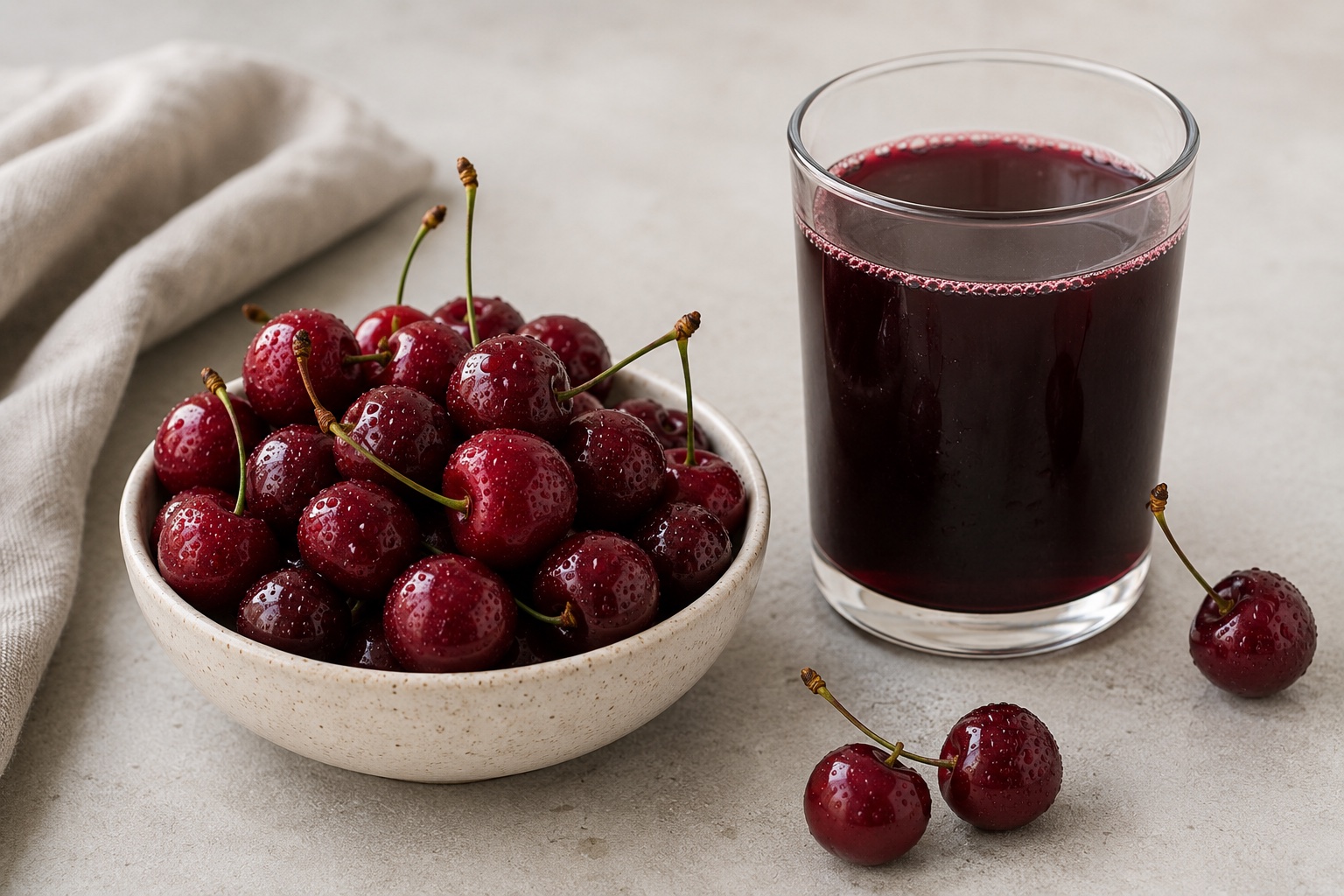
- Recovery is the best-supported use. A meta-analysis of 14 studies found tart cherry meaningfully reduced muscle soreness and sped recovery of strength and power after strenuous exercise — the effect is most useful around hard eccentric sessions and endurance events.1
- Sleep is promising but thinner. Small randomized trials show modest gains in sleep time and efficiency, plausibly via the cherry’s natural melatonin and tryptophan-sparing effects — real, but built on a dozen-or-so participants per study.34
- Gout is the most cautious claim. Cherry intake is linked to lower uric acid and roughly a third fewer recurrent gout attacks — but this is mostly observational, and it is an add-on, never a replacement for gout medication.5
- Modest, not magic — and watch the sugar. Effects are real but small, many trials are small, and a daily glass of juice or concentrate carries a real sugar load that matters for anyone managing blood glucose.
- What tart cherry actually is
- The mechanism: pigments, not magic
- The recovery evidence (the strong case)
- The sleep evidence (promising, thinner)
- The gout and uric-acid evidence (most cautious)
- Dose, form, and timing: what the trials used
- Where it fits: a tiered view
- Grey areas and the sugar problem
- Common questions
- What this article is not saying
- References
What tart cherry actually is
“Tart cherry” in the supplement world almost always means the Montmorency variety of Prunus cerasus — a sour cherry, distinct from the sweet Bing cherries you eat fresh. Because it is too sour to enjoy by the handful, it reaches you concentrated: as a juice, a thick concentrate you dilute, or a freeze-dried powder or capsule. That concentration is the whole point, because the active fraction is not the sugar or the water but the deep-red pigments packed into the skin.
Those pigments are anthocyanins — the flavonoid compounds that give tart cherries, blueberries, and red grapes their color. Anthocyanins are potent antioxidants and modulate inflammatory signaling, and tart cherries are unusually dense in them. The cherry also carries a small but real amount of melatonin, the hormone that times your sleep–wake cycle, plus the amino acid tryptophan. So a single food is pulling on three different signals at once — an anti-inflammatory signal, a sleep-timing signal, and a uric-acid signal — which is exactly why the same juice gets pitched for recovery, sleep, and gout. The honest question is how strong each of those pulls actually is.
The mechanism: pigments, not magic
The unifying thread across all three uses is the anthocyanin load, and the signal it pulls is dampened inflammation and oxidative stress. Strenuous exercise — especially the eccentric, muscle-lengthening kind, like the downhill portion of a run or the lowering phase of a heavy lift — causes micro-damage that triggers an inflammatory and oxidative cascade. That cascade is part of why you feel sore and weak for a day or two afterward. The anthocyanins in tart cherry appear to blunt the peak of that cascade, lowering circulating inflammatory markers such as interleukin-6 (IL-6) and C-reactive protein (CRP, a general inflammation marker) and raising the body’s total antioxidant capacity.2
The sleep story leans on a different but overlapping mechanism. Tart cherry contains its own melatonin, and trials confirm that drinking the concentrate measurably raises circulating melatonin levels — the body’s own sleep-onset cue.3 There is a second, subtler route: the cherry’s anti-inflammatory compounds appear to spare tryptophan, the precursor your body uses to build both serotonin and melatonin, by inhibiting an enzyme (indoleamine 2,3-dioxygenase, or IDO) that would otherwise degrade it.4
The gout angle runs through uric acid. Anthocyanins and related polyphenols appear to nudge the body toward excreting more urate and producing slightly less of it, lowering the serum uric acid that, when it crystallizes in a joint, drives a gout flare.6 Notably, the marathon-recovery trial below measured this directly and found cherry juice lowered uric acid as a side observation — the recovery and gout stories share a root.2
One food, three signals: an anti-inflammatory pull for recovery, a melatonin pull for sleep, and a urate pull for gout. The pulls are real — but they are nudges, not levers.
The recovery evidence (the strong case)
This is where tart cherry has genuinely earned its reputation, and where the data are deepest. The best single summary is Hill and colleagues’ 2021 systematic review and meta-analysis, which pooled 14 studies of tart cherry and exercise recovery.1 Pooling the trials gave a clear, consistent picture: tart cherry produced a small-but-meaningful reduction in muscle soreness (effect size −0.44) and a moderate benefit for recovery of muscular strength (effect size −0.78) and power (effect size −0.53), with a large effect specifically on the recovery of jump height (effect size −0.82).1 On the inflammatory side, it lowered CRP and IL-6 (small effects), while creatine kinase — a raw muscle-damage marker — and TNF-α were not significantly moved.1 Read honestly, that pattern says tart cherry helps you recover function faster more than it prevents the underlying damage.
The anchor randomized trial behind that picture is Howatson and colleagues’ 2010 study of 20 recreational marathon runners, who drank tart cherry juice or placebo around a marathon.2 The cherry group recovered isometric strength significantly faster (P=0.024), showed lower inflammation (IL-6, P<0.001; CRP, P<0.01), carried roughly 10% greater total antioxidant status, and had lower lipid peroxidation (a marker of oxidative damage) at 48 hours post-race — and, tellingly, lower uric acid too (P<0.05).2 This is the through-line: the strongest case for tart cherry is around strenuous, damaging events — marathons, multi-day tournaments, brutal eccentric sessions — not gentle gym days.
Two honesty notes. First, “moderate effect size” is not “you will feel transformed.” These are real, reproducible nudges to recovery, not a different body. Second, the individual trials are mostly modest in size (the marathon study was 20 people), so while the pooled signal is solid, any single study’s precision is limited. The meta-analysis is what lifts this claim to MODERATE rather than EMERGING — multiple trials, pointing the same way.
in the meta-analysis
consistent recovery signal
strength recovery
moderate, real benefit
status post-marathon
vs placebo
The sleep evidence (promising, thinner)
The sleep claim is real but rests on a much smaller foundation. The cornerstone is Howatson and colleagues’ 2012 trial: 20 healthy volunteers in a randomized, double-blind, placebo-controlled crossover took tart cherry concentrate for seven days.3 Circulating melatonin rose significantly on cherry, and the participants logged modest but significant increases in time in bed, total sleep time, and sleep efficiency (the share of in-bed time actually spent asleep).3 These were healthy sleepers, so the effect is a nudge in already-decent sleep, not a rescue of broken sleep.
The most striking number comes from a smaller, more fragile study: Losso and colleagues’ 2018 insomnia pilot. In just 8 completers (an open caveat — this is a small, mechanistic pilot, not a definitive trial) with chronic insomnia, two weeks of tart cherry juice twice daily increased polysomnography-measured sleep time by 84 minutes (P=0.018) and improved sleep efficiency.4 The same study traced a plausible mechanism — the cherry’s procyanidin B-2 inhibited the tryptophan-degrading enzyme IDO, sparing the raw material for melatonin and serotonin.4 An 84-minute gain is eye-catching, but with eight people it has to be read as a signal to chase with bigger trials, not a settled result.
The honest grade here is EMERGING. The direction is consistent, the mechanism (real melatonin content, plus tryptophan-sparing) is biologically clean, but the trials are small and there is no large, independent, long-term RCT for sleep specifically. It is reasonable to try; it is not something to oversell.
The gout and uric-acid evidence (most cautious)
Of the three claims, gout is where you should hold the most caution — and read the disclaimer hardest. The most-cited human data is Zhang and colleagues’ 2012 case-crossover study, which followed 633 people with gout for a year and compared periods with and without cherry intake.5 Cherry consumption over a two-day window was associated with a 35% lower risk of a recurrent gout attack (odds ratio 0.65, 95% CI 0.50–0.85); cherry extract showed a similar 45% reduction; and combining cherry intake with allopurinol (the standard urate-lowering drug) cut attack risk by 75% (OR 0.25).5
A 2019 systematic review of six studies reached the same broad conclusion: cherry intake correlates with lower serum uric acid and fewer gout flares — but the authors flagged that they could not run a proper meta-analysis because the studies were few and methodologically scattered, and called for larger, longer trials.6 That caveat is the headline. This is mostly observational and small-trial evidence, not a body of large RCTs.
Two things follow, and they are non-negotiable. First, a case-crossover association is not proof that cherries cause fewer attacks — though the dose-response and the allopurinol synergy make the signal more credible than a typical food-frequency correlation. Second, and more important: the very study showing the biggest benefit showed it alongside allopurinol, not instead of it. Tart cherry is a plausible add-on. It is not a replacement for prescribed urate-lowering therapy, and using it to dodge gout medication is exactly the kind of mistake that lands people in an ER mid-flare.
Dose, form, and timing: what the trials used
We do not hand out prescriptive doses, but the trial protocols are worth stating plainly because they are fairly consistent. The recovery and sleep studies generally used Montmorency cherry concentrate diluted in water (on the order of 30 mL of concentrate, roughly equivalent to 90–100 whole cherries, once or twice daily) or a comparable volume of single-strength juice.23 For recovery, the typical protocol started 4–5 days before a hard event and continued through the 48 hours after — loading the antioxidant capacity in advance, not chugging it once post-workout. For sleep, the dose was taken across the day with a portion in the evening.
Form matters for reasons beyond convenience. Concentrate delivers the most anthocyanins per calorie and is what most trials used. Single-strength juice works but carries far more sugar and volume for the same active dose. Powder and capsules are the most convenient and the lowest-sugar, but the anthocyanin content varies widely by product and is not always standardized, so a capsule is only as good as its actual polyphenol load — which the label may not disclose. If you are managing blood glucose, the powder or capsule route sidesteps the sugar problem entirely. For a broader map of how dose and form trade off across recovery supplements, see our supplements reference.
Where it fits: a tiered view
It helps to place tart cherry honestly on a spectrum of who it is actually for.
Foundational — fix the inputs first. No juice competes with the basics. For recovery, that is sleep, protein intake, and managing training load. For sleep, it is a consistent schedule, a cool dark room, and capping late caffeine. For gout, it is urate-lowering medication when prescribed, hydration, and diet. Tart cherry is a layer on top of those, never a substitute for them — the same logic we apply to every recovery tool.
Research-curious — the targeted trial-of-one. If your foundations are solid, tart cherry is one of the better-supported additions for a specific job: the days around a hard race, tournament, or brutal eccentric block, where the meta-analytic data are strongest.1 Expect faster return of strength and less soreness — a real edge, not a transformation. The sleep and gout uses sit lower on the confidence ladder but are low-risk to try.
Experimental — leaning on it as a treatment. Using tart cherry to manage diagnosed gout in place of medication, or to treat chronic insomnia as a standalone fix, is the weakest-supported use. The gout data are largely observational; the insomnia data come from a handful of people. These are clinician conversations, not juice experiments.
Tart cherry is a real, low-risk recovery nudge — but it sits inside a much larger recovery-and-sleep toolkit, and the worst mistake is treating any single supplement as the answer. The right question is rarely “cherry: yes or no,” it’s “what actually moves my recovery, and where does cherry rank against protein timing, cold exposure, curcumin, and sleep?” The Manual maps the recovery-and-sleep compounds against each other — what each one’s evidence genuinely supports, the dose and timing windows, who benefits and who is wasting their money, and how to stack them without fooling yourself. See the Manual →
Grey areas and the sugar problem
The sugar load is the real catch. A daily glass of tart cherry juice, or a daily dose of concentrate, carries a meaningful amount of sugar — concentrated fruit sugar, but sugar all the same. For a lean endurance athlete burning through glycogen, that is a non-issue and arguably useful fuel. For someone with diabetes, prediabetes, or who is managing weight, a daily sugary juice habit can quietly work against the goal. This is the single most-overlooked downside, and it is why the powder or capsule form deserves a serious look for anyone watching blood glucose.
The “blunting adaptation” debate. Because tart cherry works by dampening exercise-induced inflammation and oxidative stress, and because some of that inflammation is part of how muscle adapts and grows stronger, there is an open question about whether daily year-round use could blunt long-term training adaptations — the same debate that surrounds high-dose antioxidant vitamins. The practical read: reserve it for the periods where fast recovery is the priority (competition, tournaments, peak race blocks) rather than taking it every single day through a building phase. The evidence here is mechanistic and unsettled, not proven either way.
Not a cure-all, and not a gout drug. The genuinely unsupported claim is the marketing one: that tart cherry is a do-everything tonic that fixes recovery, sleep, and gout in one bottle. The recovery data are MODERATE; the sleep and gout data are EMERGING; and the “replaces your medication” framing is HYPE with no evidence behind it. Hold each claim to its own grade, and tart cherry is a useful, honest tool. Treat it as a panacea and you have left the science behind.
Common questions
Does tart cherry actually help muscle recovery, or is it placebo? The recovery claim is the best-supported of the three. A meta-analysis of 14 studies found consistent reductions in soreness and faster recovery of strength and power, with measurable drops in inflammatory markers — not a placebo-sized effect, but a moderate, real one, strongest around hard, damaging events.12
Will it help me sleep? Possibly, modestly. Small randomized trials show gains in sleep time and efficiency, plausibly via the cherry’s natural melatonin and tryptophan-sparing effects.34 Expect a nudge, judged over a couple of weeks, not a single dramatic night. The evidence base is thinner than for recovery.
Can it treat my gout? It may help reduce flares as an add-on — cherry intake is linked to roughly a third fewer recurrent attacks and lower uric acid — but the evidence is largely observational and it is not a replacement for prescribed gout medication.56 If you have gout, the cherry conversation belongs with your clinician, alongside your urate-lowering therapy.
Juice, concentrate, or capsule — which is best? Concentrate delivers the most anthocyanins per calorie and is what most trials used. Single-strength juice works but carries the most sugar. Powder and capsules are the lowest-sugar and most convenient, but the active content varies by product, so quality matters more than with the standardized concentrate.
When should I take it for recovery? The trials that worked best started loading 4–5 days before a hard event and continued through the 48 hours after — building antioxidant capacity in advance, not relying on a single post-workout dose.2
What this article is not saying
This is not “tart cherry doesn’t work.” For exercise recovery, the meta-analytic evidence is genuinely good, the mechanism is well characterized, and for the right athlete around the right event it is one of the better-supported functional foods available. Dismissing it outright is as wrong as overselling it.
This is not “tart cherry will transform your sleep or cure your gout.” The sleep and gout signals are real but built on small and largely observational studies, the effects are modest, and there is no large independent long-term RCT for either. A gentle, plausible, well-tolerated edge is what the evidence supports — and what the marketing inflates.
And this is not a dosing prescription or a substitute for gout medication. If you have gout or chronic insomnia, that deserves a clinician, not a juice swap; and if you are managing blood glucose, the sugar in juice and concentrate is a real consideration. The point of this piece is to tell you what the trials show, claim by claim, so your expectations — and your shopping — can be honest ones.
References
- Hill JA, Keane KM, Quinlan R, Howatson G. Tart Cherry Supplementation and Recovery From Strenuous Exercise: A Systematic Review and Meta-Analysis. Int J Sport Nutr Exerc Metab. 2021;31(2):154-167. DOI: 10.1123/ijsnem.2020-0145. PMID: 33440334.
- Howatson G, McHugh MP, Hill JA, Brouner J, Jewell AP, van Someren KA, Shave RE, Howatson SA. Influence of tart cherry juice on indices of recovery following marathon running. Scand J Med Sci Sports. 2010;20(6):843-852. DOI: 10.1111/j.1600-0838.2009.01005.x. PMID: 19883392.
- Howatson G, Bell PG, Tallent J, Middleton B, McHugh MP, Ellis J. Effect of tart cherry juice (Prunus cerasus) on melatonin levels and enhanced sleep quality. Eur J Nutr. 2012;51(8):909-916. DOI: 10.1007/s00394-011-0263-7. PMID: 22038497.
- Losso JN, Finley JW, Karki N, Liu AG, Prudente A, Tipton R, Yu Y, Greenway FL. Pilot Study of the Tart Cherry Juice for the Treatment of Insomnia and Investigation of Mechanisms. Am J Ther. 2018;25(2):e194-e201. DOI: 10.1097/MJT.0000000000000584. PMID: 28901958.
- Zhang Y, Neogi T, Chen C, Chaisson C, Hunter DJ, Choi HK. Cherry consumption and decreased risk of recurrent gout attacks. Arthritis Rheum. 2012;64(12):4004-4011. DOI: 10.1002/art.34677. PMID: 23023818.
- Chen PE, Liu CY, Chien WH, Chien CW, Tung TH. Effectiveness of Cherries in Reducing Uric Acid and Gout: A Systematic Review. Evid Based Complement Alternat Med. 2019;2019:9896757. DOI: 10.1155/2019/9896757. PMID: 31885677.