Spironolactone for acne and hair loss in women: the honest, cited evidence for the off-label anti-androgen
Spironolactone is one of medicine’s great second acts. It was built in 1959 as a potassium-sparing diuretic and aldosterone antagonist — a blood-pressure and heart-failure drug — and it still does that job every day. But it has a side gig: it blocks androgens, the “male” hormones that also circulate in women and drive oily skin, acne, unwanted hair, and pattern hair loss. That anti-androgen quirk turned an old heart pill into the most-used systemic hormonal treatment for adult female acne, and in 2023 the large SAFA randomized controlled trial in the BMJ finally gave that decades-old practice a proper placebo-controlled backbone. It is also a reasonable add-on for female pattern hair loss, usually alongside minoxidil, and a real option for hirsutism and the androgen symptoms of PCOS. But the honest story has hard edges: this is a women’s drug — it feminizes men and is teratogenic to a male fetus, so it is off-limits in pregnancy — it is prescription-only, and every use for skin and hair is off-label. Here is what the trials actually show, who it’s for, what the real risks are, and where the marketing runs ahead of the data.
How this article was built: Primary sources: the SAFA acne trial (Santer et al. 2023, BMJ), a hybrid systematic review of spironolactone for acne (Layton et al. 2017, American Journal of Clinical Dermatology), the potassium-monitoring study (Plovanich et al. 2015, JAMA Dermatology), the Cochrane review of spironolactone for hirsutism and acne (Brown et al. 2009, Cochrane Database of Systematic Reviews), a head-to-head anti-androgen hirsutism trial (Moghetti et al. 2000, Journal of Clinical Endocrinology & Metabolism), a systematic review and meta-analysis for female pattern hair loss (Aleissa 2023, Cureus), and the large breast-cancer cohort study (Mackenzie et al. 2012, BMJ) — all retrieved and verified through PubMed.
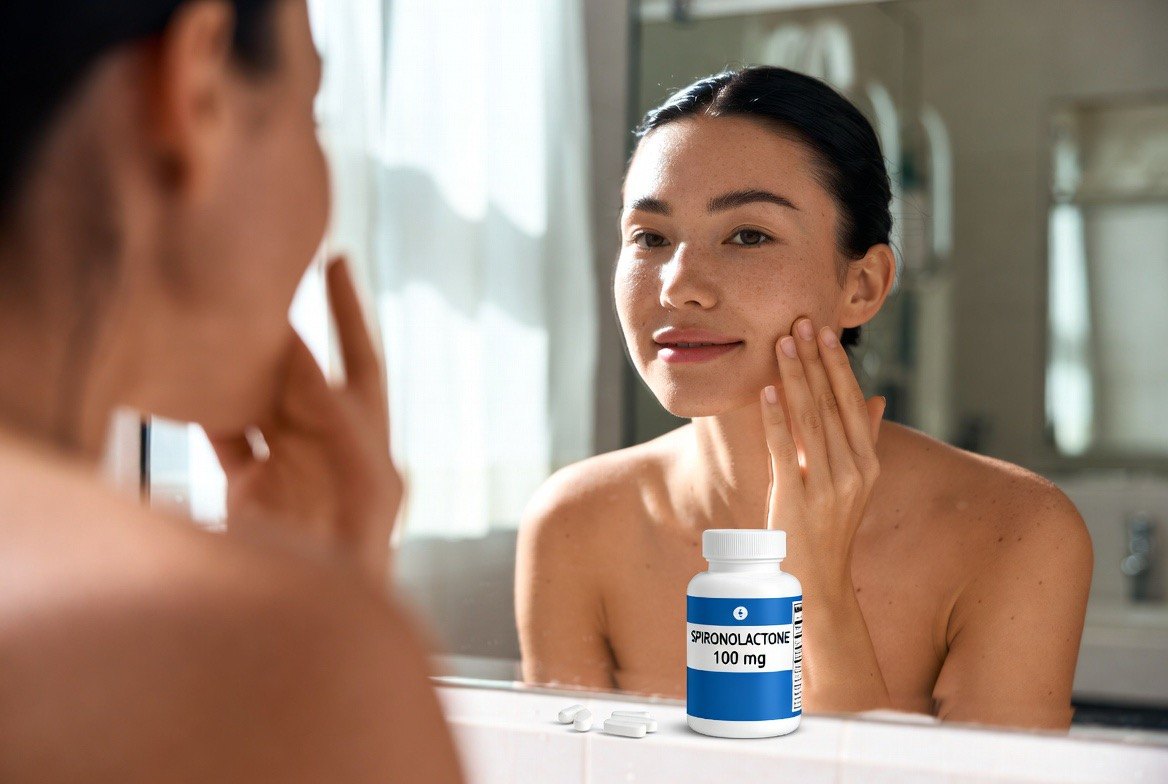
- Acne is the strongest use. Spironolactone is the leading systemic hormonal option for adult female acne, and the 2023 SAFA randomized controlled trial (RCT — the gold-standard study design where patients are randomly assigned to drug or placebo) showed it clearly improved acne versus placebo, backing a long clinical track record.12
- The mechanism is anti-androgen. It blocks androgen receptors and cuts androgen production, lowering the androgen-driven sebum (skin oil) that feeds acne, hirsutism, and pattern hair loss.4
- Hair loss is a reasonable add-on, not a lead. For female pattern hair loss it’s a moderate, mixed-evidence adjunct, usually paired with minoxidil.6
- It’s a women’s drug. The anti-androgen effect feminizes men and is teratogenic to a male fetus — so it’s contraindicated in pregnancy and generally not used for male acne.2
- The safety fears are mostly overblown. Serious high potassium (hyperkalemia) is rare in healthy young women, and the old breast-cancer scare was not borne out in large data.37
- What spironolactone actually is
- The mechanism: an accidental anti-androgen
- Acne: the strongest case, now with SAFA
- Female pattern hair loss: the moderate case
- Hirsutism and PCOS
- Why it’s for women, not men
- Safety: potassium, the breast-cancer scare, periods
- Dosing context
- The honest limits
- What this article is not saying
- References
What spironolactone actually is
Spironolactone is, on paper, a heart and blood-pressure drug. It is a potassium-sparing diuretic — a “water pill” that helps the body shed excess fluid while holding onto potassium (K+, a mineral that’s critical for heart rhythm) rather than dumping it the way most diuretics do. It achieves this by being an aldosterone antagonist: it blocks aldosterone, the hormone that tells the kidneys to retain salt and water. That is its original, FDA-approved job, and it is genuinely useful for high blood pressure (BP, the force of blood against artery walls), heart failure, and certain hormonal conditions.
But spironolactone is a chemically promiscuous molecule. Aldosterone belongs to the same broad family of steroid hormones as testosterone, and spironolactone doesn’t bind only the aldosterone receptor — it also sits on the androgen receptor and blocks it. Androgens are the hormones (chiefly testosterone and its potent derivative DHT — dihydrotestosterone) that, in both sexes, drive the oil glands, body and facial hair, and the follicle-shrinking process behind pattern hair loss. By blocking that receptor, spironolactone acts as an anti-androgen. Everything interesting about its use in dermatology flows from that off-target effect — and because it was never designed for skin or hair, every one of those uses is off-label.
The mechanism: an accidental anti-androgen
Acne, unwanted hair, and female pattern hair loss share a common engine: androgen signaling. In acne, androgens crank up the sebaceous glands so they pump out more sebum, the oily substance that, combined with dead skin cells and bacteria, plugs pores and drives inflammation. Many women with stubborn adult acne don’t have abnormally high blood androgen levels at all — their skin is simply more sensitive to normal androgen signaling. That’s why a drug that turns the signal down can help even when a blood test looks “normal.”
Spironolactone turns that signal down two ways. First, it competitively blocks the androgen receptor, so circulating testosterone and DHT have fewer docks to bind. Second, at higher doses it modestly reduces androgen production and nudges up sex-hormone-binding globulin, a blood protein that mops up free testosterone. The net effect is less androgen drive to the sebaceous gland and the hair follicle.4 We grade the mechanism claim MODERATE rather than STRONG for an honest reason: the anti-androgen action is well established in pharmacology and the clinical results are consistent with it, but the exact contribution of sebum reduction versus other effects in any given patient isn’t precisely quantified, and older sebum-specific studies are small. The direction is clear; the fine detail is softer than the clinical outcome data.
Spironolactone doesn’t raise or lower a hormone level so much as it turns down the volume on a signal — which is why it helps skin that’s over-listening to normal androgens.
Acne: the strongest case, now with SAFA
Dermatologists have prescribed spironolactone for adult female acne for decades, on the strength of clinical experience and a stack of small studies. That long track record was always its selling point — and, until recently, also its weakness, because “we’ve used it for years and it seems to work” is not the same as a large, blinded, placebo-controlled trial. A 2017 hybrid systematic review in American Journal of Clinical Dermatology captured that tension precisely: it found spironolactone was widely used and appeared effective, but that the existing RCTs were small and at high risk of bias, so the quality of evidence was low.2 The Cochrane review reached a similar verdict — convincing for hirsutism, thinner for acne.4
The SAFA trial changed the picture. Published in the BMJ in 2023, SAFA (Spironolactone for Adult Female Acne) was a pragmatic, multicentre, phase 3, double-blind, placebo-controlled RCT that randomized 410 women with persistent facial acne to spironolactone (titrated up to 100 mg daily) or placebo, both on top of usual topical treatment.1 Its primary outcome was an acne-specific quality-of-life score, and it also tracked patients’ own assessment of their acne. By week 12, the spironolactone group scored better on acne quality of life than placebo, and the gap widened by week 24, when a substantially larger share of women on spironolactone rated their acne as clear or improved compared with placebo. This was the first large, properly controlled trial to confirm what dermatologists had long practiced.
Why does this earn a STRONG grade when the older evidence was weak? Because SAFA is exactly the kind of study the field was missing: large, randomized, double-blind, placebo-controlled, and run in the real target population (adult women with persistent acne). Layered on top of a decades-long clinical track record and consistent smaller studies, it moves “spironolactone improves acne in women” from plausible-practice to well-supported. It is also strategically important: acne guidelines have leaned heavily on long courses of oral antibiotics, and a hormonal option that works without feeding antibiotic resistance is a genuinely useful alternative for the right patient. For where topical acne agents fit alongside this, our reads on azelaic acid and tretinoin cover the surface-level toolkit.
randomized
SAFA trial, 2023
studied
titrated up over weeks
gap widened
vs placebo
Female pattern hair loss: the moderate case
The same anti-androgen logic points spironolactone at female pattern hair loss — the female presentation of androgenetic alopecia (AGA), the genetic, androgen-influenced thinning that in women shows up as a widening part and diffuse loss over the crown rather than the receding hairline men get. If androgens are miniaturizing the follicles, an anti-androgen should, in theory, slow that down. In practice, the evidence is real but more modest and more mixed than the acne data.
A 2023 systematic review and meta-analysis pooled the available studies and found that a majority of women reported improved or stabilized hair loss on spironolactone — with a notably higher response rate when it was combined with other therapies than when used alone.6 That combination point is the key practical takeaway: spironolactone for hair is usually not a solo act. It is typically layered onto minoxidil (topical or low-dose oral), which works by a completely different, non-hormonal mechanism, so the two can add up. The honest framing is stabilization and modest regrowth over many months, not dramatic reversal — response often needs a year or more of consistent use to judge.
We grade the hair-loss use EMERGING, not STRONG or even fully MODERATE, because the underlying trials are smaller, more heterogeneous, and frequently confounded by concurrent treatments, so it’s hard to isolate spironolactone’s own contribution. It’s a reasonable, commonly used adjunct with a plausible mechanism and supportive but imperfect data — a sensible tool in a combination plan, not a proven stand-alone cure. For how the more heavily studied hair-loss drugs compare, see our read on finasteride versus dutasteride, the other end of the anti-androgen hair-loss spectrum.
Hirsutism and PCOS
Spironolactone’s best-evidenced dermatologic use is arguably not acne or hair loss but hirsutism — excess coarse, dark, male-pattern hair on the face, chest, or abdomen in women, usually driven by androgen excess and often a feature of PCOS (polycystic ovary syndrome, the common hormonal disorder marked by irregular cycles, elevated androgens, and metabolic changes). Here the anti-androgen effect maps directly onto the problem.
The Cochrane review concluded there was reasonable evidence that spironolactone reduces the degree of hirsutism versus placebo — a firmer conclusion than it could reach for acne at the time.4 And a well-known head-to-head RCT by Moghetti and colleagues compared spironolactone, flutamide, and finasteride (three different anti-androgen approaches) against placebo in hirsute women and found all three were effective, with broadly similar clinical benefit over six months.5 That places spironolactone as a first-line, well-tolerated, inexpensive anti-androgen for hirsutism, frequently used alongside a combined oral contraceptive (which suppresses ovarian androgen output and provides essential pregnancy prevention). For the broader hormonal context of PCOS, our sex hormones hub puts the androgen story in its wider frame.
Why it’s for women, not men
The single most important thing to understand about spironolactone in dermatology is that it is a women’s drug, and the reason is the same anti-androgen mechanism that makes it work. Blocking androgens in a man produces exactly the effects you’d expect from turning down testosterone signaling: gynecomastia (breast tissue growth), reduced libido, and other feminizing effects. That’s why spironolactone is generally not used for male acne — the trade-off is unacceptable for most men, and the acne trials were run in women for this reason.
The more serious constraint is pregnancy. Because spironolactone blocks androgens, it can interfere with the normal androgen-dependent sexual development of a male fetus — a teratogenic (birth-defect-causing) risk. For that reason it is contraindicated in pregnancy, and clinicians typically prescribe it only alongside reliable contraception in women who could become pregnant. This is not a footnote; it is central to why the drug is prescription-only and why the “safe for everyone” framing is flatly wrong. The anti-androgen effect that clears a woman’s skin is the very same effect that endangers a developing male fetus — the benefit and the hazard are two faces of one mechanism.
Everything spironolactone does for skin and hair comes from blocking androgens — and that’s precisely why it can harm a male fetus. There is no version of this drug that clears acne but is safe in pregnancy; it’s the same action doing both. That’s why it’s prescription-only, why it’s paired with contraception in women of reproductive age, and why no honest write-up can call it a casual, over-the-counter-style acne fix. The question is never “spironolactone: good or bad” in the abstract; it’s “is this woman a candidate, and is her reproductive situation accounted for?” That is a physician’s call, not a decision to make from an article. For the wider landscape of hormonally active drugs, our pharmaceuticals hub keeps the same evidence-first standard across the toolkit.
Safety: potassium, the breast-cancer scare, periods
For the population that actually uses it — otherwise healthy young and middle-aged women — spironolactone is generally well tolerated. But it carries a reputation for scary-sounding risks that deserve honest, proportionate handling.
Hyperkalemia (high potassium). Because it’s potassium-sparing, spironolactone can raise blood potassium, and dangerously high potassium can disturb heart rhythm. In older patients, those with kidney impairment, or those on other potassium-raising drugs, that’s a real concern warranting monitoring. But in healthy young women taking it for acne, the risk is low. A widely cited 2015 study in JAMA Dermatology by Plovanich and colleagues examined this directly and found the rate of hyperkalemia in healthy young women on spironolactone was essentially the same as the baseline rate in that population — leading the authors to conclude that routine potassium monitoring is unnecessary in this specific group.3 We grade that claim MODERATE: it’s a solid, influential finding that has reshaped practice, but it applies specifically to healthy young women without kidney disease or interacting drugs — not to everyone, which is exactly why prescribing judgment still matters.
The breast-cancer scare. For years spironolactone carried a shadow: because it’s a hormonally active steroid drug, some worried it might raise breast-cancer risk, and animal-study language on the old label fed that fear. Large human data did not bear it out. A 2012 BMJ cohort study by Mackenzie and colleagues, following a very large population of women, found no increased risk of breast cancer associated with spironolactone use, and subsequent analyses have been similarly reassuring.7 This is a case where a theoretical worry was tested at scale and did not materialize — worth stating plainly so it stops being repeated as an open question.
Menstrual changes and diuretic effects. The most common real-world nuisances are menstrual irregularity (spotting or cycle changes, which is one reason it’s often paired with a combined oral contraceptive that also stabilizes cycles), mild diuretic effects like increased urination and occasional lightheadedness, and breast tenderness. These are usually manageable and dose-related rather than dangerous, but they’re the reasons some women stop the drug.
Dosing context
This is context, not a prescription. For acne and hair loss, spironolactone is typically started low and titrated, with common maintenance doses in the range of roughly 50 to 100 mg per day — well below the doses sometimes used for blood pressure or heart failure. SAFA titrated up to 100 mg daily.1 Two practical realities shape expectations. First, it is slow: skin and especially hair respond over months, not weeks, and a fair trial for acne is usually several months, for hair loss often a year or more. Second, it is frequently used in combination — with topical acne treatments, with a combined oral contraceptive, or with minoxidil for hair — rather than as a lone agent. The specific dose, titration, and combination belong to a prescribing clinician who knows the individual’s history; none of the numbers here are a recommendation for any reader.
The honest limits
Spironolactone is a useful, well-established tool — but a bounded one. The clearest limit is that it is not for everyone: it’s a women’s drug, off-limits in pregnancy, and it requires attention to potassium in anyone who isn’t a healthy young woman. It’s also slow and often partial — for many women it improves rather than fully clears acne, and for hair it more often stabilizes and modestly regrows than reverses years of loss.
The evidence is also uneven across its uses. Acne now has the SAFA trial behind it and earns a strong grade; hirsutism has reasonable controlled data; but the hair-loss evidence remains smaller and more confounded, which is why it sits at EMERGING here.6 And the drug’s off-label status for skin and hair means dosing, duration, and monitoring rest on clinical practice and the trials that exist rather than a tidy FDA-approved protocol. None of this makes it a weak choice — it makes it a physician-guided one, matched to the right patient and the right problem rather than reached for reflexively.
What this article is not saying
This is not “spironolactone doesn’t work.” It does. It’s the leading systemic hormonal treatment for adult female acne, the SAFA trial gave that use a proper randomized backbone, it reduces hirsutism, and it’s a reasonable adjunct for female pattern hair loss. For the right woman, it’s a genuinely useful, inexpensive, well-understood anti-androgen. Dismissing it would be as wrong as overselling it.
This is not “spironolactone is a safe acne option for everyone, including men and pregnant women.” That’s the HYPE claim, and it fails on the mechanism. The anti-androgen action that clears skin also feminizes men (so it’s not used for male acne) and is teratogenic to a male fetus (so it’s contraindicated in pregnancy). It is prescription-only, off-label for skin and hair, and appropriate for a specific population, not a universal fix. Any framing that strips out those caveats is selling a different, false product.
And this is not a treatment recommendation. Every figure here describes what published trials reported, not what you should take. Whether spironolactone belongs in your regimen — and at what dose, with what contraception, and with what monitoring — is a decision for you and a physician who knows your full picture. The point of this piece is to tell you what the trials show and exactly where they stop, so that conversation can be an honest one. For a related look at the other main anti-androgen approach to hair loss, see our read on finasteride versus dutasteride, and browse the full Evidence Radar for how we grade every claim.
References
- Santer M, Lawrence M, Renz S, Eminton Z, et al. Effectiveness of spironolactone for women with acne vulgaris (SAFA) in England and Wales: pragmatic, multicentre, phase 3, double blind, randomised controlled trial. BMJ. 2023;381:e074349. DOI · PMID 37192767
- Layton AM, Eady EA, Whitehouse H, Del Rosso JQ, Fedorowicz Z, van Zuuren EJ. Oral Spironolactone for Acne Vulgaris in Adult Females: A Hybrid Systematic Review. Am J Clin Dermatol. 2017;18(2):169-191. DOI · PMID 28155090
- Plovanich M, Weng QY, Mostaghimi A. Low Usefulness of Potassium Monitoring Among Healthy Young Women Taking Spironolactone for Acne. JAMA Dermatol. 2015;151(9):941-944. DOI · PMID 25796182
- Brown J, Farquhar C, Lee O, Toomath R, Jepson RG. Spironolactone versus placebo or in combination with steroids for hirsutism and/or acne. Cochrane Database Syst Rev. 2009;(2):CD000194. DOI · PMID 19370553
- Moghetti P, Tosi F, Tosti A, Negri C, et al. Comparison of spironolactone, flutamide, and finasteride efficacy in the treatment of hirsutism: a randomized, double blind, placebo-controlled trial. J Clin Endocrinol Metab. 2000;85(1):89-94. DOI · PMID 10634370
- Aleissa M. The Efficacy and Safety of Oral Spironolactone in the Treatment of Female Pattern Hair Loss: A Systematic Review and Meta-Analysis. Cureus. 2023;15(8):e43559. DOI · PMID 37719557
- Mackenzie IS, Macdonald TM, Thompson A, Morant S, Wei L. Spironolactone and risk of incident breast cancer in women older than 55 years: retrospective, matched cohort study. BMJ. 2012;345:e4447. DOI · PMID 22797844