Finasteride vs dutasteride for hair loss: the honest head-to-head on the two DHT blockers
They are the two drugs that actually move the needle on male pattern baldness, and they work the same way — both throttle the enzyme that makes dihydrotestosterone, the hormone that shrinks scalp follicles. Finasteride blocks one form of that enzyme; dutasteride blocks both and drives DHT lower. In the head-to-head trials that pitted them directly against each other, dutasteride 0.5 mg edged out finasteride 1 mg on hair count. So dutasteride wins, right? Not so fast. Finasteride is the drug regulators approved for hair loss, the one with two decades of large trials and long-term data behind it; dutasteride is borrowed off-label from prostate medicine, is more potent, and lingers in the body far longer. Then there is the side-effect debate — sexual dysfunction in a minority, and the fiercely contested question of whether some men never recover after stopping. Here is what the evidence actually says, where it stops, and why the sharper drug is not automatically the right one.
How this article was built: Primary sources: the landmark finasteride trial (Kaufman et al. 1998, Journal of the American Academy of Dermatology), the dutasteride-versus-finasteride phase II study (Olsen et al. 2006, JAAD), the larger dose-ranging head-to-head trial (Gubelin Harcha et al. 2014, JAAD), a network meta-analysis of hair-loss treatments (Gupta et al. 2022, JAMA Dermatology), a benefit-risk network meta-analysis of the two 5-ARIs (Gupta & Charrette 2014, Journal of Dermatological Treatment), a study of persistent sexual side effects (Irwig 2012, The Journal of Sexual Medicine), and a phase III topical-finasteride trial (Piraccini et al. 2022, JEADV) — all retrieved and verified through PubMed.
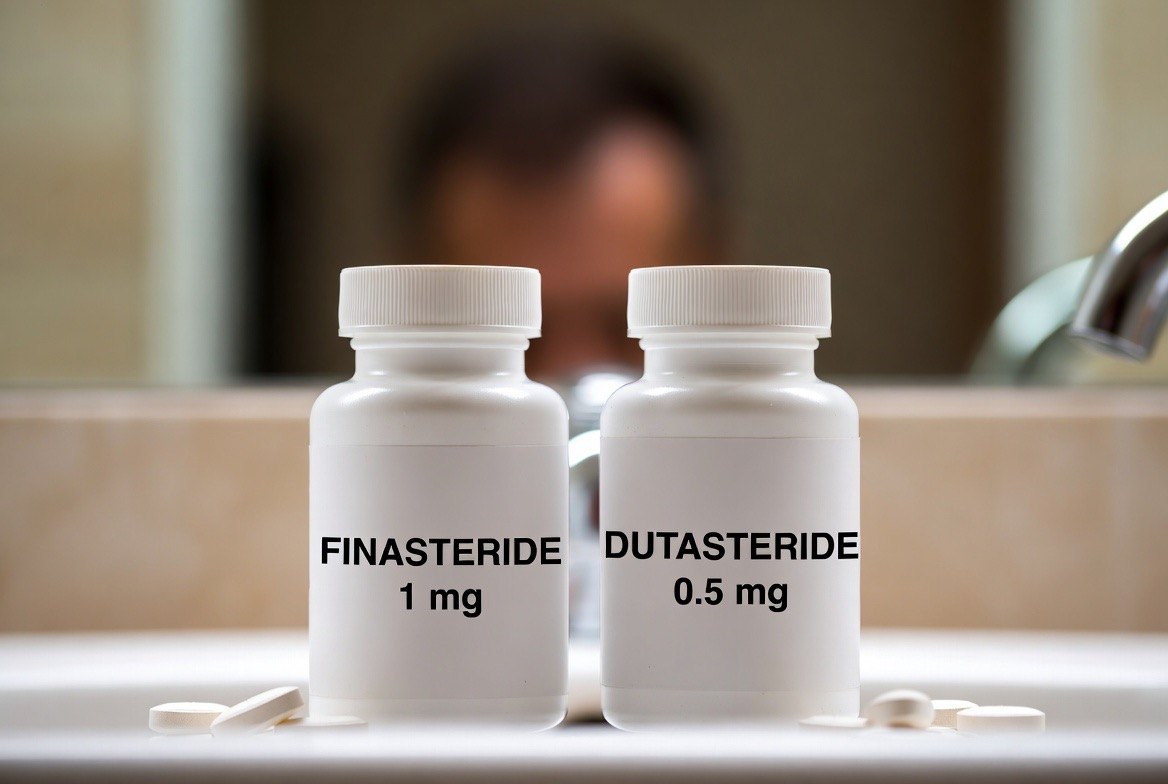
- Same mechanism, different reach. Both block 5-alpha-reductase (5-AR), the enzyme that converts testosterone to DHT (dihydrotestosterone), the androgen that miniaturizes scalp follicles. Finasteride blocks mostly the type II enzyme; dutasteride blocks type I and II and lowers circulating DHT more — roughly 90 percent versus about 70 percent.2
- Both clearly work; dutasteride edges it. Each beats placebo strongly for androgenetic alopecia (AGA). In head-to-head trials, dutasteride 0.5 mg produced modestly higher hair counts than finasteride 1 mg over 24 weeks.23
- But finasteride is first-line for a reason. Finasteride 1 mg is FDA-approved for hair loss with two decades of large trials; dutasteride is approved for prostate enlargement and used off-label for hair, with a much longer half-life.1
- The side-effect story is real but often overstated. Sexual side effects hit a minority and usually reverse on stopping; persistent effects (“post-finasteride syndrome”) are reported and genuinely debated, not proven common. This is a physician conversation, not an internet one.6
- The two drugs, and what they’re approved for
- The mechanism: DHT and the shrinking follicle
- Why dutasteride lowers DHT more
- Do they actually work? Yes, both do
- The head-to-head: dutasteride’s modest edge
- Side effects and the honest numbers
- Post-finasteride syndrome: the contested part
- Half-life and washout: the quiet difference
- Topical formulations
- Who might reasonably choose which
- What this article is not saying
- References
The two drugs, and what they’re approved for
Finasteride — sold as Propecia at the 1 mg hair-loss dose and Proscar at 5 mg for the prostate — was approved by the FDA (the U.S. Food and Drug Administration) for male pattern hair loss in 1997. It is the reference standard: the drug every other treatment gets compared against, backed by the largest and longest randomized trials in the field.
Dutasteride — sold as Avodart at 0.5 mg — was developed and approved for BPH (benign prostatic hyperplasia), the non-cancerous prostate enlargement that plagues older men. It is not FDA-approved for hair loss in most markets. (South Korea and Japan are notable exceptions, where a 0.5 mg dutasteride is licensed for AGA.) When a dermatologist in North America or Europe prescribes dutasteride for a receding hairline, that is an off-label use — legal, common, and evidence-supported, but not the same regulatory footing as finasteride.
That approval gap is not a technicality. It is the single most important thing to hold in mind through everything that follows: dutasteride is the more potent molecule, but finasteride is the more thoroughly vetted hair-loss drug. Potency and proof are not the same currency.
The mechanism: DHT and the shrinking follicle
Androgenetic alopecia is not a scalp that runs out of hair. It is a scalp whose follicles progressively shrink, cycle after cycle, until the thick terminal hairs are replaced by fine, barely visible vellus hairs. The driver of that miniaturization is DHT (dihydrotestosterone), a more potent cousin of testosterone.
DHT is made when the enzyme 5-alpha-reductase (5-AR) converts testosterone into it. In genetically susceptible men, the follicles at the crown and hairline are exquisitely sensitive to DHT: the hormone binds androgen receptors inside the follicle and, over years, shortens the growth phase and shrinks the follicle a little more each cycle. Lower the DHT reaching those follicles and you slow — and to a degree reverse — the shrinkage. That is the entire premise of both drugs. Neither adds anything to the follicle; both simply remove the signal that is starving it. It is a close conceptual cousin to how copper peptides are proposed to nudge follicles from a different angle — except 5-ARIs act on the hormonal signal itself, which is why they are the heavyweights of the category.
Crucially, 5-alpha-reductase comes in two main forms. Type I is concentrated in the skin, sebaceous glands, and liver. Type II dominates in the prostate, seminal vesicles, and the hair follicles of the scalp. That two-enzyme reality is where the two drugs diverge — and where dutasteride’s extra reach comes from.
Neither drug adds anything to a follicle. They just switch off the hormone that is quietly starving it — and dutasteride switches off a little more of it.
Why dutasteride lowers DHT more
Finasteride is a selective inhibitor of type II 5-alpha-reductase, with only weak activity against type I. Because scalp follicles rely heavily on type II, blocking it lowers scalp and serum DHT substantially — a serum DHT reduction on the order of 70 percent at the 1 mg dose. That is enough to change the trajectory of hair loss in most men who respond, which is why finasteride works at all.
Dutasteride is a dual inhibitor: it blocks both type I and type II with high potency. Shutting down both isoenzymes drives circulating DHT down far more — roughly 90 percent or more at the 0.5 mg dose, a level finasteride simply cannot reach because it leaves the type I pathway largely open.2 This is not a contested figure; the pharmacology is well established and consistent across studies, which is why the DHT-suppression claim carries a STRONG grade.
The obvious question is whether crushing DHT harder translates into proportionally more hair. It does not scale one-to-one — the relationship between systemic DHT suppression and follicular response flattens out — but more suppression does buy a measurable, if modest, edge in the clinic. That is the bridge from pharmacology to the trial data.
Do they actually work? Yes, both do
Before comparing them, it is worth being clear that both are genuinely effective, because hair-loss treatments are a graveyard of overhyped nothing. These two are not that.
The foundational evidence for finasteride comes from the pivotal trials published by Kaufman and colleagues in 1998, in which more than 1,500 men with male pattern hair loss took finasteride 1 mg or placebo daily for a year, with many continuing into a second year.1 Finasteride slowed the progression of loss and increased hair count, while the placebo group kept shedding. The effect held and, in many men, improved over the second year — a durable, replicated result across a large randomized population. This is textbook RCT (randomized controlled trial) evidence, and it is why finasteride grades STRONG for efficacy versus placebo.
Dutasteride cleared the same bar. In the phase II study by Olsen and colleagues, and again in the larger dose-ranging trial led by Gubelin Harcha, dutasteride beat placebo convincingly on hair count and photographic assessment.23 Network meta-analyses that pool the whole treatment landscape place both 5-ARIs among the most effective options available, comfortably ahead of most topicals on raw hair-count gains.4 So the “both work” claim is not a hedge — it is the strongest, best-supported statement in this entire article.
on finasteride
1 mg, type II block
on dutasteride
0.5 mg, dual block
for hair loss
finasteride only
The head-to-head: dutasteride’s modest edge
Now the fight everyone actually cares about. When you put the two drugs in the same trial and compare them directly, which wins?
Olsen’s 2006 phase II study was the first serious head-to-head, and it found dose-dependent gains with dutasteride, with the higher dutasteride doses outperforming finasteride 5 mg on hair count over 24 weeks — the study that established the “dual inhibition matters” principle.2 The larger and more definitive comparison came from Gubelin Harcha and colleagues in 2014: men aged 20 to 50 were randomized to several dutasteride doses, finasteride 1 mg, or placebo for 24 weeks, with hair count as the primary endpoint. Dutasteride 0.5 mg significantly increased hair count and width, and improved photographic hair growth, compared with both finasteride and placebo.3
Pooled analyses agree on the direction. A benefit-risk network meta-analysis by Gupta and Charrette placed dutasteride 0.5 mg ahead of finasteride 1 mg on efficacy,5 and the broader 2022 JAMA Dermatology network meta-analysis ranked oral dutasteride 0.5 mg as the treatment with the highest probability of being the single most efficacious option, with finasteride close behind.4
So dutasteride wins on the scoreboard. But read the size of the win carefully. This is a modest edge — a step up in hair count, not a different category of result. Both drugs land in the same tier; dutasteride sits at the top of it. And the head-to-head trials are relatively short (24 weeks) and were not primarily built to compare long-term safety between the two drugs. That is why the “dutasteride is more effective” claim grades MODERATE rather than STRONG: the direction is consistent and replicated, but the margin is small and the long-horizon comparative data thinner than the finasteride monotherapy base.
Side effects and the honest numbers
This is where the conversation gets heated, and where honesty matters most — because both the drug’s defenders and its detractors tend to overstate their case.
The side effects that matter to most men are sexual: reduced libido, erectile difficulty, and reduced ejaculate volume. In the large finasteride trials, these occurred in a small minority — typically a couple of percentage points more than placebo — and in most affected men they resolved either during continued treatment or after stopping.1 That is the measured, trial-derived reality: a real but uncommon effect, usually reversible. Dutasteride’s sexual side-effect profile in trials is broadly similar in kind, though its deeper DHT suppression and much longer half-life mean effects, if they occur, may take longer to clear.
Two honest complications sit on top of that clean picture. First, a strong nocebo effect muddies the data: in blinded trials, men told they might get sexual side effects report them at elevated rates even on placebo, which means some real-world complaints are anxiety-amplified rather than pharmacological. Second, and pulling the other way, spontaneous real-world reporting and some post-marketing analyses suggest the trials may have under-captured sexual dysfunction, because the pivotal studies were not primarily designed to hunt for it. Both things can be true. The defensible summary — sexual side effects hit a minority and usually reverse on stopping — grades MODERATE, held there by exactly this genuine uncertainty at the edges.
Beyond the sexual effects, both drugs can occasionally cause breast tenderness or gynecomastia and mood changes, and finasteride carries a well-known interaction with the prostate cancer screening test (PSA), roughly halving PSA values — a fact any older man on either drug needs his physician to know about.
Post-finasteride syndrome: the contested part
The sharpest controversy is not whether side effects happen during treatment, but whether a subset of men suffer persistent sexual, and sometimes cognitive or mood, symptoms that do not resolve after stopping the drug. This is what the term PFS (post-finasteride syndrome) refers to.
The evidence here is real but weak, and the honesty is in that exact phrasing. The most-cited work is a small 2012 study by Irwig, which prospectively followed 54 young men with at least three months of persistent sexual side effects after stopping finasteride and found that, in most of them, the dysfunction continued for many months or years.6 That is a genuine, published signal — men reporting durable harm — and it should not be waved away. Regulators in several countries have added persistent-dysfunction language to finasteride labeling in response to accumulating reports.
But the limits are equally real. Irwig’s study was small, had no control group, and recruited men who had already reported persistent problems — a design that can establish that the phenomenon exists but cannot tell you how common it is or prove the drug caused it. Large controlled datasets have not established that persistent PFS is common, and its underlying biology remains unexplained. So the claim as often stated online — that PFS is common and permanent for most users — fails on the evidence and grades WEAK. The accurate version is narrower and more unsettling for its honesty: persistent effects are reported in some men, appear uncommon, are not well understood, and are real enough to take seriously and discuss before starting. Dismissing PFS and catastrophizing it are both wrong. If the possibility of a rare but persistent effect is unacceptable to you, that is a completely legitimate reason to decline the drug — a decision to make with a physician, not a forum.
Half-life and washout: the quiet difference
One under-discussed but practically important contrast is how long each drug lingers. Finasteride has a relatively short half-life — on the order of hours — so if a man stops, the drug clears his system within days, and DHT rebounds fairly quickly.
Dutasteride is the opposite. Its terminal half-life is measured in weeks — roughly five weeks — and detectable levels can persist in the blood for months after the last dose. For efficacy this is arguably a feature: a missed dose matters less. But for anyone worried about side effects, it is a meaningful consideration, because if dutasteride does cause a problem, you cannot simply flush it out over a weekend. This washout asymmetry is one reason a cautious prescriber may reach for finasteride first: it is the more reversible experiment. It is also why men are counseled not to donate blood while on dutasteride and for a period after stopping.
It is tempting to read “dutasteride lowers DHT more and grows slightly more hair” and conclude it is simply the superior drug. That skips the trade-off. Dutasteride is off-label for hair, more potent, and far slower to leave the body — a bigger, longer-committed lever. Finasteride is FDA-approved for exactly this use, backed by the largest long-term dataset, and clears in days if you change your mind. For many men the rational first move is the better-studied, more reversible drug, escalating to dutasteride only if finasteride under-delivers. Which lever fits you depends on your goals, your risk tolerance, and your physician’s read of your case — not on which molecule has the bigger number next to it.
Topical formulations
Part of the appeal of a topical is the hope of scalp-level DHT suppression with less systemic exposure — and therefore, in theory, fewer sexual side effects. The evidence is strongest for topical finasteride. A phase III randomized trial by Piraccini and colleagues found that a topical finasteride spray significantly increased hair count versus placebo and, importantly, lowered scalp DHT while affecting serum DHT far less than the oral tablet.7 That lower systemic reach is the mechanistic basis for hoping topical carries a gentler side-effect profile.
Two cautions keep this honest. First, “less systemic absorption” is not “zero” — topical finasteride still measurably lowered serum DHT in that trial, so it is not a guaranteed escape from systemic effects. Second, topical dutasteride is far less studied, with only small or early-phase data, and should be considered experimental for hair. Topicals are a promising middle path for men who want the mechanism with a softer systemic footprint, but they are not a proven free lunch. For non-hormonal topical options with their own evidence base, our reads on rosemary oil and copper peptides map where the gentler alternatives actually stand.
Who might reasonably choose which
None of what follows is a prescription — it is a map of how a physician and patient might reason together.
Finasteride first is the conventional and, for most men, the sensible default. It is FDA-approved for hair, carries the deepest long-term safety record, clears quickly if problems arise, and is effective for the majority of responders. Starting here is choosing the well-lit path.
Dutasteride becomes a rational consideration for the man who has given finasteride a genuine trial — typically a year, since hair responds slowly — and found the response inadequate, and who understands and accepts that he is choosing a more potent, off-label, longer-lasting drug. Some men also start on dutasteride deliberately, with a physician, when aggressive early loss makes the extra potency appealing enough to accept the trade-offs. Its longer half-life also forgives imperfect adherence.
A topical may suit the man who is drawn to the mechanism but wary of systemic sexual side effects and willing to accept a somewhat thinner evidence base and the reality that systemic exposure is reduced, not eliminated. And for some men, the honest answer is neither — if the possibility of sexual side effects, however uncommon, is unacceptable, declining is a legitimate, respectable choice, and combing the evidence on the pharmaceuticals hub or comparing against the graded-evidence library can help frame that conversation. What no one should do is pick based on a single dramatic anecdote in either direction.
What this article is not saying
This is not “these drugs don’t work.” They are the two most effective medical treatments for male pattern hair loss, both proven against placebo in randomized trials, and for many men they are the difference between steady loss and holding the line for years.13
This is not “they regrow all your hair and work for everyone.” That is the HYPE claim, and it fails on the evidence.4 These drugs are best at slowing loss and producing modest regrowth, they work primarily on the crown and mid-scalp far more than a mature receded hairline, they do nothing for follicles that are already dead, a meaningful fraction of men respond weakly or not at all, and any gains reverse within months of stopping because the DHT signal simply returns. A drug that maintains what you have and thickens somewhat is genuinely valuable — but it is not the total reversal the before-and-after marketing implies.
And this is not a recommendation to take either one. Every figure here describes what published trials reported, not what you should do. Finasteride and dutasteride are prescription drugs with real, if uncommon, risks and a debate about persistent effects that is not fully settled. Whether either belongs in your regimen — oral or topical, first-line or escalation — is a decision for you and a physician who can weigh your goals against those risks honestly. The purpose of this piece is to give you an accurate map of what the two drugs do and exactly where the evidence stops, so that conversation can be a clear-eyed one.
References
- Kaufman KD, Olsen EA, Whiting D, Savin R, et al. Finasteride in the treatment of men with androgenetic alopecia. Finasteride Male Pattern Hair Loss Study Group. J Am Acad Dermatol. 1998;39(4 Pt 1):578-589. DOI · PMID 9777765
- Olsen EA, Hordinsky M, Whiting D, Stough D, et al. The importance of dual 5alpha-reductase inhibition in the treatment of male pattern hair loss: results of a randomized placebo-controlled study of dutasteride versus finasteride. J Am Acad Dermatol. 2006;55(6):1014-1023. DOI · PMID 17110217
- Gubelin Harcha W, Barboza Martínez J, Tsai TF, Katsuoka K, et al. A randomized, active- and placebo-controlled study of the efficacy and safety of different doses of dutasteride versus placebo and finasteride in the treatment of male subjects with androgenetic alopecia. J Am Acad Dermatol. 2014;70(3):489-498.e3. DOI · PMID 24411083
- Gupta AK, Venkataraman M, Talukder M, Bamimore MA. Relative Efficacy of Minoxidil and the 5-α Reductase Inhibitors in Androgenetic Alopecia Treatment of Male Patients: A Network Meta-analysis. JAMA Dermatol. 2022;158(3):266-274. DOI · PMID 35107565
- Gupta AK, Charrette A. The efficacy and safety of 5α-reductase inhibitors in androgenetic alopecia: a network meta-analysis and benefit-risk assessment of finasteride and dutasteride. J Dermatolog Treat. 2014;25(2):156-161. DOI · PMID 23768246
- Irwig MS. Persistent Sexual Side Effects of Finasteride: Could They Be Permanent? J Sex Med. 2012;9(11):2927-2932. DOI · PMID 22789024
- Piraccini BM, Blume-Peytavi U, Scarci F, Jansat JM, et al. Efficacy and safety of topical finasteride spray solution for male androgenetic alopecia: a phase III, randomized, controlled clinical trial. J Eur Acad Dermatol Venereol. 2022;36(2):286-294. DOI · PMID 34634163