Copper peptides for hair growth: does GHK-Cu actually regrow hair?
Copper peptide serums — GHK-Cu and copper tripeptide-1 — have become the breakout ingredient of the “natural” hair-loss aisle, sold for thickness, regrowth, and as a gentler stand-in for minoxidil. The honest position sits between the marketing and the dismissal. The underlying follicle biology is real and genuinely interesting: copper peptides nudge the same signals a hair follicle uses to stay in its growth phase. But almost all of the hard evidence for that lives in dishes and isolated follicles, not in large trials on real heads — and the studies most often quoted as proof either combine copper peptides with proven drugs or come straight from product marketing. Here is what the research actually shows, where the “natural minoxidil” story stops being true, and how to think about a low-risk adjunct that is not yet a proven treatment.
How this article was built: Primary sources retrieved and verified through PubMed and the published literature: the Pyo et al. 2007 ex vivo human hair-follicle study in Archives of Pharmacal Research; the Pickart & Margolina 2018 gene-data review in the International Journal of Molecular Sciences; the Kuceki et al. 2025 minoxidil-dutasteride-copper-peptide microinfusion case series in JAAD International; the Shin & Huh 2025 androgenetic alopecia treatment review in Annals of Dermatology; and the Pickart et al. 2015 mechanism review in BioMed Research International. Where the strongest data are laboratory-only, we say so rather than upgrading them.
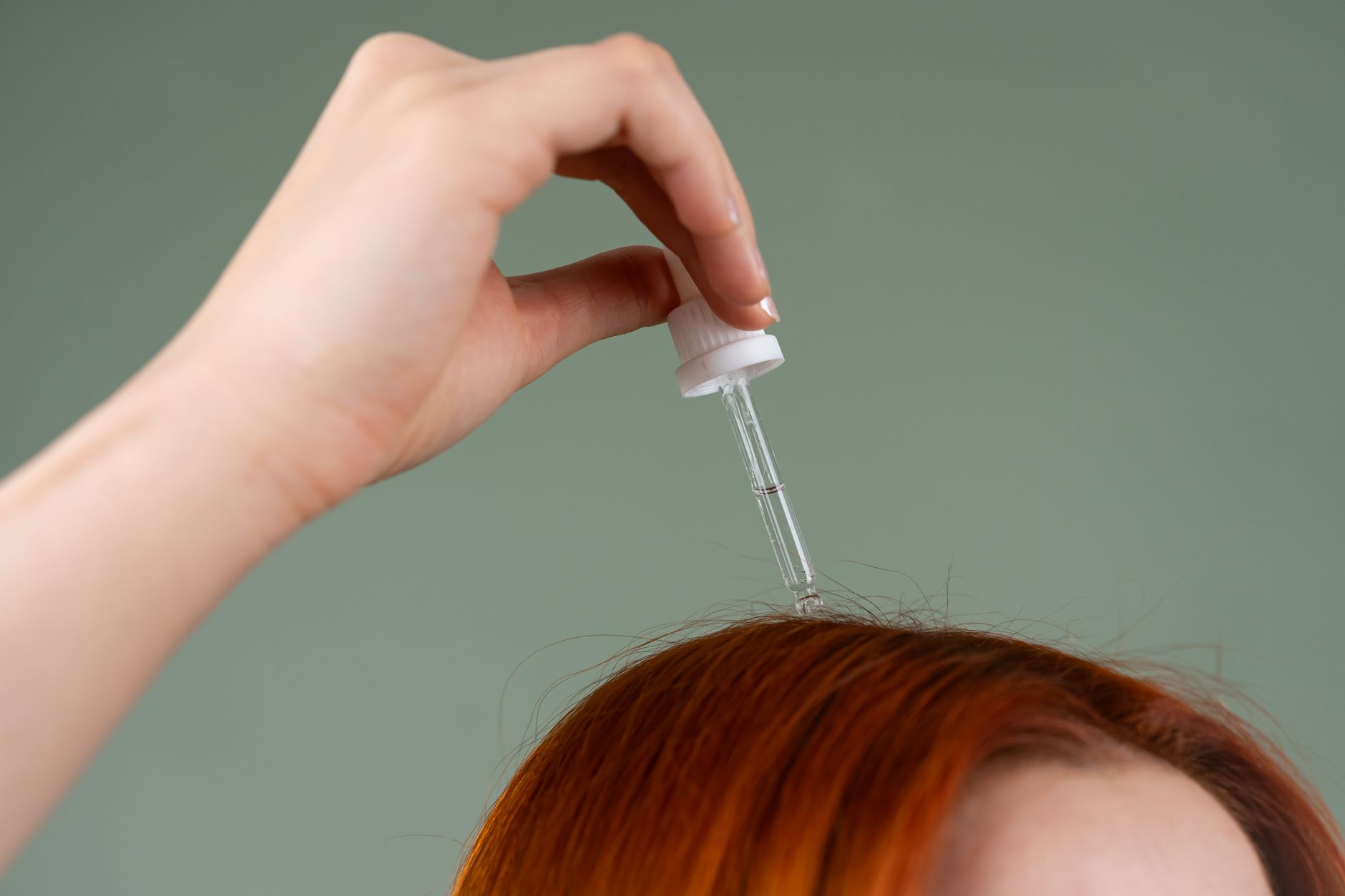
- The biology is real but early: a copper tripeptide made human hair follicles grow longer in the lab and pushed dermal papilla cells to multiply — in dishes and isolated follicles, not on real heads.1
- There is no large, independent trial showing a copper peptide serum regrows hair on its own. The most cited recent human study combined copper peptides with two proven drugs in just seven men, so the copper peptide’s own effect can’t be separated out.3
- Minoxidil and finasteride remain the gold standard — the 2025 treatment review of androgenetic alopecia does not even list copper peptides.4 “Natural minoxidil alternative” overstates the evidence.
- Who it’s actually for: someone who wants a low-risk add-on to a proven routine — not a standalone hair-loss treatment, and not a reason to skip the drugs that are proven to work.
- What copper peptides are — and what the hair claim rests on
- The mechanism: the signal a copper peptide pulls in a follicle
- The human evidence — honest assessment
- Where it sits next to minoxidil and finasteride
- Where it fits: a tiered view
- Grey areas: “natural” is not “proven”
- What we don’t know yet
- What this article is not saying
- References
What copper peptides are — and what the hair claim rests on
“Copper peptide” on a hair-serum label almost always means one of two closely related molecules. The famous one is GHK-Cu (glycine-histidine-lysine bound to a copper ion), the naturally occurring tripeptide your body already makes and circulates — the same molecule behind the copper peptide skin-aging story.6 The other is copper tripeptide-1, the cosmetic-ingredient name for the same GHK-Cu complex, with close chemical cousins such as AHK-Cu (an alanine-for-glycine variant) used in some follicle research. For the purpose of a scalp serum, treat them as one family with one core idea: a small peptide that uses a bound copper ion to send tissue-repair and remodeling signals into skin — including the skin of the scalp.
That last clause is where the hair story begins, and it is worth being precise about what is being claimed. The skin-aging case for copper peptides rests on collagen, the matrix, and gene-expression data accumulated over decades. The hair case borrows the same molecule but asks a different question: can the signal it pulls in scalp tissue keep a follicle in its growth phase, feed it through better local blood supply, and hold off the shrinking process that drives pattern hair loss? The biology says “plausibly yes.” The clinical record says “not yet shown the way the gold-standard drugs have shown it.” Holding both of those at once is the entire job of this article.
Hair loss itself is not one thing. The most common form, androgenetic alopecia (AGA) — male- and female-pattern hair loss — is driven largely by the hormone dihydrotestosterone (DHT) gradually miniaturizing genetically susceptible follicles. That matters here because the two treatments proven to work against AGA act squarely on that process or on follicle growth-phase length, and a fair test of any new ingredient is whether it can do the same on real heads, not just in a dish.
The mechanism: the signal a copper peptide pulls in a follicle
A hair follicle is not a static structure — it cycles. It spends years in anagen (the active growth phase), briefly enters catagen (a regression phase), then rests in telogen before shedding and restarting. In pattern hair loss, the anagen phase shortens cycle by cycle and follicles shrink, until the hair they produce is too fine and short to count. Anything that lengthens anagen, slows the slide into catagen, or supports the cells that drive the cycle is, in principle, working in the right direction.
This is where copper peptides have a genuinely coherent mechanistic story, and it converges on three signals. First, copper peptides prompt fibroblasts to release vascular endothelial growth factor (VEGF), the signal that builds new blood vessels — more local circulation means more oxygen and nutrients delivered to the follicle.5 Second, they appear to damp transforming growth factor-beta (TGF-β), one of the messengers that pushes a follicle out of growth and into regression; quieting that signal is, in effect, telling the follicle to stay in its growth phase longer.5 Third, they support the dermal papilla cells (DPCs) at the base of the follicle — the command center that orchestrates the whole hair cycle — nudging them to multiply and resisting the cell-death pathways that thin their numbers with age.1
The cleanest direct evidence for that DPC effect comes from a 2007 study by Pyo and colleagues at Seoul National University, published in Archives of Pharmacal Research.1 Working with human hair follicles cultured outside the body and human dermal papilla cells in the dish, they found that a copper tripeptide (AHK-Cu) stimulated follicle elongation at strikingly low concentrations and drove DPC proliferation, while measurably suppressing the molecular markers of programmed cell death in those cells.1 In plain terms: in the lab, the copper peptide kept the follicle’s engine running and its control cells alive.
The mechanism is genuinely elegant: feed the follicle more blood, tell it to stay in its growth phase, and keep its control cells alive. The catch is that almost every clean demonstration of that signal lives in a dish — not on a head.
Two honest caveats sit on top of this. The headline gene-data review of GHK-Cu, Pickart and Margolina’s 2018 paper, lists “increase hair growth and thickness, enlarge hair follicle size” among the peptide’s actions — but it states this in passing, without an attached hair-specific trial to support it, and the review itself is overwhelmingly about skin, wound, and lung tissue.2 And the Pyo work, elegant as it is, was done on isolated follicles and cultured cells. Mechanism-plausible in the lab is real and worth taking seriously; it is also not the same as a measured regrowth result on a living scalp over months. The next section is where that gap shows.
The human evidence — honest assessment
Here is the part the product pages skip. For all the mechanistic appeal, there is no large, independent, placebo-controlled trial showing that a topical copper peptide serum, used on its own, regrows hair or meaningfully thickens it in people with pattern hair loss. That sentence is the single most important one in this article, and it should be read without a hedge: the standalone human efficacy case for copper peptide hair serums has not been made at the level the field expects.
What does exist is suggestive, and worth describing precisely. The most-cited recent human study is a 2025 case series by Kuceki and colleagues in JAAD International.3 It treated seven men with androgenetic alopecia using five monthly sessions of a microinfusion (“tattooing”) technique that delivered a compounded solution into the scalp — and the median top-of-scalp severity score improved substantially, with most patients gaining meaningful regrowth assessed by blinded dermatologists.3 Impressive on its face. But the solution was a blend of 0.5% minoxidil, 0.1% dutasteride, and 1.2% copper peptides — two of those three are powerful, proven anti-hair-loss drugs (a DHT-blocking 5-alpha-reductase inhibitor and a growth-phase extender). With seven patients, one arm, and no copper-peptide-only comparison, there is no way to separate what the copper peptide contributed from what the minoxidil and dutasteride did. It is a signal that copper peptides may earn a place in a combination protocol — not evidence that they work alone.
Hair-serum marketing frequently cites specific numbers — “27% increase in density,” “a Phase 2 trial,” “45 patients.” When you trace those back through the published literature, the robust, independently verifiable primary sources for copper-peptide-only hair regrowth in humans are not there. The strongest verifiable human data combine copper peptides with proven drugs. Be skeptical of any standalone percentage that does not link to a real, named, peer-reviewed trial of copper peptides on their own.
So the honest shape of the evidence is lopsided in a specific way. The laboratory and mechanistic tier is real and coherent: follicle elongation, DPC proliferation, the VEGF-up, TGF-β-down signal.15 The human tier is thin and entangled: the best recent data come bundled with drugs that work on their own.3 That is the opposite of the situation for the gold-standard treatments, where decades of standalone randomized trials anchor the claim. Copper peptides for hair are an ingredient with a good story and an unfinished evidence base — which is exactly why the grade for human efficacy here is weak, not strong.
Where it sits next to minoxidil and finasteride
The framing that does the most damage is “natural minoxidil alternative,” so it is worth stating the comparison plainly. For androgenetic alopecia, the treatments with the deepest evidence and formal regulatory backing are topical minoxidil (which lengthens the follicle’s growth phase and improves its blood supply) and oral finasteride (which blocks the conversion of testosterone to DHT, the hormone driving miniaturization). A 2025 review of AGA treatment in Annals of Dermatology lays out the approved options — minoxidil, the 5-alpha-reductase inhibitors, and low-level light therapy — and copper peptides do not appear in it at all.4 An ingredient that the current treatment reviews don’t list is, by definition, not an evidence-equal swap for the ones they do.
That is not a dismissal of copper peptides — it is a measurement of the distance between them and the standard. Minoxidil and finasteride earn their place through repeated standalone trials with clear regrowth endpoints. Copper peptides have laboratory plausibility and combination-protocol hints. Calling the second one a “replacement” for the first inverts the evidence. The fair statement is narrow: copper peptides are a plausible, gentler-sounding adjunct that some clinicians fold alongside proven drugs — not a stand-in for them, and certainly not a reason to avoid the treatments that are proven to work. If maximal, evidence-backed regrowth is the goal, the proven actives remain the starting point, and our broader map of the peptides worth knowing in 2026 places copper peptides honestly within that wider field.
Where it fits: a tiered view
It helps to place copper peptides honestly on a spectrum of who they are actually for, alongside the rest of the hair and skin and aging toolkit. For the underlying peptide pharmacology referenced throughout, our peptide reference covers the class.
Foundational — rule out the treatable causes first. Before any serum, the higher-yield move is diagnosis: pattern loss, telogen effluvium from stress or illness, thyroid issues, iron deficiency, and several other causes all look like “thinning” and have completely different fixes. A dermatologist visit beats a guess. For confirmed androgenetic alopecia, the proven actives (minoxidil, finasteride where appropriate) are the evidence-backed core, full stop.4
Research-curious — the low-risk add-on. If you are already on a proven routine and want to layer a well-tolerated ingredient with coherent follicle biology and minimal downside, a copper peptide scalp serum is a reasonable experiment — with expectations set to “possible modest support,” not “regrowth on its own.”1 Judge it over months, not weeks, and don’t let it crowd out the treatments doing the real work.
Experimental — betting it replaces the drugs. Using a copper peptide serum instead of minoxidil or finasteride, on the belief that it is an equal “natural” substitute, runs well ahead of the evidence. This is the weakest-supported use and the one most likely to cost someone the window in which proven treatment would have preserved their hair.
Copper peptides are a real, low-risk tool — but they sit inside a much larger toolkit, and the worst mistake is treating any single ingredient as the fix. The right question is rarely “copper peptides: yes or no,” it’s “what is actually driving my hair loss, which proven treatments address it, and where does an adjunct like a copper peptide serum — or topical peptides more broadly — genuinely add value without replacing what works?” The Manual maps the peptide and skin-aging actives against each other: what each one’s evidence genuinely supports, who benefits and who is wasting their money, and how to layer them sensibly. See the Manual →
Grey areas: “natural” is not “proven”
Tolerability is the genuine upside — and it is graded honestly here as moderate, not unlimited. Topical copper peptides have a long cosmetic track record and are generally well tolerated, with the main reported issues being mild, local, and uncommon: transient irritation, redness, or occasional contact dermatitis in sensitive individuals.25 That favorable safety profile is real and is part of why a copper peptide serum is a low-stakes add-on. But “well tolerated” is not “effective,” and a clean safety record is not a substitute for an efficacy record.
“Natural” tells you nothing about whether it works. GHK-Cu being a molecule the body already makes is a nice piece of biology, but botanical or endogenous origin is not evidence of clinical benefit; purity, formulation, concentration, and — above all — trial results are. The “natural” framing is doing persuasive work that the data have not earned, and it is the exact point where the marketing leaps ahead of the science.
The product is not the molecule. A serum listing “copper peptides” tells you an ingredient is present, not at what concentration, in what delivery vehicle, or alongside what else. Copper peptides are also hydrophilic and not trivial to deliver into the scalp at biologically relevant depth, so formulation matters as much as the percentage on the label — and varies enormously across the market.
What we don’t know yet
No standalone, controlled human trial. The single most useful study that does not yet exist is a properly sized, randomized, placebo-controlled trial of a copper peptide serum used by itself for androgenetic alopecia, with hair-count and thickness endpoints. Until that exists, the human efficacy claim rests on mechanism plus combination data — suggestive, not decisive.
No head-to-head against the gold standard. There is no trial comparing a copper peptide serum to minoxidil at equivalent rigor, so any “as good as minoxidil” claim is unsupported on its face. The combination data hint copper peptides might add something on top of proven drugs; whether they do, and how much, is unmeasured.
Population and durability gaps. The data skew toward laboratory models and small, short, entangled human use. There is little on long-term continuous use, on women specifically, on different patterns and severities of loss, or on what happens to any gains when you stop. “Promising mechanism, unproven in the populations that matter” is the accurate ceiling.
What this article is not saying
This is not “copper peptides are useless.” The follicle biology is real, the safety profile is favorable, and as a low-risk adjunct layered onto a proven routine, a copper peptide serum is a defensible experiment for the right person. Dismissing the ingredient outright is as wrong as overselling it.
This is not “copper peptides regrow hair like minoxidil.” There is no standalone trial showing that, and the current treatment reviews don’t list copper peptides at all.4 The honest claim is “coherent mechanism, thin standalone human evidence, plausible adjunct” — not “a natural drug-equal.”
And this is not a recommendation to change your routine. It is a map of what the research shows and where it stops, so your expectations — and your shelf — can be honest ones. If you are losing hair, the highest-value first move is a clinician working out why, not a label swap.
References
- Pyo HK, Yoo HG, Won CH, Lee SH, Kang YJ, Eun HC, Cho KH, Kim KH. The effect of tripeptide-copper complex on human hair growth in vitro. Arch Pharm Res. 2007;30(7):834-839. DOI · PMID 17703734
- Pickart L, Margolina A. Regenerative and Protective Actions of the GHK-Cu Peptide in the Light of the New Gene Data. Int J Mol Sci. 2018;19(7):1987. DOI · PMID 29986520
- Kuceki G, Coppinger AJ, Ragi SD, et al. Enhanced hair regrowth with five monthly sessions of minoxidil-dutasteride-copper peptides tattooing for androgenetic alopecia assessed by artificial intelligence and blinded evaluators. JAAD Int. 2025;20:38-40. DOI · PMID 40225275
- Shin JW, Huh CH. Updates in Treatment for Androgenetic Alopecia. Ann Dermatol. 2025;37(6):327-335. DOI
- Pickart L, Vasquez-Soltero JM, Margolina A. GHK Peptide as a Natural Modulator of Multiple Cellular Pathways in Skin Regeneration. Biomed Res Int. 2015;2015:648108. DOI · PMID 26236730
- Wellness Radar. GHK-Cu: the copper peptide that reprograms aging skin at the gene level. Wellness Radar, 2026. Read the sibling deep-dive on copper peptides for skin, referenced throughout this article.