Magic mushrooms and longevity: what the psilocybin aging study actually found
A peer-reviewed 2025 paper extended human cell lifespan by more than half and pushed aged-mouse survival up by roughly a third. It's real, it's exciting, and it is not a reason to eat mushrooms. Here's the honest line between the two.
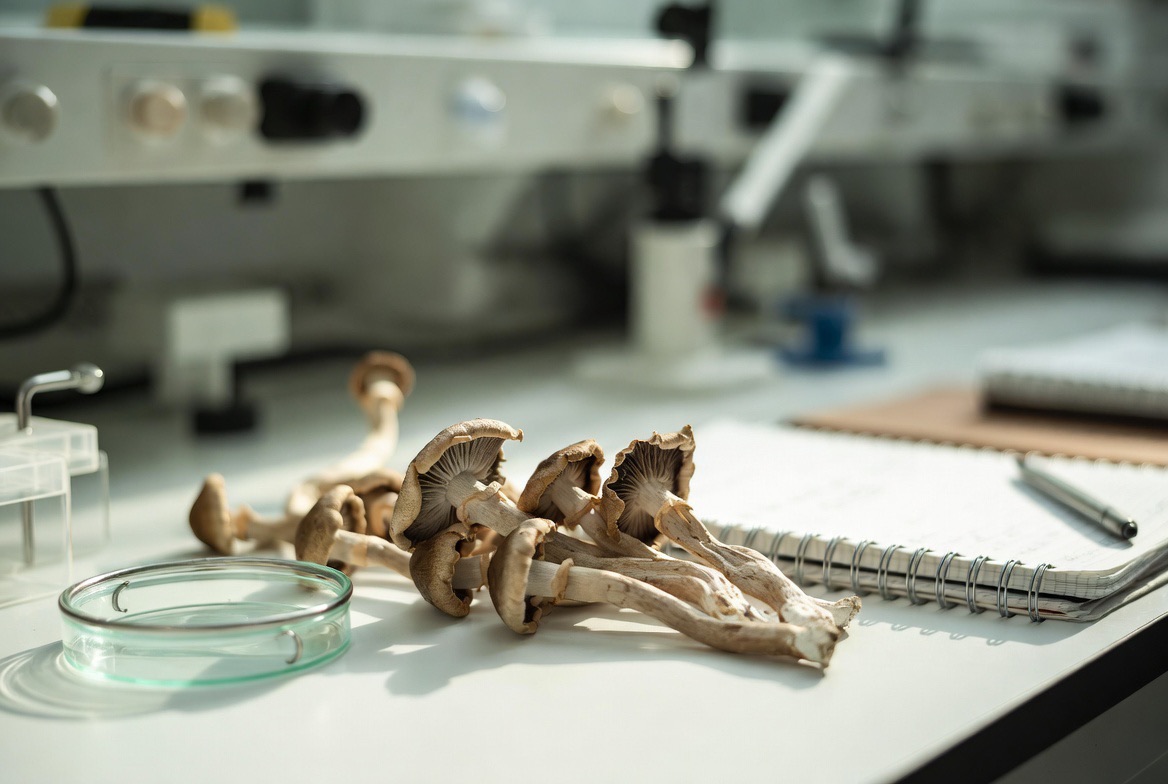
- A 2025 npj Aging paper from Emory found psilocin — the active form psilocybin converts to — extended cultured human cell lifespan by up to 57%, and pushed aged-mouse survival from 50% to 80%.
- The mechanism touches real aging biology: lower oxidative stress, preserved telomere length, fewer DNA-damage markers, higher SIRT1.
- The honest caveat: this is cells and mice only. There is no human longevity trial, the human dose is unknown, and the mouse protocol is nothing anyone can copy.
- Who this is for: people who want the real signal without the "shrooms cure aging" headline — and who understand the difference between a hypothesis and a protocol.
The study that set off the headlines
In July 2025 a team at Emory University published a paper in npj Aging — a Nature Partner Journal, peer-reviewed, not a preprint — with a title that reads like clickbait but isn't: "Psilocybin treatment extends cellular lifespan and improves survival of aged mice"1. The headlines that followed were the predictable mess. "Magic mushrooms reverse aging." "The fountain of youth is a psychedelic." That framing is wrong, and I want to be blunt about it up front. But the underlying science is not wrong, and dismissing it because the coverage was breathless would be the lazy move.
Here is what the team actually did. First, in a dish: they treated cultured human cells with psilocin — the molecule psilocybin converts to in the body, the part that actually does the work — and watched how long those cells kept dividing before they burned out. Second, in animals: they gave aged mice psilocybin on a monthly schedule for most of a year and tracked who was still alive at the end. Both arms moved, and they moved a lot. That is the news. Everything after this is the difference between what moved in a dish, what moved in a mouse, and what any of it means for a person — which is a gap most of the coverage never bothered to draw.
This sits squarely inside the question I keep circling back to in longevity work: can you preserve the machinery before it fails, rather than wait for it to break and then go shopping for a replacement? A signal that touches the wear-and-tear pathways of aging is exactly the kind of thing worth taking seriously — and exactly the kind of thing that gets oversold the moment it leaves the lab.
Mechanism: why a psychedelic touches aging at all
The obvious objection is fair: psilocybin is a serotonergic psychedelic, the thing studied for depression and end-of-life anxiety. What does the signal it pulls in the brain have to do with how long a skin cell keeps dividing? The answer the authors propose is that the relevant receptor isn't only in the brain. Serotonin 2A receptors (the main target psilocin binds) show up in many tissues outside the central nervous system, and the downstream signal appears to feed into stress-response and repair programs at the cellular level rather than purely the psychedelic experience1.
What makes the result interesting rather than random is where it lands. Aging isn't one process; it's a set of overlapping failures that the field now catalogs as the hallmarks of aging — genomic instability, telomere attrition, loss of proteostasis, and a list of others2. A compound that nudges one hallmark is mildly interesting. A compound that appears to touch several at once is the profile of something worth a real look. In the Emory data, psilocin reduced oxidative stress in a dose-dependent way, preserved telomere length in treated cells while untreated senescent cells lost theirs, lowered markers of DNA damage, and raised SIRT1 — a regulator the longevity field has chased for two decades1.
The reason this matters isn't that a psychedelic is magic. It's that the signal it pulls seems to land on the same wear-and-tear pathways every serious longevity intervention is trying to reach — and it lands on more than one of them.
That convergence is the honest case for paying attention. It is also exactly where the temptation to overstate begins, because "touches the hallmarks of aging in a dish" and "extends human lifespan" are separated by about fifteen years of trials that do not yet exist.
The evidence, claim by claim
Let me put the actual numbers down, because the numbers are both better than you'd guess and narrower than the headlines imply.
The cell data
In human fetal lung fibroblasts (the IMR-90 line, a workhorse cell for aging studies), 10 µM psilocin extended replicative lifespan by 29%, and a higher 100 µM dose extended it by 57%1. In adult human skin fibroblasts, 100 µM psilocin increased lifespan by 51%1. So the "over 50%" figure is real — but read the label honestly: this is a preliminary signal in cultured human cells, two cell types, one lab, in vitro. It is not a measurement of how long a person lives. It is a measurement of how many more times a cell divided in a dish.
The mouse data
The animal arm is where the headline "30% longer" comes from. The team used 19-month-old female mice — roughly equivalent to a human in their early-to-mid sixties — gave an initial 5 mg/kg dose, then 15 mg/kg once a month for ten months by oral gavage1. At the end, 80% of treated mice were alive versus 50% of controls (p = 0.014)1. That's the ~30-percentage-point survival gap. Treated mice also showed visibly better fur, fewer white hairs, and hair regrowth — striking to look at, but described qualitatively, not quantified1.
This is a preliminary signal in aged mice, single study, modest group sizes, one sex. The authors themselves frame it as the first long-term in vivo look at systemic psilocybin in aged animals — "first" is a tell that it needs replication, not a victory lap. Strong signal, early stage. That is precisely what the EMERGING grade in the Evidence Radar above means.
Why both grades stay at EMERGING
Real, peer-reviewed, mechanistically coherent — and still cells and mice from a single group. Conservative grading isn't pessimism; it's the rule that keeps this site from sounding like the press releases. A result earns its way up to MODERATE when an independent lab replicates it and the population starts to look like ours. Neither has happened yet.
What this does and doesn't translate to
There is no protocol here, and I'm not going to invent one. But it's worth being precise about the tiers of what this finding can honestly support, because the distance between them is the whole story.
Psilocin belongs on the list of compounds worth funding for human longevity study, alongside the senolytic and autophagy work. The mechanism is plausible and the preclinical signal is strong. That is a real, defensible statement.
The mouse got 15 mg/kg monthly under lab conditions. Nobody knows the human equivalent for a longevity endpoint — not the dose, not the frequency, not the age to start. The authors don't claim to know either. Translating a gavage schedule in a mouse to a person is not a calculation anyone can responsibly do.
A monthly high-dose lab protocol is not recreational use and not a microdose trend. Reading "mice lived longer" and reaching for mushrooms is the exact error this article exists to prevent. The cell-and-mouse signal is a hypothesis, not a regimen.
If you want to see where psilocin would sit if it ever cleared human trials, the company it would keep is instructive: the senolytic compounds clearing senescent cells, the autophagy triggers like spermidine, and the mitochondrial-quality work on urolithin A. Those have something psilocin doesn't yet — published human data. That's the bar.
The grey areas, named
Two claims deserve to be called what they are, because they're the ones the internet will run with.
"Magic mushrooms extend human lifespan" is HYPE. There is no human longevity trial. None. Extrapolating a mouse survival curve to human lifespan is the single most common way preclinical results get laundered into supplement marketing. The honest sentence is: psilocin extended lifespan in cells and in mice. Drop those last four words and you've told a lie by omission.
"You can replicate this yourself" is HYPE — and the dangerous one. Psilocybin is a controlled substance in most jurisdictions; possession carries legal risk. It carries real psychological risk too, especially for anyone with a personal or family history of psychosis. And even setting law and safety aside, nobody knows the dose. I'm not telling anyone to take it. That's not my call to make, and the data doesn't support the leap regardless.
There's also the longevity-specific caution I apply to anything that touches growth and repair pathways: a signal that pushes cells to keep dividing is the kind of signal you screen carefully, not the kind you assume is free. The body's feedback systems are the safety mechanism. Any intervention that nudges proliferation deserves the same aggressive screening posture I'd want around the GH/IGF-1 axis — and right now we have no long-term human safety data on psilocybin used this way at all.
What we don't know yet
- Replication. One lab, one study. Until an independent group reproduces both the cell and mouse arms, this stays a single data point — a good one, but one.
- Sex. The survival arm used female mice. Male data is missing, and aging interventions notoriously diverge by sex.
- Human dose and schedule. No published human longevity protocol exists. The mouse schedule does not transplant.
- Long-term safety. No human safety data for repeated dosing aimed at aging endpoints, and the cancer-latency question that haunts every pro-proliferation intervention is wide open here.
- Mechanism specificity. Whether the effect runs primarily through the 2A receptor, through a metabolite, or through something downstream is not fully resolved.
Where this lands for me: genuinely exciting, genuinely real, and genuinely premature. It is the kind of preserve-the-machinery signal I find compelling — and a cell-and-mouse signal is a hypothesis, not a protocol. Both of those sentences are true at once, and anyone selling you only one of them is selling you something.
References
- Kato K, Kleinhenz JM, Shin YJ, Coarfa C, Zarrabi AJ, Hecker L. Psilocybin treatment extends cellular lifespan and improves survival of aged mice. npj Aging. 2025;11(1):55. DOI · PMC12238350
- López-Otín C, Blasco MA, Partridge L, Serrano M, Kroemer G. Hallmarks of aging: An expanding universe. Cell. 2023;186(2):243-278. DOI · PMID 36599349