Neurofeedback: Can a Headband Train Your Brain?
Slip on a slim headband, close your eyes, and an app reads your brainwaves in real time — rain falls when your mind wanders, calms when it settles. Muse and its competitors promise to turn that loop into a sharper, calmer, more optimized brain. The honest picture splits cleanly. Clinical neurofeedback — decades of it, in epilepsy and ADHD — has a real, if contested, evidence base. The consumer meditation headbands can genuinely help some people meditate more, and that has value. But the moment the pitch becomes “rewire your brain” or “upgrade your cognition,” the data thins out fast — and the field carries a problem it has never fully solved: fake feedback often works as well as the real thing. Here is what the headband can do, what it can’t, and where the marketing runs past the science.
How this article was built: Primary sources: the 2021 double-blind placebo-controlled ADHD neurofeedback RCT in JAACAP; the 2022 sham-controlled fMRI-neurofeedback ADHD trial in JAACAP; a 2022 meta-analysis of surface-EEG neurofeedback for sustained attention in Frontiers in Human Neuroscience; the Sitaram et al. 2017 mechanism review in Nature Reviews Neuroscience; the 2024 healthy-adult attentional-performance meta-analysis in Imaging Neuroscience; a 2023 sensorimotor-rhythm clinical-applications meta-analysis in Frontiers in Human Neuroscience; the 2019 Muse-headband meditation RCT in breast-cancer patients in Integrative Cancer Therapies; and a 2024 consumer-vs-research-grade EEG comparison in Sensors — all retrieved and verified through PubMed and the Consensus research database.
- There is a real clinical niche — and it is narrow. Decades of neurofeedback research support specific uses, with the strongest signal as an adjunct in epilepsy and a contested, modest one in ADHD. That is a long way from “train your brain” for the general buyer.1
- As a meditation aid, the headband can genuinely help some people. Real-time feedback can make a sit feel less abstract and keep people coming back — useful for adherence and engagement. That benefit is real, and it’s mostly about behavior, not rewiring.7
- The field’s deepest problem: fake feedback often works as well as real. In properly blinded, sham-controlled trials, the specific brainwave training frequently fails to beat a placebo loop — which means a lot of the benefit is expectation, attention, and structure, not the EEG signal itself.2
- The “rewire your brain / cognitive upgrade” pitch is the weakest part. Lasting cognitive enhancement from a consumer headband is not supported, the signal a four-sensor headband captures is coarse and motion-prone, and the field has a long history of overclaiming. Treat it as a meditation gadget, not a brain trainer.8
- What a neurofeedback headband is actually claiming
- The mechanism: EEG, brainwave bands, and training a signal
- The evidence: the clinic, the sham problem, and the headband
- Claim vs. evidence, at a glance
- What’s evidence-based vs. what’s marketed
- The sham problem and other grey areas
- Open questions
- What this article is not saying
- References
What a neurofeedback headband is actually claiming
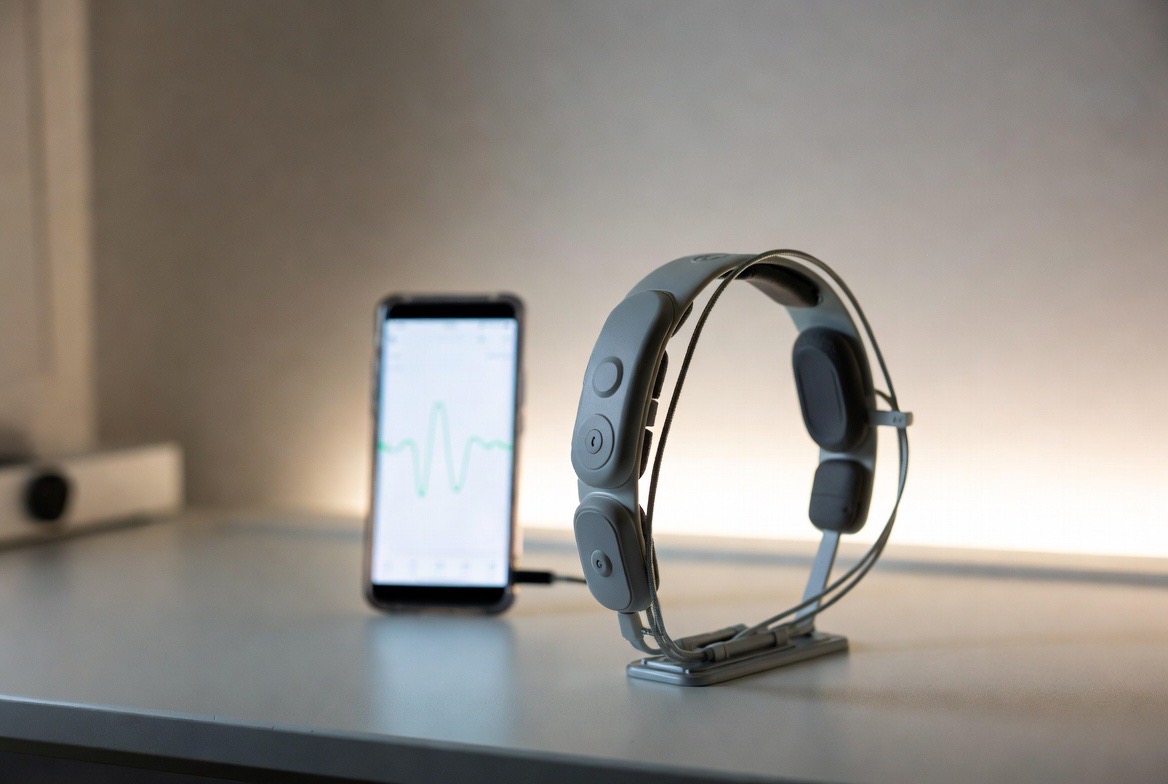
A consumer neurofeedback device — Muse is the best-known, but the category is crowded — is a headband with a few electrodes that sit against your forehead and behind your ears, reading the faint electrical activity of your cortex. An app translates that signal into something you can perceive in real time: the sound of weather, a tone, a moving graphic. When your brain activity drifts toward the “wrong” state, the feedback nudges; when it settles toward the “right” one, the feedback rewards. The promise is that, session by session, you learn to steer your own brain — calmer, more focused, better at sleep, sharper at thinking.
The honest reading requires holding two things at once. First, neurofeedback is not fringe: it descends from real laboratory science going back to the 1960s, and in narrow clinical lanes it has a defensible evidence base. Second, the leap from “a trained clinician runs forty sessions of targeted EEG training for a diagnosed condition” to “a $300 headband upgrades your brain in ten minutes a day” is enormous — and the second product borrows the credibility of the first. This piece sits in our biohacking coverage because the EEG headband is a clean case of a legitimate clinical tool, a genuinely useful meditation gadget, and a pile of overclaiming all wearing the same headband.
The mechanism: EEG, brainwave bands, and training a signal
Here is where the jargon earns its place. Electroencephalography (EEG) measures the summed electrical activity of large populations of cortical neurons through electrodes on the scalp. That activity oscillates, and researchers carve it into frequency bands: delta (slow, deep sleep), theta (drowsy, meditative), alpha (relaxed wakefulness), the sensorimotor rhythm (SMR) and beta (alert, engaged), and gamma (fast, binding activity). Neurofeedback works by operant conditioning of these signals: you are shown a real-time readout of a target band, and rewarded — with a pleasant sound or image — whenever your brain produces more or less of it. In principle, the brain learns to self-regulate the targeted state the way you’d shape any rewarded behavior.4
That is the elegant version. The catch is buried in the engineering. A clinical EEG rig uses many electrodes, conductive gel, and a controlled setting to pull a relatively clean signal. A consumer headband uses a handful of dry electrodes over a limited patch of scalp, worn in your living room, and the signal it captures is a coarse, noise-prone approximation. The brainwave bands themselves are also broad summaries, not precise dials: the relationship between, say, “more alpha” and “better focus” is far looser than the marketing implies. So when a headband tells you it’s reading your “calm,” it is reading a signal that correlates loosely with calm — mixed with eye movement, muscle tension, and motion artifact — and converting it into a cue. The signal it pulls is real. The precision the app implies is not.8
The headband reads a real electrical signal off your scalp. The “state” it claims to train is a loose statistical proxy — and a dry-electrode headband worn at home reads it coarsely.
The evidence: the clinic, the sham problem, and the headband
Start with the clinical lane, because it is the strongest part — and even there, “strong” needs qualifying. The oldest and most defensible application is epilepsy. Sensorimotor-rhythm training has a research lineage going back decades, and a 2023 systematic review and meta-analysis of SMR-based neurofeedback found a significant reduction in seizure frequency after training across the pooled studies.9 But the same review was candid about the methodology: of dozens of studies, only a handful were double-blinded, and the authors concluded the clinical benefit could not yet be pointed to with confidence. So this is a genuine signal sitting on a thin methodological base — which is exactly an EMERGING grade, not a slam dunk.
ADHD is the most-studied consumer-adjacent claim, and it is where the field’s central tension is sharpest. Open-label and unblinded trials, and meta-analyses that include them, have reported real improvements in attention — a 2022 meta-analysis of surface-EEG neurofeedback found a significant effect on sustained attention in ADHD.3 But when you tighten the design, the effect tends to shrink or vanish. A 2021 double-blind, placebo-controlled RCT — the large multisite iCAN study — found that real neurofeedback was no better than a sham version at improving ADHD symptoms, with the difference holding at 13-month follow-up.1 A 2022 sham-controlled trial of fMRI-based neurofeedback in children with ADHD likewise found no advantage of real over sham on clinical or cognitive measures.2
That pattern — benefit in unblinded studies, no specific advantage once you add a credible placebo — is the single most important fact about neurofeedback, and it is why one of our graded claims is the sham finding itself. It does not mean nothing happens. It means a large share of what happens is the well-documented machinery of any engaging intervention: expectation, the structure of showing up, sustained attention to a task, and a clinician’s encouragement. The same caution shows up in healthy adults: a 2024 meta-analysis of neurofeedback for attentional performance found an overall effect, but no significant pooled effect in the subset of trials that compared real against sham feedback.5 Strip out the placebo, and the specific brainwave-training signal struggles to stand on its own.
Now the consumer headband itself. Here the honest verdict is gentler than the cognitive-enhancement marketing deserves but kinder than a pure debunk. Small studies of devices like Muse suggest a real, mostly behavioral benefit: a 2019 randomized controlled trial using a wearable EEG meditation headband in newly diagnosed breast-cancer patients reported improvements in well-being and good adherence over the program.7 The plausible mechanism there is not “rewiring” — it is that turning meditation into an interactive, gamified loop helps some people actually do it, and meditation done consistently has its own modest evidence. That is a legitimate use. It is also a completely different claim from “this headband makes you smarter,” and the gap between the two is where most of the hype lives. We make the parallel argument for every quantified-self gadget in our read on over-read wearable data: the device is most defensible as a behavior-change nudge, least defensible as a precise verdict.
Claim vs. evidence, at a glance
The cleanest way to hold this field is to keep the clinical lane, the placebo problem, and the consumer pitch in separate columns — because the marketing depends on you merging them.
| Claim | What the evidence shows | Read |
|---|---|---|
| Epilepsy adjunct (SMR training) | Pooled meta-analysis shows reduced seizure frequency, but few blinded trials.9 | Real but methodologically thin |
| ADHD symptom improvement | Effects in unblinded trials; no specific edge over sham in double-blind RCTs.1 | Contested; largely non-specific |
| Sham works as well as real | Repeatedly observed across ADHD and healthy-adult trials.2 | Well-replicated; undermines specificity |
| Meditation adherence / engagement | Feasibility studies show real-time feedback aids practice and well-being.7 | Plausible, mostly behavioral |
| Cognitive enhancement / “rewiring” | No specific benefit once placebo is controlled; signal quality limited.5 | Unsupported |
What’s evidence-based vs. what’s marketed
Place the uses honestly on a spectrum of how much weight each can carry. This is calibration, not a prescription — and certainly not medical advice.
Clinical — provider-run, for a diagnosis. The defensible clinical use is narrow: supervised neurofeedback, with proper equipment, as one adjunct among others for a specific condition like drug-resistant epilepsy, decided with a clinician who knows the contested evidence.6 Even here, the honest framing is “promising adjunct with a placebo question,” not “proven cure.” This is not the same activity as wearing a consumer headband at home.
Meditation aid — a behavior nudge for some people. If a real-time feedback loop is what finally gets you to meditate regularly, the headband is doing something genuinely worthwhile, and the small studies support that use.7 Treat the benefit as “it helped me build a practice,” not “it trained my brain” — and know that a free app and a timer get many people to the same place.
Brain optimization — the weakest-supported use. Buying a headband expecting lasting gains in IQ, focus, or memory — a measurably better brain — is the claim the sham-controlled data give no clear support to.5 The specific brainwave training, isolated from expectation and structure, has not earned that promise, and a coarse home signal makes the precision worse, not better.
The cleanest way to think about a consumer EEG headband is to ask what you’re actually buying. If the answer is “a more engaging way to build a meditation habit,” the purchase can make sense, and the small studies back that use. If the answer is “a device that rewires my cognition,” you’re paying for a claim the controlled evidence doesn’t support — and the sham-feedback problem means even apparent gains may be expectation, not the EEG. The right question is never “did the rain calm down today?” It’s “am I meditating more, and does the rest of my life reflect it?” The Manual maps the brain-sensing and biofeedback field against itself — what each device’s evidence genuinely supports, where the placebo problem bites, and how to read a wellness gadget without letting the loop run your expectations. See the Manual →
The sham problem and other grey areas
The grey area that matters most is the one the marketing never mentions: the placebo and blinding problem, and it is worth naming directly because it reframes everything else. Across well-designed trials, when researchers give one group real neurofeedback and another group sham feedback — a loop that looks and feels identical but is driven by noise or a pre-recording — the two groups often improve about equally.1 The careful interpretation is not “neurofeedback is fake.” People in these trials genuinely get better. The interpretation is that the specific ingredient — training your actual brainwaves — frequently fails to outperform the non-specific ingredients of expectation, attention, structure, and relaxation. For a consumer device sold on the specific mechanism, that is a serious caveat. It is also a contested literature: defenders argue some sham-controlled trials were designed in ways that prevented genuine self-regulation, and that debate is unresolved — which is precisely why we grade this MODERATE rather than treating it as settled.4
Three more flags. First, signal quality: a few dry electrodes over a small patch of scalp, worn while you breathe and shift, capture a noisier, lower-resolution signal than a clinical rig, and motion and muscle artifact contaminate the very bands the device claims to train.8 Second, cost and regulation: these are consumer wellness products, not regulated medical devices, which means the cognitive-enhancement language faces a far lower evidentiary bar than a drug or a diagnostic would — the marketing is allowed to run ahead of the data. Third, the field’s history of overclaiming: neurofeedback has cycled through decades of enthusiastic claims that outpaced replication, and a buyer should weight a bold promise accordingly. None of this makes the underlying science fake. All of it belongs in the honest accounting before you strap on a headband.
Open questions
Several gaps keep the overall verdict at emerging-and-mixed rather than positive. The biggest: can the specific signal be separated from the placebo at all in a real-world product? Until consumer devices are tested head-to-head against credible sham loops — and most never are — we cannot say a given headband’s benefit comes from the EEG rather than the ritual around it.5 Beyond that: does any home-trained change in a brainwave band transfer to real-life focus or mood, and does it last after you stop? Does the coarse signal from a dry-electrode headband even reliably reflect the state it claims to train, or is it tracking eye movement and muscle tension as much as cortex?8 And in the clinical lane, the epilepsy and ADHD literatures both need more, better-blinded trials before the adjunct claims firm up.6 These are the questions a buyer should keep open — and the reasons today’s headband is best read as a meditation aid with an interesting sensor, not a proven brain trainer.
What this article is not saying
This is not “neurofeedback is pseudoscience.” It descends from real laboratory work, it has a defensible — if contested — clinical evidence base in epilepsy and ADHD, and dismissing it outright is as wrong as believing the headband upgrades your brain. The science is real; the consumer claims outrun it.
This is not “the headband does nothing.” For some people, a feedback loop is what finally makes meditation stick, and the well-being and adherence benefit in the small studies is genuine. The error is reading “it helped me practice” as “it trained my brain” — two very different claims with very different evidence behind them.
And this is not a recommendation to buy, or not buy, any device. The point is calibration: respect the clinical research, take the sham problem seriously, value the headband as a meditation nudge if that’s what helps you, and distrust any promise of lasting cognitive enhancement from a dry-electrode headband worn at home. Read it the way our companion piece on hyperbaric oxygen and the reverse-aging pitch reads its chamber — a legitimate tool with a narrow real use, sold with a far broader claim than the data authorizes.
References
- Neurofeedback Collaborative Group. Double-Blind Placebo-Controlled Randomized Clinical Trial of Neurofeedback for Attention-Deficit/Hyperactivity Disorder With 13-Month Follow-up. J Am Acad Child Adolesc Psychiatry. 2021;60(7):841-855. DOI · PMID 33359834
- Lam SL, Criaud M, Lukito S, Westwood SJ, Agbedjro D, Rubia K, et al. Double-Blind, Sham-Controlled Randomized Trial Testing the Efficacy of fMRI Neurofeedback on Clinical and Cognitive Measures in Children With ADHD. Am J Psychiatry. 2022;179(12):947-958. DOI · PMID 36349428
- Yan L, Wang S, Yuan Y, Zhang J. Surface electroencephalographic neurofeedback improves sustained attention in ADHD: a meta-analysis of randomized controlled trials. Front Hum Neurosci. 2022;16:1014205. DOI · PMC9764556
- Sitaram R, Ros T, Stoeckel L, et al. Closed-loop brain training: the science of neurofeedback. Nat Rev Neurosci. 2017;18(2):86-100. DOI · PMID 28003656
- Chen Y, Wang E, Tang Y, et al. Efficacy of neurofeedback training for improving attentional performance in healthy adults: A systematic review and meta-analysis. Imaging Neurosci. 2024;2:1-22. DOI
- Hosseini SA, Ferdosi MK, et al. Clinical applications of neurofeedback based on sensorimotor rhythm: a systematic review and meta-analysis. Front Hum Neurosci. 2023;17:1273860. DOI · PMC10694284
- Millstine DM, Bhagra A, Jenkins SM, et al. Use of a Wearable EEG Headband as a Meditation Device for Women With Newly Diagnosed Breast Cancer: A Randomized Controlled Trial. Integr Cancer Ther. 2019;18:1534735419878770. DOI · PMID 31313624
- Williams NS, McArthur GM, Badcock NA, et al. Comparison of EEG Signal Spectral Characteristics Obtained with Consumer- and Research-Grade Devices. Sensors (Basel). 2024;24(24):8108. DOI
- Tan G, Thornby J, Hammond DC, et al. Meta-analysis of EEG biofeedback in treating epilepsy. Clin EEG Neurosci. 2009;40(3):173-179. DOI · PMID 19715180