Cupping therapy: do those Olympic circles actually do anything?
Ever since the round purple marks showed up on swimmers’ shoulders at the 2016 Olympics, cupping has been sold as a recovery and performance secret. Strip the mystique off, and you’re left with a glass or silicone cup, a vacuum, and a bruise. Here’s the honest, cited read: the evidence for short-term pain relief is real but genuinely weak, the case for athletic recovery is essentially missing, and the marks are not toxins leaving your body — they’re broken capillaries. A low-risk ritual oversold by its own fame.
How this article was built: Primary sources: Wang et al. 2023 evidence-mapping study of cupping for pain in Frontiers in Neurology; Wang et al. 2025 updated systematic review and meta-analysis of cupping for pain in the Journal of Traditional Chinese Medicine; Bridgett et al. 2018 systematic review of cupping in athletes in the Journal of Alternative and Complementary Medicine; Coutinho et al. 2025 randomized controlled trial of cupping after running in the Journal of Bodywork and Movement Therapies; and Mohamed et al. 2023 evidence-and-adverse-effects review in the Journal of Back and Musculoskeletal Rehabilitation — each retrieved and verified against PubMed-indexed records via web, as the Consensus and PubMed research tools were offline at the time of writing.
- For short-term pain, the evidence is real but weak: reviews that pool dozens of trials find a modest benefit, then grade their own confidence as low-to-very-low because almost every trial is small and at high risk of bias.12
- For athletic recovery and performance — the whole Olympic story — the evidence is essentially absent. The biggest review couldn’t recommend for or against it, and a 2025 trial found no benefit on pain, fatigue, recovery, or jump height.34
- The marks are bruising, not detox. Nothing is being “pulled out” — the cup ruptures tiny surface blood vessels, exactly like a hickey.
- Who it’s for: someone who finds it relaxing and wants short-term comfort, knows it’s mostly placebo and ritual, and keeps the skin-breaking wet version with a licensed practitioner only.
- What cupping actually is
- The mechanism: the signal it pulls
- Pain: the best-supported use, and why it’s still weak
- Performance and recovery: the Olympic myth
- Toxins and the marks: the detox myth
- Safety: dry versus wet
- Where it fits: a tiered view
- Grey areas and open questions
- What this article is not saying
- References
What cupping actually is
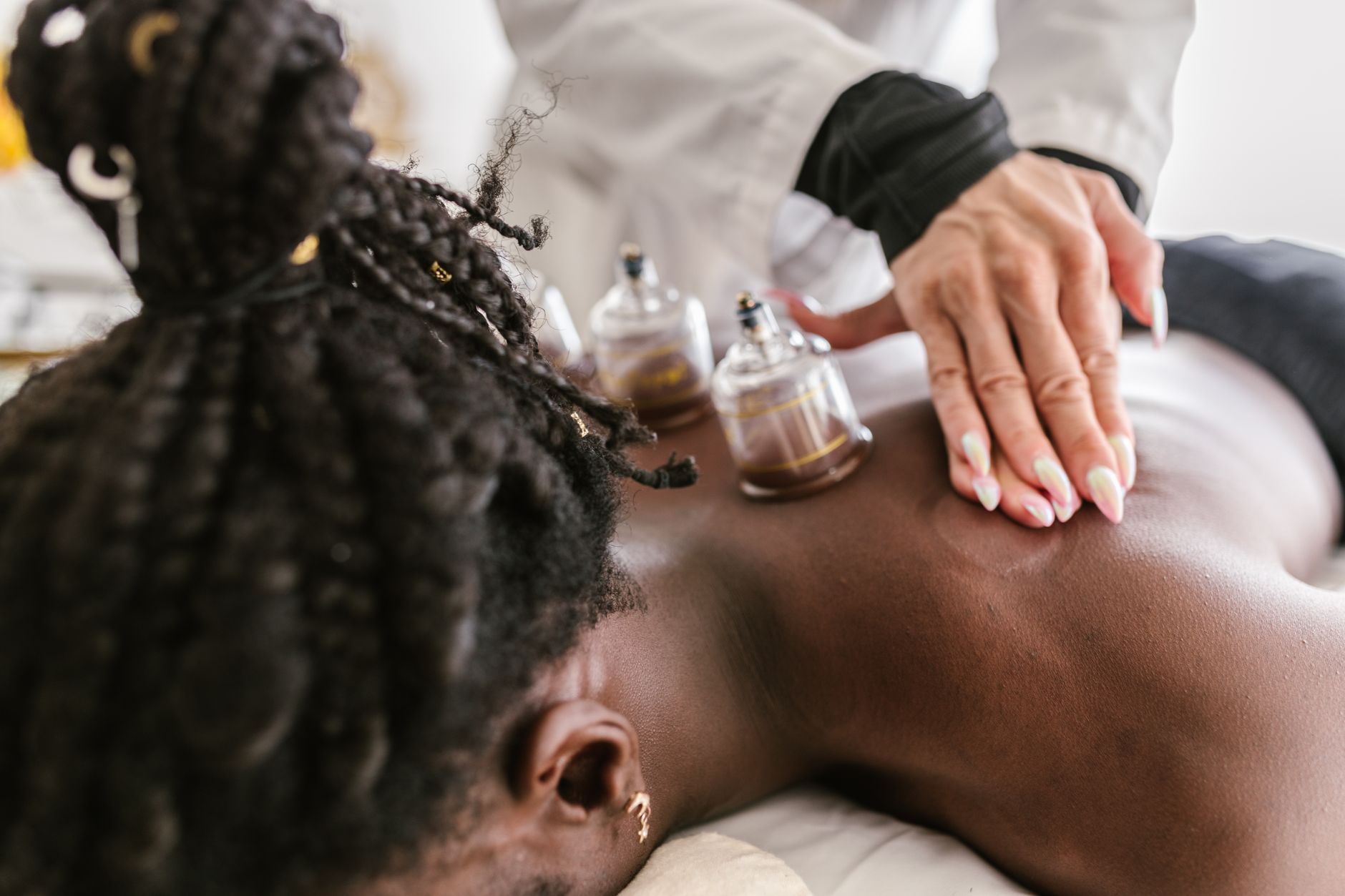
Cupping is one of the oldest tricks in the bodywork book, and the device is almost comically simple. A practitioner places a cup — glass, bamboo, or silicone — on the skin and creates suction inside it, either by briefly heating the air (the “fire cupping” version) or by pumping the air out. The vacuum pulls the skin and the surface tissue up into the cup and holds it there, usually for five to fifteen minutes. That’s the entire mechanism of action you can actually see: negative pressure, lifting skin, for a few minutes at a time.
There are two families worth keeping straight, because they carry very different risk. Dry cupping leaves the skin intact — suction only. Wet cupping (also called hijama) adds small, deliberate skin punctures so that a little blood is drawn into the cup. The round, often purple marks everyone associates with cupping come from the dry version and are simply bruising. When you saw them on Olympic swimmers and gymnasts starting in 2016, that single image did more for cupping’s marketing than any study ever has — and it’s worth asking the same question we ask across the whole devices hub: once you separate what’s been put through real trials from what’s riding on a viral photo, what’s left?
The mechanism: the signal it pulls
The honest mechanistic story is “a few plausible ideas, none of them well-mapped.” The most defensible version is that the suction is a strong, novel sensory input. Lifting and stretching the skin floods the local pressure and stretch sensors, and that stream of signal can compete with pain signals heading to the brain — the same broad gate-control idea behind why rubbing a sore spot helps. The cup also visibly draws blood toward the surface, which is the kernel of truth inside the “improves circulation” claim, and the negative pressure pulls on the connective tissue, which is where the trendier phrase myofascial decompression comes from (the idea of lifting and “decompressing” the fascia, the sheet of connective tissue wrapping muscle).
Here’s the catch: those are descriptions of what the cup does to tissue, not proof that any of it produces a meaningful clinical result. The signal cupping pulls is real and local — surface blood moves, sensors fire, tissue lifts — but the leap from “blood comes to the surface” to “therefore your back heals faster” is exactly the leap that has never been demonstrated. The connecting tissue between the visible effect and the promised outcome is mostly assumption. That’s why the mechanism claim earns a WEAK grade: the marketing describes the mechanism with total confidence, and the evidence that the mechanism translates into benefit is thin.5
Cupping pulls a genuine signal — it floods the skin’s sensors and brings blood to the surface. What it doesn’t do is the thing the marketing promises: turn that brief, local effect into healing, detox, or a performance edge.
Pain: the best-supported use, and why it’s still weak
If cupping does anything you can point to in the literature, it’s short-term relief of musculoskeletal pain — mostly chronic neck and low back pain. And on a surface read, the numbers look encouraging. A 2025 updated meta-analysis pooled 72 randomized trials covering 5,720 participants and found cupping reduced pain scores and improved quality of life versus comparison treatments.2 A 2023 evidence-mapping study that sat above this whole field reached the same surface conclusion: cupping “is effective in managing chronic pain… low back pain, neck pain.”1 Taken alone, those sentences sound like a green light.
Read the very next line of each paper, and the green light turns amber. The same 2023 mapping study found no high-quality evidence anywhere in the field — the best studies were moderate quality, most were low or very low.1 The 2025 meta-analysis is blunter still: it rated all of its evidence as low or very-low quality, judged every included trial to be at high risk of bias, and noted that not one of them reported proper blinding.2 That last point is the quiet killer. You cannot easily fake a cup — the person knows the suction is on, the practitioner knows they applied it, and a vivid mark is sitting on the skin as proof. Without a convincing sham, a large slice of any measured “benefit” is expectation: a striking, hands-on ritual that feels like treatment.
So the honest position is a genuinely awkward one to hold, and we’ll hold it anyway: cupping may offer modest short-term pain relief, and the confidence we can have in that is low. That is the textbook definition of a WEAK grade — a real signal, pointing the right way, sitting on a foundation too shaky to bear much weight. It is not nothing. It is also not the slam-dunk the wellness pitch implies, and anyone selling it as proven is reading the abstract and skipping the limitations.
Performance and recovery: the Olympic myth
Now the claim that actually sells cupping: the idea that it speeds muscle recovery and sharpens athletic performance, blessed by the sight of decorated Olympians wearing the marks. This is where the evidence goes from weak to barely-there. The most thorough look at the question — a 2018 systematic review built specifically around amateur and professional athletes — concluded that no explicit recommendation for or against cupping in athletes could be made, that the majority of trials carried an unclear or high risk of bias, and, tellingly, that none of the included studies even reported on safety.3 When the best available review of a topic ends in a shrug, the marketing has run miles ahead of the data.
And when researchers test the recovery claim head-on, it tends to come back empty. A 2025 randomized controlled trial took 81 recreational runners, applied cupping after a run, and measured the things the recovery pitch promises — quadriceps pain, fatigue, perceived recovery, and vertical jump height. The result was clean and negative: cupping did not improve any of them, and the authors openly raised doubts about choosing it in practice.4 That’s a properly designed, decent-sized trial finding nothing on exactly the outcomes athletes care about.
So the Olympic association — the entire reason most people have heard of cupping — is a marketing and placebo story, not a demonstrated performance benefit. Elite athletes try everything, copy each other relentlessly, and operate inside a recovery culture where looking like you’re leaving nothing on the table is its own reward. A swimmer wearing cupping marks tells you that swimmer believes in cupping. It does not tell you cupping made them faster. The performance claim earns a WEAK grade, and that’s arguably generous to a body of work this thin.
Toxins and the marks: the detox myth
One claim gets repeated so often it deserves naming and killing directly: that cupping “draws out toxins,” and that the darker the marks, the more toxins came out. This is wrong, and it’s wrong in a way that’s easy to verify. The round marks are bruising — the suction ruptures tiny capillaries just under the skin, and the colour is pooled blood under intact skin, exactly like a hickey or any other bruise. Nothing is being pulled through the skin and out of the body; in dry cupping, the skin isn’t even broken. The marks darken with stronger suction or more fragile vessels, not with some hidden toxic load, and they fade over days as the body reabsorbs the blood — the same way every bruise does.
There’s no defined “toxin” that cupping has ever been shown to remove, no measurement of one before and after, and no biological route for suction on the skin to clear metabolic waste — that’s what your liver and kidneys are for. This isn’t a modest overstatement of a real effect; it describes a mechanism that isn’t happening. That’s why the detox claim earns a flat HYPE grade. You can find cupping relaxing, you can even find it helps your stiff neck for an afternoon, and the toxin story can still be pure fiction. Both things are true at once.
Safety: dry versus wet
The reassuring part of the story is that dry cupping is, for most people, a low-risk thing to try. The systematic reviews that tracked harms found the incidence of adverse effects from cupping to be very low to low, and the ones that do occur are mostly minor: the bruising itself, a day or two of soreness, occasional skin irritation, and — specific to fire cupping — the rare burn when heat is involved.5 For dry cupping done by someone competent, that low-risk profile is real, and it earns the safety claim a MODERATE grade. The downside is mostly cosmetic and temporary.
Wet cupping is a different conversation, and the difference is the broken skin. The moment you’re making punctures and drawing blood, you’ve added infection risk, scarring, and bloodborne-pathogen exposure to the ledger — risks that depend entirely on sterile technique and a trained, licensed practitioner. This is the line where “harmless ritual” stops applying. And one caution holds across both versions: a cup placed on your skin is not a diagnosis. If you’re reaching for cupping because of pain that’s new, severe, spreading, or unexplained, the cup is the wrong tool — that’s a clinician’s job, and decorating the problem with marks can delay the assessment that actually matters.
Where it fits: a tiered view
It helps to place cupping honestly on a spectrum of what to expect.
Foundational — the legitimate, modest use. As a relaxing, hands-on session that may take the edge off chronic neck or back stiffness for a short window, dry cupping is a low-risk thing to enjoy.15 Treat it the way you’d treat a good massage: pleasant, possibly helpful for comfort, not a cure. The same calibrated lens applies to other popular recovery devices, like the TENS unit for pain and the massage gun.
Research-curious — the comfort add-on. Used alongside the things that actually drive recovery and pain control — sleep, load management, graded movement, and strength work — cupping is a reasonable low-harm extra if you find it relaxing. Expect a placebo-flavoured comfort effect, and don’t let it crowd out or delay care that’s evidence-based.
Hype — the reasons it’s oversold. Buying cupping to recover faster, perform better, “detox,” or fix an injury is buying the marketing and the Olympic photo, not the data.34 None of that is what the cup has been shown to do.
Cupping is a low-risk ritual with a weak evidence base — and the worst mistake is treating any single gadget or session as the answer to pain or recovery on its own. The right question is rarely “cupping: yes or no,” it’s “what actually moves my pain and recovery, and where does a cup rank against sleep, training load, movement, and the genuinely evidence-based tools?” The Manual maps the recovery and pain tools against each other — what each one’s evidence genuinely supports, who benefits and who’s wasting money, and how to combine them without fooling yourself. See the Manual →
Grey areas and open questions
The sham problem. The single biggest weakness in this entire literature is that you can’t convincingly fake a cup. The suction is obvious, the mark is visible, and the practitioner always knows. Until someone designs a believable sham — and a few have tried, with limited success — we genuinely cannot separate the modest measured benefit from the placebo a dramatic, hands-on ritual always carries. Some unknown but real fraction of cupping’s reported pain relief is expectation, and the current trials can’t tell us how much.
Small, biased, heterogeneous trials. The reviews are candid that the underlying studies are mostly small, frequently at high risk of bias, and wildly inconsistent in how they apply cupping — type, suction strength, duration, number of cups, and number of sessions all vary.12 Pooling that into a tidy meta-analysis number hides how shaky each ingredient is. “There are 72 trials” sounds authoritative; “72 mostly-low-quality, high-bias trials” is the accurate version.
Whole populations unstudied. Almost none of this work tells us what cupping does over months of regular use, or in older adults, or in specific clinical pain conditions beyond the back and neck. The honest summary is “possible short-term comfort, low confidence, in the populations that have been studied” — not “proven therapy for pain.”
What this article is not saying
This is not “cupping is a scam.” It’s a low-risk, often relaxing practice that may give some people modest short-term relief, and finding it pleasant is a perfectly good reason to do it.1 Dismissing it outright is as overconfident as the marketing that oversells it — the truthful position is simply “weak evidence, low confidence,” not “worthless.”
This is not “cupping will make you recover faster or perform better.” That half of the pitch — the Olympic half — is the part that doesn’t survive contact with the data: the best athlete review couldn’t recommend it, and a proper trial found nothing.34 And it is emphatically not a detox: the marks are bruises, and nothing toxic is leaving your body.
And this is not a treatment protocol or medical advice. Pain that’s new, severe, or unexplained deserves a clinician steering the plan, and the wet-cupping cautions above are not optional. The point here is to draw the line clearly between a harmless, mildly-helpful ritual and the wide, confident marketing pitch stacked on top of it — so your expectations, and your money, can be honest ones.
References
- Wang L, Cai Z, Li X, Zhu A. Efficacy of cupping therapy on pain outcomes: an evidence-mapping study. Front Neurol. 2023;14:1266712. DOI · PMID 37965178
- Wang Y, Dong S, Li B, Han M, Cao H. Update evidence of effectiveness on pain relieving of cupping therapy: a systematic review and meta-analysis of randomized controlled trials. J Tradit Chin Med. 2025;45(2):234-253. DOI · PMID 40151111
- Bridgett R, Klose P, Duffield R, Mydock S, Lauche R. Effects of cupping therapy in amateur and professional athletes: systematic review of randomized controlled trials. J Altern Complement Med. 2018;24(3):208-219. DOI · PMID 29185802
- Coutinho LOB, Alves BS, Caetano RO, et al. Cupping therapy does not improve quadriceps muscle pain and fatigue intensity, perceived recovery, and vertical jump height after running: a randomized clinical trial. J Bodyw Mov Ther. 2025;42:441-445. DOI · PMID 40325704
- Mohamed AA, Zhang X, Jan YK. Evidence-based and adverse-effects analyses of cupping therapy in musculoskeletal and sports rehabilitation: a systematic and evidence-based review. J Back Musculoskelet Rehabil. 2023;36(1):3-19. DOI · PMID 35848010