Colchicine for the heart: an ancient drug, a new approval, and the honest evidence
For two thousand years colchicine was a gout drug — a cheap, oral, plant-derived anti-inflammatory that doctors reached for when a big toe caught fire. Now it is the first pure anti-inflammatory the FDA has ever approved to reduce cardiovascular risk. That is a genuinely important story, because it is proof that the inflammation behind heart disease is a target you can actually drug. But the same month the approval landed, a large trial came back neutral and cooled the room. Here is the graded line between what colchicine really does for the heart, who it is for, and where the hype outruns the numbers.
How this article was built: The pivotal secondary-prevention trials — LoDoCo2 and COLCOT in the New England Journal of Medicine, the CANTOS proof-of-concept with canakinumab, the Fiolet 2021 meta-analysis in the European Heart Journal, the mechanism literature on the NLRP3 inflammasome, a 2025 Cleveland Clinic review covering the 2023 FDA approval, and the neutral 2025 CLEAR SYNERGY (OASIS-9) trial — were pulled from their source journals and checked against the live record. Where the data is strong, I say so. Where a trial came back neutral or the benefit is modest, I name it. Nothing here is medical advice or a dosing instruction.
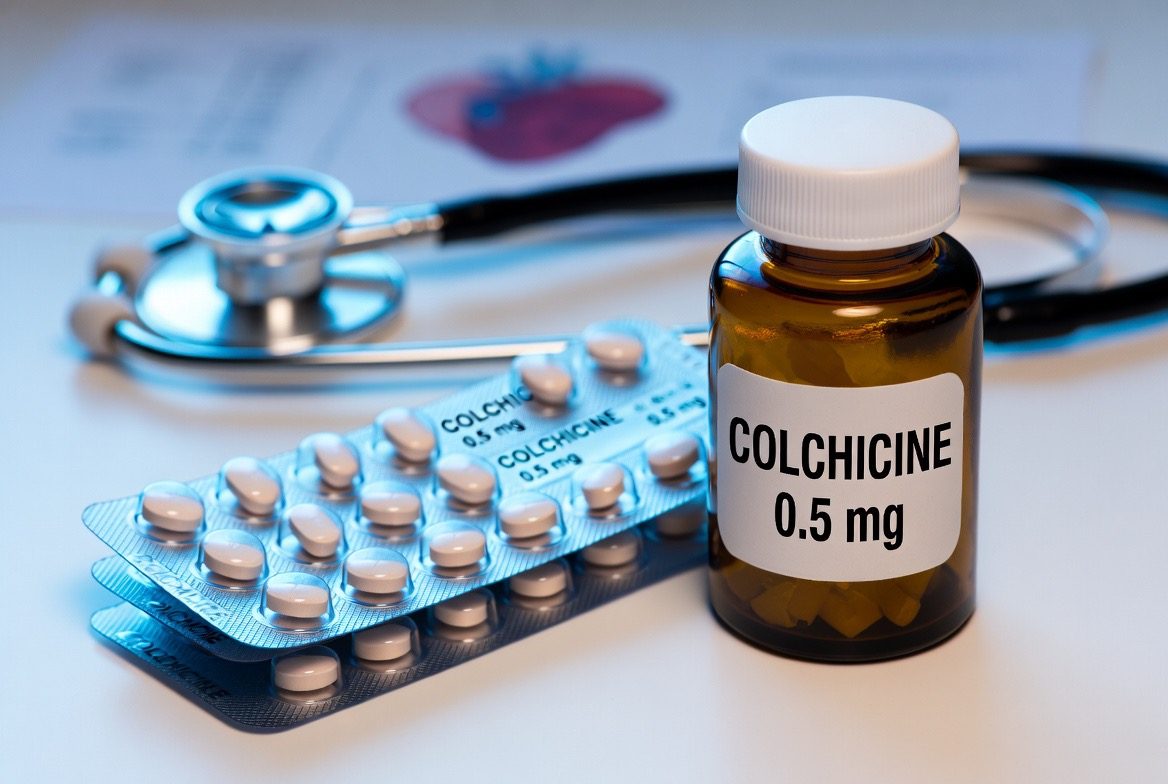
- The evidence is real and it is cheap. In people who already have coronary disease, low-dose colchicine cut major cardiovascular events by roughly a quarter to a third in two large trials — on top of statins, for pennies a day.12
- It proves inflammation is a drug target. The signal it pulls is anti-inflammatory: it quiets the same NLRP3 / IL-1β pathway that the expensive injectable canakinumab hit in CANTOS — the trial that first proved lowering inflammation cuts heart attacks.35
- The approval is a landmark — and a 2025 trial complicated it. The FDA approved low-dose colchicine (Lodoco) in 2023, the first anti-inflammatory ever cleared for cardiovascular risk. Then the large CLEAR SYNERGY trial came back neutral in post-heart-attack patients, cooling some of the enthusiasm.67
- This is a prescription add-on, not a biohack. The absolute benefit is modest, the GI side effects are common, and the drug interactions — certain statins, some antibiotics, kidney impairment — are genuinely dangerous. It is a physician-managed decision, full stop.6
- The news, and where I actually land
- The inflammation hypothesis: what colchicine is actually doing
- The trials: LoDoCo2, COLCOT, and the approval
- The complication: the neutral 2025 trial
- Where colchicine fits, and who it is for
- The grey areas: side effects, interactions, and the DIY trap
- What we still don’t know
- References
The news, and where I actually land
Let me put my position down before I defend it. Colchicine for the heart is one of the more interesting repurposing stories in modern cardiology, and it is also a drug that most people should never touch without a cardiologist deciding it is right for them. Both are true at once. The interesting part is that a 2,000-year-old anti-inflammatory — extracted from the autumn crocus, used for gout since antiquity, costing almost nothing — turns out to lower the risk of heart attacks and strokes in people who already have coronary disease. That is not a supplement-company claim. It is two large randomized trials and, in 2023, an FDA approval. The cautionary part is that the benefit is modest in absolute terms, the drug has a narrow safety margin, and a big trial in 2025 came back neutral. Any take that gives you only the exciting half is selling you something.
Here is the shape of it. For thirty years, the story of heart-disease prevention was cholesterol: lower the LDL (low-density lipoprotein, the “bad” cholesterol) with statins, cut the events. That worked, and it still works. But even with LDL driven down hard, a large chunk of people still have heart attacks — what cardiologists call residual risk. A big slice of that residual risk turned out to be inflammation: the arterial plaque that causes heart attacks is not just a grease clog, it is an active, inflamed lesion. The question for two decades was whether you could reduce events by treating the inflammation directly, independent of cholesterol. Colchicine is one of the cheapest ways anyone found to test that idea — and to a meaningful degree, it worked.
This belongs squarely in the pharmaceuticals hub, and it sits alongside the running argument on this site about how heart-disease risk actually gets managed — a debate we take up in our read on statins and the absolute-risk numbers. Colchicine is the next chapter of that same story: what do you do about the risk statins leave on the table? So let me separate the parts — the mechanism, the trials, the approval, and the trial that complicated it.
The inflammation hypothesis: what colchicine is actually doing
Start with the biology, because this is where colchicine’s credibility comes from — the mechanism is not hand-waved, it is one of the better-mapped stories in cardiology.
The wall of an artery with atherosclerosis is full of immune cells, and the ones that drive the danger are neutrophils and macrophages reacting to cholesterol crystals lodged in the plaque. Those crystals switch on a molecular alarm inside the immune cell called the NLRP3 inflammasome (a protein complex named for the gene that encodes it). When the inflammasome fires, it releases IL-1β (interleukin-1 beta, a master inflammatory signaling molecule), which recruits more inflammation, destabilizes the plaque, and makes it more likely to rupture and cause a heart attack.5 That cascade — cholesterol crystal, inflammasome, IL-1β, unstable plaque — is the inflammation hypothesis of heart disease in one line.
Colchicine interrupts it early. Its oldest-known action is binding tubulin and blocking the assembly of microtubules, the internal scaffolding a cell uses to move, divide, and traffic its contents. In an inflammatory neutrophil, that scaffolding is how the cell crawls to the plaque and how the inflammasome components come together to fire. Jam the microtubules and you blunt neutrophil migration, dampen the NLRP3 inflammasome, and lower IL-1β output.5 The signal it pulls is a brake on the specific inflammatory machinery that destabilizes plaque — not a broad immune shutdown, but a targeted cooling of the arterial fire.
The reason we know this pathway matters — and matters independently of cholesterol — is a landmark trial called CANTOS. It tested canakinumab, an expensive injectable antibody that neutralizes IL-1β directly, in more than 10,000 people who had already had a heart attack. Canakinumab reduced recurrent cardiovascular events compared with placebo, with no change in cholesterol — the first hard proof that lowering inflammation alone cuts heart attacks.3 That was the proof of concept. The catch was that canakinumab is costly, injectable, and raised the risk of fatal infections, so it never became a mass heart drug. CANTOS answered “does treating inflammation work?” with a yes — and left the door open for a cheap, oral drug hitting the same pathway. Colchicine walked through it.
CANTOS proved you could prevent heart attacks by treating inflammation instead of cholesterol. Colchicine is the cheap, oral, 2,000-year-old way to do roughly the same thing.
The trials: LoDoCo2, COLCOT, and the approval
Here are the numbers that anchor the whole case. Two large randomized trials tested low-dose colchicine — 0.5 mg once daily — in people who already had coronary disease, on top of standard therapy including statins.
LoDoCo2 (2020, in the New England Journal of Medicine) enrolled 5,522 patients with chronic coronary disease and randomized them to colchicine 0.5 mg daily or placebo. Over a median of about 29 months, colchicine reduced the primary composite of cardiovascular death, heart attack, stroke, and urgent revascularization by roughly 31% relative to placebo.1 That is a large relative reduction for a drug that costs almost nothing, layered on top of already-optimized care.
COLCOT (2019, also in the NEJM) came at it from the acute end: 4,745 patients randomized within 30 days of a heart attack to colchicine or placebo. It cut the primary composite of ischemic cardiovascular events by about 23%.2 Two trials, two different populations — stable disease and recent heart attack — both pointing the same direction. When the Fiolet 2021 meta-analysis in the European Heart Journal pooled the randomized colchicine trials in coronary disease, it found roughly a 25% relative reduction in major adverse cardiovascular events, with the benefit driven by fewer heart attacks, strokes, and revascularizations.4 That is a consistent, pre-registered, thousands-of-patients signal.
On the strength of that body of evidence, in June 2023 the FDA approved low-dose colchicine (brand name Lodoco) to reduce the risk of heart attack, stroke, coronary revascularization, and cardiovascular death in adults with established atherosclerotic disease or multiple risk factors.6 This matters more than a routine approval, because it was the first time a pure anti-inflammatory drug was ever approved to treat cardiovascular disease — a formal regulatory acknowledgment that inflammation is a heart-disease target you can drug. That factual approval is not in dispute, which is why I grade it Strong: it happened, it is on the label, and it reframed the field.
| Trial | Population / design | What it found |
|---|---|---|
| CANTOS3 | Canakinumab (anti-IL-1β), post-MI, >10,000 patients | Proof of concept: lowering inflammation cut events with no cholesterol change |
| COLCOT2 | Colchicine 0.5 mg/day, within 30 days of MI, 4,745 patients | ≈23% reduction in ischemic cardiovascular events |
| LoDoCo21 | Colchicine 0.5 mg/day, chronic coronary disease, 5,522 patients | ≈31% reduction in the primary composite endpoint |
| Fiolet meta-analysis4 | Pooled randomized colchicine trials in coronary disease | ≈25% relative reduction in major adverse cardiovascular events |
| CLEAR SYNERGY / OASIS-97 | Colchicine after PCI for acute MI, 7,062 patients, ~3-yr follow-up | Neutral — no significant reduction in the primary endpoint |
The complication: the neutral 2025 trial
Now the part an honest article cannot skip. In 2025 the largest colchicine cardiovascular trial yet, CLEAR SYNERGY (OASIS-9), read out in the NEJM — and it was neutral. It randomized 7,062 patients to colchicine or placebo shortly after a percutaneous coronary intervention (a stent) for acute heart attack, and followed them for about three years. The primary composite outcome occurred in 9.1% of the colchicine group versus 9.3% of placebo — no significant difference.7 After two positive trials and an FDA approval, this was a genuine surprise, and it deservedly cooled some of the enthusiasm.
So how do I reconcile a 25%-reduction meta-analysis with a flat 7,000-patient trial? Honestly, not by explaining the neutral trial away. A few things are worth holding in mind at once. CLEAR SYNERGY tested colchicine started right after an acute heart attack, a very inflamed, high-treatment-intensity moment that is not identical to the stable, chronic-disease setting where LoDoCo2 saw its biggest effect. The overall event rates were lower than some earlier trials, which makes a modest benefit harder to detect. And it is entirely possible the earlier positive trials slightly overstated the true effect — that happens, and larger, later trials often pull an estimate back toward a smaller real number. The fair reading is not “colchicine failed” and not “the neutral trial doesn’t count.” It is that the true benefit is probably real but smaller and more context-dependent than the headline 31% suggested — strongest in stable chronic coronary disease, less certain in the immediate post-heart-attack window. That is exactly why the core claim grades Moderate and not Strong.
Where colchicine fits, and who it is for
We do not write dosing protocols on this site, and I am certainly not going to start with a narrow-margin prescription drug that interacts dangerously with common medications. What I can do is frame where colchicine sits relative to established heart-disease prevention, sorted by how well the evidence has your back — and every tier assumes a prescribing cardiologist, not a vendor and a screenshot.
The bedrock of cardiovascular prevention is LDL lowering with statins, blood-pressure and glucose control, and the lifestyle foundations. This has decades of hard outcome data behind it. Colchicine is only ever discussed as an add-on after this is optimized — it is measured against this floor, never a replacement for it.
For selected patients who already have coronary disease and still have residual risk on top of a statin, low-dose colchicine is a defensible, FDA-approved, cheap add-on with two positive trials behind it.126 This is a shared decision with a cardiologist who has checked your kidney function and your other medications — not a self-start.
Taking colchicine as a general anti-aging or anti-inflammatory supplement, in a healthy person with no established heart disease, or buying it to self-experiment, runs straight past the evidence and into the interaction risk.6 The trials studied sick hearts, not healthy ones, and the safety margin is too narrow for casual use. This is where hype wears the costume of a protocol.
The grey areas: side effects, interactions, and the DIY trap
Four things the “cheap wonder drug” framing tends to skip, and they are the reason this is a prescription and not a supplement. First, the side effects are common and start in the gut. The most frequent complaint is diarrhea, along with nausea and abdominal cramping — a direct consequence of colchicine hitting the fast-dividing cells of the gut lining. Most people tolerate the low 0.5 mg dose, but a meaningful minority stop because of it. Rarer but more serious is myotoxicity — muscle damage — which becomes far more likely when colchicine builds up in the body.6
Second, and this is the big one, the drug interactions are genuinely dangerous. Colchicine is cleared by two systems — the liver enzyme CYP3A4 and a cellular pump called P-glycoprotein (P-gp). Anything that blocks those systems lets colchicine accumulate to toxic levels. That list includes some commonly co-prescribed drugs: certain statins, the antibiotic clarithromycin, some antifungals, and others.6 Because heart patients are often already on a statin, this is not a theoretical concern — it is the specific reason a physician has to check your full medication list before starting colchicine. This is also precisely why buying it off a website to self-treat is a bad idea: the danger is not the drug in isolation, it is the drug plus what you are already taking.
Third, the kidneys and liver matter. Colchicine is contraindicated, or requires real caution, in people with significant renal or hepatic impairment, because impaired clearance is exactly how a safe dose becomes a toxic one.6 Kidney function has to be known and monitored. Fourth, the absolute benefit is modest. A 25–31% relative reduction sounds enormous, but in absolute terms it means a few percentage points of risk avoided over years — real and worthwhile in a high-risk patient, but not the miracle the relative number implies. Weigh a modest absolute benefit against a real interaction risk and you get the honest verdict: worth it for the right patient, wrong for almost everyone else. Anyone selling colchicine as a consequence-free longevity pill is ignoring every line of this section, which is why that specific claim grades Hype while the secondary-prevention claim grades Moderate.
With colchicine the tell is anyone framing it as a supplement — a “natural,” “ancient,” “anti-inflammatory longevity” pill you can just add to a stack. The word “natural” is doing a lot of dishonest work there: colchicine is one of the more toxic natural compounds in the pharmacopeia, with a narrow margin between a helpful dose and a harmful one. Its cardiovascular use is real, but it is a prescription decision made with a doctor who knows your kidneys and your other medications — not a bottle you order to biohack your arteries.
What we still don’t know
- How to reconcile the positive trials with the neutral one. LoDoCo2 and COLCOT were positive; CLEAR SYNERGY was neutral. Whether the difference is the acute-versus-chronic setting, event rates, or a smaller true effect than first estimated is the central open question, and it will take further analysis to settle.7
- Exactly which patients benefit most. The strongest signal is in stable chronic coronary disease, but who within that group gets the most — and whether an inflammation marker like CRP (C-reactive protein) can identify them — is not nailed down.4
- Primary prevention is essentially untested. Every pivotal trial studied people who already had coronary disease. Whether colchicine does anything for healthy people with no established disease is unproven, and I would not assume it does.1
- Long-term safety at scale. The trials ran a few years. How a cheap drug with a narrow margin behaves across a decade of real-world use, in older patients with shifting kidney function and changing medication lists, is the safety question that only time and monitoring answer.6
Where this lands for me: colchicine for the heart is a genuinely important, genuinely cheap repurposing story with real secondary-prevention evidence — two positive trials, a coherent anti-inflammatory mechanism validated by CANTOS, and a landmark FDA approval that formally made inflammation a cardiovascular drug target.136 That is not nothing; that is one of the more interesting things to happen to prevention in a decade. But the neutral 2025 trial means the true benefit is probably smaller and more context-dependent than the headlines said, the absolute benefit is modest, and the interaction and renal risks are real enough that this has to be a physician-managed add-on in the right patient — not a supplement, not a longevity hack, and never something to self-prescribe. Respect the data, discount the hype, and take the actual decision to a cardiologist who knows your kidneys and your medication list.
References
- Nidorf SM, Fiolet ATL, Mosterd A, Eikelboom JW, Schut A, Opstal TSJ, et al. Colchicine in Patients with Chronic Coronary Disease (LoDoCo2). N Engl J Med. 2020;383(19):1838-1847. DOI · PMID 32865380. (The pivotal secondary-prevention trial: 5,522 patients with chronic coronary disease, colchicine 0.5 mg/day cut the primary cardiovascular composite by about 31% versus placebo over a median 29 months on top of standard care.)
- Tardif JC, Kouz S, Waters DD, Bertrand OF, Diaz R, Maggioni AP, et al. Efficacy and Safety of Low-Dose Colchicine after Myocardial Infarction (COLCOT). N Engl J Med. 2019;381(26):2497-2505. DOI · PMID 31733140. (4,745 patients randomized within 30 days of a heart attack: colchicine reduced ischemic cardiovascular events by about 23% versus placebo — the acute-setting companion to LoDoCo2.)
- Ridker PM, Everett BM, Thuren T, MacFadyen JG, Chang WH, Ballantyne C, et al. Antiinflammatory Therapy with Canakinumab for Atherosclerotic Disease (CANTOS). N Engl J Med. 2017;377(12):1119-1131. DOI · PMID 28845751. (The proof-of-concept: the IL-1β antibody canakinumab reduced recurrent cardiovascular events with no change in cholesterol — the first hard evidence that treating inflammation alone cuts heart attacks.)
- Fiolet ATL, Opstal TSJ, Mosterd A, Eikelboom JW, Jolly SS, Keech AC, et al. Efficacy and safety of low-dose colchicine in patients with coronary disease: a systematic review and meta-analysis of randomized trials. Eur Heart J. 2021;42(28):2765-2775. DOI · PMID 33769515. (Pooled the randomized colchicine coronary-disease trials and found roughly a 25% relative reduction in major adverse cardiovascular events, driven by fewer heart attacks, strokes, and revascularizations.)
- Martínez GJ, Celermajer DS, Patel S. The NLRP3 inflammasome and the emerging role of colchicine to inhibit atherosclerosis-associated inflammation. Atherosclerosis. 2018;269:262-271. DOI · PMID 29352570. (The mechanism: cholesterol crystals activate the NLRP3 inflammasome and IL-1β in plaque; colchicine disrupts microtubules and neutrophil function to dampen that cascade.)
- Singh A, Sunder V, Cho L. Low-dose colchicine for management of coronary artery disease. Cleve Clin J Med. 2025;92(10):609-618. DOI · PMID 41033847. (Reviews the June 2023 FDA approval of low-dose colchicine — the first pure anti-inflammatory approved for atherosclerotic risk reduction — along with the side-effect profile, CYP3A4/P-gp drug interactions, and renal cautions.)
- Jolly SS, d’Entremont MA, Lee SF, Mian R, Tsang M, Nsair A, et al. Colchicine in Acute Myocardial Infarction (CLEAR SYNERGY / OASIS-9). N Engl J Med. 2025;392(7):633-642. DOI · PMID 39555823. (The large neutral trial: 7,062 patients given colchicine or placebo after PCI for acute MI, ~3-year follow-up, no significant reduction in the primary composite — the result that tempered the enthusiasm after LoDoCo2 and COLCOT.)