Akkermansia probiotic: who actually benefits, and why it's an ecology question.
Two recent randomised trials told the same story from different angles. Akkermansia muciniphila supplementation helps the metabolic markers we care about — fat mass, HbA1c, gut-barrier integrity — but only in people who start deficient. The one-size-fits-all probiotic story has collapsed. Here is the decision framework that replaces it.
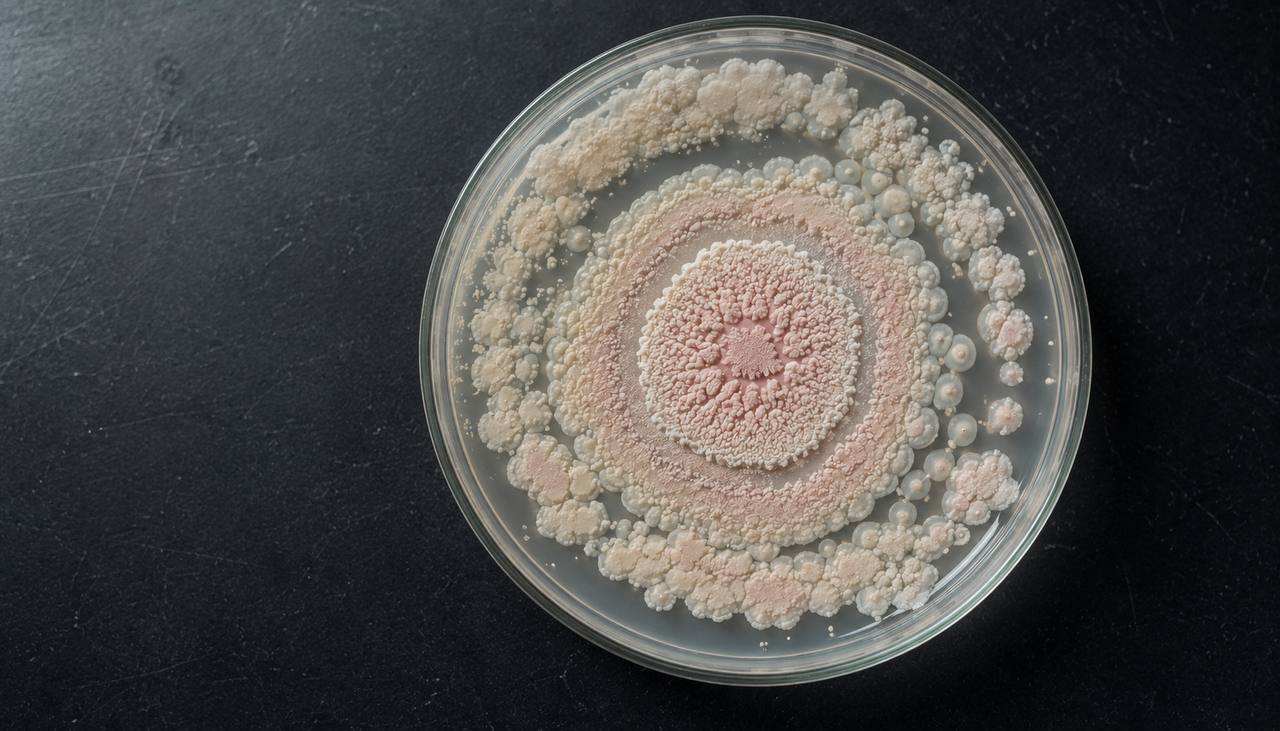
What Akkermansia muciniphila actually does
Akkermansia muciniphila is a Gram-negative anaerobic bacterium first isolated by Derrien and colleagues in 2004 from human faeces. It accounts for 1–4% of the total gut microbial community in healthy adults [Derrien 2004]. What sets it apart from the Lactobacillus and Bifidobacterium strains that dominate the supplement aisle: Akkermansia lives in the intestinal mucus layer and uses host mucin as its primary carbon and nitrogen source.
That feeding strategy is not destructive. By turning over the mucin layer, Akkermansia stimulates the host's mucin-producing goblet cells to replenish it — producing a continuously refreshed, thicker mucus layer over time. The mucus layer is the physical interface between the gut lumen and the epithelial cells, and it is the first barrier against translocation of lipopolysaccharide (LPS, a Gram-negative bacterial cell-wall fragment) and other inflammatory molecules into systemic circulation. A thinner mucus layer is one of the structural hallmarks of metabolic syndrome and chronic low-grade inflammation; a healthier mucus layer is what people mean when they talk about "gut-barrier integrity."
Low Akkermansia abundance has been observed in patients with type 2 diabetes, obesity, inflammatory bowel disease, and non-alcoholic fatty liver disease across multiple cohort studies. Whether low Akkermansia drives those conditions or merely tracks them is the question the interventional trials are trying to answer.
Two 2025 RCTs, one consistent story
The first foundational human trial was Depommier et al. 2019, a pilot study in Nature Medicine that tested live and pasteurised A. muciniphila against placebo in 32 overweight or obese insulin-resistant participants over three months [Depommier 2019]. That trial established that pasteurised A. muciniphila — not the live form — produced the improvements in insulin sensitivity, total cholesterol, and several inflammatory markers. It was small. It was preliminary. It set the stage.
The story sharpened in 2025 with two larger randomised trials.
The Zhang et al. trial (Ruijin Hospital, Shanghai Jiao Tong University, published in Cell Metabolism in March 2025) randomised 58 adults with overweight or obese type 2 diabetes to AKK-WST01 (pasteurised Akkermansia muciniphila) plus lifestyle guidance vs. placebo plus lifestyle guidance for 12 weeks [Zhang 2025 Cell Metab]. Headline: across the full cohort, both groups improved on body weight and HbA1c, with no statistically significant between-group difference. That is the kind of headline that has historically buried promising probiotic trials.
Then they stratified by baseline Akkermansia abundance. In participants with low baseline Akkermansia, the supplementation arm produced significant reductions in body weight, fat mass, and HbA1c, and colonisation of the supplemented strain succeeded. In participants with high baseline Akkermansia, the supplementation arm showed no clinical improvement and colonisation largely failed. The team replicated the pattern in germ-free mice receiving faeces from low- vs. high-baseline donors — a clean mechanistic confirmation that the responder split was driven by terrain, not by chance.
The Nanchang University trial, published in Food Science and Human Wellness in late 2025, randomised 130 overweight adults to live A. muciniphila PROBIO (1010 CFU), pasteurised A. muciniphila PROBIO (1010 equivalent), or placebo for 8 weeks [Nanchang 2025]. Across the full cohort, body-weight and fat-mass changes did not reach statistical significance — the authors attributed this to the short 8-week window. Where the trial produced clear between-group differences was on waist circumference and lipid markers (total cholesterol, triglycerides, LDL) — the live form outperformed the postbiotic form on those endpoints, which is the opposite of what Depommier's 2019 data suggested.
The two 2025 trials do not perfectly agree on whether live or pasteurised wins. They do agree on the structural finding underneath both readouts: the average effect across an unselected cohort is small, and the meaningful effect lives in a stratified subgroup. That is the story this article is built on.
The interesting probiotic question stopped being "does this work" and became "does this work for me" — and the answer turns on terrain, not on capsule quality.
Why baseline ecology decides the outcome
The result is intuitive once you frame it ecologically. You cannot re-seed a forest that already has the trees. If your gut is already a hospitable environment for Akkermansia — sufficient mucin substrate, polyphenol availability, fibre fermentation producing the short-chain fatty acid precursors A. muciniphila needs — then your endogenous Akkermansia is already where ecological equilibrium has placed it. Adding more capsules does not move that equilibrium. The exogenous bacteria pass through.
If your gut is not a hospitable environment — chronic Western-pattern diet, repeated antibiotic exposure, low-fibre intake, low polyphenol intake — the question is more complicated. Adding Akkermansia by capsule does not fix the underlying terrain problem either. But the 2025 trial data suggest that in low-baseline patients, there is enough open niche (and possibly enough mucin-substrate availability driven by other dysbiosis) for the supplemented strain to engraft transiently and produce downstream metabolic benefit before the broader ecology returns to its prior state.
That framing recasts what a probiotic is. It is not a replacement organ. It is a temporary signal — a transient ecological perturbation. The persistence of the benefit depends on whether the rest of the terrain can hold the new signal. For most strains, the answer is no, which is why most probiotic effects fade within weeks of stopping the capsule.
How to infer your baseline without a stool test
Commercial stool-microbiome tests can measure A. muciniphila abundance directly. They are also expensive, variable in quality, and produce point-in-time snapshots that may not reflect long-term ecology. For most readers, the honest first step is inference rather than testing.
The patterns associated with low Akkermansia baseline across the cohort literature:
- Western-pattern diet — low fibre (<15 g/day), low polyphenol intake, high ultra-processed food fraction.
- Multiple recent courses of broad-spectrum antibiotics, particularly within the previous 12–24 months.
- Type 2 diabetes or significant insulin resistance.
- Obesity, particularly visceral-predominant obesity.
- Chronic low-grade systemic inflammation (elevated hsCRP, elevated fasting insulin without overt diabetes).
- Inflammatory bowel disease, particularly Crohn's disease.
- Significant alcohol intake.
- Advancing age (Akkermansia abundance reliably declines with chronological age).
The patterns associated with preserved Akkermansia:
- Mediterranean-pattern diet with consistent polyphenol intake (berries, pomegranate, green tea, olive oil, cocoa, colourful vegetables).
- Adequate fibre intake (≥30 g/day), particularly from diverse plant sources.
- No recent antibiotic exposure.
- Normal glycaemic regulation and body composition.
- Regular physical activity (independent effects on gut diversity in observational data).
This is not a diagnostic tool. It is a probabilistic frame. A 32-year-old who eats Mediterranean-pattern, exercises regularly, has not been on antibiotics in five years, and has normal body composition is statistically likely to be in the upper tertile of A. muciniphila abundance. A 55-year-old with elevated HbA1c, central adiposity, and three antibiotic courses in the last two years is statistically likely to be in the lower tertile. The 2025 trial data suggests the first person should not bother supplementing, and the second person is the population where the trial benefit actually accrued.
Raising Akkermansia without supplementing it
For most readers in the "low-baseline" pattern, the structural intervention worth running before any capsule purchase is dietary. The pre-supplement dietary moves with the cleanest mechanistic and observational support for raising endogenous Akkermansia:
- Polyphenol intake — pomegranate, cranberry, green tea, cocoa, berries. The mechanism is partially mediated by polyphenols supporting Akkermansia's growth through redox-environment effects in the gut [Anhe 2015]. Concentrated extracts (pomegranate extract, cranberry extract) have produced the cleanest abundance shifts in interventional work, but consistent dietary intake is the realistic version of this for most people.
- Diverse plant fibre — particularly fermentable fibres that produce the short-chain fatty acid butyrate (resistant starch, inulin, oats, beans). The cross-feeding ecology that supports Akkermansia depends on the butyrate-producing community being intact.
- Reduction of dietary emulsifiers — observational and animal data link common food-grade emulsifiers (CMC, polysorbate-80) to mucus-layer thinning and Akkermansia depletion [Chassaing 2015]. Reducing ultra-processed-food intake reduces emulsifier exposure as a side effect.
- Caloric restriction or time-restricted eating — multiple cohorts have shown Akkermansia abundance shifts under structured caloric restriction, with the largest gains in participants starting with low baseline.
- Avoidance of unnecessary antibiotics — obvious, often overlooked. Antibiotics depress Akkermansia for months after exposure.
Notably, the dietary interventions also produce metabolic benefits through pathways that do not require Akkermansia at all. Whether the eventual change is mediated by Akkermansia specifically, by the broader ecology those changes shift, or by direct effects on insulin signalling and hepatic metabolism is a different question. The structural advice does not change.
When the supplement actually makes sense
The honest 2025 read on when an Akkermansia supplement crosses the threshold from "interesting" to "worth the cost":
- You fit the low-baseline pattern with multiple risk factors (metabolic, antibiotic history, dietary pattern).
- You have implemented the dietary structural moves above for at least 8–12 weeks and are looking for an additional lever.
- You are working with a clinician who can track at least HbA1c, fasting insulin, hsCRP, and body composition before and after a 12-week supplementation trial.
- The product you are considering is pasteurised AKK-WST01 (Zhang trial) or live A. muciniphila PROBIO (Nanchang trial) at the dose used in the trial — most marketed Akkermansia products use undocumented strains at unspecified CFU counts, and the trial benefits do not transfer automatically.
The honest version of when the supplement does not make sense: if you are already in the preserved-baseline pattern, the capsule will pass through and not engraft. If you have not run the structural dietary moves yet, you are paying for an expensive signal you are not set up to hold. If your clinician is not running before/after biomarkers, you have no way to know whether you are in the responder or non-responder subset.
A tiered framework
We do not write protocols. We write frameworks that you take to a clinician. With that established:
Run 12 weeks of consistent dietary structural change: 30+ g fibre/day, daily polyphenol intake (berries, pomegranate, green tea), reduced ultra-processed food, no unnecessary antibiotics. Track HbA1c, hsCRP, waist circumference, and energy. Most of the metabolic gain from "improving Akkermansia" lives here, not in a capsule.
If you fit the low-baseline pattern and have completed the structural dietary work, a 12-week trial of pasteurised Akkermansia (the Zhang trial protocol) is a reasonable experiment — provided you have baseline and follow-up biomarkers to determine whether you are in the responder subset. Stop if no biomarker movement at 12 weeks; the supplement is not for you.
For users in the metabolic-syndrome category with multiple risk factors, paired stool-microbiome testing (baseline + 12-week post-intervention) combined with the clinical biomarker panel above produces the highest-information outcome. This is still expensive and the testing landscape is imperfect, but for the population the 2025 trial data actually maps to, it is where the data lives.
Akkermansia is the cleanest test case so far of "precision probiotics" — the idea that responder/non-responder splits in probiotic trials are predictable from baseline microbial ecology rather than from product quality. The Zhang stratified data and the germ-free mouse replication will be the template that future probiotic trials are designed around. The era of marketing a probiotic as universally beneficial is winding down, and the honest framing — terrain-dependent, baseline-conditional — is starting to replace it.
References
- Zhang Y, et al. Akkermansia muciniphila supplementation in patients with overweight/obese type 2 diabetes: Efficacy depends on its baseline levels in the gut. Cell Metab. 2025;37(3):592-605. PMID: 39879980. NCT04797442.
- Depommier C, et al. Supplementation with Akkermansia muciniphila in overweight and obese human volunteers: a proof-of-concept exploratory study. Nat Med. 2019;25(7):1096-1103. PMID: 31263284.
- Nanchang University Research Group. Effects of viable and postbiotic Akkermansia muciniphila PROBIO on weight, lipids, and metabolic markers in overweight adults. Food Sci Hum Wellness. 2025. doi:10.26599/FSHW.2025.9250659.
- Derrien M, et al. Akkermansia muciniphila gen. nov., sp. nov., a human intestinal mucin-degrading bacterium. Int J Syst Evol Microbiol. 2004;54(Pt 5):1469-1476. PMID: 15388697.
- Everard A, et al. Cross-talk between Akkermansia muciniphila and intestinal epithelium controls diet-induced obesity. Proc Natl Acad Sci. 2013;110(22):9066-9071. PMID: 23671105.
- Anhe FF, et al. A polyphenol-rich cranberry extract protects from diet-induced obesity, insulin resistance and intestinal inflammation in association with increased Akkermansia spp. Gut. 2015;64(6):872-883. PMID: 25080446.
- Chassaing B, et al. Dietary emulsifiers impact the mouse gut microbiota promoting colitis and metabolic syndrome. Nature. 2015;519(7541):92-96. PMID: 25731162.
- Plovier H, et al. A purified membrane protein from Akkermansia muciniphila or the pasteurized bacterium improves metabolism in obese and diabetic mice. Nat Med. 2017;23(1):107-113. PMID: 27892954.
- Cani PD, de Vos WM. Next-Generation Beneficial Microbes: The Case of Akkermansia muciniphila. Front Microbiol. 2017;8:1765. PMID: 29018410.
- Roopchand DE, et al. Dietary polyphenols promote growth of the gut bacterium Akkermansia muciniphila and attenuate high-fat diet-induced metabolic syndrome. Diabetes. 2015;64(8):2847-2858. PMID: 25845659.