Lemon balm for anxiety and stress: what the evidence actually shows
Lemon balm is one of the oldest calming herbs in the Western tradition, and unlike most of the garden it actually has human trials behind it — a small but real set of randomized studies showing that a standardized extract can lift self-rated calmness and blunt the mood hit of an acute stressor within an hour or two. The catch is that those trials are small, short, and run on a patchwork of different extracts, so the size of the effect is genuinely uncertain. The mechanism is the interesting part: lemon balm appears to slow the breakdown of GABA, the brain’s main calming chemical, through a compound called rosmarinic acid. Here is the honest read on what lemon balm does for acute anxiety and stress, how it works, what the trials measured, and where it sits next to the other calming botanicals.
How this article was built: Primary sources: the Kennedy et al. 2004 laboratory-stress crossover trial in Psychosomatic Medicine, the Kennedy et al. 2002 and 2003 acute mood-and-cognition crossover trials in Pharmacology, Biochemistry, and Behavior and Neuropsychopharmacology, the Cases et al. 2011 open-label Cyracos trial in the Mediterranean Journal of Nutrition and Metabolism, the Ghazizadeh et al. 2021 systematic review and meta-analysis in Phytotherapy Research, the Mathews et al. 2024 review in Nutrients, the Awad et al. 2009 GABA-transaminase fractionation study in Phytotherapy Research, and the Yoo et al. 2010 corticosterone-and-GABA study in Neurochemical Research — all retrieved and verified through PubMed and the Consensus research database.
- The effect is modest but real, and fast. In small randomized crossover trials, a single dose of standardized lemon balm extract (often 300–600 mg) raised self-rated calmness within an hour or two — a gentle nudge, not a knockout.34
- It blunts acute stress on demand. Given before a deliberately stressful lab task, a 600 mg dose softened the negative mood hit and kept people feeling calmer — the clearest evidence that lemon balm is an acute, situational tool.2
- The mechanism is plausible and clean. Lemon balm slows the enzyme that breaks down GABA, the brain’s main calming signal, through rosmarinic acid and related triterpenoids — though that pathway is mapped mostly in vitro and in animals, not yet proven in humans.5
- Read the evidence honestly. The trials are small (often 18–20 people), short, and run on different extracts; a pooled analysis found a real effect but with high heterogeneity, and the largest single anxiety result came from an open-label study with no placebo.6 The signal is consistent and promising, not settled.
What lemon balm actually is
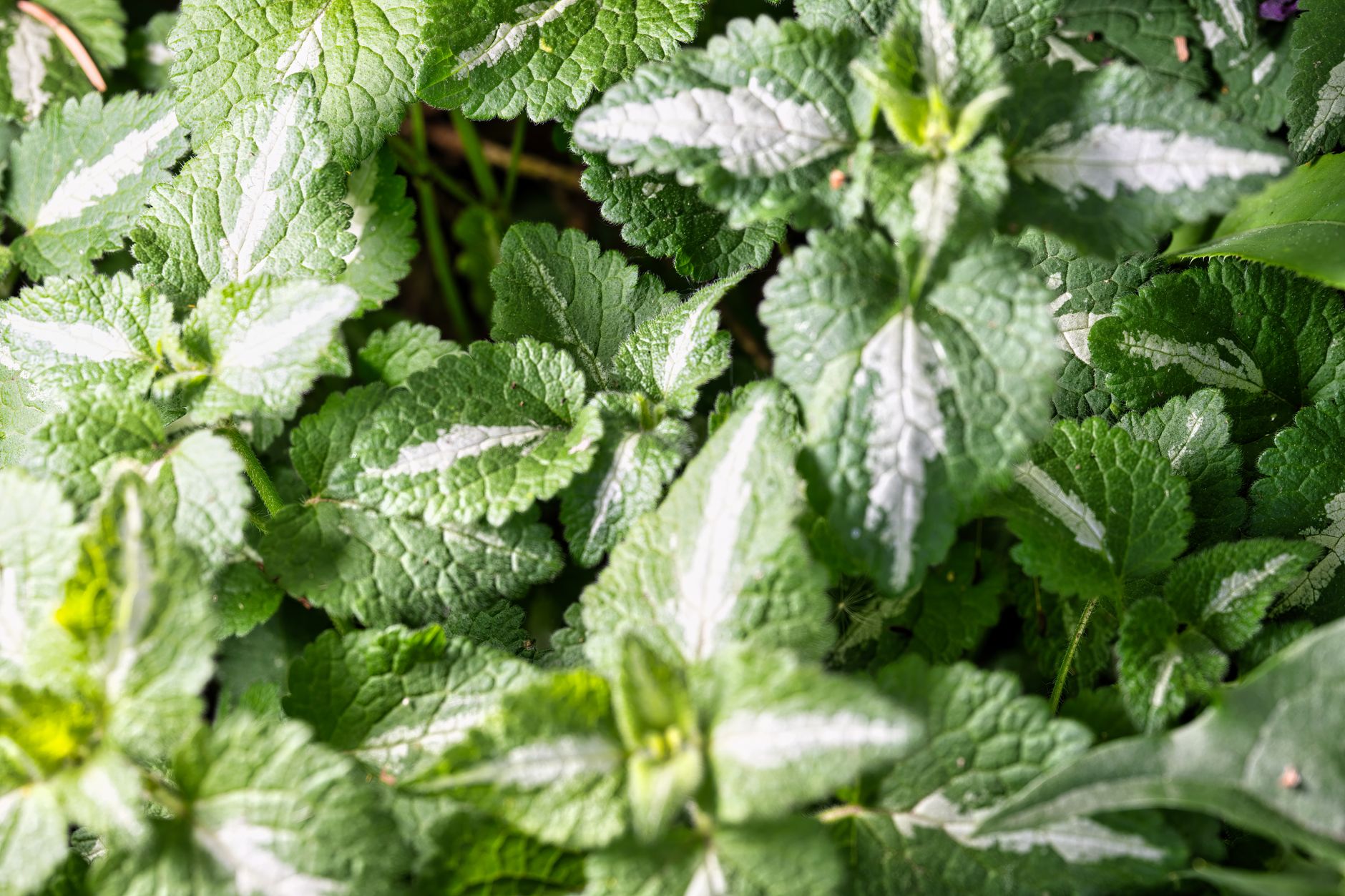
Lemon balm is Melissa officinalis, a lemon-scented perennial in the mint family that has been used as a calming and digestive herb since at least the Middle Ages — the herbalists of the era reputedly used it to “chase away melancholy.” That long folk history is not, on its own, evidence. What makes lemon balm worth a serious look is that it is one of the few traditional calming herbs that has actually been put through controlled human trials, and those trials point in a consistent direction.
Chemically, the plant is a mix of aromatic compounds. Its leaves are rich in rosmarinic acid — a polyphenol shared with rosemary and several other mints — alongside triterpenoids such as ursolic acid and oleanolic acid, and a fragrant essential oil dominated by citral and citronellal.7 Rosmarinic acid is the compound most often credited with the calming signal, and it is the thread that ties the human trials to the laboratory mechanism work. That combination — a clear lead compound plus actual clinical data — is what separates lemon balm from the broader category of “relaxing teas” that have folklore but no trials.
The mechanism: slowing GABA breakdown
The most coherent explanation for lemon balm’s calming effect runs through GABA — gamma-aminobutyric acid, the brain’s primary inhibitory, or quieting, neurotransmitter. (GABA is the same calming signal that benzodiazepines and alcohol amplify, though by a different route.) The more GABA signaling there is, the more the nervous system’s “brake” is engaged. One way to raise GABA tone is to slow the enzyme that destroys it: GABA transaminase (GABA-T), the protein that breaks GABA down. Inhibit GABA-T and you let GABA linger — which is, in fact, how the anti-seizure drug vigabatrin works.
This is exactly the signal lemon balm appears to pull. In a bioassay-guided fractionation study, a methanol extract of lemon balm was a potent inhibitor of GABA transaminase in rat brain tissue, and when the researchers chased the activity down to its source, the major active compound was rosmarinic acid, with the triterpenoids ursolic and oleanolic acid contributing as well.5 Supporting work in mice found that a lemon balm extract lowered GABA-T levels in the brain and, alongside it, reduced circulating corticosterone — the rodent stress hormone — while promoting new neuron formation in the hippocampus.8 Broader pharmacological reviews add that lemon balm and its constituents may also touch cholinergic and serotonergic signaling, so the GABA story is probably not the whole picture.7
Lemon balm doesn’t flood the brain with a calming chemical. It seems to keep the brain’s own calming signal in play a little longer — by slowing the enzyme that clears it away.
Two honest caveats keep this grounded. First, the GABA-transaminase mechanism is established in test tubes and animals; the dose of rosmarinic acid that reaches the human brain after swallowing a capsule, and whether it inhibits the enzyme there to a meaningful degree, is not settled — bioavailability of these polyphenols is a known weak point, which is partly why newer formulations try to improve absorption.7 Second, the early human crossover trials used extracts that did not show strong cholinergic receptor binding in vitro yet still moved mood, which tells you the active pathway in people is still partly an open question.3 So this is mechanism-plausible, not mechanism-proven in humans — a reasonable story that the clinical data are consistent with, not a closed case.
The human evidence
The most useful human work comes from a series of tightly controlled crossover trials. In the first, twenty healthy young adults took single doses of a standardized lemon balm extract (300, 600, or 900 mg) or placebo on separate days, with mood and cognition tracked for six hours afterward.3 Self-rated “calmness” on a standard mood scale rose at the earliest time points after the lowest dose, while the higher doses produced a more sedative profile, reducing self-rated alertness.3 A follow-up study using a different, dried-leaf preparation found that the highest dose tested (1600 mg) improved both memory performance and calmness at every post-dose time point — but, tellingly, a lower-dose preparation did not reproduce the same profile.4 That divergence is the single most important practical lesson in the lemon balm literature: the preparation matters, and results from one extract do not automatically transfer to another.
Stepping back from any one trial, a 2021 systematic review and meta-analysis pooled the randomized controlled trials of lemon balm in people with anxiety or depression symptoms.6 Across those studies, lemon balm significantly outperformed placebo for both anxiety (a standardized mean difference of −0.98, a large effect on paper) and depression (−0.47, a moderate one), with no serious side effects reported.6 The authors were careful, though, to flag that the studies were few, methodologically varied, and statistically heterogeneous — meaning the trials disagreed enough that the pooled number should be read as a direction, not a precise dose of reassurance.6 A 2024 narrative review reached the same balanced verdict: lemon balm holds genuine promise as a calming agent with anxiolytic and antidepressant signals, but robust, larger randomized trials are still needed to firm it up.7 (Worth noting for transparency: two authors of that review are affiliated with a lemon balm extract manufacturer — the verdict is still cautious, but the source isn't disinterested.)
The most-cited efficacy numbers come from an open-label study of a standardized extract (sold as Cyracos) in twenty volunteers with mild-to-moderate anxiety and sleep disturbance. Over fifteen days it reported a 18% reduction in anxiety manifestations, a 15% drop in associated symptoms, and a striking 42% reduction in insomnia, with 95% of subjects responding.1 Those figures get quoted everywhere — and here is the honesty this topic demands: it was an open-label trial with no placebo group and only twenty people, and the authors themselves explicitly called for placebo-controlled follow-up with physiological stress markers.1 Without a control arm, a chunk of that improvement is almost certainly expectation and the natural ebb of symptoms. Treat those headline percentages as a hypothesis-generating signal, not a measured effect size.
range
where acute calm showed up
effect (SMD)
large on paper, heterogeneous
sample size
small N, short duration
The acute-stress finding
If you want the cleanest single demonstration of what lemon balm does, it is the laboratory-stress trial. Eighteen healthy volunteers took a 300 mg dose, a 600 mg dose, or placebo on separate days, then sat through a deliberately stressful, multitasking battery designed to raise psychological strain on demand.2 The 600 mg dose blunted the negative mood swing the stressor produced — participants reported significantly more calmness and, consistent with a mild sedative profile, somewhat lower alertness — while the 300 mg dose sped up mathematical processing without costing accuracy.2
That design is what makes the result persuasive. It is one thing to feel calmer on a quiet afternoon; it is another to be measurably less rattled by a task built to stress you out, in a randomized, placebo-controlled, crossover design where each person is their own control. This is the study that most justifies framing lemon balm as an acute, situational tool — something you reach for before a known stressor, the way you might before a presentation or a tense conversation — rather than a daily mood foundation. The honesty footnote: it is still eighteen people and a single session, so it is a strong proof-of-concept, not a definitive effect size.
Dose, form, and timing: what the trials used
We do not give prescriptive doses here, but it is worth stating plainly what the published trials administered, because the pattern is informative. The acute mood and stress benefits clustered around 300–600 mg of a standardized extract taken as a single dose, with effects appearing within roughly one to three hours.23 Push the dose higher and the profile tilts toward sedation — more calm, but also more drop in alertness — which is useful to know if the goal is daytime composure rather than winding down at night.23
The crucial complication is standardization. The trials used different preparations — one branded extract, a dried leaf, a couple of standardized commercial extracts — and they did not behave identically; the same nominal dose of one preparation moved mood while another did not.4 A tea bag, an essential-oil aromatherapy product, and a polyphenol-standardized capsule are simply not interchangeable, and the milligram figure on a label tells you little unless it also specifies how much rosmarinic acid is in it.7 This is the practical heart of the lemon balm story: the herb has a real signal, but the product you actually buy may or may not match the one the trial tested.
Where it fits among calming botanicals
Lemon balm does not exist in isolation; it sits in a crowded field of calming plants and amino acids, and its profile is distinctive. Its closest mechanistic cousin is kava, which also works largely through the GABA system but hits harder — with a correspondingly more serious safety conversation around the liver. Lemon balm is gentler on both counts: a milder effect and a cleaner tolerability record across the trials.6 For pure, jitter-free daytime calm-with-focus, the better-characterized comparator is L-theanine, the calming amino acid from tea, whose acute-calm evidence is arguably tidier; lemon balm’s edge is its broader traditional and trial history across both anxiety and mood.
For low mood specifically rather than acute nerves, the standout botanical is saffron, which carries a stronger and more replicated antidepressant trial base than lemon balm’s. The cleanest way to hold all of this: think of lemon balm as a fast-acting, situational calming herb with a plausible GABA mechanism and a modest, somewhat noisy evidence base — not the strongest single agent in any one lane, but a well-tolerated generalist with genuine acute data. For a structured walk through the wider anxiety and mood toolkit, our hub maps these agents against each other.
Where it fits: a tiered view
It helps to place lemon balm honestly on a spectrum of how settled the evidence is and who it is for.
Foundational — fix the inputs first. No herb competes with the basics of stress regulation: sleep, movement, daylight, and the slow work of changing what is actually generating the stress. For clinical anxiety, the evidence-based first lines are therapy (particularly cognitive behavioral therapy) and, where indicated, prescribed medication — not a botanical. If the foundation is shaky, that is the higher-yield lever, every time.
Research-curious — the situational, acute tool. If the foundations are solid and the need is acute — pre-presentation nerves, a tense afternoon, a known stressor on the calendar — lemon balm is a low-risk, well-tolerated option with a plausible GABA mechanism and genuine acute human data at roughly 300–600 mg of a standardized extract.23 Expect a gentle nudge toward calm, not a transformation, and choose a product that actually states its rosmarinic-acid content.
Experimental — treating it as a fix for an anxiety disorder. Using lemon balm to manage diagnosed generalized anxiety or major depression, or leaning on it nightly in place of addressing an underlying problem, is the weakest-supported use. There is no large, independent, long-term randomized trial, the headline efficacy numbers come from an uncontrolled study, and a diagnosable disorder warrants a clinician, not a supplement experiment.16
Lemon balm is a gentle, real, low-risk acute tool — but it sits inside a much larger calm-and-mood toolkit, and the worst mistake is treating any single herb as the answer. The right question is rarely “lemon balm: yes or no,” it’s “what actually moves my stress, and where does lemon balm rank against L-theanine, kava, saffron, magnesium, and the behavioral work that does the heavy lifting?” The Manual maps the calming compounds against each other — what each one’s evidence genuinely supports, the dose and standardization that matter, who benefits and who is wasting their money, and how to combine them without fooling yourself. See the Manual →
Grey areas and open questions
The standardization problem. The single most honest weakness is that “lemon balm” is not one thing. Trials used different extracts that behaved differently, and the product on a store shelf may bear little resemblance to the one tested.4 Without a rosmarinic-acid figure on the label, a milligram dose is close to meaningless, and the poor bioavailability of these polyphenols means even a “correct” dose may not deliver much to the brain.7
Small, short, sometimes uncontrolled trials. The crossover studies are well-designed but tiny — eighteen to twenty people — and acute. The longer anxiety data lean heavily on an open-label trial with no placebo, which cannot separate the herb from expectation.1 The pooled meta-analysis found a real effect but warned of high heterogeneity, which is exactly what you would expect from a small literature built on mismatched extracts.6 There is no large, independent, long-duration randomized trial.
Population gaps. The studied groups are narrow — mostly healthy young adults in the acute trials. There is little data in older adults, in pregnancy or breastfeeding, or in people with diagnosed anxiety disorders, and limited long-term safety data for daily use specifically for mood.
The sedation and interaction caveat. Because lemon balm engages the GABA system and shows a mild sedative profile at higher doses, it is not inert with respect to other sedating agents. Stacking it with sleep medication, benzodiazepines, or alcohol could plausibly add to drowsiness, and some sources flag a theoretical interaction with thyroid medication. The practical translation: if you take a sedative, a sleep aid, thyroid medication, or any centrally acting prescription, treat lemon balm as a prescriber conversation, not a self-experiment.
What this article is not saying
This is not “lemon balm doesn’t work.” Within its limits, the human trials are positive and consistent, the acute-stress demonstration is genuinely persuasive, and the mechanism is one of the cleaner stories among calming herbs. For the right person, at a standardized 300–600 mg before a known stressor, it is a reasonable, well-tolerated tool with real data behind it. Dismissing it outright is as wrong as overselling it.
This is not “lemon balm will cure your anxiety.” The effects are modest, the trials are small and short and run on mismatched extracts, the biggest efficacy numbers come from an uncontrolled study, and there is no large independent replication. It is a gentle, situational nudge, not a treatment for an anxiety disorder — and a marginal, plausible, well-tolerated edge is exactly what the evidence supports and exactly what the marketing inflates.
And this is not a dosing prescription or a treatment for a diagnosed condition. If you have persistent or severe anxiety, that deserves a clinician, not a capsule; and if you take sedatives, sleep medication, thyroid medication, or other CNS-active prescriptions, lemon balm is a prescriber conversation. The point of this piece is to tell you what the trials show and where they stop, so your expectations — and your stress toolkit — can be honest ones.
References
- Cases J, Ibarra A, Feuillère N, Roller M, Sukkar SG. Pilot trial of Melissa officinalis L. leaf extract in the treatment of volunteers suffering from mild-to-moderate anxiety disorders and sleep disturbances. Med J Nutrition Metab. 2011;4(3):211-218. DOI · PMID 22207903
- Kennedy DO, Little W, Scholey AB. Attenuation of laboratory-induced stress in humans after acute administration of Melissa officinalis (Lemon Balm). Psychosom Med. 2004;66(4):607-613. DOI · PMID 15272110
- Kennedy DO, Scholey AB, Tildesley NTJ, Perry EK, Wesnes KA. Modulation of mood and cognitive performance following acute administration of Melissa officinalis (lemon balm). Pharmacol Biochem Behav. 2002;72(4):953-964. DOI · PMID 12062586
- Kennedy DO, Wake G, Savelev S, Tildesley NTJ, Perry EK, Wesnes KA, Scholey AB. Modulation of mood and cognitive performance following acute administration of single doses of Melissa officinalis (Lemon balm) with human CNS nicotinic and muscarinic receptor-binding properties. Neuropsychopharmacology. 2003;28(10):1871-1881. DOI · PMID 12888775
- Awad R, Muhammad A, Durst T, Trudeau VL, Arnason JT. Bioassay-guided fractionation of lemon balm (Melissa officinalis L.) using an in vitro measure of GABA transaminase activity. Phytother Res. 2009;23(8):1075-1081. DOI · PMID 19165747
- Ghazizadeh J, Sadigh-Eteghad S, Marx W, et al. The effects of lemon balm (Melissa officinalis L.) on depression and anxiety in clinical trials: A systematic review and meta-analysis. Phytother Res. 2021;35(12):6690-6705. DOI · PMID 34449930
- Mathews IM, Eastwood J, Lamport DJ, Cozannet RL, Fanca-Berthon P, Williams CM. Clinical efficacy and tolerability of lemon balm (Melissa officinalis L.) in psychological well-being: a review. Nutrients. 2024;16(20):3545. DOI · PMID 39458539
- Yoo DY, Choi JH, Kim W, Yoo KY, Lee CH, Yoon YS, Won MH, Hwang IK. Effects of Melissa officinalis L. (lemon balm) extract on neurogenesis associated with serum corticosterone and GABA in the mouse dentate gyrus. Neurochem Res. 2011;36(2):250-257. DOI · PMID 21076869