Horny goat weed and icariin: is it really a natural Viagra for libido and erections?
The name is doing a lot of work, and so is the marketing. Horny goat weed — the herb Epimedium, a fixture of traditional Chinese medicine — is sold everywhere as a botanical alternative to Viagra, and unlike most aphrodisiac claims, this one has a real molecular story behind it. Its active compound, icariin, genuinely inhibits phosphodiesterase type 5 (PDE5), the exact same enzyme that sildenafil (Viagra) and tadalafil (Cialis) block to produce an erection. In the laboratory, icariin relaxes erectile tissue, raises the pressure inside the penis in animal models, and works through the same nitric-oxide signalling pathway the drugs exploit. That is a legitimately interesting pharmacology, and it is why this herb deserves a more serious hearing than most of the shelf around it. But three hard facts sit between "shares a mechanism with Viagra" and "works like Viagra," and they are the whole point of this article. Icariin as it exists in the herb is far weaker than the drug — on the order of 80 times weaker against the human enzyme. Almost every encouraging result comes from rats and cell cultures, not people; rigorous human trials of the whole herb for erectile dysfunction or libido barely exist. And because it lives in the sexual-enhancement supplement aisle, a real fraction of products are spiked with undeclared pharmaceutical PDE5 inhibitors — which turns a "natural" purchase into an unlabelled, unmonitored dose of a real drug. Here is the cited, evidence-graded read on what is real, what is thin, and what is genuinely risky.
How this article was built: Primary sources: the Dell'Agli et al. 2008 icariin PDE5 structure-activity study in the Journal of Natural Products; the Shindel et al. 2010 erectogenic/neurotrophic study in The Journal of Sexual Medicine; the Tian et al. 2004 intracavernosal-pressure study in the Chinese Medical Journal; the Zhou et al. 2012 icariside II diabetic-rat study in the Journal of Andrology; the Xu et al. 2017 icariin-plus-sildenafil study and the Liu et al. 2021 eNOS study, both in Andrology; and two adulteration-surveillance papers — the Kee et al. 2017 review of 80 PDE5-inhibitor adulterants in the Journal of Pharmaceutical and Biomedical Analysis and the Bujang et al. 2017 Malaysian market survey in Food Additives & Contaminants — all retrieved and verified through PubMed and the Consensus research database.
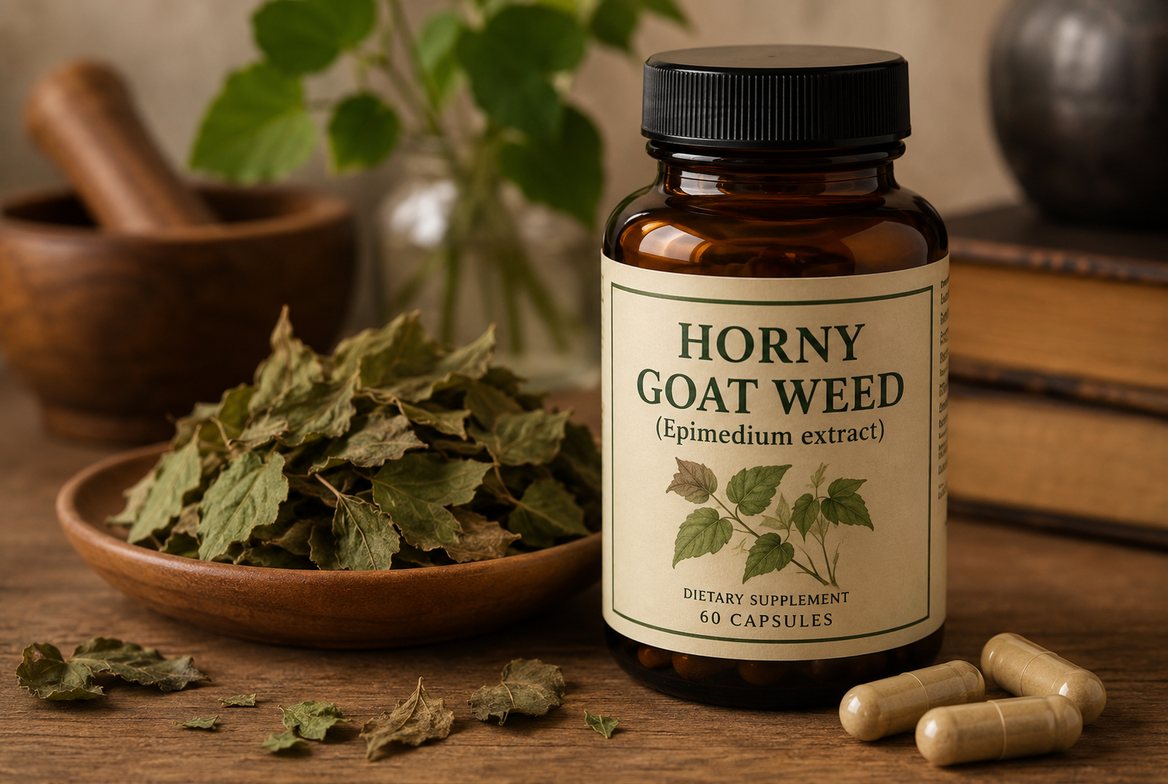
- The mechanism is real, not folklore. Icariin, the active flavonoid in horny goat weed, is a genuine PDE5 inhibitor — the same enzyme class as sildenafil — and it relaxes erectile tissue through the nitric-oxide / cyclic-GMP pathway in lab and animal models.13
- But it is far weaker than the drug. Against the human enzyme, icariin's IC50 is about 5.9 micromolar versus 74 nanomolar for sildenafil — roughly 80 times weaker. It took chemically modifying icariin in the lab to reach sildenafil-level potency; the herb itself does not contain that modified molecule.1
- The human evidence is thin to the point of near-absence. Nearly all the erectile data is rodent and in-vitro. There is no adequately powered, placebo-controlled human trial of the whole herb for erectile dysfunction or libido that would let anyone say it beats placebo in people.24
- Adulteration is a documented, serious risk. Because it sits in the sexual-enhancement aisle, a real share of these products are spiked with undeclared pharmaceutical PDE5 inhibitors — 82% of unregistered products in one market survey.78 That is the same drug, same nitrate danger, with no label and no dose control.
- What horny goat weed and icariin actually are
- The mechanism: a real PDE5 inhibitor
- The potency problem: about 80x weaker than Viagra
- The human evidence: thin to almost missing
- Testosterone and libido: the softer claim
- Forms, dosing, and standardization
- Safety, cardiac risk, and interactions
- The adulteration problem you cannot ignore
- The hype: "natural Viagra"
- The honest verdict
- References
What horny goat weed and icariin actually are
Behind the memorable name is a real plant genus. Horny goat weed is Epimedium, a group of shade-loving perennials with heart-shaped leaves, several species of which — Epimedium brevicornum, sagittatum, koreanum and others — have been used in traditional Chinese medicine for centuries under the name yin yang huo. In that tradition it is classed as a "kidney yang" tonic, prescribed for what would loosely translate to fatigue, low sexual vigour, and impotence. The origin story is folk etymology at its most on-the-nose: a goatherd supposedly noticed his flock getting friskier after grazing on the plant. As with most such stories, it is charming and evidentially worthless — but the plant turned out to have real chemistry inside it, which is the part that matters.
That chemistry centres on a family of flavonoid compounds called prenylflavonoids, and the star of the group is icariin. Icariin is the compound most product labels standardize to, and it is the molecule responsible for essentially all the interesting pharmacology below. It is worth knowing one wrinkle early: in the body, icariin is partly metabolized into related compounds — most notably icariside II — and some researchers think these metabolites, not icariin itself, do a share of the work, because icariin is relatively poorly absorbed on its own.4 That is a recurring theme in this herb's story: the molecule that is easy to measure in a capsule is not necessarily the molecule doing the job in your bloodstream, and the amount that actually reaches erectile tissue after an oral dose is a genuine open question.
So set the frame honestly from the start. This is not a herb where the only evidence is tradition and hope. It is a herb with a characterized active compound, a defined molecular target, and a plausible mechanism — which is exactly why it warrants a careful look rather than a reflexive dismissal. The interesting work is separating the parts of the pitch that the pharmacology supports from the parts that the marketing invented.
The mechanism: a real PDE5 inhibitor
To see why icariin is intriguing, you have to know how an erection works chemically, and how Viagra works on it. Sexual stimulation releases nitric oxide (NO) in the penis, which triggers production of a signalling molecule called cyclic GMP (cyclic guanosine monophosphate, or cGMP). cGMP relaxes the smooth muscle of the erectile tissue, blood floods in, and you get an erection. An enzyme called PDE5 (phosphodiesterase type 5) then breaks cGMP down, ending the erection. Sildenafil and every other drug in its class work by blocking PDE5: with the off-switch inhibited, cGMP lingers, and the erection is easier to get and to keep. The drugs do not create desire or bypass the nitric-oxide signal — they amplify and prolong a signal that stimulation has already started.
Here is the genuinely notable part: icariin hits that same enzyme. Multiple laboratory studies show icariin inhibits PDE5 directly, which places it in the identical mechanistic category as the pharmaceuticals.1 And the downstream effects behave the way that mechanism predicts. In a classic rat study, icariin injected into the erectile tissue raised intracavernous pressure (the pressure inside the penis) in a dose-dependent manner, without dropping systemic blood pressure — and crucially, that effect was abolished when researchers blocked nitric oxide synthesis or the enzyme that makes cGMP, confirming it was working through the NO–cGMP pathway exactly as the theory requires.3 Purified icariin has since been shown to improve erectile parameters in rats with nerve injury and to have additional neurotrophic effects — helping regenerate the nerves that drive erection — on top of its PDE5 action,2 and later work traced its benefit in diseased models to improvements in nitric-oxide signalling and the health of the erectile tissue itself.46
This is a real, reproducible, mechanism-consistent body of preclinical pharmacology, and it earns an EMERGING grade rather than a dismissal. Icariin is not snake oil pretending to have a target; it has the right target, and it moves the right needles in animals. The reason it lands at EMERGING and not higher is entirely about the two gaps the next sections open up: how strongly it hits that target compared with the drug, and whether any of it has been shown to matter in an actual human being.
Icariin has the right target and works through the right pathway. The question was never whether the mechanism exists — it does. The question is whether it is strong enough, and proven enough in people, to matter.
The potency problem: about 80x weaker than Viagra
This is the section that quietly deflates most of the marketing, and it comes from the single most important study on this herb. In 2008, Dell'Agli and colleagues put icariin head-to-head against sildenafil on the actual human recombinant PDE5 enzyme in a test tube — the cleanest possible comparison of raw potency.1 Icariin did inhibit the enzyme, confirming the mechanism. But its potency, expressed as the concentration needed to inhibit half the enzyme's activity (the IC50), was 5.9 micromolar. Sildenafil's IC50 in the same assay was 74 nanomolar. Because a micromolar is a thousand nanomolar, that is roughly an 80-fold difference: you would need on the order of eighty times more icariin to match what sildenafil does molecule-for-molecule against the enzyme.
That gap only widens once you leave the test tube. Sildenafil is a purpose-built drug, dosed at a known milligram amount, absorbed efficiently, and delivered to the target at a concentration that reliably works. Icariin in a capsule is one flavonoid among many in a plant extract, is poorly absorbed orally, and reaches erectile tissue at concentrations nobody can guarantee. So the real-world potency gap between a horny goat weed capsule and a Viagra tablet is almost certainly far larger than 80-fold — the 80x figure is the best case, measured on the pure compound against the pure enzyme, before absorption and dosing losses stack the deck further against the herb.
The Dell'Agli paper also contains the tell that should end the "natural Viagra" claim on its own. The researchers were able to reach sildenafil-level potency — an IC50 of 75 nanomolar, essentially matching the drug's 74 — but only by chemically modifying icariin in the lab, replacing its sugar groups to create a new synthetic derivative that was about 80 times more potent than natural icariin.1 Read that carefully: the way scientists made an icariin-based molecule as strong as Viagra was to turn it into something that is not in the plant. The herb you can buy contains the weak parent compound, not the potent laboratory derivative. When a label leans on "the compound that rivals sildenafil," it is quietly borrowing the credibility of a molecule you are not actually taking.
the human PDE5 enzyme
IC50 5.9 µM vs 74 nM, Dell'Agli 2008
human trials of the whole herb
for erectile dysfunction or libido
products spiked with real PDE5 drugs
Malaysian market survey, Bujang 2017
The human evidence: thin to almost missing
Now the awkward fact that the mechanism section has been building toward. For all the elegant pharmacology, the human evidence that horny goat weed works — that a person with erectile dysfunction or low libido who takes the whole herb does better than they would on placebo — is startlingly thin. Nearly everything cited in this article is from rats, cell cultures, or isolated enzyme assays. The erectile studies used Sprague-Dawley rats with surgically injured cavernous nerves,2 streptozotocin-induced diabetic rats,4 spontaneously hypertensive rats,6 and rat penile tissue on a bench.3 This is genuinely useful science for understanding how icariin might act. It is not evidence that a human will benefit.
The gap between "works in a rat model" and "works in people" is not a technicality — it is where most promising compounds go to die. Rodent erectile models use injected or high controlled doses of purified icariin delivered in ways that sidestep the absorption problem entirely; a human swallowing a standardized capsule faces poor oral bioavailability and an uncertain amount reaching the target. Sexual function is also famously placebo-responsive, which means that without a blinded, placebo-controlled design, any "it worked for me" signal is close to uninterpretable. And erectile dysfunction is frequently the visible tip of an underlying vascular, metabolic, or hormonal problem, so a herb that produced a modest real effect and a herb that produced pure expectation would look identical in an uncontrolled setting.
What would settle it is exactly what is missing: an adequately powered, randomized, double-blind, placebo-controlled trial of a standardized Epimedium extract, in men with defined erectile dysfunction, using a validated outcome like the International Index of Erectile Function. That trial, in a form that would let anyone say "the herb beat placebo," essentially does not exist. That is why the human claim lands at WEAK — not because the herb was rigorously tested and failed, but because the decisive test has never really been run. Given how heavily this herb is marketed, that absence is not a neutral gap; it is the strongest single reason to keep expectations low.
The most seductive move in horny goat weed marketing is the leap from "hits the same enzyme as Viagra" to "works like Viagra." Those are different claims separated by two things the lab has already measured: a roughly 80-fold potency gap on the pure compound,1 and the absence of a single decisive human trial. The Manual maps the libido and erectile interventions — herbs, peptides, and the actual drugs — side by side, each with its mechanism pinned down and its human evidence graded, so a "natural PDE5 inhibitor" gets held to the same standard as the pharmaceutical it is compared to. See the Manual →
Testosterone and libido: the softer claim
Alongside the erectile-function pitch runs a second, vaguer claim: that horny goat weed raises testosterone and boosts libido as a hormonal tonic, in keeping with its traditional "yang" role. The evidence here is softer still. Some animal work has reported testosterone-related and hypothalamic-pituitary-gonadal signals in stressed or hormone-depleted rodent models, and icariin has documented antioxidant and tissue-protective effects that could plausibly support erectile tissue health over time. But there is no convincing human data showing that horny goat weed meaningfully raises testosterone in men, and the "libido" claim in particular is the one most inflated by expectation and by the herb's suggestive name.
It is worth separating the two things the herb is sold to do, because they are pharmacologically distinct. A PDE5 mechanism, if it worked in humans, would help the plumbing — the physical ability to get and keep an erection given desire and stimulation. It would do essentially nothing for desire itself, which is driven by hormones, mood, relationship context, and central nervous system signalling. So even in the most generous reading of the pharmacology, horny goat weed's plausible benefit is erectile, not libidinal. If low desire rather than erectile difficulty is the actual problem, the mechanistic case for this herb is weaker still, and the honest options look different — which is why we cover desire-specific interventions like PT-141 (bremelanotide) and traditional botanicals like maca root separately. For the testosterone question specifically, the better-studied levers are laid out in our reads on fenugreek and fadogia agrestis — and even those come with real evidence caveats.
Forms, dosing, and standardization
With the standing caveat that "here is how people use it" is not "here is a proven protocol" — because the human outcome trials that would anchor a dose do not exist — here is the practical landscape. Horny goat weed is sold as dried herb, teas, tinctures, and, most commonly, capsules of powdered extract. The number that matters on a capsule is the icariin standardization: products are typically labelled as a percentage of icariin, ranging from a token amount up to concentrated extracts standardized to 10%, 20%, or higher. A capsule of raw, unstandardized Epimedium powder may contain very little active compound; the percentage is the difference between a meaningful dose of the characterized molecule and mostly filler.
Even with a well-standardized product, though, the bioavailability problem from earlier bites hard. Icariin is poorly absorbed orally, which is part of why some researchers focus on its metabolites rather than the parent compound,4 and why the impressive concentrations used in rat studies are not obviously reproducible from a swallowed human dose. In practice this means two products with identical "milligrams of icariin" on the label may deliver very different amounts to the tissue that matters, and no supplement label can tell you which. There is no established, evidence-based human dose for erectile or libido benefit, precisely because the trials that would define one have not been done.
The honest framing for anyone considering it: choose a product that at least discloses its icariin percentage and comes from a manufacturer willing to show third-party testing (which matters enormously for the adulteration reason below), keep expectations calibrated to "weak PDE5 activity of uncertain oral delivery," and do not stack it with an actual PDE5 drug or use it to self-treat a symptom that warrants a clinician. The dosing conversation, in other words, is downstream of a bigger question the evidence has not answered: whether the swallowed herb does anything measurable at all.
Safety, cardiac risk, and interactions
Horny goat weed is often described as well tolerated, and in the sense that most people who take a standard extract report at most mild effects — nausea, dizziness, dry mouth, or a racing feeling — that is broadly true. But "generally well tolerated" hides the single most important safety point in this article, and it flows directly from the mechanism that makes the herb interesting in the first place. If icariin genuinely inhibits PDE5, then it carries, in miniature and unpredictably, the same interaction that makes prescription PDE5 inhibitors dangerous in the wrong combination.
The critical one is nitrates. Nitrate medications (nitroglycerin and related drugs for angina and heart conditions) work by boosting the very nitric-oxide / cGMP pathway that PDE5 inhibitors prolong. Combine the two and cGMP can accumulate to the point of a severe, potentially fatal drop in blood pressure. This is the hard, absolute contraindication for Viagra, and any product with real PDE5 activity — herbal or not — inherits it. The same logic argues for caution with alpha-blockers and other blood-pressure medications, and it makes stacking horny goat weed with an actual ED drug a genuinely bad idea rather than a synergy. There are also scattered case reports of cardiac effects, including rapid or irregular heartbeat, associated with these products — though as the next section explains, some of those cases may reflect hidden pharmaceutical adulteration rather than the herb itself.
Two more cautions round it out. First, data in the settings that matter most — people with cardiovascular disease, on multiple medications, or with bleeding-risk concerns — is thin, so this is a herb to clear with a physician, not to try around the edges of a cardiac history. Second and most important: erectile dysfunction is frequently an early, visible warning sign of underlying vascular disease, diabetes, or a hormonal disorder. Reaching for a supplement that might weakly paper over the symptom, while the underlying condition goes undiagnosed, is the real hazard here — not because the herb is potent, but because comfort with the symptom can delay finding the cause. Soothing a symptom is not the same as diagnosing it.
The adulteration problem you cannot ignore
This is the risk that turns an academic discussion about weak pharmacology into a genuine safety warning, and it is specific to this category. Sexual-enhancement supplements are among the most heavily adulterated products on the market: manufacturers seeking a "natural" product that actually produces an erection have a strong incentive to secretly spike it with real, undeclared pharmaceutical PDE5 inhibitors — sildenafil, tadalafil, or chemically disguised analogs of them. This is not a fringe worry. A 2017 review catalogued 80 different synthetic PDE5-inhibitor adulterants that had been found hidden in dietary supplements, the majority sildenafil or tadalafil analogs, many of them structural tweaks designed to evade routine testing.7 A market-surveillance study in Malaysia over 2014–2016 tested 62 men's sexual-health products and found that 82% of the unregistered ones were adulterated with at least one PDE5 inhibitor or analog, and more than a third contained a mixture of two or more.8
Sit with what that means for a buyer. If you purchase a "horny goat weed" product and feel a strong, unmistakable effect, the most likely explanation is not that the herb is more potent than the pharmacology predicts — it is that you have swallowed an unknown, unlabelled, unmeasured dose of an actual drug. That is dangerous in three distinct ways. The dose is uncontrolled, so it could be far higher than a prescriber would give. It is hidden, so a person who avoids Viagra precisely because they take nitrates or have heart disease can be exposed to the exact interaction that could kill them, with no idea they are taking it. And the disguised analogs are unstudied molecules with unknown safety profiles. This is why the adulteration issue is not a footnote here but a headline safety concern: the "natural" label is doing double duty as a reason to trust the product and a shield against the scrutiny a real drug would face. Third-party-tested products from reputable manufacturers reduce this risk; anonymous online or gas-station "male enhancement" products maximize it.
The hype: "natural Viagra"
Now the phrase to reject cleanly, because it is doing exactly the sleight of hand the evidence exposes. "Natural Viagra" collapses three separate things into one: shares a mechanism with Viagra (true), is about as strong as Viagra (false — roughly 80 times weaker on the pure compound, and worse after absorption losses), and is proven to work in people like Viagra (unestablished — the decisive human trials do not exist). The marketing quietly borrows the credibility of the first fact to sell the second and third, which it has not earned.
This is HYPE in the technical sense: a claim that reaches far past what the evidence supports, and one that swaps a modest, real mechanism for a dramatic, unproven equivalence. The tell is in Dell'Agli's own data — the only way anyone got an icariin-based molecule to rival sildenafil was to redesign it in a lab into a compound the plant does not contain.1 The natural product, the one on the shelf, is the weak parent. It is perfectly fair to say horny goat weed contains a compound with genuine PDE5 activity and an interesting mechanism. It is not fair, on the current evidence, to call it a natural equivalent of the drug. The correct posture is the unglamorous middle: a real mechanism, real preclinical pharmacology, far weaker potency, thin human proof, and a serious adulteration risk sitting on top.
The honest verdict
Put it together and horny goat weed resolves into one of the more scientifically interesting entries in the aphrodisiac aisle — and one of the most over-sold. The mechanism is real and earns an EMERGING grade: icariin genuinely inhibits PDE5, works through the same nitric-oxide / cGMP pathway as the drugs, and improves erectile parameters across multiple animal models, with a neurotrophic bonus effect on top.123 The human claim — that the whole herb reliably helps erectile function or libido in people — is WEAK, not because it failed a fair test but because that test has essentially never been run: the evidence is almost entirely rodent and in-vitro.46 And the "natural Viagra" pitch is HYPE: the pure compound is about 80 times weaker than sildenafil, and matching the drug required turning icariin into something that is not in the plant.1
For a practical bottom line: this is a herb with legitimate pharmacology and illegitimate marketing, wrapped around a category with a documented adulteration problem. If you are drawn to it, the sober version is a well-standardized, third-party-tested extract, taken with modest expectations, never combined with nitrates or an actual PDE5 drug, and never used to self-treat erectile dysfunction that has not been evaluated by a clinician — because that symptom is often the first sign of something the herb cannot fix and can only hide. And if a "natural" product produces a strong, drug-like effect, treat that as a red flag for adulteration, not a testament to potency. You can browse the wider evidence base on sex hormones and our full Evidence Radar for how we grade claims like these.
This is not medical advice, and erectile and sexual function is a place where the boundary matters. Whether horny goat weed has any role for you — and whether a proper workup, a better-evidenced option, or a prescription belongs first — is a clinical judgment that belongs with a professional who knows your history and your heart, not with a supplement label or an article. Read horny goat weed for what it honestly is: a herb with a real, weak version of a real drug's mechanism, a human evidence base that never caught up to the hype, and a purity problem that makes "natural" the least trustworthy word on the bottle.
References
- Dell'Agli M, Galli GV, Dal Cero E, et al. Potent inhibition of human phosphodiesterase-5 by icariin derivatives. J Nat Prod. 2008;71(9):1513-1517. DOI · PMID 18778098
- Shindel AW, Xin ZC, Lin G, et al. Erectogenic and neurotrophic effects of icariin, a purified extract of horny goat weed (Epimedium spp.) in vitro and in vivo. J Sex Med. 2010;7(4 Pt 1):1518-1528. DOI · PMID 20141584
- Tian L, Xin ZC, Yuan YM, et al. Effects of icariin on intracavernosal pressure and systematic arterial blood pressure of rat. Zhonghua Yi Xue Za Zhi. 2004;84(2):142-145. PMID 14990132
- Zhou F, Xin H, Liu T, et al. Effects of icariside II on improving erectile function in rats with streptozotocin-induced diabetes. J Androl. 2012;33(5):832-844. DOI · PMID 22403279
- Xu Y, Xin H, Wu Y, et al. Effect of icariin in combination with daily sildenafil on penile atrophy and erectile dysfunction in a rat model of bilateral cavernous nerves injury. Andrology. 2017;5(3):598-605. DOI · PMID 28296277
- Liu QW, Yang ZH, Jiang J, Jiang R. Icariin modulates eNOS activity via effect on post-translational protein-protein interactions to improve erectile function of spontaneously hypertensive rats. Andrology. 2021;9(1):342-351. DOI · PMID 33507631
- Kee CL, Ge X, Gilard V, Malet-Martino M, Low MY. A review of synthetic phosphodiesterase type 5 inhibitors (PDE-5i) found as adulterants in dietary supplements. J Pharm Biomed Anal. 2017;147:250-277. DOI · PMID 28903860
- Bujang NB, Chee CF, Heh CH, Rahman NA, Buckle MJC. Phosphodiesterase-5 inhibitors and their analogues as adulterants of herbal and food products: analysis of the Malaysian market, 2014-16. Food Addit Contam Part A. 2017;34(7):1101-1109. DOI · PMID 28580889