Float tanks: what sensory deprivation actually does for stress and recovery
Lie back in a dark, silent tank of skin-temperature water so dense with Epsom salt that you float without effort, and the outside world goes quiet — no light, no sound, no gravity to fight, barely any sensation of your own body. Floatation-REST has been sold for anxiety, stress, pain, sleep and athletic recovery, and the marketing leans hard on magnesium soaking in through your skin. Here is the honest read: the anxiety and stress case is the strongest, with a small but real and growing evidence base, including measurable drops in blood pressure. The pain and recovery case is thinner and rests mostly on how people feel. And the transdermal-magnesium story is the weakest part of the pitch — the lever that actually moves is the sensory quiet itself, not the salt.
How this article was built: With the Consensus and PubMed research tools offline, every source below was retrieved and verified individually through PubMed, PubMed Central, and the publishing journals' own pages. Primary sources: the Feinstein et al. 2018 open-label study in PLOS ONE, the Feinstein et al. 2018 anxiety-sensitivity study in Biological Psychiatry: Cognitive Neuroscience and Neuroimaging, the Jonsson & Kjellgren 2016 generalized-anxiety pilot trial in BMC Complementary and Alternative Medicine, the Garland et al. 2024 randomized trial in PLOS ONE, the Flux et al. 2022 cardiovascular study in Frontiers in Neuroscience, the van Dierendonck & te Nijenhuis 2005 meta-analysis in Psychology & Health, the Caldwell et al. 2022 recovery trial in Medicine & Science in Sports & Exercise, and the Gröber et al. 2017 transdermal-magnesium review in Nutrients.
- Anxiety and stress is the best-supported use. A single float session produced very large drops in state anxiety in clinically anxious people — Cohen's d above 2 — and a small randomized trial in generalized anxiety disorder saw 37% of the treated group hit full remission. The samples are small and often unblinded, so call it strong-leaning-emerging, not settled.
- The body visibly downshifts. During a float, blood pressure falls (over 12 mm Hg in one study) and heart-rate variability swings toward a calmer, parasympathetic state — an objective signature of the relaxation people describe, not just a vibe.
- Pain and athletic recovery are thinner. Floating reliably makes people feel less sore and more recovered, but the objective performance data are sparse and the trials are tiny. Treat the recovery pitch as promising-but-unproven.
- The magnesium story is the weakest part. The benefit almost certainly comes from the sensory quiet, not from Epsom-salt magnesium soaking through your skin — a 2017 review called transdermal magnesium "scientifically unsupported." Don't float for the magnesium.
- What floatation-REST actually is
- The mechanism: turning down the volume on the senses
- Anxiety and stress: the strongest case
- Pain and muscle tension: real signal, thin data
- Athletic recovery: popular, but the proof is soft
- The Epsom-salt magnesium myth
- Where it fits: a tiered view
- Grey areas and open questions
- What this article is not saying
- References
What floatation-REST actually is
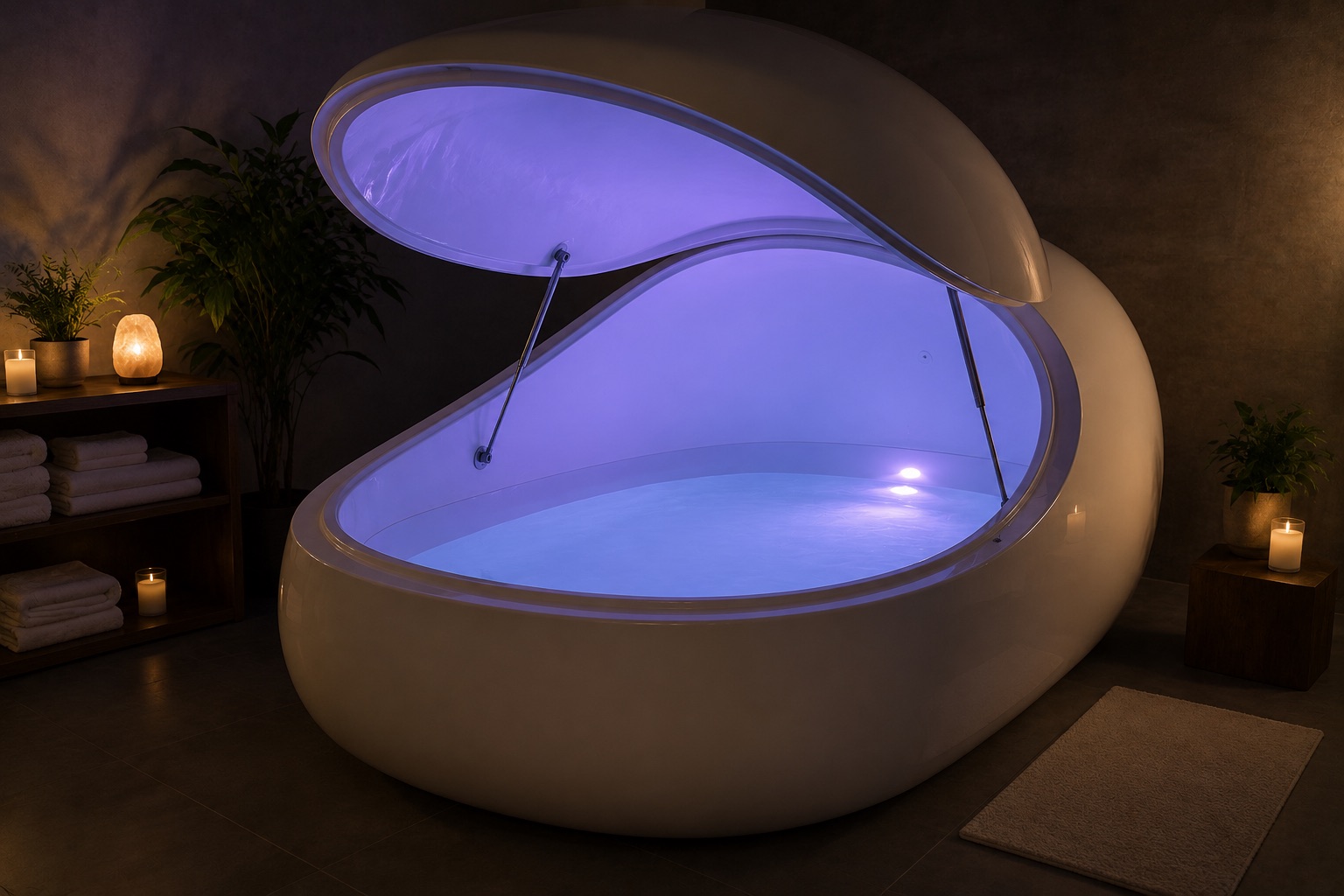
Strip the spa branding away and a float tank is a deliberately boring machine. You lie supine in about 25–30 cm of water held at skin temperature — roughly 35°C — so saturated with Epsom salt (magnesium sulfate) that your body floats on the surface with no effort. Close the lid, kill the light, and the soundproofing does the rest. Within a minute or two you stop registering the water, the air and your own weight. The clinical name for this is Floatation-REST, where REST stands for Reduced Environmental Stimulation Therapy. The whole design goal is subtraction: remove as much sensory input as a person can tolerate and see what the nervous system does with the silence.
That subtraction is the entire point, and it is why this is worth taking seriously as a recovery tool rather than a gimmick. Most wellness interventions add something — a compound, a cold shock, a heat load. Floating does the opposite. It is one of the cleaner ways to ask a stressed nervous system to stand down, and the question this piece answers is which of the many claims attached to that idea the published evidence actually supports. The honest answer is that they sort into clear tiers, and the strongest one is also the oldest promise: calming an anxious mind.
The mechanism: turning down the volume on the senses
Here is where the precise vocabulary belongs. The leading explanation for why floating works is interoception — the brain's sense of the body's internal state, the channel that carries signals like heartbeat, breath and muscle tension. In ordinary life that channel competes with a flood of external input. In a float tank, with sight, sound, touch and gravity stripped away, the external noise drops to near zero and interoceptive signals come to the foreground. For an anxious brain that habitually misreads those internal signals as threat, a safe, low-stakes hour of attending to them appears to be the active ingredient. That is the signal a float tank pulls: it quiets the outside so the inside can be felt without alarm.
This is not just theory; the body visibly downshifts. In a within-subjects study of 31 people with high anxiety sensitivity, a single float produced significant blood-pressure reductions throughout the session, with diastolic pressure dropping by an average of more than 12 mm Hg, alongside falling muscle tension and rising feelings of relaxation and serenity (all p < .001).2 A later crossover study of 57 people compared floating with watching a relaxing nature film and found significantly larger decreases in both systolic and diastolic blood pressure during the float, plus a significant rise in high-frequency heart-rate variability — the marker of a parasympathetic, "rest-and-digest" state. Notably, blood pressure was the one cardiac measure that tracked with how much anxiety fell and serenity rose.5 So the relaxation people describe has a measurable physiological fingerprint, which is more than can be said for most wellness rituals.
The float-tank effect isn't the salt. It's what happens when you take away nearly everything the senses can grab onto and let an over-revved nervous system finally idle.
Anxiety and stress: the strongest case
Of everything floating is sold for, the anxiety-and-stress claim has by far the cleanest support. The landmark study is Feinstein and colleagues, 2018: an open-label trial in which 50 people with anxiety disorders — most also carrying major depression — each completed a single 60-minute float. The drop in state anxiety was enormous, with a Cohen's d above 2 (an effect size most psychiatric interventions never approach), alongside significant reductions in stress, muscle tension and depression, and increases in serenity, relaxation and overall wellbeing. The most severely anxious participants reported the biggest gains, and the group approached the anxiety levels of a non-anxious reference sample by the end of the hour.1
A single session is one thing; a course of treatment is another. The closest thing to a controlled efficacy test is Jonsson and Kjellgren's 2016 pilot randomized trial in generalized anxiety disorder. Forty-six participants were randomized to either a waiting list or twelve 45-minute float sessions over seven weeks. The treated group improved significantly on anxiety symptoms where the control group did not, and 37% of the float group achieved full remission versus 14% of controls, with parallel gains in depression, sleep and emotion regulation that largely held at six-month follow-up.3 A 2005 meta-analysis pooling 27 earlier REST studies reached the same direction of travel, reporting lower cortisol, lower blood pressure and improved wellbeing across mostly healthy participants, and judging floatation more effective than muscle relaxation, biofeedback or standard meditation on its pooled outcomes.6
Now the honesty that keeps this at EMERGING rather than MODERATE. The Feinstein study was open-label and uncontrolled — no blinding, no comparison condition, so expectation and the simple act of an hour's enforced rest are baked into that huge effect size.1 The GAD trial used a waiting-list control, which is the weakest kind, and had only two dozen people per arm.3 The most rigorous test to date — Garland and colleagues' 2024 single-blind randomized trial of 75 anxious and depressed people, comparing floating against an active "chair-REST" comparator — was explicitly designed to establish safety and feasibility rather than efficacy. It cleared both bars with no serious adverse events and good adherence, and the authors were candid that larger trials powered for clinical efficacy are still needed.4 The defensible claim is therefore narrow but real: for acute anxiety and stress, floating has a genuine, replicated, mechanistically grounded signal — the strongest in the whole category — that has not yet been proven in a large, blinded, placebo-controlled trial.
after one float
open-label, clinically anxious sample
after 12 sessions
vs 14% waiting-list control
during a float
high-anxiety-sensitivity study
Pain and muscle tension: real signal, thin data
Floating's effect on pain rides on the same relaxation it produces, and the signal is real but the data are thin. In the Feinstein open-label study, the single float significantly reduced self-reported pain and muscle tension alongside the anxiety drop — a plausible knock-on of a body that has gone limp in warm, weightless water and a nervous system that has stopped bracing.1 Earlier REST work pooled in the 2005 meta-analysis pointed the same way on tension and physiological stress markers.6
But notice what is missing. There is no large randomized trial of floating for a defined chronic-pain condition, no blinded comparison against a credible sham, and the pain outcomes that do exist are mostly secondary measures inside anxiety studies rather than primary endpoints. That is exactly the profile of a WEAK grade: a believable mechanism and a consistent direction, attached to small, uncontrolled, mostly self-reported data. For stress-related muscle tension — the clenched-shoulders, can't-unwind kind — floating is a reasonable thing to try. As a treatment for an established pain disorder, the evidence is not there yet, and anyone selling it as one is ahead of the science.
Athletic recovery: popular, but the proof is soft
Floating has become a fixture in elite sport, and the appeal is obvious: an hour of total stillness after a brutal session feels restorative. The published evidence backs the feeling more than the performance. The most relevant trial is Caldwell and colleagues, 2022, which put 11 resistance-trained men through a punishing squat protocol and then, in a crossover design, gave them either a one-hour float or a passive control. The float significantly reduced perceived muscle soreness — the difference biggest right after the session — and improved mood disturbance and fatigue, with measurable shifts in norepinephrine and testosterone signalling.7
That is a genuine result, but read the limits before you book a tank. The sample was 11 people; the headline outcome was perceived recovery, not a hard performance metric the next day; and there was no blinding possible, so the same expectation effect that inflates the anxiety numbers applies here too.7 A handful of other small studies report better mood, lower soreness and the occasional jump or sprint improvement, but they are tiny, heterogeneous and far from the kind of evidence that would let you say floating objectively speeds recovery. The honest verdict: if a float helps an athlete feel fresher and calmer between hard efforts, that has value on its own terms — but the claim that it measurably improves recovery or performance is WEAK, and the marketing runs well ahead of it.
The Epsom-salt magnesium myth
This is the claim to push back on hardest, because it is the one the industry leans on most. The pitch is that the tank's hundreds of kilograms of Epsom salt — magnesium sulfate — deliver magnesium through your skin while you float, and that this transdermal magnesium is doing the therapeutic work. The mechanism is weak to the point of being implausible as the main lever.
A 2017 review in Nutrients examined the evidence for transdermal magnesium directly and concluded that the idea is "scientifically unsupported," noting that the skin is an effective barrier to mineral ions and that the studies claiming absorption are small, often unpublished, or methodologically flawed.8 The single most-cited "proof" of Epsom-salt absorption is a small bathing study that was never published in a peer-reviewed journal — not the kind of evidence that should anchor a therapeutic claim. Even where a trickle of magnesium does cross the skin, there is no trial showing that float-tank magnesium produces a clinically meaningful rise in body magnesium or drives any of the anxiety, blood-pressure or recovery effects documented above. Those effects show up because of the sensory quiet and the relaxation it triggers — mechanisms that have actual data behind them. The salt is there to make you float, full stop. If your goal is to raise magnesium, that is a job for diet or an oral supplement with real bioavailability, not a soak. Which magnesium forms actually absorb is its own question, and the answer does not run through your skin.
Where it fits: a tiered view
It helps to place floatation-REST honestly on a spectrum of how settled the evidence is and who it is for. None of this is a prescription — it is a map of where the data are strong and where they thin out.
Foundational — acute anxiety and stress relief. The least speculative use is exactly the one with the most support: an occasional float to down-regulate an over-revved, anxious or stressed nervous system. The effect is replicated, the body measurably calms, and for a healthy adult the downside is mainly cost and the oddness of the experience.125 This is the tier the evidence actually earns.
Research-curious — adjunct for clinical anxiety, or recovery between hard efforts. Using a course of floats as a complement to standard care for generalized anxiety, or as a way to feel fresher between training sessions, sits on real but early data — a small randomized pilot on one side,3 small perceived-recovery trials on the other.7 Reasonable to try with clear eyes; not a substitute for treatment that works.
Experimental — floating for chronic pain, or for the magnesium. Treating an established pain condition with a tank, or floating specifically to absorb magnesium, is the weakest tier. The pain data are thin and uncontrolled,1 and the transdermal-magnesium rationale is unsupported.8 This is where the claims outrun the science.
A float tank is a real but narrow tool — genuinely good for acute anxiety and stress, plausible for perceived recovery, oversold for pain and magnesium. The worst mistake is treating any single ritual as the whole answer. The better question is rarely "float tank: yes or no," it's "what actually moves stress, recovery and resilience for someone at my level, and where does floating rank against sleep, breathwork, heat and cold?" The Manual maps the recovery-and-stress levers against each other — what each one's evidence genuinely supports, who benefits, and how to combine them without fooling yourself. See the Manual →
Grey areas and open questions
The blinding problem is real. You cannot give someone a convincing placebo float — they know they are lying in a silent tank — so expectation is welded into every result, including the headline anxiety effects.1 The Garland trial's "chair-REST" comparator is the field's best attempt at an active control, and the fact that a large efficacy trial against it still hasn't been run is the single biggest gap in the literature.4
Dose and durability are unknown. How many floats, how often, and for how long the benefits last are all unsettled. The GAD pilot saw some gains hold at six months but depression effects fade, hinting that booster sessions matter — on a sample far too small to set a protocol.3
Who is underrepresented. The trials skew small, often skew toward already-anxious volunteers, and rarely report results separately for older adults or across the menstrual cycle. As with most of this field, much of what circulates as a precise float "protocol" is extrapolation, not established fact.
The commercial incentive. Floating is now a paid product — memberships, branded tanks, salt-as-medicine framing — and the incentive to inflate a real, narrow anxiety effect into a cure-all for pain, immunity and mineral status is large. Separating the documented effect from the marketed one is most of the work.
What this article is not saying
This is not "float tanks don't work." They do something real, and the anxiety-and-stress effect is one of the more impressive signals in the whole wellness space — a single hour producing a measurable drop in blood pressure and a very large fall in state anxiety in the people who need it most. Dismissing floating as a fad is as wrong as overselling it.
It is also not "floating cures anxiety." The best studies are small, mostly unblinded, and short on the large randomized comparisons that turn a promising signal into an established treatment. For pain and athletic recovery the case is thinner still, resting largely on how people feel. And the magnesium pitch should be retired: the lever is the sensory quiet, not the salt.
Finally, this is not a protocol. It is a summary of what the trials show and where they stop — so that if you step into a tank, you do it with honest expectations about what the dark and the silence can and cannot do.
References
- Feinstein JS, Khalsa SS, Yeh HW, Wohlrab C, Simmons WK, Stein MB, Paulus MP. Examining the short-term anxiolytic and antidepressant effect of Floatation-REST. PLoS One. 2018;13(2):e0190292. DOI: 10.1371/journal.pone.0190292. PMID: 29394251.
- Feinstein JS, Khalsa SS, Yeh HW, et al. The Elicitation of Relaxation and Interoceptive Awareness Using Floatation Therapy in Individuals With High Anxiety Sensitivity. Biol Psychiatry Cogn Neurosci Neuroimaging. 2018;3(6):555-562. DOI: 10.1016/j.bpsc.2018.02.005. PMID: 29656950.
- Jonsson K, Kjellgren A. Promising effects of treatment with flotation-REST (restricted environmental stimulation technique) as an intervention for generalized anxiety disorder (GAD): a randomized controlled pilot trial. BMC Complement Altern Med. 2016;16:108. DOI: 10.1186/s12906-016-1089-x. PMID: 27016217.
- Garland MM, Wilson R, Thompson WK, Stein MB, Paulus MP, Feinstein JS, Khalsa SS. A randomized controlled safety and feasibility trial of floatation-REST in anxious and depressed individuals. PLoS One. 2024;19(6):e0286899. DOI: 10.1371/journal.pone.0286899. PMID: 38843272.
- Flux MC, Fine TH, Poplin T, et al. Exploring the acute cardiovascular effects of Floatation-REST. Front Neurosci. 2022;16:995594. DOI: 10.3389/fnins.2022.995594. PMID: 36389222.
- van Dierendonck D, te Nijenhuis J. Flotation restricted environmental stimulation therapy (REST) as a stress-management tool: a meta-analysis. Psychol Health. 2005;20(3):405-412. DOI: 10.1080/08870440412331337093.
- Caldwell LK, Kraemer WJ, Post EM, et al. Acute Floatation-REST Improves Perceived Recovery After a High-Intensity Resistance Exercise Stress in Trained Men. Med Sci Sports Exerc. 2022;54(8):1371-1381. DOI: 10.1249/MSS.0000000000002906. PMID: 35389942.
- Gröber U, Werner T, Vormann J, Kisters K. Myth or Reality—Transdermal Magnesium? Nutrients. 2017;9(8):813. DOI: 10.3390/nu9080813. PMID: 28788060.