Devil's claw for joint and back pain: what the trials show
Most herbal joint remedies collapse the moment you pool the trials. Devil’s claw is one of the rare exceptions. A Southern African root with a long anti-rheumatic tradition, it has actually been run through randomized trials and Cochrane reviews for osteoarthritis and low-back pain — and it held up. In head-to-head studies it relieved pain about as well as a reference arthritis drug and a COX-2 inhibitor, and in several trials people on devil’s claw reached for fewer NSAIDs. That is a genuinely unusual result for a supplement-aisle botanical, and it deserves to be said plainly. It also comes with real limits: the trials are short, the quality is moderate, and “better than placebo for a few weeks” is not “cure.” Here is the honest read on what devil’s claw does for aching joints and backs, how to think about dosing to harpagoside, and where the evidence runs out.
How this article was built: Primary sources: the Gagnier et al. Cochrane review of herbal medicine for low back pain (2006 and 2016 update), the Chrubasik randomized trials of Harpagophytum in exacerbated low back pain and versus rofecoxib, the Chantre/Leblan multicenter trials of Harpagophytum versus diacerhein in knee and hip osteoarthritis, the Brien 2006 efficacy-and-safety review, and mechanistic work on harpagoside — all retrieved and verified through peer-reviewed literature databases.
- It has real data — unusual for a joint herb. Randomized trials and two Cochrane reviews found devil’s claw reduced short-term pain in osteoarthritis and in non-specific low-back pain more than placebo, at moderate quality of evidence. Most botanical joint remedies never clear that bar.
- It held up against drugs. In knee and hip OA it matched the reference drug diacerhein for pain and function; in low-back pain a proprietary extract performed comparably to the COX-2 inhibitor rofecoxib in a pilot trial — and across studies, devil’s claw users needed fewer NSAIDs and rescue painkillers.
- The dose is defined by harpagoside, not the root weight. The trials that worked standardized to roughly 50–100 mg of harpagoside per day. A label that only lists “milligrams of root” tells you almost nothing about the active dose.
- Who it’s for: people with mild-to-moderate OA or recurrent low-back pain who want a lower-GI-risk, NSAID-sparing option to complement — not replace — movement, strength work, and their clinician’s plan. Watch the stomach, blood thinners, ulcers, and gallstones. It relieves symptoms; it does not repair joints.
- What devil’s claw actually is
- Why it might work: quieting the inflammatory signal
- The osteoarthritis evidence
- The low-back-pain evidence
- The NSAID-sparing angle
- Dosing, forms, and the harpagoside number
- Evidence Radar: how strong is each claim?
- A tiered way to think about it
- Safety and who should be careful
- Grey areas and honest limits
- What this article is not saying
- References
What devil’s claw actually is
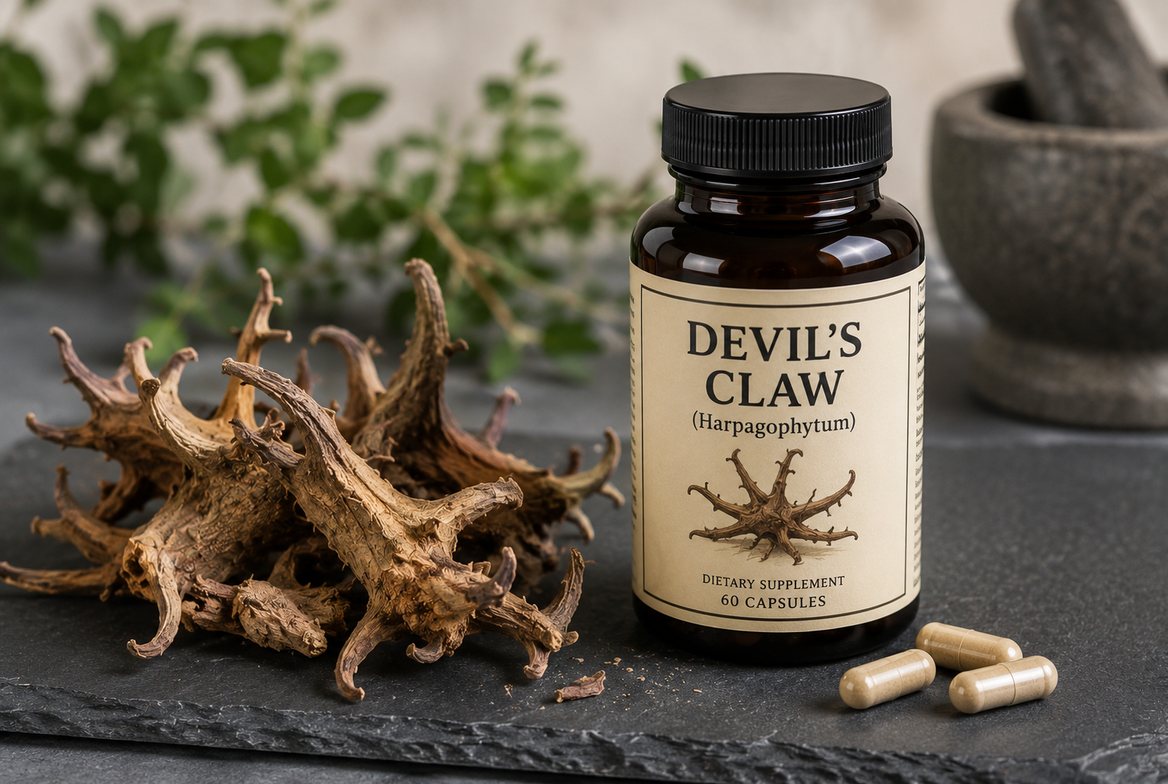
Devil’s claw is Harpagophytum procumbens (and its close relative H. zeyheri), a low-growing plant native to the Kalahari regions of Southern Africa — Namibia, Botswana, South Africa. Its common name comes from the vicious hooked barbs on its fruit, which snag the hooves and fur of passing animals. The part used medicinally is not the fruit but the dried secondary storage roots (tubers), which have been used in traditional Southern African medicine for generations for fever, digestive complaints, and — the use that survived into modern clinics — painful rheumatic and musculoskeletal conditions.1
The root is chemically busy, but the compound that gets the credit is an iridoid glycoside called harpagoside — the marker molecule most extracts are standardized to. Related iridoids (harpagide, procumbide) and various phenolic compounds are present too, and the “whole extract acts as more than harpagoside alone” debate is genuine. But for practical purposes, when researchers describe a devil’s claw product, they describe it by its harpagoside content — and that number, not the raw milligrams of powdered root, is what you should anchor on. A capsule of “600 mg devil’s claw root” and a standardized extract delivering “50 mg harpagoside” are not the same thing.3
Why it might work: quieting the inflammatory signal
Osteoarthritis was long dismissed as pure “wear and tear,” but it is now understood to carry a real low-grade inflammatory component inside the joint — and non-specific low-back pain often involves inflammatory and nociceptive signaling too. That is the kind of target a broad plant anti-inflammatory could plausibly hit. The proposed mechanism for devil’s claw runs through the same master inflammatory switch that keeps coming up in joint biology: the transcription factor NF-κB (nuclear factor kappa-B), which, when switched on inside cells, turns on the genes for inflammatory enzymes and mediators.
In laboratory work, harpagoside blunts that switch. It suppressed lipopolysaccharide-induced activation of NF-κB in cultured human and macrophage cell lines, and in doing so cut the expression of cyclooxygenase-2 (COX-2) — the same enzyme NSAIDs inhibit — and inducible nitric oxide synthase (iNOS), two engines of the inflammatory and pain cascade.9 In an animal model of inflammatory arthritis, harpagoside lowered inflammatory cytokines (TNF-α, IL-6, IL-1β) and reduced joint and bone erosion.10 The story is mechanistically coherent: a plant compound that dampens the COX-2 pathway ends up looking, at the cellular level, a little like a gentle, broad NSAID.
Label this honestly, though. That NF-κB / COX-2 mechanism is established in cell-culture and rodent models, not demonstrated directly in human joints.910 Mechanism is a hypothesis-generator, not proof of benefit. The signal it pulls in a petri dish is real and points the right way — but what gives devil’s claw its standing is that, unlike most herbs with a tidy mechanism story, it was actually taken into randomized human trials. So the question is whether the mechanism survived contact with real patients. Mostly, it did — with caveats.
The osteoarthritis evidence
Start with the cleanest human trial. Chantre and colleagues (2000) ran a multicenter, double-blind, randomized study in 122 patients with osteoarthritis of the knee or hip, comparing a powdered devil’s claw product (Harpadol, ~2.6 g/day of cryoground root) against diacerhein 100 mg/day — an actual slow-acting osteoarthritis drug — over four months. Spontaneous pain improved significantly over the course of the study, and the Lequesne functional index fell — with no significant difference between devil’s claw and the reference drug on pain or function. The devil’s claw group also had significantly fewer adverse events (notably less diarrhea) and, importantly, was using significantly fewer NSAIDs and other painkillers by the end.6 A companion report of the same trial reached the same conclusion: Harpagophytum was at least as effective as diacerhein and reduced the need for analgesic and anti-inflammatory drugs.7
The wider literature is more mixed but broadly supportive. Brien and colleagues (2006) reviewed 14 clinical studies of devil’s claw in osteoarthritis — observational studies, comparator trials, and four double-blind, placebo-controlled RCTs. Their verdict was measured and worth quoting in spirit: many trials had methodological weaknesses, but the data from the higher-quality studies suggested devil’s claw was effective at reducing the main symptom, pain, and appeared to carry only minor risk relative to NSAIDs — while a definitive, high-quality trial was still lacking.1 An evidence-based systematic review from the same era reached a similar “promising but under-powered” read.3
More recent randomized work keeps the signal alive. A 12-week, placebo-controlled, double-blind trial of a combination product containing devil’s claw root extract (alongside rosehip and nettle) in 92 patients with knee osteoarthritis found significantly greater improvement in the WOMAC pain score versus placebo, plus better quality of life and a trend toward reduced analgesic use.8 It is a combination, not devil’s claw alone — a real caveat — but it points the same direction as the older single-herb data.
knee/hip OA, 4 months
Chantre 2000, n=122
the trial-level dose
Cochrane, low back pain
vs comparators
multiple RCTs
Read those numbers for what they are and aren’t. They are consistent, statistically significant symptom benefits across independent trials, with comparability to actual drugs and a recurring drop in painkiller use — a stronger showing than almost any other joint botanical manages. They are also drawn from trials that are relatively small, mostly a few weeks to four months long, and rated moderate quality with methodological gaps. Both things are true at once. The effect is real; the confidence around its exact size is looser than the clean summary suggests.
The low-back-pain evidence
This is where devil’s claw has its most quoted credential: it is one of the very few herbs to earn a positive verdict in a Cochrane systematic review. The Gagnier et al. Cochrane review of herbal medicine for non-specific low-back pain found that two high-quality trials of Harpagophytum procumbens gave strong evidence that daily doses standardized to 50 mg or 100 mg of harpagoside were better than placebo for short-term improvements in pain and reduced rescue-medication use — and another high-quality trial showed it was roughly equivalent to 12.5 mg/day of rofecoxib, a COX-2 inhibitor.4 The 2016 update of that Cochrane review kept devil’s claw on the “seems to reduce pain more than placebo” list, while grading the underlying evidence as moderate quality at best and calling for larger, better trials.5
Behind those pooled verdicts sit real randomized trials. Chrubasik and colleagues (1999) randomized 197 patients with chronic, currently-exacerbated back pain to placebo or one of two doses of a devil’s claw extract (WS 1531) delivering 50 or 100 mg of harpagoside daily for four weeks. Significantly more patients on devil’s claw became pain-free without needing the rescue painkiller (tramadol) than on placebo, with a dose-related trend.2 A later Chrubasik pilot study compared a proprietary extract (Doloteffin, ~60 mg harpagoside/day) head-to-head against rofecoxib 12.5 mg/day in acutely exacerbated low-back pain for six weeks and found no significant difference between the herb and the drug on the pain measures — though the authors were careful to note the trial was a pilot, too small to prove formal equivalence.11
The honest headline isn’t “devil’s claw beats the drug.” It’s “in short trials, it relieved back and joint pain about as well as a COX-2 inhibitor and a reference arthritis drug, and people needed fewer painkillers” — which, for a plant root, is already an unusually strong claim.
Keep the frame tight. These are short trials — four to six weeks — in non-specific low-back pain, which often improves on its own. “Comparable to rofecoxib at six weeks” is real and useful; “comparable over the years a bad back actually lasts” is an extrapolation the data don’t support. And the Cochrane authors were blunt that the reporting quality across these trials was generally poor, which is exactly why the grade is moderate and not strong.5
The NSAID-sparing angle
The most practically interesting thread running through the whole devil’s-claw literature isn’t “does it beat placebo” — it’s that people taking it consistently reached for fewer conventional painkillers. In the Chantre osteoarthritis trial, the devil’s claw group used significantly less NSAID and analgesic medication than the diacerhein group by four months.67 In the Cochrane-reviewed back-pain trials, the outcome measures literally counted rescue-medication use, and devil’s claw reduced it.42
Why that matters: chronic NSAID use carries a well-known toll — gastrointestinal bleeding and ulcers, kidney stress, raised cardiovascular risk — and a large share of the people who most need ongoing pain relief (older adults with OA, people with recurrent back pain) are precisely those who tolerate long-term NSAIDs least well. For that person, “works reasonably, easier on the stomach, lets me use the ibuprofen less often” is a meaningful proposition, not a marketing line. That is the real-world lane devil’s claw fits: an NSAID-sparing adjunct, discussed with a clinician — not a replacement you swap in unilaterally, and not a reason to stop a medication someone prescribed.
Dosing, forms, and the harpagoside number
This is a framework for understanding the evidence, not a prescription. The single most useful practical fact is the one the marketing most reliably buries: dose devil’s claw by harpagoside, not by root weight. The trials that showed benefit standardized to roughly 50 to 100 mg of harpagoside per day — that is the figure the Cochrane review anchors on for back pain, and the range that appears across the osteoarthritis work.42 A product that only tells you “600 mg of devil’s claw root” without a harpagoside percentage is asking you to guess at the active dose.
Forms. Devil’s claw shows up as standardized dried-extract capsules and tablets (the form used in most positive trials), as powdered whole root in capsules, and as liquid tinctures and teas. The standardized extract is the version with the cleanest supporting data, precisely because you can read the harpagoside dose off the label. Whole-root and tea preparations vary enormously in potency and are much harder to map onto the trial doses. One pharmacological wrinkle worth knowing: harpagoside is somewhat acid-sensitive, which is part of the rationale behind extract standardization and, in some products, enteric formulation — another reason the raw-powder-versus-standardized-extract distinction isn’t trivial.
Timeline. Devil’s claw is not an acute painkiller you take for a flare and expect to work in an hour. The trials dosed it daily over weeks to months, and benefit built over that window. If someone is going to try it, the honest expectation is a gradual, modest reduction in background pain over two to eight weeks — not instant relief — and a plan to reassess, with a clinician, whether it’s actually doing anything worth continuing.
Evidence Radar: how strong is each claim?
Wellness Radar grades the specific claims, not the headline. These grades are provisional and verified by our editorial team against current literature; here is the honest read on devil’s claw for joint and back pain.
MODERATE — Devil’s claw reduces osteoarthritis pain and can lower NSAID use. Supported by a 122-patient randomized trial matching diacerhein on pain and function (with reduced painkiller use) plus supportive reviews — held back from STRONG by small, mostly short trials and moderate methodological quality.167
MODERATE — Devil’s claw eases short-term low-back pain (50–100 mg harpagoside/day). One of the few herbs with a positive Cochrane verdict; two high-quality trials versus placebo and one versus rofecoxib — but the evidence is graded moderate-at-best, trials are short, and reporting quality is poor.45211
EMERGING — Harpagoside quiets inflammation via NF-κB / COX-2 suppression. Coherent and consistent across cell-culture and animal models — but demonstrated in the lab and in rodents, not directly in human joints.910
HYPE — Devil’s claw cures arthritis, reverses joint damage, or replaces all NSAIDs. No trial shows disease modification or structural repair; benefit is symptomatic and short-term, and “NSAID-sparing” is not “NSAID-replacing.”15
A tiered way to think about it
This is a framework for understanding the evidence, not a prescription. Dosing and product choice for a medical condition belong with your clinician.
Foundational (well-supported, low-risk). For mild-to-moderate knee or hip OA, or recurrent non-specific low-back pain, a standardized devil’s claw extract delivering 50–100 mg harpagoside per day is one of the better-evidenced botanicals to add to the things that actually move these conditions: regular movement, lower-limb and core strength work, and weight management where relevant. It is an adjunct to that foundation, not a substitute for it.4
Research-curious. If you tolerate NSAIDs poorly or want to reduce how often you use them, the comparator trials make devil’s claw a reasonable thing to raise with a clinician as a partial, NSAID-sparing option — not because it’s proven superior, but because “comparable short-term relief, fewer painkillers, easier on the gut” is a sensible trade for the right person. This is a conversation to have, not a swap to make on your own, especially alongside other medications.6
Experimental. Treating devil’s claw as disease-modifying — expecting it to protect cartilage, reverse joint damage, or replace prescribed medication — runs well ahead of the human evidence, which is symptomatic and short-term only. High doses, indefinite use, and stacking it with multiple other anti-inflammatory agents all push past where the trials can vouch for safety or benefit.
Safety and who should be careful
Devil’s claw is well tolerated in trials — often better tolerated than the drug it was compared against — but “natural” is not “consequence-free.” The commonest complaint is gastrointestinal: diarrhea, nausea, and abdominal discomfort. Because it may increase gastric acid secretion, it is a poor choice for anyone with an active peptic ulcer, gastritis, or a history of GI bleeding.3 It stimulates bile flow, so people with gallstones or bile-duct obstruction should avoid it. It can theoretically potentiate anticoagulant and antiplatelet drugs (warfarin, clopidogrel, and similar), raising bleeding risk. And because devil’s claw may nudge blood sugar, blood pressure, and heart rhythm, anyone on diabetes, antihypertensive, or cardiac medication should treat it cautiously and loop in their prescriber — the interaction data are thin, which is a reason for care, not comfort. Pregnancy and breastfeeding are traditional cautions where it should be avoided for lack of safety data. None of this makes devil’s claw dangerous for most people; it makes it a medicine, which is exactly how it should be treated.
Grey areas and honest limits
The trials are small, short, and moderate-quality. Most enrolled dozens to low-hundreds of patients over four to sixteen weeks, and both Cochrane reviews and the OA reviews flagged poor reporting and methodological caveats.51 That is enough to detect a real symptomatic effect and not enough to settle long-term efficacy, durability, or rare harms. Devil’s claw still lacks the single large, rigorous, independently funded trial that would move it to STRONG.
Products aren’t interchangeable. Different extracts (WS 1531, Doloteffin, Harpadol, and others) deliver different harpagoside doses and were made differently, and the “whole extract vs harpagoside alone” question is unresolved. Reading a benefit across from one product to another is not straightforward — another reason to buy by standardized harpagoside content, not by brand halo.
Symptoms, not structure. Every human benefit here is about how the joint or back feels, over weeks. No trial has shown devil’s claw slows the structural progression of osteoarthritis or repairs cartilage; the chondroprotective and bone-erosion findings are preclinical.10 Treat the pain benefit as real and the disease-modifying story as unproven.
Devil’s claw is one of the more evidence-backed botanicals in the joint-and-recovery toolkit — but it is one tool, and the right question is rarely “devil’s claw: yes or no,” it’s “which anti-inflammatory approaches fit this joint, this goal, and this risk profile.” The Manual maps devil’s claw against the rest of the recovery stack — what each botanical’s evidence actually supports, how standardization changes the real dose, where the drug interactions and screening lines sit, and how to layer the foundational work (load, strength, weight) that does the heavy lifting in osteoarthritis and back pain. See the Manual →
What this article is not saying
This is not “devil’s claw cures arthritis.” The trials show short-term symptomatic pain relief in mild-to-moderate osteoarthritis and non-specific low-back pain — not a cure, and not structural repair. The pain got better; the disease was not shown to change.
This is not “devil’s claw replaces your NSAIDs” or “stop your prescribed medication.” The comparator trials show comparable short-term relief with fewer painkillers used alongside — a reason to discuss an NSAID-sparing plan with a clinician, not to make a unilateral swap, especially on blood thinners or with an ulcer, gallstones, or diabetes.
And this is not a claim that all “devil’s claw” on a shelf is equivalent. The benefit belongs to standardized extracts delivering 50–100 mg of harpagoside a day; a bottle listing only root weight, or a random tea, is not the thing the trials tested. We’d rather tell you exactly where the randomized evidence ends — at how the joint feels, over weeks, in moderate-quality trials — than pretend the line extends to cartilage, cure, or the long term. The point is to let an informed conversation with your clinician start from what’s actually known.
References
- Brien S, Lewith GT, McGregor G. Devil's Claw (Harpagophytum procumbens) as a treatment for osteoarthritis: a review of efficacy and safety. J Altern Complement Med. 2006;12(10):981-993. DOI: 10.1089/acm.2006.12.981. PMID: 17212570.
- Chrubasik S, Junck H, Breitschwerdt H, Conradt C, Zappe H. Effectiveness of Harpagophytum extract WS 1531 in the treatment of exacerbation of low back pain: a randomized, placebo-controlled, double-blind study. Eur J Anaesthesiol. 1999;16(2):118-129. DOI: 10.1046/j.1365-2346.1999.00435.x. PMID: 10101629.
- Brendler T, Gruenwald J, Ulbricht C, Basch E. Devil's Claw (Harpagophytum procumbens DC): an evidence-based systematic review by the Natural Standard Research Collaboration. J Herb Pharmacother. 2006;6(1):89-126. PMID: 17135164.
- Gagnier JJ, van Tulder MW, Berman B, Bombardier C. Herbal medicine for low back pain: a Cochrane review. Spine (Phila Pa 1976). 2007;32(1):82-92. DOI: 10.1097/01.brs.0000249525.70011.fe. PMID: 17202897.
- Gagnier JJ, Oltean H, van Tulder MW, Berman BM, Bombardier C, Robbins CB. Herbal Medicine for Low Back Pain: A Cochrane Review. Spine (Phila Pa 1976). 2016;41(2):116-133. DOI: 10.1097/BRS.0000000000001310. PMID: 26630428.
- Chantre P, Cappelaere A, Leblan D, Guedon D, Vandermander J, Fournie B. Efficacy and tolerance of Harpagophytum procumbens versus diacerhein in treatment of osteoarthritis. Phytomedicine. 2000;7(3):177-183. DOI: 10.1016/S0944-7113(00)80001-X. PMID: 11185727.
- Leblan D, Chantre P, Fournie B. Harpagophytum procumbens in the treatment of knee and hip osteoarthritis. Four-month results of a prospective, multicenter, double-blind trial versus diacerhein. Joint Bone Spine. 2000;67(5):462-467. PMID: 11143915.
- Moré M, Gruenwald J, Pohl U, Uebelhack R. A Rosa canina – Urtica dioica – Harpagophytum procumbens/zeyheri combination significantly reduces gonarthritis symptoms in a randomized, placebo-controlled double-blind study. Planta Med. 2017;83(18):1384-1391. DOI: 10.1055/s-0043-112750. PMID: 28614869.
- Huang TH, Tran VH, Duke RK, Tan S, Chrubasik S, Roufogalis BD, Duke CC. Harpagoside suppresses lipopolysaccharide-induced iNOS and COX-2 expression through inhibition of NF-kappaB activation. J Ethnopharmacol. 2006;104(1-2):149-155. DOI: 10.1016/j.jep.2005.08.055. PMID: 16203115. (Preclinical: cell-culture model.)
- Kim JY, Cheon YH, Ahn SJ, Kwak SC, Chung CH, Lee CH, Lee MS. Harpagoside attenuates local bone erosion and systemic osteoporosis in collagen-induced arthritis in mice. BMC Complement Med Ther. 2022;22(1):214. DOI: 10.1186/s12906-022-03694-y. PMID: 35948905. (Preclinical: animal model.)
- Chrubasik S, Model A, Black A, Pollak S. A randomized double-blind pilot study comparing Doloteffin and Vioxx in the treatment of low back pain. Rheumatology (Oxford). 2003;42(1):141-148. DOI: 10.1093/rheumatology/keg053. PMID: 12509627.