Boswellia for joint pain: what the osteoarthritis evidence shows
Frankincense is one of the oldest substances humans have burned, traded and rubbed on aching joints — and, unusually for a supplement-aisle botanical, the modern joint claim is actually backed by randomized trials. Standardized Boswellia serrata extracts modestly reduce knee osteoarthritis pain and stiffness and improve function versus placebo, through a different inflammatory pathway than ibuprofen. That is a real result and it deserves to be said plainly. But it comes wrapped in caveats the label never mentions: the effect is modest, the trials are small and often industry-funded, and the result belongs to a specific branded extract at a specific dose — not to “boswellia” in the abstract. Here is the honest read on what frankincense does for an arthritic knee, and where the evidence runs out.
How this article was built: Because our usual research databases (Consensus and the PubMed API) were offline at the time of writing, every source here was retrieved and read directly on the live journal or PubMed Central page and verified by hand. Primary sources: the Yu et al. 2020 systematic review and meta-analysis in BMC Complementary Medicine and Therapies, the Sengupta et al. 2008 5-Loxin randomized controlled trial in Arthritis Research & Therapy, the Inprasit et al. 2025 network meta-analysis of curcumin, boswellia and their combination in Complementary Therapies in Medicine, and the Dubey et al. 2024 Aflapin sub-group meta-analysis in EXPLORE.
- The joint claim is real but modest: across randomized placebo-controlled trials and their meta-analyses, standardized boswellia extracts cut knee osteoarthritis pain, stiffness and improve function — a 2020 meta-analysis of 7 RCTs reported a roughly 8-point drop in VAS pain and double-digit WOMAC improvements versus placebo over four-plus weeks.
- It works through a different door than NSAIDs. The signal boswellia pulls is the 5-LOX/leukotriene inflammatory pathway, not the COX pathway that ibuprofen blocks — which is why the two aren’t simply interchangeable.
- The effect is product-specific. Trials use standardized branded extracts (5-Loxin, Aflapin) at specific AKBA concentrations; many are small, short and industry-funded, and you can’t read results across to a generic “frankincense” capsule.
- Who it’s for: people with mild-to-moderate knee OA who want a generally well-tolerated, evidence-backed botanical to add to — not replace — movement, strength work and weight management. Reasonable adjunct, not a cure, and it does not regrow cartilage.
- What boswellia actually is
- Why it works: a different inflammatory door than NSAIDs
- The evidence, in numbers
- Why the brand on the bottle matters
- Evidence Radar: how strong is each claim?
- A tiered way to think about it
- Grey areas and honest limits
- Open questions
- What this article is not saying
- References
What boswellia actually is
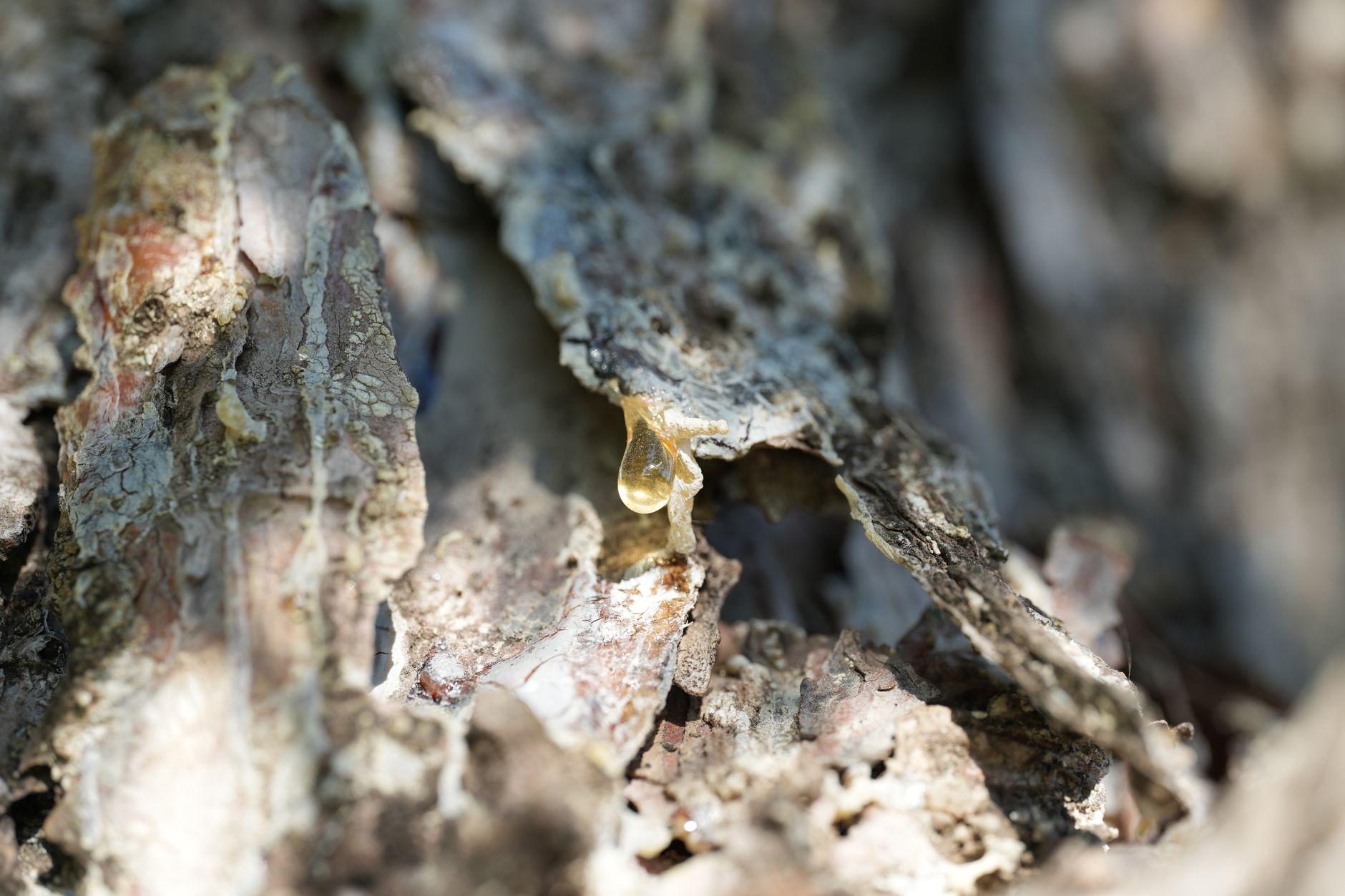
Boswellia is frankincense — the aromatic resin that weeps from the bark of Boswellia trees when the trunk is cut, hardens into golden tears, and has been traded across Arabia and East Africa for thousands of years. The species used in joint research is almost always Boswellia serrata, the Indian variety, and the part that matters for an arthritic knee is a family of compounds in the resin called boswellic acids. The most pharmacologically interesting of these has an unwieldy name — 3-O-acetyl-11-keto-β-boswellic acid, mercifully abbreviated to AKBA — and it is the marker that serious extracts are standardized to.2
That standardization is the whole game, and it is worth pausing on before any data. The frankincense in an incense shop and the capsule in an osteoarthritis trial are not the same thing. Trial-grade products are concentrated extracts — branded names like 5-Loxin (enriched to around 30% AKBA) and Aflapin (a 5-Loxin further blended with boswellia oil) — with defined boswellic-acid content. Generic “boswellia” on a bargain-bin label may contain a fraction of the active acids, or an undeclared amount. Keep that in mind: when this article says boswellia “works,” it means a specific, standardized extract at a specific dose worked in a specific trial. We will come back to why that caveat is load-bearing.5
Why it works: a different inflammatory door than NSAIDs
Most over-the-counter joint relief runs through one pathway. Ibuprofen, naproxen and the rest are NSAIDs — non-steroidal anti-inflammatory drugs — and they work by blocking cyclooxygenase (COX), the enzyme that makes pro-inflammatory prostaglandins. Boswellia is interesting precisely because it does not primarily target that door. Its boswellic acids, AKBA in particular, inhibit a different enzyme: 5-lipoxygenase, or 5-LOX, which sits at the head of a separate inflammatory cascade that produces messengers called leukotrienes.2
In plain terms: the signal boswellia pulls is the leukotriene signal, not the prostaglandin one. Both are arms of inflammation, but they are distinct arms — which is the mechanistic reason boswellia is not simply “a weaker, herbal ibuprofen.” It is reaching for a lever NSAIDs mostly leave alone. AKBA binds to a dedicated site on the 5-LOX enzyme and, in laboratory work, shuts down leukotriene production at low concentrations; it is the most potent of the boswellic acids at doing so.2 That specificity is also why standardizing to AKBA matters: the marker compound and the mechanism are the same molecule.
There is a second mechanistic thread that the trials gesture at but haven’t proven in human joints. In the controlled human work, boswellia didn’t only calm symptoms — in the 5-Loxin trial it was associated with a roughly 46% drop in synovial-fluid matrix metalloproteinase-3 (MMP-3), one of the enzymes that breaks down cartilage.2 Preclinical rat-model work points the same way, with 5-Loxin reducing leukotriene B4 and prostaglandin E2 and slowing matrix breakdown.8 That is a genuinely interesting biochemical signal — but it is a biomarker and an animal finding, not proof that boswellia preserves cartilage in people. Hold it loosely; we’ll flag it again in the grey areas.
The evidence, in numbers
Start with the anchor. Yu et al. 2020, in BMC Complementary Medicine and Therapies, pooled seven randomized controlled trials covering 545 patients with knee osteoarthritis. Against the control groups, boswellia and its extracts produced significant improvements across the board: visual analogue scale (VAS) pain fell by a weighted mean difference of −8.33 points, WOMAC pain by −14.22, WOMAC stiffness by −10.04, and WOMAC physical function by −10.75, with the Lequesne functional index improving by −2.27.1 Those are real, consistent, statistically significant reductions — the kind of consistency that separates boswellia from the long list of joint supplements that evaporate when pooled.
Now the honesty tax. The heterogeneity in that meta-analysis was extreme — I² values of 93% to 99% for the WOMAC and VAS outcomes, meaning the individual trials disagreed with each other enormously about the size of the effect.1 The authors flagged unclear randomization in several studies, high risk of bias in outcome assessment and reporting, and small samples, and concluded — in their own words — that the conclusion should be formulated cautiously and that larger, double-blind RCTs are needed.1 So the right reading of those clean numbers is “direction is reliable, exact magnitude is not.” Boswellia helps; precisely how much is fuzzier than the decimal points suggest. Treatment needs to run at least four weeks to show up.1
The single most-cited trial under that umbrella is Sengupta et al. 2008, the 5-Loxin study in Arthritis Research & Therapy. It randomized 75 knee-OA patients to 100 mg/day of 5-Loxin, 250 mg/day, or placebo for 90 days. Both active doses beat placebo on pain and function, and the high-dose group improved markedly — with a striking feature: statistically significant pain and function gains appeared as early as day 7 in the 250 mg arm.2 A botanical showing a measurable effect inside a week is unusual and is part of why boswellia gets attention. The catch, which we will not bury: the study was funded by the extract’s manufacturer and several authors were employees or consultants.2
vs control
7 RCTs, n=545
5-Loxin 250 mg arm
Sengupta 2008
WOMAC pain pool
read the size loosely
More recent syntheses keep the story alive without inflating it. A 2024 sub-group meta-analysis by Dubey et al. in EXPLORE pulled together nine RCTs (712 participants) across multiple boswellia ingredients and found the standardized Aflapin extract performed best on pain, stiffness and movement — while explicitly noting that the advantage of one branded extract over another needs confirmation in head-to-head studies.3 And a 2025 network meta-analysis by Inprasit et al. in Complementary Therapies in Medicine, covering 20 RCTs and 1,633 participants, found that modified boswellia formulations significantly improved WOMAC pain, stiffness and function.4 Multiple independent syntheses, same direction: a modest, real, formulation-dependent benefit.
Why the brand on the bottle matters
This is the practical fact that the supplement aisle most reliably obscures, and it is the boswellia equivalent of the bioavailability problem that haunts turmeric and curcumin for the same joints: the result belongs to the formulation, not to the plant in general. The trials that “worked” used defined, standardized extracts — 5-Loxin enriched to roughly 30% AKBA, or Aflapin, which blends that extract with boswellia gum oil to push the active acids higher still and which appears to act fast.23
A generic capsule labelled “boswellia extract” with no AKBA percentage on the panel is not the thing that was tested. It may contain a respectable dose of boswellic acids; it may contain a token amount. You can’t tell from the front of the bottle, and you can’t assume the trial data transfer. The 2024 sub-group analysis exists precisely because different boswellia ingredients are not equivalent and one of them (Aflapin) outperformed the field.3 The takeaway is blunt: when you buy “boswellia,” you are buying a specific extract or you are buying a question mark — and only the specific extracts have the evidence behind them.
The honest headline isn’t “frankincense fixes arthritis.” It’s “a standardized, AKBA-rich boswellia extract modestly eases knee-OA pain and stiffness through a pathway NSAIDs leave alone” — and that, in small trials, is already more than most joint supplements can claim.
Evidence Radar: how strong is each claim?
Wellness Radar grades the specific claims, not the headline. These grades are reviewed by our editorial team against current literature; here is the honest read on boswellia for osteoarthritis.
A tiered way to think about it
This is a framework for understanding the evidence, not a prescription. Dosing and product choice for a medical condition belong with your clinician.
Foundational (well-supported, low-risk). For mild-to-moderate knee OA, a standardized, AKBA-rich boswellia extract is one of the better-evidenced supplement options to add to the things that actually move osteoarthritis outcomes: regular movement, lower-limb strength work, and weight management if relevant. The trial-level intake clusters around 100–250 mg/day of a 5-Loxin-class extract, run for at least four weeks — but the standardization on the label matters more than the raw milligram number.12 If you want to see how a washout or trial period maps onto a compound’s timeline, our half-life tool is a simple way to think it through.
Research-curious. If you tolerate NSAIDs poorly, boswellia’s distinct 5-LOX mechanism makes it a reasonable thing to discuss with a clinician as a complementary option — not because it’s proven to match a drug, but because reaching a different inflammatory lever, with a generally gentle side-effect profile, is a sensible trade for the right person. This is a conversation to have, not a swap to make unilaterally, especially alongside other medications. You can browse the wider recovery and pain evidence to see where it sits among the options.
Experimental. Treating boswellia as disease-modifying — expecting it to regrow cartilage or reverse joint damage — runs well ahead of the human evidence, which is symptomatic. The MMP-3 and rat-model cartilage findings are intriguing biochemistry, not a proven human outcome. High doses, exotic stacks, and treating it as a cure all push past where the trials can vouch for benefit or safety.
Grey areas and honest limits
The trials are small, short and often industry-funded. The pooled samples run to a few hundred patients over four to twelve weeks, and several of the cornerstone studies — the 5-Loxin trial among them — were funded by the extract manufacturers, with authors on the payroll.12 That doesn’t make the results false, but it is exactly the configuration where effect sizes tend to run optimistic, and it is why the grade is MODERATE rather than STRONG.
The heterogeneity is enormous. I² values near 99% mean the trials genuinely disagree about how big the benefit is. The direction is consistent; the magnitude is not a settled number. Read the headline figures as “real and modest,” not as a precise dose-response.1
The combo question is open. Boswellia is frequently sold paired with curcumin, and the pairing is mechanistically reasonable — two different anti-inflammatory levers. But the 2025 network meta-analysis that specifically looked at curcumin, boswellia and their mixed formulation concluded only that the combination “warrants further investigation,” not that it clearly beats either alone.4 Plausible, marketed hard, not yet proven additive. That is why it sits at EMERGING.
Cartilage protection is a biomarker, not an outcome. The drop in synovial MMP-3 and the rat-model matrix findings are a genuine signal that boswellia may touch the disease process and not just the pain.28 But no human trial has shown it preserves cartilage or slows structural progression on imaging. Interesting; unproven.
Open questions
The honest gaps are specific. Does boswellia actually slow the structural progression of osteoarthritis, or only quiet the symptoms? No human trial has shown disease modification on imaging — the MMP-3 finding is suggestive, not conclusive. Which extract, at which AKBA concentration and dose, is genuinely optimal — and is Aflapin’s apparent edge real or an artifact of who ran the trials? Unconfirmed in head-to-head studies. Does the boswellia-plus-curcumin pairing add anything over either alone? Unsettled. How does it perform over years rather than weeks, and does it hold up in hip and hand OA, where the trials largely haven’t looked? Untested. None of these gaps erase the existing pain-and-function benefit — but they mark exactly where the evidence stops and the marketing begins.
Boswellia is one of the more evidence-backed entries in the joint toolkit — but it is one tool, and the right question is rarely “boswellia: yes or no,” it’s “which anti-inflammatory levers fit this joint, this goal, and this risk profile.” It pulls the leukotriene lever; curcumin pulls others; the foundational work — load, strength, weight — does the heavy lifting that no capsule replaces. The right move is usually to layer the evidence-backed pieces, not to chase a single hero supplement.
What this article is not saying
This is not “burn frankincense or eat the resin and your knees heal.” The trials used concentrated, standardized extracts at defined doses; incense-grade or unstandardized resin is a different thing entirely, and you can’t read across.
This is not “boswellia is a proven cure for arthritis” or “it regrows cartilage.” Every benefit shown in humans is symptomatic — less pain, less stiffness, better function over weeks. The cartilage and MMP-3 story is a preclinical and biomarker signal, not a demonstrated human outcome, and anyone selling it as a regenerative cure is ahead of the data.
And this is not “stop your prescribed treatment.” Boswellia’s value is as a generally well-tolerated adjunct with a distinct mechanism — a reason to discuss it with a clinician, not to make a unilateral swap. We’d rather tell you exactly where the randomized evidence ends — at how the joint feels, over weeks, in small and often industry-funded trials — than pretend the line extends to cartilage preservation or a cure. The point is to let an informed conversation with your clinician start from what’s actually known.
References
- Yu G, Xiang W, Zhang T, Zeng L, Yang K, Li J. Effectiveness of Boswellia and Boswellia extract for osteoarthritis patients: a systematic review and meta-analysis. BMC Complement Med Ther. 2020;20(1):225. DOI: 10.1186/s12906-020-02985-6 · PMID 32680575
- Sengupta K, Alluri KV, Satish AR, Mishra S, Golakoti T, Sarma KVS, Dey D, Raychaudhuri SP. A double blind, randomized, placebo controlled study of the efficacy and safety of 5-Loxin for treatment of osteoarthritis of the knee. Arthritis Res Ther. 2008;10(4):R85. DOI: 10.1186/ar2461 · PMID 18667054 (Manufacturer-funded; several authors affiliated with the extract maker.)
- Dubey V, Kheni D, Sureja V. Efficacy evaluation of standardized Boswellia serrata extract (Aflapin) in osteoarthritis: a systematic review and sub-group meta-analysis study. EXPLORE (NY). 2024;20(5):103003. DOI: 10.1016/j.explore.2024.02.007 · PMID 38365549
- Inprasit C, Bunyamahote S, Boonpattharatthiti K, et al. Evaluating the efficacy and safety of Curcuma longa, Boswellia serrata, and their mixed formulation in treating knee osteoarthritis: a systematic review and network meta-analysis. Complement Ther Med. 2025;87:103256. DOI: 10.1016/j.ctim.2025.103256 · PMID 41082950
- Siddiqui MZ. Boswellia serrata, a potential antiinflammatory agent: an overview. Indian J Pharm Sci. 2011;73(3):255-261. DOI: 10.4103/0250-474X.93507 · PMID 22457547
- Shin S, Ko J, Kim M, et al. Boswellia serrata extract, 5-Loxin, prevents joint pain and cartilage degeneration in a rat model of osteoarthritis through inhibition of inflammatory responses and restoration of matrix homeostasis. Evid Based Complement Alternat Med. 2022;2022:3067526. DOI: 10.1155/2022/3067526 · PMID 36262169 (Preclinical: rat model.)