5-HTP for mood and sleep: does the serotonin precursor actually work, and is it safe?
5-HTP (5-hydroxytryptophan) is sold as a “natural antidepressant” — the raw material your body turns directly into serotonin, in a bottle. That framing is half true and half dangerous. The mechanism is real: 5-HTP crosses into the brain and pushes serotonin production up. But the efficacy evidence for depression is old, sparse, and low-quality; the sleep and appetite data are thinner still; and the same crude serotonin push that makes it interesting is exactly what makes stacking it on top of an antidepressant a genuine medical risk, not a wellness experiment. Here is the honest read, with the safety part said plainly.
How this article was built: Primary sources: the Shaw, Turner & Del Mar 2002 Cochrane systematic review of tryptophan and 5-HTP for depression; the Das et al. 2004 safety review in Toxicology Letters; the Klarskov et al. 2003 structural analysis of the “Peak X” contaminant in The Journal of Rheumatology; the Patel & Marzella 2017 serotonin-syndrome case report in The American Journal of Case Reports; and the Meloni et al. 2022 randomized crossover sleep trial in Sleep & Breathing. The Consensus and PubMed research databases were unavailable during drafting, so every citation here was retrieved and verified directly against PubMed and the publishers’ records; that method is stated openly rather than implied.
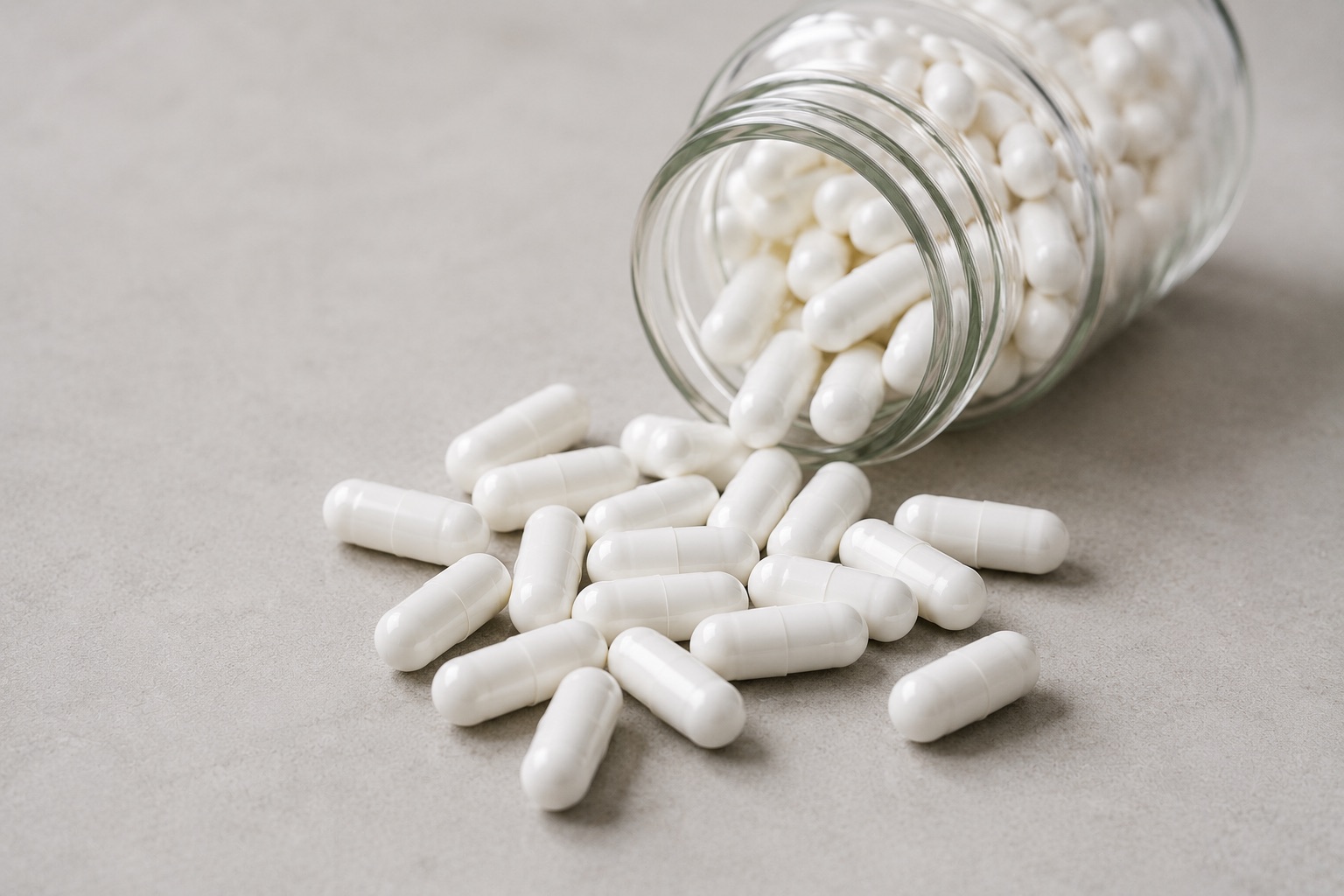
- The mechanism is real. 5-HTP is one chemical step away from serotonin, crosses into the brain, and reliably raises serotonin production — that part isn’t in dispute.1
- The depression evidence is weak and dated. The most-cited review found 5-HTP and tryptophan may beat placebo, but only 2 of 108 trials (64 patients total) were good enough to count, and the authors called the evidence too poor to be conclusive.2
- The real catch is safety, not whether it “works.” Pushing serotonin up bluntly is the problem: stacked with an SSRI, SNRI, MAOI, or triptan, 5-HTP can trigger serotonin syndrome — documented in case reports, occasionally severe.6
- It is not a benign “natural Prozac” to self-stack. Between the dated efficacy data, GI side effects, a contamination history, and the interaction risk, 5-HTP is a clinician conversation — not a default purchase.
- What 5-HTP actually is
- The mechanism: the signal it pulls
- The depression evidence: old and thin
- Sleep and appetite: thinner still
- The safety problem: serotonin syndrome
- The EMS chapter: a contamination history
- Where it fits: a tiered view
- Grey areas and open questions
- What this article is not saying
- References
What 5-HTP actually is
5-HTP is short for 5-hydroxytryptophan, and the name is the whole story. Your body builds serotonin in two steps: it takes the amino acid tryptophan, converts it to 5-HTP, and then converts 5-HTP to serotonin. The middle step — tryptophan to 5-HTP — is the slow, tightly regulated one. So when you swallow 5-HTP, you are skipping the bottleneck and handing the body the second-to-last ingredient in the serotonin recipe.
The 5-HTP on the shelf isn’t synthesized in a lab the way most drugs are. It is extracted from the seeds of Griffonia simplicifolia, a woody climbing plant from West Africa whose seeds are unusually rich in it. That botanical origin is where the “natural” marketing comes from — and, as we’ll see, it’s also where part of the safety story comes from, because plant-extracted products carry whatever else comes along for the ride.
It is sold for four overlapping promises: lifting low mood, easing anxiety, helping sleep, and blunting appetite. All four trace back to one idea — more serotonin — and that single idea is worth examining closely on the anxiety and mood beat, because it is doing a lot of work.
The mechanism: the signal it pulls
Here is the part that is genuinely solid. 5-HTP crosses the blood-brain barrier without needing a transport system to ferry it, and once inside it is converted to serotonin.1 In plain terms, the signal it pulls is the serotonin signal — the same broad lever that the whole serotonin-and-mood model of antidepressants is built on. That is why the idea is seductive: if low serotonin is part of the picture for some people, why not just supply more raw material?
Because the body’s own production of serotonin runs through that tightly controlled tryptophan-to-5-HTP step, it has a built-in brake. Flooding the system with ready-made 5-HTP partly bypasses that brake. The conversion to serotonin happens wherever the enzyme that does it is present — and that enzyme isn’t confined to the brain. A meaningful share of the serotonin made from supplemental 5-HTP is produced outside the central nervous system, in the gut and elsewhere, which is one reason nausea and other digestive effects are the most common complaint.1
The mechanism isn’t the weak point — it’s the strong point. 5-HTP really does raise serotonin. The trouble is that raising serotonin crudely, without the body’s normal feedback control, is exactly what makes it both possibly useful and genuinely risky.
The depression evidence: old and thin
This is where the “natural antidepressant” label has to earn its keep, and it mostly can’t. The single most important document here is a Cochrane systematic review by Shaw, Turner and Del Mar, published in 2002, which set out to gather every trial of tryptophan and 5-HTP for depression and judge the evidence as a whole.2
What they found is the headline of this entire article. Their search located 108 trials. Of those, only two — involving 64 patients between them — were of high enough quality to include. Pooling those two, the substances did come out better than placebo at relieving depression (the odds favored treatment, with a wide and uncertain confidence interval).2 So there is a real, suggestive signal in the right direction. But the reviewers were blunt about what it was worth: the evidence was of insufficient quality to be conclusive, and given safety concerns and the availability of well-tested alternatives, they judged the practical usefulness of 5-HTP and tryptophan to be limited.2
Sit with the ratio: 106 of 108 trials were too small or too poorly designed to trust. That is not a story of an effective remedy buried by skeptics. It is a story of an idea that has been studied many times, badly, and never properly resolved. And the date matters — the foundational verdict is from 2002, and the rigorous modern randomized trials that would settle it have largely never been run. An old, mostly-low-quality literature with a faint positive signal is exactly what an WEAK evidence grade is for: the direction is encouraging, the proof is not there.
A positive result from two small trials totaling 64 people is a hypothesis worth testing, not a conclusion you can lean on. Small studies routinely report effects that vanish when larger, better-controlled trials are run. The Cochrane authors didn’t say 5-HTP fails — they said the evidence is too weak to say either way. Twenty-plus years later, that is still roughly true.
Sleep and appetite: thinner still
If the depression evidence is thin, the sleep and appetite evidence is thinner. The logic is appealing on paper — serotonin is a precursor to melatonin, the hormone that times sleep, so more serotonin should mean easier sleep — but the human trials are small, scattered, and rarely designed to answer the everyday question of whether 5-HTP helps a healthy adult fall asleep faster.
The most rigorous recent sleep data doesn’t even come from general insomnia. A 2022 randomized, double-blind, placebo-controlled crossover trial tested 5-HTP at 50 mg/day in just 18 patients with Parkinson’s disease and REM sleep behavior disorder — a very specific population — and reported improved sleep stability without worsening the disorder.7 That is a legitimate but small and narrow finding; it tells you little about a stressed thirty-year-old reaching for a sleep supplement. Notably, mainstream sleep-medicine guidance does not recommend tryptophan-family supplements for ordinary sleep-onset or sleep-maintenance insomnia, precisely because the high-quality evidence isn’t there.
The appetite claim rests on serotonin’s role in satiety signaling and a handful of small, mostly older studies suggesting 5-HTP might reduce food intake. It is biologically plausible and under-tested — an idea, not an established effect. Across sleep and appetite alike, the honest grade is WEAK: a coherent rationale sitting on top of evidence too sparse to rely on.
The safety problem: serotonin syndrome
This is the section that matters most, so it gets stated without hedging. The single biggest reason 5-HTP is not a casual supplement is serotonin syndrome — a potentially dangerous condition that happens when there is too much serotonin activity in the body. Its features range from agitation, sweating, tremor, and a racing heart up through high fever, muscle rigidity, seizures, and, in severe cases, organ failure and death.
5-HTP raises serotonin. So do SSRIs (selective serotonin reuptake inhibitors — the most common antidepressant class, like sertraline or fluoxetine), SNRIs (serotonin–norepinephrine reuptake inhibitors), MAOIs (monoamine oxidase inhibitors, an older antidepressant class), triptans (migraine drugs), tramadol, and certain other medications. Stack two serotonin-raising agents and you can drive serotonin activity past the safe ceiling. This is not theoretical. A 2017 case report in The American Journal of Case Reports documents a 28-year-old man who combined the SSRI sertraline with a 5-HTP supplement, then exercised hard — and developed serotonin syndrome severe enough to cause muscle breakdown that progressed to acute compartment syndrome requiring emergency surgery.6
The mechanism that makes this dangerous is the same one from the mechanism section: 5-HTP isn’t regulated by the body’s normal feedback brake the way internally-produced serotonin is, so it can drive levels up in a way that’s hard to predict.6 Outright serotonin syndrome from 5-HTP alone, at typical doses, appears uncommon. The risk concentrates sharply when it is combined with another serotonergic drug — which is exactly the scenario someone self-treating low mood is most likely to walk into, since many such people are already on, or about to start, an antidepressant.
Do not combine 5-HTP with an SSRI, SNRI, MAOI, triptan, tramadol, or any other serotonergic medication without a prescriber explicitly signing off. “Natural” does not mean “safe to layer on top of your meds” — in this case it means the opposite. If you take any psychiatric or migraine medication, 5-HTP is a conversation to have before, not after.
Beyond the interaction risk, the routine side effects skew gastrointestinal — nausea, cramping, diarrhea — which fits the fact that a lot of the serotonin made from 5-HTP is produced in the gut.1 These are usually mild and dose-related, but they’re common enough to be the main reason people stop taking it.
The EMS chapter: a contamination history
There is one more piece of the safety story that gets either ignored or overhyped, and it deserves an honest middle treatment. In 1989, an outbreak of a serious illness called eosinophilia-myalgia syndrome (EMS) — marked by a surge in a type of white blood cell and severe, sometimes disabling muscle pain — was traced to contaminated batches of L-tryptophan, 5-HTP’s chemical cousin, from a single manufacturer.3 Tryptophan was pulled from the market, and 5-HTP partly stepped into the gap.
The reason this still matters for 5-HTP is a contaminant nicknamed “Peak X.” Analytical chemists found trace impurities in some commercial 5-HTP products, and a 2003 structural study identified one of them as a compound flagged as a putative neurotoxin, present in over-the-counter 5-HTP samples at low but measurable levels.4 That is the alarming version. The reassuring version is real too: a 2004 safety review argued that, across roughly two decades and worldwide use, no clear epidemic of 5-HTP-caused toxicity has emerged, and characterized the Peak X concern as resting on chromatographic artifacts and vanishingly small concentrations.5
So which is it? Honestly: unresolved. The causal link between 5-HTP and EMS has never been firmly established, and it has never been firmly ruled out either. The defensible reading is that this is a genuine cautionary chapter — a reminder that a plant-extracted, loosely regulated supplement is only as clean as its manufacturing — not a settled indictment. It argues for caring about product quality and source, not for panic.
Where it fits: a tiered view
We don’t hand out prescriptive protocols here, but it helps to place 5-HTP honestly on a spectrum of how settled the evidence is and who it is — and isn’t — for.
There is no use of 5-HTP that sits on solid, modern, high-quality trial evidence. The least-weak case is short-term, low-dose use for low mood in someone not on any serotonergic medication, after a clinician has ruled out interactions — understood as an experiment with a faint evidence base, not a treatment.
The sleep, appetite, and anxiety uses are plausible-mechanism, thin-data territory. If explored at all, it belongs to someone with no serotonergic prescriptions, using a quality-verified product, watching for GI side effects, and treating it as a trial of one — not a standing habit.
Combining 5-HTP with an SSRI, SNRI, MAOI, triptan, or tramadol on your own is the highest-risk, lowest-justified use of all. So is self-treating diagnosed depression with 5-HTP instead of clinical care. Both are the ones to refuse outright.
The real question is rarely “5-HTP: yes or no.” It’s “what actually moves mood, anxiety, or sleep for someone in my situation — and how does 5-HTP rank against therapy, exercise, light, sleep hygiene, prescribed medication, and the better-tested botanicals?” On the evidence, several other options have stronger or cleaner data: saffron has surprisingly good head-to-head trials for mild-to-moderate depression, L-theanine has a calmer safety profile for everyday tension, lemon balm has its own small anxiety signal, and ashwagandha is the adaptogen most often compared for stress and low mood.
Grey areas and open questions
Where the modern trials are. The single biggest gap is the absence of large, rigorous, contemporary randomized trials of 5-HTP for depression. The field has effectively been frozen since the early-2000s Cochrane verdict. Until someone runs an adequately powered modern trial, the efficacy question stays genuinely open.2
The EMS question. Whether trace contaminants like Peak X pose any real risk at modern manufacturing standards is unsettled, with credible analyses pointing in opposite directions.45 Better surveillance of commercial product purity would resolve it; right now it’s an open caution.
Dosing and durability. Because the trials are old and small, there is no well-established dose, no clear picture of how the effect holds over months, and no good data on rarer harms. “We don’t really know” is the accurate answer to most precise questions about how to use it.
Pregnancy and combined conditions. 5-HTP has not been adequately studied in pregnancy, in adolescents, or in people with multiple conditions on multiple medications — all populations where the interaction surface is largest and the evidence is smallest.
What this article is not saying
This is not “5-HTP is useless.” The mechanism is real, the depression signal points the right way, and the sleep and appetite ideas are biologically coherent. For some people, supervised, it may turn out to help.
But this is emphatically not “5-HTP is a safe natural antidepressant you can self-stack.” That framing — the one printed on half the bottles — is the part this article grades as HYPE. It papers over weak efficacy evidence, a real and occasionally severe interaction risk with the exact medications its target buyers are most likely to take, common GI side effects, and an unresolved contamination history. “Natural” is doing a lot of dishonest work in that sentence.
And this is not a treatment plan. Depression and anxiety are medical conditions that deserve real clinical care. The point here is to tell you what the literature actually shows and where it stops — so that if 5-HTP comes up in a conversation with your clinician, especially if you take any other medication, you can have an honest, evidence-anchored version of it.
References
- Das YT, Bagchi M, Bagchi D, Preuss HG. Safety of 5-hydroxy-L-tryptophan. Toxicol Lett. 2004;150(1):111-122. DOI: 10.1016/j.toxlet.2003.12.070 · PMID 15068828
- Shaw K, Turner J, Del Mar C. Tryptophan and 5-hydroxytryptophan for depression. Cochrane Database Syst Rev. 2002;(1):CD003198. DOI: 10.1002/14651858.CD003198 · PMID 11869656
- Das YT, Bagchi M, Bagchi D, Preuss HG. Safety of 5-hydroxy-L-tryptophan (EMS and L-tryptophan history). Toxicol Lett. 2004;150(1):111-122. DOI: 10.1016/j.toxlet.2003.12.070 · PMID 15068828
- Klarskov K, Johnson KL, Benson LM, et al. Structural characterization of a case-implicated contaminant, “Peak X,” in commercial preparations of 5-hydroxytryptophan. J Rheumatol. 2003;30(1):89-95. PMID 12508395
- Das YT, Bagchi M, Bagchi D, Preuss HG. Safety of 5-hydroxy-L-tryptophan (Peak X assessment). Toxicol Lett. 2004;150(1):111-122. DOI: 10.1016/j.toxlet.2003.12.070 · PMID 15068828
- Patel YA, Marzella N. Dietary supplement-drug interaction-induced serotonin syndrome progressing to acute compartment syndrome. Am J Case Rep. 2017;18:926-930. DOI: 10.12659/AJCR.904375 · PMID 28839121
- Meloni M, Figorilli M, Carta M, et al. Preliminary finding of a randomized, double-blind, placebo-controlled, crossover study to evaluate the safety and efficacy of 5-hydroxytryptophan on REM sleep behavior disorder in Parkinson’s disease. Sleep Breath. 2022;26(3):1023-1031. DOI: 10.1007/s11325-021-02417-w · PMID 34403081