TRT in 2026: FDA's New Libido Indication and What It Changes.
The Food and Drug Administration published a Federal Register notice in April 2026 inviting sponsors to pursue a first-of-its-kind testosterone replacement indication for idiopathic hypogonadism with low libido. Simultaneously, the largest real-world TRT cohort ever published — over 9,000 men at 12 months — landed in the literature. Here is what the regulatory shift means, how the delivery options stack up, and where the risk picture actually sits.
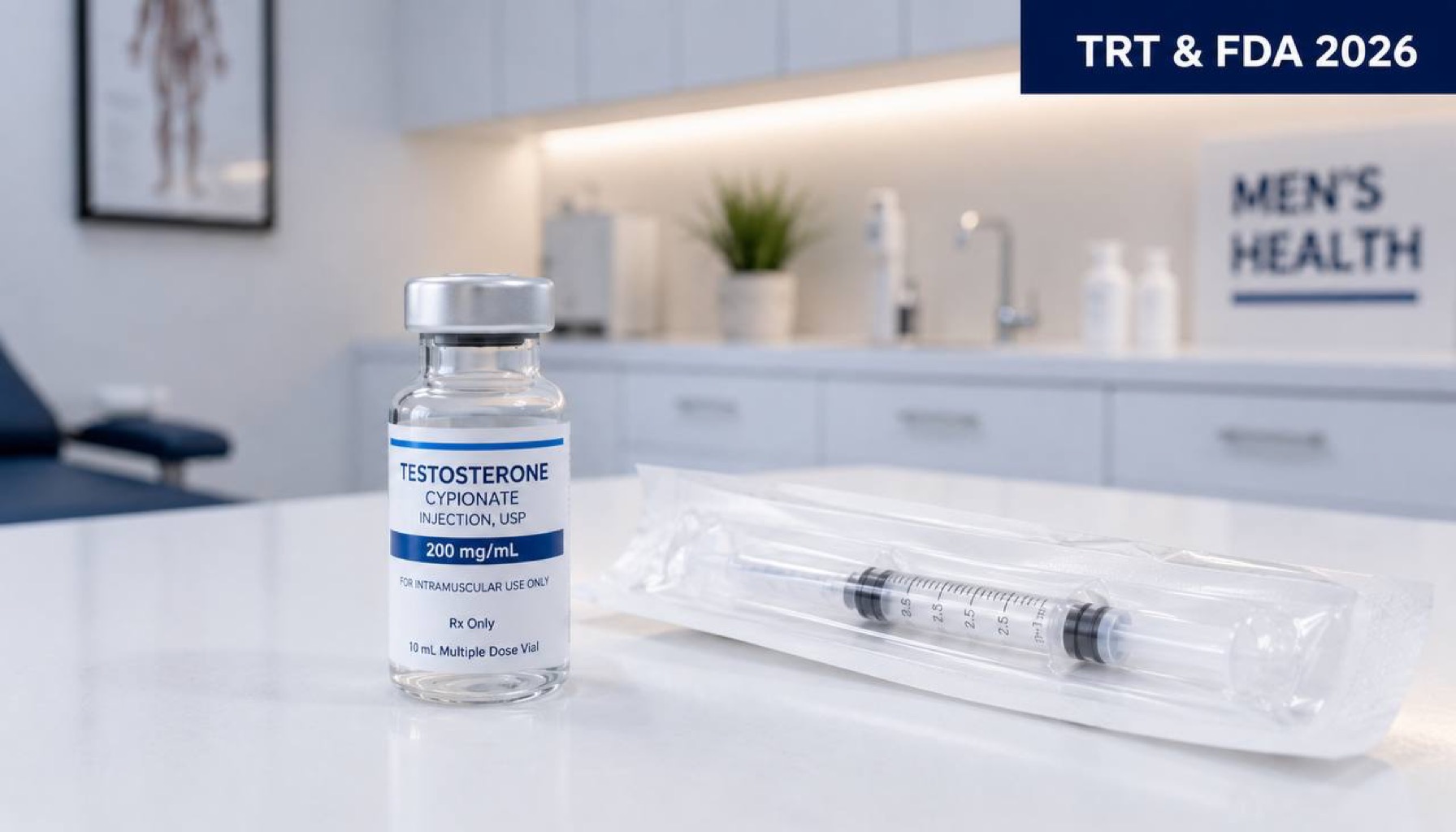
- The FDA Federal Register notice — what it actually says
- The Clift 2026 cohort — 9,537 men, 12 months
- TRAVERSE and JCEM substudy — the cardiovascular and libido picture
- Oral vs. injectable — how KYZATREX fits
- Enclomiphene — the fertility-preserving alternative
- Surgical and thromboembolic risk — the data that warrants caution
- A tiered framework
- References
Testosterone replacement therapy (TRT) has existed in a regulatory grey zone for decades. Approved indications have historically required classical hypogonadism — low testosterone from a diagnosable organic cause, usually testicular failure or hypothalamic-pituitary pathology. Millions of men with low-normal testosterone, low libido, and no clear structural cause have been caught between a clinical problem and an indication their doctor couldn't officially support.
The Food and Drug Administration (FDA) moved the goalposts in April 2026. Docket No. FDA-2025-N-6743 — a Federal Register notice — formally invited pharmaceutical sponsors to pursue a new indication: testosterone replacement for idiopathic hypogonadism with low libido. This is not an approval. It is an invitation to submit. But regulatory invitations of this kind are how entire drug classes pivot from off-label use to mainstream medicine. The signal is worth reading carefully.
The FDA Federal Register notice — what it actually says
Published in Vol. 91, No. 75 of the Federal Register on April 20, 2026, Docket No. FDA-2025-N-6743 represents the FDA's acknowledgment that the idiopathic hypogonadism category — men with documented low testosterone and symptomatic low libido without an identifiable organic cause — is clinically meaningful and underserved by existing label language [1].
The notice does not mandate sponsors to file. It does not pre-approve anything. What it does is reduce regulatory uncertainty: sponsors submitting an NDA (new drug application) or sNDA (supplemental new drug application) targeting this population now have explicit guidance on what the FDA considers an approvable endpoint framework. In practical terms, this lowers the development-risk calculation for sponsors who have been sitting on strong clinical datasets and waiting for a regulatory green light.
The clinical hook here is libido specifically — not energy, not body composition, not bone mineral density. That distinction is deliberate. It keeps the indication narrow enough to be defensible in a risk-benefit framework while addressing the symptom that most consistently drives men to seek TRT outside of classical hypogonadism criteria in the first place.
Idiopathic hypogonadism is the diagnosis when: total testosterone is below the laboratory reference range (typically <300 ng/dL), symptoms are present, and workup has ruled out structural causes — no Klinefelter syndrome, no pituitary lesion, no primary testicular failure with clear etiology. These men represent a large portion of TRT users in clinical practice, but historically could not access an on-label prescription in many jurisdictions. The FDA notice acknowledges this population explicitly for the first time.
The commercial and clinical downstream effects are real. If sponsors pursue the new indication, TRT products will carry label language directly addressing libido in low-testosterone men without organic pathology. That changes insurance coverage conversations, prescribing confidence, and the legal exposure calculation for clinicians in conservative practice environments.
The Clift 2026 cohort — 9,537 men, 12 months
The regulatory notice landed alongside the largest real-world TRT outcomes dataset published to date. Clift, Johnson, Huang, and Morgentaler published a longitudinal retrospective cohort study in the World Journal of Men's Health in April 2026 — 9,537 men, median age 42, followed for 12 months on TRT [2].
The study's design is important context. Retrospective cohorts are not randomized controlled trials. They are susceptible to selection bias — men who stay on therapy tend to be the ones doing well on it. With that acknowledged, the scale of the dataset and the length of follow-up provide something the earlier TRT literature frequently lacked: a real-world safety and quality-of-life picture at one year across a patient population that looks like actual clinical practice, not a trial-enrollment filter.
The key findings at 12 months were positive on quality-of-life measures — including sexual function and libido — with a safety profile consistent with the TRAVERSE randomized controlled trial (RCT) data [3]. Major adverse cardiovascular events (MACE) were not elevated compared to the untreated comparator group at the 12-month horizon. Erythrocytosis (elevated red blood cell mass, a known TRT effect) was the most clinically relevant hematologic signal and tracked with expectations from prior literature.
What the Clift cohort adds to the existing evidence base is the median-age-42 profile. Prior landmark TRT trials — including the Testosterone Trials (T Trials) from Snyder and Bhasin [10] — enrolled substantially older men, often 65+. The real-world TRT user in 2026 is not a 70-year-old with classical hypogonadism. He is in his early 40s, often symptomatic without organic pathology, and making decisions based on a literature that was largely not built around him. The Clift cohort is the first large-scale data point that actually reflects that population.
The median TRT user in 2026 is 42, not 70. The regulatory shift finally acknowledges the patient population that was already there.
TRAVERSE and JCEM substudy — the cardiovascular and libido picture
The TRAVERSE (Testosterone Replacement therapy for Assessment of long-term Vascular Events and efficacy ResponSE) trial, published in the New England Journal of Medicine in 2023, remains the definitive cardiovascular safety dataset for TRT [3]. TRAVERSE enrolled over 5,200 men aged 45–80 with hypogonadism and elevated cardiovascular risk, randomized to testosterone gel or placebo, followed for a mean of 33 months.
The MACE (major adverse cardiovascular events — the composite of cardiovascular death, nonfatal myocardial infarction, and nonfatal stroke) finding was noninferiority for TRT versus placebo. That settled, for practical purposes, the long-standing concern that testosterone therapy accelerates heart attacks and strokes in the population studied. That debate had been driving overly cautious prescribing for over a decade; the TRAVERSE data effectively closed it in high-cardiovascular-risk men.
What the TRAVERSE principal analysis did not resolve cleanly: atrial fibrillation (AF) and pulmonary embolism (PE) were both statistically higher in the TRT arm [3]. AF incidence was 3.5% in the TRT group versus 2.4% in placebo. PE incidence was 0.9% versus 0.5%. Neither of these is trivial, and neither cancels the MACE noninferiority finding — but they represent a cardiovascular signal that belongs in every informed-consent conversation for TRT, particularly in men who already carry AF or clotting risk.
The Journal of Clinical Endocrinology & Metabolism (JCEM) published the TRAVERSE sexual function substudy in 2024 [4]. In men who had documented low sexual desire at baseline, TRT produced statistically significant and clinically meaningful improvement in sexual desire scores. This is the direct clinical evidence underpinning the FDA's libido-indication notice. The agency is not operating in a vacuum — the TRAVERSE substudy gave regulators the randomized trial data to point to when asking sponsors to build the new indication around libido as the primary endpoint.
The T Trials (Testosterone Trials), the earlier multi-site placebo-controlled trial from Snyder, Bhasin, and Cunningham [10], established the foundational picture in older men: TRT improved sexual function, bone mineral density, and walking distance, with a more equivocal picture on cognitive outcomes. The T Trials enrolled men 65 and older with testosterone below 275 ng/dL — a different population from the 2026 clinical reality, but a foundational dataset for understanding the physiological effects.
Oral vs. injectable — how KYZATREX fits
The TRT delivery landscape has changed materially over the past five years. The dominant options — injectable testosterone cypionate or enanthate, transdermal gels, and transdermal patches — are now joined by oral testosterone undecanoate in a lipid-based formulation (brand name: KYZATREX).
The older oral testosterone products failed commercially and clinically because testosterone is extensively metabolized in the liver on first pass, and early oral formulations either required fatty meal co-administration for unpredictable absorption or carried hepatotoxic risk. KYZATREX solves the absorption problem via a self-emulsifying drug delivery system that routes the hormone through lymphatic absorption rather than portal circulation, substantially reducing first-pass hepatic metabolism.
The phase 3 single-arm trial for KYZATREX (Bernstein and Dhingra, Therapeutic Advances in Urology, 2024) reported that 87.8–96.1% of men achieved eugonadal testosterone levels (defined as total testosterone within the 300–1,000 ng/dL range) across the dose range studied [5]. Twice-daily dosing with a meal is required, and dose titration is needed to find the level that keeps a given patient in range without overshooting.
The practical comparison to injectables: KYZATREX produces more stable serum testosterone levels without the weekly or biweekly peak-and-trough cycle that injectable testosterone cypionate generates. The trough after an injection — particularly in men on longer injection intervals — can drop below eugonadal range before the next dose. Some men find that trough the most symptomatic period. Oral testosterone eliminates that pattern but introduces twice-daily pill burden, food requirements, and cost.
Transdermal gel remains the modal TRT delivery method in clinical practice — convenient, adjustable, no injection barrier — but skin transfer to partners and children is a documented risk that clinical guidelines flag. Injectables, at self-administered subcutaneous dosing (a community-adapted protocol rather than the original intramuscular standard), have become the cost-effective backbone of TRT for men willing to handle needles. KYZATREX positions itself in the middle: no injection, stable levels, higher cost than generic injectables.
Community use of subcutaneous testosterone injections (typically 50–100 mg testosterone cypionate 1–2×/week) has driven more consistent pharmacokinetics than intramuscular injections because of slower, more even absorption. The needle is not the obstacle it was treated as five years ago. A man willing to self-inject has access to the most cost-effective, predictable TRT delivery available. Oral testosterone is a genuine option for men who won't inject — it is a convenience-for-some-efficacy-uncertainty trade, not a strict upgrade.
One note for men currently using GLP-1 (glucagon-like peptide-1) receptor agonists for weight management: GLP-1 therapies — semaglutide, tirzepatide, retatrutide — produce significant weight loss but carry a lean mass cost of 20–40% of total weight lost, with facial volume and skeletal muscle among the affected compartments. If you're a GLP-1 user considering TRT, the testosterone-and-lean-mass equation is a specific conversation to have with your prescribing clinician. TRT's anabolic signaling can attenuate lean mass loss during GLP-1-driven caloric restriction — but it requires deliberate stack design, not an afterthought. See our GLP-1 era article for the full lean-mass picture.
Enclomiphene — the fertility-preserving alternative
Exogenous testosterone shuts down the HPG (hypothalamic-pituitary-gonadal) axis. When you administer testosterone from the outside, the hypothalamus reads the systemic level as sufficient and stops signaling the pituitary to release LH (luteinizing hormone) and FSH (follicle-stimulating hormone). LH and FSH are what tell the testes to produce both testosterone and sperm. The result: exogenous TRT produces azoospermia (absence of sperm in semen) or severe oligospermia in most men within weeks to months. Men on TRT who want to preserve fertility face a direct conflict between treating their hypogonadism and maintaining reproductive capacity.
Enclomiphene citrate — the trans-isomer of clomiphene — is the clean answer to that conflict. It is a selective estrogen receptor modulator (SERM) that blocks estrogen's negative feedback signal at the hypothalamus, prompting increased GnRH (gonadotropin-releasing hormone) pulse frequency, which drives LH and FSH release, which stimulates endogenous testosterone production and spermatogenesis — all without suppressing the HPG axis.
Wiehle et al. published the pivotal RCT comparing enclomiphene to topical testosterone in Fertility and Sterility in 2014 [6]. Enclomiphene raised serum testosterone into the eugonadal range while maintaining sperm counts. Topical testosterone raised testosterone while reducing sperm counts. The differential was stark and clinically meaningful for any man in or near a reproductive window.
Kim and colleagues replicated and extended this finding in BJU International in 2016, specifically in obese hypogonadal men [7]. Enclomiphene raised testosterone and preserved sperm counts in that subgroup, while topical testosterone suppressed spermatogenesis. The obese hypogonadal male — aromatase-heavy adipose tissue converting testosterone to estradiol, HPG axis suppressed by the resulting hyperestrogenism — is a common clinical picture, and enclomiphene's mechanism addresses it directly by unblocking the feedback axis rather than bypassing it.
The trade-off with enclomiphene: it does not raise testosterone as high as exogenous testosterone in most men, and its effects are dependent on intact testicular function. Men with primary hypogonadism (testicular failure) will not respond because the problem is downstream of the HPG signaling enclomiphene restores. For secondary and idiopathic hypogonadism, enclomiphene is a legitimate first-line option — particularly now that the FDA's new indication notice has named idiopathic hypogonadism as a regulatory target. The question of whether enclomiphene qualifies as TRT under the new indication framework is one that sponsors will need to clarify.
As of 2026, enclomiphene is available off-label in the United States through compounding pharmacies and select TRT clinics. It is not FDA-approved for hypogonadism — the original NDA was not pursued to completion — but clinical use is widespread enough that a prescribing physician comfortable in this space will have protocol experience with it. For a full walkthrough of the pharmacology, Phase 3 data, and HCG combination rationale, see our enclomiphene + HCG deep-dive.
Surgical and thromboembolic risk — the data that warrants caution
The thromboembolic signal in TRT is real and deserves direct treatment. It shows up in three separate datasets, and dismissing it because MACE was noninferior in TRAVERSE would be a mistake.
First: TRAVERSE itself. PE was statistically elevated in the TRT arm (0.9% vs. 0.5%), as was AF. These are absolute risk numbers that look small in a clinical trial but translate to material additional cases when multiplied across the scale of real-world TRT use [3].
Second: a 2025 study in the Journal of Arthroplasty (PubMed ID: 41276233) examined men who underwent total knee arthroplasty (TKA) and were on TRT preoperatively [8]. Preoperative TRT was associated with PE odds ratio (OR) of 1.4 at 90 days and deep vein thrombosis (DVT) OR of 1.4 at one year compared to non-TRT controls. This is a peri-surgical context, not a general population estimate, but it is clinically critical: TRT users who are planning orthopedic or other major surgery need a protocol for preoperative discontinuation — and the risk window is not just the day of surgery.
Third: Cannarella et al. published a systematic review and meta-analysis in Asian Journal of Andrology in 2024, pooling available TRT and vascular thromboembolic event data [9]. The meta-analysis confirmed a modestly elevated VTE (venous thromboembolism) risk on TRT. The magnitude was consistent with TRAVERSE's PE finding and the arthroplasty data — not catastrophic, but real, and concentrated in men with additional clotting risk factors (obesity, polycythemia, sedentary lifestyle, prior VTE history).
The mechanistic explanation is hematologic. Testosterone stimulates erythropoiesis — red blood cell production — via EPO (erythropoietin) upregulation and direct bone marrow signaling. Elevated hematocrit increases blood viscosity and clotting risk. The clinical response is hematocrit monitoring (typically at 3 and 6 months after initiation, then annually) and dose reduction or temporary discontinuation if hematocrit exceeds 54%. Men who donate blood while on TRT are, incidentally, using a practical hematocrit management tool that clinical practice rarely formalizes.
The bottom line on VTE risk: it is the strongest non-MACE safety signal in the TRT literature, it is amplified in the peri-surgical window, and it is manageable with monitoring and dose control. It is not a reason to avoid TRT in appropriate candidates. It is a reason to take hematocrit tracking seriously and to have an explicit preoperative discontinuation plan. Men with concurrent insulin resistance or elevated metabolic risk carry additional clotting load and warrant closer monitoring intervals.
A tiered framework
We do not write protocols. What follows is a framework — take it to a clinician who knows this space.
If your testosterone is low-normal (250–350 ng/dL) and symptoms are mild, the evidence-based first step is structured resistance training, sleep optimization, body fat reduction, and alcohol reduction — all of which raise endogenous testosterone meaningfully. Get a complete hormonal workup (total and free testosterone, LH, FSH, SHBG, estradiol, prolactin, thyroid panel) before considering exogenous intervention. Many men find their testosterone moves substantially without TRT once the obvious suppressors are addressed.
For men with confirmed idiopathic hypogonadism and documented low libido who have addressed lifestyle factors: enclomiphene is the first-line option if reproductive capacity is a current or near-term consideration. For men who are done with reproduction, low-dose testosterone cypionate (50–100 mg/week subcutaneous) with hematocrit, PSA (prostate-specific antigen), and lipid monitoring is the most cost-effective, evidence-backed approach. KYZATREX is a legitimate alternative for men who will not self-inject and can manage the food requirement.
For men who have completed the standard approach and want to optimize within TRT: frequent dosing (e.g., 2×/week injectable) for stable levels, hematocrit checked every 3 months, blood donation protocol if hematocrit trends high, estradiol management with anastrozole only if symptomatic hyperestrogenism is confirmed (not prophylactically), and annual PSA surveillance. Men on concurrent GLP-1 therapy should have a deliberate lean-mass retention plan — TRT's anabolic signal is relevant here. Aggressive does not mean unmonitored — it means maximally tracked.
If you are on TRT and planning any major surgery, the 2025 arthroplasty data [8] and the meta-analytic VTE signal [9] make a preoperative discontinuation conversation non-optional. The standard practice recommendation is to discontinue TRT 4–6 weeks before elective surgery in men with additional VTE risk factors, with the specific window adjusted for delivery method (injectable testosterone cypionate has a longer clearance time than transdermal gel or oral forms). Your surgeon and your prescribing clinician need to coordinate on this. It is not enough to tell one and not the other.
What the 2026 moment actually changes
The FDA Federal Register notice does not put testosterone in a different pharmacological category. It does not alter the existing safety profile. What it changes is the regulatory architecture around a patient population that already exists — millions of men with low testosterone, documented libido complaints, and no organic cause who have been making decisions in a grey zone.
The combination of the notice, the Clift 2026 real-world cohort [2], and the TRAVERSE sexual function substudy [4] creates a convergence: regulatory signal, real-world safety data, and randomized libido-endpoint evidence all pointing in the same direction at the same time. That is not a coincidence. It is what pharmaceutical sponsors and regulators watch before committing resources to a formal indication build.
The practical effect for men in 2026: prescribing access is likely to improve in the next 12–24 months as sponsors respond to the FDA signal. Insurance coverage for idiopathic hypogonadism with low libido — currently inconsistent and often denied — will shift if an approved indication with that label language exists. Clinicians in conservative practice environments will have cleaner regulatory backing for what many were already doing.
None of that changes the underlying risk picture. The AF and PE signals from TRAVERSE [3], the VTE signal from the arthroplasty literature [8] and meta-analysis [9], and the HPG axis suppression from exogenous testosterone are not regulatory artifacts — they are pharmacology. The framework applies regardless of what the indication label says.
References
- FDA Federal Register, Docket No. FDA-2025-N-6743. "Potential New Indication for Testosterone Replacement Therapy." Vol. 91, No. 75. Published April 20, 2026.
- Clift AK, Johnson H, Huang DR, Morgentaler A. "Real-World Outcomes and Safety of Testosterone Therapy: A Longitudinal, Retrospective Cohort Study of Over 9,000 Men." World Journal of Men's Health. April 2026. DOI: 10.5534/wjmh.250245.
- Lincoff AM, Bhasin S, et al. "Cardiovascular Safety of Testosterone-Replacement Therapy." N Engl J Med. 2023;389(2):107–117. (TRAVERSE trial)
- Pencina KM, Travison TG, Cunningham GR, et al. "Effect of Testosterone Replacement Therapy on Sexual Function and Hypogonadal Symptoms." J Clin Endocrinol Metab. 2024;109(2):569–580.
- Bernstein JS, Dhingra OP. "A phase III, single-arm, 6-month trial of a wide-dose range oral testosterone undecanoate product." Ther Adv Urol. 2024. DOI: 10.1177/17562872241241864.
- Wiehle RD, et al. "Enclomiphene citrate stimulates testosterone production while preventing oligospermia." Fertil Steril. 2014;102(3):720–727.
- Kim ED, et al. "Oral enclomiphene citrate raises testosterone and preserves sperm counts in obese hypogonadal men, unlike topical testosterone." BJU Int. 2016;117(4):677–685.
- "Preoperative Testosterone Replacement Therapy Is Associated With Increased Complication Risk After Total Knee Arthroplasty." J Arthroplasty. 2025. PubMed ID: 41276233.
- Cannarella R, et al. "Testosterone replacement therapy and vascular thromboembolic events: a systematic review and meta-analysis." Asian J Androl. 2024;26(2):144–154.
- Snyder PJ, Bhasin S, Cunningham GR, et al. "Effects of Testosterone Treatment in Older Men." N Engl J Med. 2016;374(7):611–624. (Testosterone Trials)