Tretinoin vs copper peptides: which one actually earns a place in your anti-aging routine
Put these two side by side and you are really comparing two different philosophies of skincare. Tretinoin is the prescription heavyweight — a vitamin-A derivative with decades of randomized trials, FDA approval for photoaging, and a genuine ability to rebuild collagen and reset how fast skin renews itself. Copper peptides (GHK-Cu) are the gentle challenger — a cosmetic signaling ingredient with a compelling wound-healing story, some collagen data, and a tolerability profile that tretinoin can only dream of. The internet loves to frame this as a fair fight, or worse, to sell copper peptides as a “retinoid without the downside.” It is not a fair fight on evidence, and it is not a clean swap. This is the honest head-to-head: what each one is, why the evidence gap between them is so large, whether you can layer both, who should reach for which, and the verdict that the studies actually support. If you want the full single-ingredient stories, we have separate deep-dives on tretinoin and copper peptides — this piece is the decision layer that sits on top of both.
How this article was built: Primary sources: the Weiss et al. 1988 double-blind vehicle-controlled tretinoin photoaging trial in JAMA, the Griffiths et al. 1993 collagen-restoration study in the New England Journal of Medicine, the Griffiths et al. 1995 tretinoin dose-comparison trial in the Journal of the American Academy of Dermatology, the Mukherjee et al. 2006 retinoid review in Clinical Interventions in Aging, and the Pickart 2008 Journal of Biomaterials Science and Pickart & Margolina 2018 International Journal of Molecular Sciences reviews of GHK-Cu — all retrieved and verified through PubMed, with the copper-peptide sources’ industry links flagged in the text.
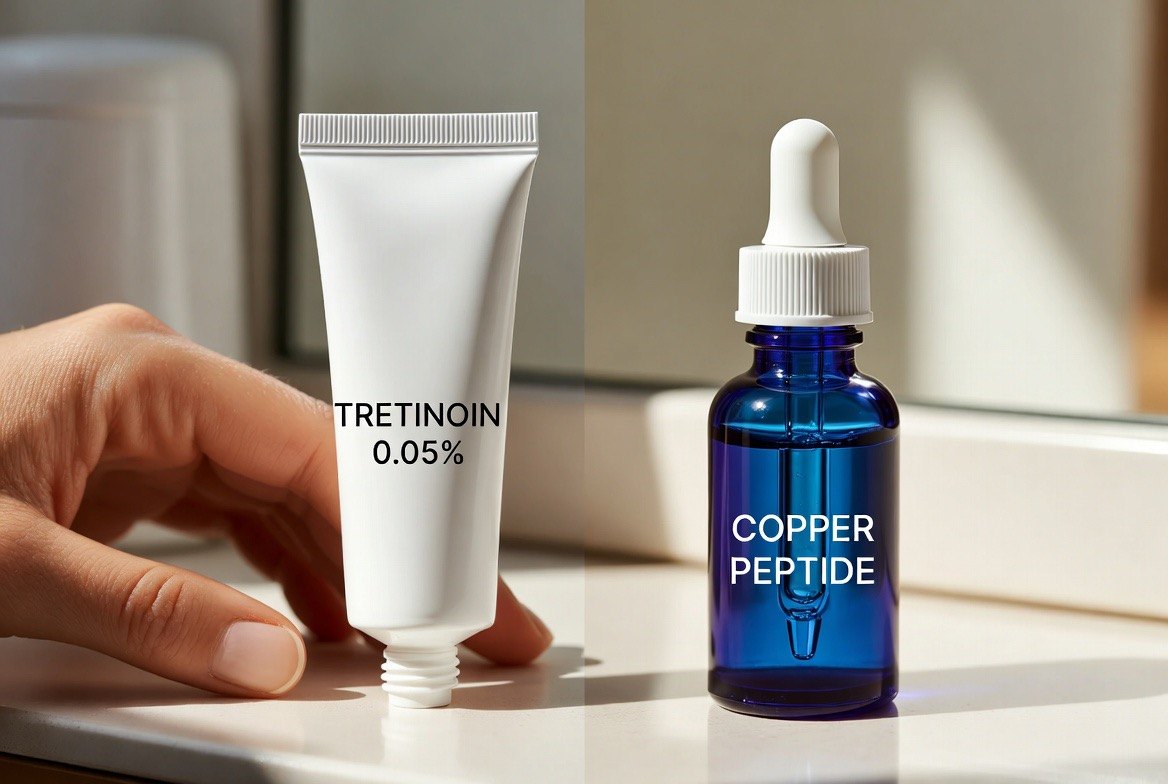
- Tretinoin wins on evidence, decisively. It is a prescription vitamin-A retinoid with decades of randomized controlled trials (RCTs, the gold-standard trial design) and FDA approval for photoaging; it measurably rebuilds collagen and smooths wrinkles.12
- Copper peptides (GHK-Cu = the copper tripeptide glycyl-L-histidyl-L-lysine) are the gentler option, with a thinner and more industry-linked evidence base — real signaling and wound-healing biology, far fewer and smaller human anti-wrinkle trials.56
- The trade-off is potency vs tolerability. Tretinoin irritates, purges, needs a slow ramp and daily sunscreen; GHK-Cu is calm enough for sensitive skin. That gentleness is the copper peptide’s real selling point — not superior results.
- You can often use both, and pregnancy is the clean tiebreaker. Layer them with sequencing and separation; retinoids are off-limits in pregnancy and breastfeeding, which is exactly where a gentle GHK-Cu serve becomes a genuine alternative.
What each one actually is
Start with the basics, because these two ingredients are not even in the same regulatory category. Tretinoin — also called all-trans retinoic acid — is a prescription retinoid, meaning a vitamin-A derivative that binds directly to receptors inside skin cells and tells them what to do. It is a drug, not a cosmetic. In the United States and much of the world you cannot buy it over the counter (OTC = over-the-counter, available without a prescription); you need a clinician to prescribe it. That gatekeeping exists precisely because it is potent enough to have real effects and real side effects.
Copper peptides, in the form most people mean, are GHK-Cu — the copper tripeptide glycyl-L-histidyl-L-lysine bound to a copper ion. It is a naturally occurring fragment of a larger protein, first isolated from human plasma, and in skincare it is a cosmetic ingredient, not a drug. You can buy a GHK-Cu serum off the shelf. It works by signaling — nudging cells toward repair behaviors — rather than by forcing a receptor-level command the way tretinoin does. That single distinction, drug versus cosmetic signal, drives almost everything else in this comparison: the evidence, the potency, the side effects, and who each is right for.
It is worth being explicit about what this article is not. It is not a from-scratch teardown of either ingredient; the site already has those. If you want the full mechanism, dosing, and formulation story on the retinoid, read the tretinoin deep-dive. For the complete copper-peptide picture, the GHK-Cu deep-dive and our broader copper peptides evidence review cover it. What follows is the layer those pieces don’t: which one wins, when, and whether you have to choose at all.
Mechanism: rebuild vs signal
The cleanest way to hold these two apart is to think of tretinoin as a rebuilder and GHK-Cu as a signaler.
Tretinoin rebuilds by command. Once absorbed, it binds nuclear retinoic-acid receptors and directly changes gene expression in keratinocytes and fibroblasts. In practice that means three things: it accelerates cell turnover so the outer layer renews faster, it normalizes how skin cells mature and shed, and — the part that matters most for aging — it stimulates fibroblasts to lay down new collagen while dialing back the enzymes that break collagen down. This is not a soft nudge; it is a receptor-level instruction, which is why the effects are large and the irritation is real. Griffiths and colleagues showed this concretely: in photodamaged skin, tretinoin measurably restored the formation of type I collagen that ultraviolet damage had depleted.2 That is the mechanism behind the wrinkle-smoothing everyone associates with retinoids.
GHK-Cu signals repair. The copper tripeptide behaves less like a drug and more like a messenger the body already uses. The foundational work by Pickart frames GHK-Cu as a tissue-remodeling molecule: it attracts repair cells to a site, damps inflammation, and stimulates fibroblasts to produce collagen, elastin, and glycosaminoglycans — the scaffolding and cushioning of the dermis.5 A later, gene-level review argued GHK-Cu influences a strikingly broad set of pathways, resetting gene-expression patterns toward a younger, more regenerative state and supporting wound healing across many tissue types.6 On paper this is genuinely interesting biology, and it overlaps with tretinoin on one key output: both can push fibroblasts to make more collagen.
But note the asymmetry hiding inside that overlap. Tretinoin’s collagen effect is documented in controlled human skin biopsies; GHK-Cu’s is strongest in cell-culture and wound-healing models, with human cosmetic data that is thinner and softer. Same headline — “stimulates collagen” — very different weight of proof behind it. That is the crux of the whole comparison, and it deserves its own section.
Both ingredients can “stimulate collagen.” Only one has proven it in decades of controlled human trials. The other has a compelling mechanism and a fraction of the evidence — and the marketing quietly treats those as equal.
The evidence gap — and it’s a big one
This is where the head-to-head stops being close. Tretinoin’s anti-aging claim is one of the best-supported in all of dermatology — a STRONG grade — and copper peptides’ is EMERGING at best. Pretending otherwise is the single most common mistake in the copper-peptide-versus-retinoid conversation.
Tretinoin’s case. The modern evidence starts in the late 1980s and never really stops. Weiss and colleagues ran a 16-week double-blind, vehicle-controlled trial (“vehicle-controlled” means the comparison was the identical cream base minus the active) and found statistically significant improvement in photoaging on tretinoin-treated skin but not on the vehicle-treated side.1 Griffiths then showed the mechanism underneath that clinical result — restored collagen formation in photodamaged skin.2 A dose-comparison RCT established that even lower concentrations delivered meaningful photoaging improvement with less irritation, giving clinicians a way to titrate the trade-off.3 By the time Mukherjee and colleagues reviewed the field in 2006, the verdict was settled: tretinoin was described as arguably the most potent and certainly the most thoroughly investigated retinoid for photoaging.4 Layered on top of that literature is FDA approval for photoaging — a regulatory bar that requires exactly this kind of replicated, controlled proof.
Copper peptides’ case. The GHK-Cu literature is real, but it is a different animal. Its strongest pillars are mechanistic and wound-healing reviews — how the molecule behaves in cells and injured tissue — rather than large, independent, randomized anti-wrinkle trials.56 The human cosmetic studies that do exist tend to be small, short, and frequently connected to the people or companies commercializing the ingredient. That last point is not a smear; it is a fact worth stating plainly. Much of the foundational and review work on GHK-Cu traces back to Loren Pickart, who discovered the peptide and holds patents and commercial interests around it. Industry-linked research is not automatically wrong — but it is exactly the kind of evidence that needs independent replication before it can carry the weight of a tretinoin-level claim, and that independent, large-scale replication has not accumulated.
So the honest scoreboard: for wrinkles and photoaging, tretinoin has decades of controlled human data and a regulator’s sign-off; copper peptides have promising biology, a handful of small and often conflicted human studies, and a lot of extrapolation. That is not a tie. It is why the claim “tretinoin is more potent and better-evidenced than copper peptides” earns at least a MODERATE-to-STRONG grade, and why the reverse claim earns HYPE.
photoaging RCTs
plus FDA approval
vs cosmetic GHK-Cu
drug vs signal
ramp & purge
GHK-Cu needs none
Potency vs tolerability
If evidence were the only axis, this article would end here. But skincare lives or dies on whether people can actually use a product, and on that axis the two ingredients trade places completely.
Tretinoin is potent and it makes you feel it. The classic pattern is a few weeks of dryness, flaking, redness, and stinging as skin adapts — sometimes with an early “purge,” a temporary uptick in breakouts as the accelerated turnover pushes already-forming clogs to the surface. Managing tretinoin is a skill: start low-strength and infrequent (a couple of nights a week), buffer with moisturizer, build up slowly, and — non-negotiably — wear daily broad-spectrum sunscreen, because retinized skin is more sun-sensitive and the whole point is to protect the collagen you are trying to build. The dose-comparison data exist precisely because that irritation is dose-dependent and worth titrating.3 For a meaningful slice of people — sensitive skin, rosacea-prone skin, eczema-prone skin — the irritation is the deal-breaker, no matter how good the evidence is.
GHK-Cu is gentle, and that is the whole point. Copper peptides do not typically cause the ramp, the purge, or the flaking. They are calm enough that sensitive and reactive skin usually tolerates them without a slow introduction, and there is a plausible barrier-supportive angle to their repair biology. This is the copper peptide’s genuine, defensible advantage — not that it out-performs tretinoin, but that it can be used comfortably by people for whom tretinoin is misery. In the tolerability column, GHK-Cu wins as decisively as tretinoin wins the evidence column. Recognizing that the two are winning different contests is the key to using them intelligently. If barrier comfort is your priority, our reads on ceramides and azelaic acid cover other gentle, well-tolerated actives in the same conversation.
Can you use both? Sequencing and cautions
Here is the good news the “either/or” framing misses: for many people the smartest answer is not to choose. Tretinoin and GHK-Cu target overlapping goals through different routes, and their profiles are complementary — one potent but irritating, the other gentle and barrier-friendly. Using the copper peptide alongside a retinoid to support comfort and repair is a reasonable, popular strategy. We grade the combination EMERGING rather than STRONG only because there is little formal trial data on the pairing itself; the rationale is sound, but nobody has run the definitive head-to-head-plus-combination study.
A few practical rules make the pairing sensible:
Separate them in time. The common approach is copper peptides in the morning and tretinoin at night. That keeps the potent, photosensitizing retinoid on its evening schedule and lets the gentle peptide do barrier-supportive work during the day. Alternating nights is another low-friction option while your skin acclimates to the retinoid.
Mind the copper chemistry. This is the one real technical caution, and it is worth stating precisely because it is often overstated. Copper is a reactive metal ion, and there is a long-standing theoretical concern that layering GHK-Cu in the same application with strong antioxidants like high-strength vitamin C (L-ascorbic acid) or with potent acids could destabilize one or both ingredients — the vitamin C potentially reducing the copper, the low pH disrupting the peptide. The evidence that this meaningfully degrades results in real-world routines is thin, but the fix is trivial: don’t layer copper peptides directly on top of a strong vitamin C or a high-concentration acid in the same step. Put them in different parts of the day (peptides AM, acids or C at a separate time), and the theoretical interaction stops mattering. Tretinoin itself is not a strong acid in this sense, so the retinoid-plus-copper-peptide pairing is not the concern — it is the copper-plus-vitamin-C or copper-plus-exfoliating-acid stacking to keep apart.
Don’t pile on all at once. Introduce one active at a time so that if something stings or breaks out, you know which ingredient to blame. Adding a retinoid and a new peptide and a new acid in the same week is how people end up with an irritated barrier and no idea of the cause.
If you want both without overthinking it: copper-peptide serum in the morning under sunscreen, tretinoin at night a few times a week and building up, and keep any strong vitamin C or exfoliating acid in a separate step from the copper peptide. That routine gives you tretinoin’s proven collagen-building power on the schedule it belongs on, plus GHK-Cu’s gentleness and repair signaling — and sidesteps the one real chemistry caution entirely. Our Skin & Aging hub maps how the rest of the actives shelf fits around this core. Browse Skin & Aging →
The pregnancy tiebreaker
There is one scenario where the entire comparison collapses to a single clear answer, and it is important enough to isolate. Retinoids are contraindicated in pregnancy and breastfeeding. Oral retinoids are potent teratogens, and while topical tretinoin’s systemic absorption is low, the standard, cautious clinical guidance is to avoid it entirely during pregnancy and while nursing. That is not a gray area to push against; it is a hard stop.
Which is exactly where copper peptides go from “gentler alternative” to “actually usable option.” A pregnant or nursing person who wants to keep supporting their skin has had their most-evidenced anti-aging tool taken off the table, and GHK-Cu — a gentle cosmetic signaling ingredient — is a reasonable thing to reach for in its place. We grade the “copper peptides as the gentler, retinoid-intolerant-and-pregnancy option” claim MODERATE: the gentleness and general cosmetic-safety profile are well-established, even if large pregnancy-specific efficacy trials do not exist. As always, the responsible move is to clear any product — peptide or otherwise — with your own clinician during pregnancy, because cosmetic-safe is not the same as studied-in-pregnancy. But as a category, this is a real and rare situation where the copper peptide is not the runner-up. It is the pick.
Who should pick which
Strip away the marketing and the fit is genuinely clear-cut.
Reach for tretinoin if your priority is wrinkles, photoaging, sun damage, or texture, and your skin can tolerate an active with a break-in period. If you want the tool with the deepest evidence and the largest effect on the aging endpoints most people care about, this is it, full stop — the trade is that you have to earn the results through the ramp and commit to daily sunscreen.14 It is also the right call for acne-plus-aging, since retinoids work on both.
Reach for copper peptides if you have sensitive, reactive, rosacea-prone, or barrier-compromised skin that retinoids inflame; if you have tried tretinoin and genuinely could not tolerate it; if you are pregnant or breastfeeding and off retinoids; or if you simply want a gentle, low-effort repair-and-support ingredient without a break-in period. GHK-Cu is a reasonable gentler adjunct or, for the retinoid-intolerant, a reasonable alternative — with the honest caveat that it is not an evidence-equal substitute for what tretinoin does to wrinkles.56
Use both if you can tolerate a retinoid but also want the peptide’s comfort and repair signaling — the layering routine above gives you the potency of one and the gentleness of the other, which for a lot of people is the best of the comparison rather than a compromise.
Where copper peptides get oversold
The one HYPE grade in this piece goes to a specific, widespread claim: that copper peptides match or beat tretinoin for wrinkles, and can replace a retinoid entirely. They cannot, on the evidence as it stands.
This overclaim usually rides on two moves. The first is the “stimulates collagen” equivalence — true that GHK-Cu can push fibroblasts toward collagen production in models, but sleight-of-hand to present that as equal to tretinoin’s biopsy-confirmed, decades-replicated collagen restoration in human photoaged skin.26 The second is the “retinoid results without the irritation” pitch, which quietly assumes the results are equivalent and only the side effects differ. In reality it is the results that differ most; the gentleness is real, but it comes precisely because GHK-Cu is a milder signal, not a receptor-level command. Milder means better tolerated and less powerful — you don’t get one without the other.
None of this makes copper peptides bad. A gentle, plausibly barrier-supportive, repair-signaling ingredient with an interesting mechanism is a perfectly good thing to have in a routine, and for some people it is the only tolerable anti-aging option they have. The hype is not that GHK-Cu works — it is the framing that it works as well as or better than the single most-proven anti-ager in dermatology. Judge it as what it is: a good gentle adjunct, not a retinoid replacement.
The honest verdict
Put the two on the same table and the ruling writes itself, as long as you keep the two different contests separate.
On evidence and potency for wrinkles and photoaging, tretinoin wins decisively. Decades of randomized controlled trials, biopsy-level proof that it rebuilds collagen, and FDA approval put it in a class copper peptides do not currently occupy.124 If your goal is the largest, best-proven effect on aging skin and you can tolerate the ramp, it is the pick.
On tolerability and accessibility, copper peptides win. They are gentle, don’t require a prescription, spare sensitive skin the purge-and-flake ordeal, and step in cleanly where retinoids are off the table — most notably in pregnancy. That makes GHK-Cu a reasonable gentler adjunct to a retinoid, and a reasonable alternative for the retinoid-intolerant.56
What it is not is an equal substitute. Copper peptides do not match tretinoin’s anti-wrinkle evidence or potency, and anyone selling them as a retinoid replacement is running ahead of the science. The most honest framing is not “which is better” but “which contest are you trying to win” — and for most people the smartest move is to let each ingredient win the one it is actually built for, in the same routine. For the full single-ingredient evidence, keep going with the tretinoin deep-dive and the GHK-Cu deep-dive, or see how we grade every skin active on the Evidence Radar.
References
- Weiss JS, Ellis CN, Headington JT, Tincoff T, Hamilton TA, Voorhees JJ. Topical tretinoin improves photoaged skin. A double-blind vehicle-controlled study. JAMA. 1988;259(4):527-532. DOI · PMID 3336176
- Griffiths CE, Russman AN, Majmudar G, Singer RS, Hamilton TA, Voorhees JJ. Restoration of collagen formation in photodamaged human skin by tretinoin (retinoic acid). N Engl J Med. 1993;329(8):530-535. DOI · PMID 8336752
- Griffiths CE, Kang S, Ellis CN, Kim KJ, Finkel LJ, Ortiz-Ferrer LC, White GM, Hamilton TA, Voorhees JJ. Two concentrations of topical tretinoin (retinoic acid) cause similar improvement of photoaging but different degrees of irritation. A double-blind, vehicle-controlled comparison of 0.1% and 0.025% tretinoin creams. Arch Dermatol. 1995;131(9):1037-1044. DOI · PMID 7544967
- Mukherjee S, Date A, Patravale V, Korting HC, Roeder A, Weindl G. Retinoids in the treatment of skin aging: an overview of clinical efficacy and safety. Clin Interv Aging. 2006;1(4):327-348. DOI · PMID 18046911
- Pickart L. The human tri-peptide GHK and tissue remodeling. J Biomater Sci Polym Ed. 2008;19(8):969-988. DOI · PMID 18644225
- Pickart L, Margolina A. Regenerative and protective actions of the GHK-Cu peptide in the light of the new gene data. Int J Mol Sci. 2018;19(7):1987. DOI · PMID 29986520