Slippery elm and marshmallow root: do the demulcent herbs actually soothe your gut lining?
Slippery elm (Ulmus rubra) and marshmallow root (Althaea officinalis) are the classic demulcents — herbs whose defining feature is mucilage, a gel-forming soluble fiber that swells in water into a thick, slick coating. The traditional idea is intuitive and hard to argue with in the abstract: swallow that gel and it lays down a soothing film over irritated tissue, from a raw throat to a reflux-inflamed esophagus to a twitchy gut. As a mechanism, coating and physically buffering an inflamed surface is genuinely plausible, and it is the same principle behind medicines you already trust. The problem is that plausible is not the same as proven, and when you go looking for rigorous human trials of these herbs on their own for gut symptoms, there is startlingly little there. Nearly all the encouraging digestive data comes from multi-ingredient combination formulas, and the single best-studied herbal preparation for reflux and IBS-type symptoms — STW-5, sold as Iberogast — contains neither slippery elm nor marshmallow. The strongest isolated-herb evidence is actually for marshmallow calming a dry cough and sore throat, and even that leans heavily on pharmacology and animal work. Here is the cited, evidence-graded read on what demulcents really are, where the coating mechanism holds up, where the human data thins out to almost nothing, and how to use these low-risk herbs sensibly — including the timing rule that stops their mucilage from quietly blunting your other medicines.
How this article was built: Primary sources: the Ried et al. 2020 herbal-formula gut study in Nutrition Research; the Hawrelak & Myers 2010 slippery-elm-containing IBS pilot in the Journal of Alternative and Complementary Medicine; the Ottillinger et al. 2012 and Malfertheiner 2018 reviews of STW-5 (Iberogast) in Wiener Medizinische Wochenschrift and Digestive Diseases, plus the Madisch et al. 2017 phytotherapy systematic review; the Sutovska et al. 2011 and 2009 marshmallow-polysaccharide antitussive studies in Bratislava Medical Journal and the International Journal of Biological Macromolecules; and the Benbassat et al. 2013 marshmallow-lozenge formulation paper in the Pakistan Journal of Pharmaceutical Sciences — all retrieved and verified through PubMed and the Consensus research database.
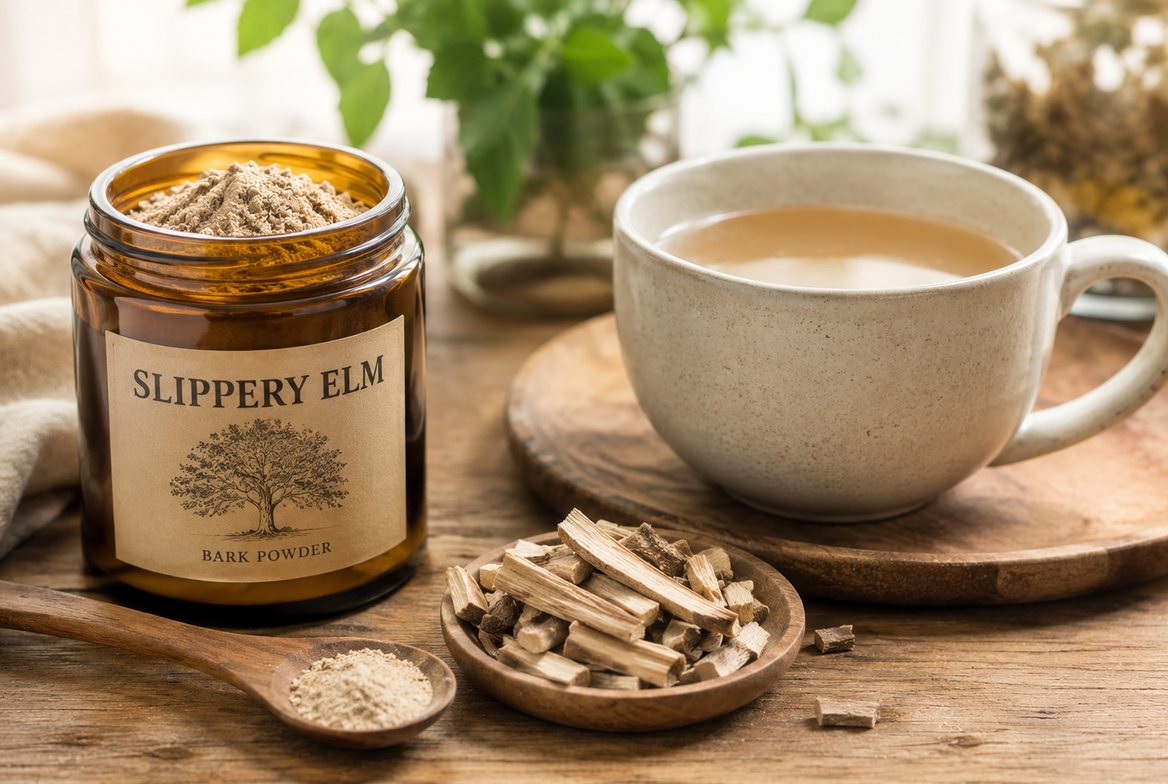
- Demulcents are defined by mucilage. Slippery elm and marshmallow root are rich in mucilage — a soluble fiber that swells in water into a slick gel that can coat mucous membranes. The soothing, coat-and-buffer mechanism is real and plausible, which is exactly why these herbs have been used for irritated throats and guts for centuries.
- The isolated-herb gut trials are almost missing. There is very little rigorous human data on slippery elm or marshmallow alone for reflux or IBS. The encouraging digestive studies use multi-herb combination formulas, so you cannot attribute the benefit to the demulcent itself.12
- The best-studied "herbal reflux/IBS" product contains neither herb. STW-5 (Iberogast) is the phytotherapy with real randomized-trial support for functional dyspepsia and IBS — and it is a nine-herb blend that includes no slippery elm and no marshmallow.34 It is often cited as if it validated demulcents. It does not.
- The cleanest isolated-herb signal is for the throat, not the gut. Marshmallow polysaccharides suppress cough and soothe irritated throat tissue in pharmacology and animal studies, and appear in lozenge and syrup formulations for exactly that.678 These herbs are low-risk — but low-risk is not the same as proven, and "heals leaky gut" is a claim the evidence does not support.
- What demulcents actually are
- The traditional use — and why it makes sense
- Reflux and IBS: the isolated-herb data barely exists
- The Iberogast problem: the winning herb blend has neither
- Sore throat and cough: the cleaner signal
- Forms, dosing, and the timing rule that matters
- Safety and who should be careful
- The hype: "heals your leaky gut"
- The honest verdict
- References
What demulcents actually are
Start with the word, because it explains the whole category. A demulcent is a substance that forms a soothing film over a mucous membrane — the word shares a root with "mollify." What lets slippery elm and marshmallow root do that is mucilage: a family of large, water-loving polysaccharides (long chains of sugars) that, when they meet water, absorb it and swell into a thick, slippery gel. Stir a spoon of slippery elm bark powder into warm water and you can watch it happen — the liquid turns cloudy, viscous, and unmistakably slick. That gel is not a metaphor for the mechanism; it is the mechanism the tradition rests on.
Slippery elm comes from the inner bark of the North American red elm, Ulmus rubra; marshmallow from the root of Althaea officinalis, a mallow-family plant whose Greek name literally means "to heal." Both have been used the same way for a very long time, and both are built around the same active principle. In marshmallow the best-characterized fraction is a polysaccharide called rhamnogalacturonan, isolated from the root's mucilage, which has been the subject of most of the plant's laboratory pharmacology.67 Functionally, this mucilage behaves as a soluble, gel-forming fiber — the same broad class as the soluble fiber in psyllium, though used for coating and soothing rather than for stool bulk or cholesterol binding.
Two implications follow, and they set up everything below. First, because the mucilage is a physical, bulky gel rather than a molecule that has to be absorbed, its plausible action is local and topical — it works by touching the surface it coats, not by entering the bloodstream. That is a point in its favor for throat and upper-gut soothing and a point against grander systemic claims. Second, a gel that coats and binds does not politely restrict itself to inflamed tissue: it can just as easily coat and slow the absorption of a pill you swallowed at the same time. Hold onto that; it becomes the single most practical safety rule in the article.
The traditional use — and why it makes sense
The traditional indications for demulcents are remarkably consistent across herbal traditions, and they all track the same logic: wherever a mucous membrane is raw, dry, or inflamed, coat it. That means sore and scratchy throats, dry irritating coughs, heartburn and acid reflux, the general category of an "irritated" or "sensitive" stomach, and the crampy, unpredictable bowel of what we now call irritable bowel syndrome (IBS — a functional gut disorder marked by pain, bloating, and altered bowel habits without visible tissue damage). Slippery elm gruel was a folk food for the convalescent and the queasy precisely because it was bland, coating, and easy on an unhappy gut.
As a hypothesis, this is genuinely reasonable, and it deserves credit before the skepticism starts. A protective film over an inflamed esophagus could plausibly blunt the burn of refluxed acid. A soluble gel moving through the colon could plausibly smooth stool consistency and buffer a hypersensitive gut wall. A coating on a raw throat could plausibly reduce the mechanical irritation that triggers a cough. None of this is fringe biology — it is the same principle behind over-the-counter products you already accept. Sucralfate, a prescription ulcer drug, works largely by forming a protective barrier over damaged stomach lining. Alginate reflux remedies form a raft that physically blocks acid. Simple throat lozenges soothe partly by stimulating saliva and coating tissue. Demulcents sit in exactly that conceptual neighborhood.
So the mechanism earns a fair hearing, and we grade it EMERGING — plausible, supported by the physical behavior of the gel and by analogy to accepted barrier agents, but not yet nailed down for these specific herbs by direct human outcome data. The catch, and it is the recurring theme here, is that a sensible mechanism and a long tradition are the beginning of an evidence case, not the end of one. The interesting question is what happens when researchers actually put these herbs into a controlled trial. And that is where the story gets thin.
A demulcent is one of the most intuitive interventions in herbal medicine: coat the sore thing. The frustration is that "obvious" and "demonstrated in a clean human trial" are, once again, two different things.
Reflux and IBS: the isolated-herb data barely exists
Here is the honest and slightly awkward fact at the center of this article: for slippery elm or marshmallow root taken on their own, for reflux or IBS, well-controlled human trials essentially do not exist. This is not a case of "the evidence is mixed." It is closer to "the evidence has barely been generated." What does exist is a small body of studies on combination formulas that happen to contain one of these herbs among several others — and that design makes it impossible to credit the demulcent specifically.
Consider the strongest-looking positive study. A 2020 pre-post trial in Nutrition Research tested a "Gut Relief" herbal formula in 43 Australian adults with digestive disorders and reported large improvements — 60–80% reductions in the frequency and severity of upper and lower gut symptoms, better measured intestinal permeability, and a shifted microbiome.1 Slippery elm was in the formula. But so were curcumin, aloe vera, guar gum, pectin, peppermint oil, and glutamine — seven or more actives at once. Worse for causal inference, the study had no placebo control and no blinding; it simply measured people before and after. In a symptom-driven condition where expectation alone routinely produces 40%+ improvement, an open-label combination product tells you almost nothing about whether the slippery elm did anything, let alone whether it did it by coating.
The IBS picture is the same shape. A 2010 pilot study tested two herbal formulas for IBS, both of which contained slippery elm bark, and reported meaningful reductions in straining, abdominal pain, bloating, and global symptoms — genuinely encouraging on the surface.2 But it was an open-label, uncontrolled pilot of 31 people, and the formulas also contained bilberry, agrimony, cinnamon, oat bran, lactulose, and licorice depending on the arm. Lactulose and oat bran alone would be expected to change bowel habit in constipation-predominant IBS, entirely independent of any demulcent effect. The authors themselves framed it as hypothesis-generating and called for further research. It is a reasonable signal that a formula helped some people; it is not evidence that slippery elm relieved IBS, and it is certainly not evidence about mechanism.
That is the whole isolated-herb gut evidence base, more or less: a couple of small, uncontrolled combination-product studies. There is no adequately powered, placebo-controlled, blinded trial of slippery elm alone or marshmallow alone for reflux or IBS symptoms that would let anyone say "this herb, by itself, beat placebo." Given how cheap, safe, and popular these herbs are, that absence is striking — and it is the reason the gut claim lands at WEAK. Not because the herbs were tested and failed, but because they have barely been tested at all in the form that would actually answer the question.
slippery elm or marshmallow alone
for reflux or IBS symptoms
gut formula — no placebo arm
Ried 2020, open-label pre-post
— none are demulcents
the best-studied reflux/IBS phytotherapy
The Iberogast problem: the winning herb blend has neither
There is a persistent piece of confusion worth clearing up directly, because it props up a lot of demulcent marketing. When people argue that "herbal medicine works for reflux and IBS," the study base they are almost always leaning on is STW-5, the multi-herb preparation sold as Iberogast. And STW-5 genuinely has the best evidence in this space: it is the one herbal medicinal product whose efficacy in functional dyspepsia and IBS has been shown in multiple randomized, double-blind, placebo-controlled trials, with a comparable effect to a standard prokinetic drug and a very favorable safety record.34 A systematic review positioned it as a legitimate therapeutic option where conventional prokinetics fell short.5 That is real evidence, and it is fair to respect it.
But here is the point that gets quietly skipped: STW-5 is a fixed combination of nine standardized herbal extracts — bitter candytuft, angelica, chamomile, caraway, milk thistle, lemon balm, celandine, licorice, and peppermint — and not one of them is slippery elm or marshmallow. It contains no demulcent at all. Its proposed mechanism is not coating; it is a "multi-target" combination of anti-spasmodic, prokinetic, acid-modulating, and anti-inflammatory actions on the gut wall.4 So when the strong Iberogast data is invoked to justify a slippery-elm-and-marshmallow product, it is a bait-and-switch: the herbs that were actually tested are absent from the bottle being sold. The successful phytotherapy for reflux and IBS demonstrably does its work by a different route than the demulcent one, using different plants. That does not prove demulcents fail — but it removes the single most-cited crutch propping up the claim that they succeed.
Sore throat and cough: the cleaner signal
Move from the gut up to the throat and the evidence, encouragingly, gets better — which fits the mechanism nicely, because the throat is the surface a swallowed or dissolved demulcent contacts most directly and most immediately. Here marshmallow is the better-studied of the two, and its mucilage has a genuine pharmacology behind it. In a guinea-pig model, the marshmallow-root polysaccharide rhamnogalacturonan produced a clear, dose-dependent suppression of the cough reflex, with the higher dose comparable in effect to codeine — a striking result for a plant mucilage.6 A companion study probing the mechanism found the anti-cough effect appeared to involve serotonergic (5-HT2 receptor) signaling rather than any bronchodilator action, suggesting the polysaccharide is doing something more specific than pure physical coating.7
This has translated into real products designed around exactly that use. Marshmallow-root extract has been formulated into lozenges specifically to treat an irritated oropharyngeal (mouth-and-throat) lining and the associated dry, tickly cough — the lozenge format chosen precisely because slowly dissolving it bathes the throat in mucilage where it is needed.8 Marshmallow syrups and preparations are widely used across Europe for dry cough on this basis. The honest limits still apply: much of the mechanistic evidence is animal and in vitro, large blinded human trials for throat symptoms are limited, and a dry cough is a self-limiting, placebo-sensitive complaint. But the combination of a specific characterized active, a plausible receptor-level mechanism, and use in purpose-built formulations makes the throat-soothing claim the strongest one in the demulcent portfolio. It earns an EMERGING grade that sits at the upper end of that band — and it is telling that the cleanest demulcent signal is for the tissue closest to the mouth, not the gut two metres downstream.
The most useful question with any demulcent product is the same one that trips up the whole category: was this herb tested by itself, and for the tissue you care about? A win in a nine-ingredient "gut formula" cannot be pinned on slippery elm. A cough result in guinea pigs is not a reflux result in people. And the impressive Iberogast trials studied a blend that contains neither of these herbs. The Manual maps the gut and soothing-herb interventions against each other with the evidence graded and the mechanism pinned down — so a claim about "coating the gut lining" gets held to the same standard as a drug. See the Manual →
Forms, dosing, and the timing rule that matters
If you have read this far and still want the practical landscape, here it is — with the standing caveat that "here is how people use them" is not "here is a proven protocol," because the outcome trials to anchor a dose barely exist. Both herbs come in several forms, and the form partly determines whether you are getting the mucilage that supposedly does the work.
Powder (bark or root). The most traditional and, for the coating mechanism, the most sensible: stirred into warm water it produces the full, visible mucilaginous gel. Slippery elm powder is often taken as a teaspoon or two mixed to a gruel or thin paste before meals or when symptoms flare. It must be taken with plenty of water — a concentrated gel-forming fiber swallowed dry is an obvious choking and obstruction risk.
Tea and cold infusions. Marshmallow root is classically prepared as a cold infusion (steeped in cool water for hours) because heat can degrade some of the mucilage; the result is a cloudy, slightly slippery drink. This is a pleasant, low-dose way to bathe the throat and upper gut.
Lozenges. For throat use specifically, lozenges are the logical delivery system — slow dissolution coats the oropharynx directly, which is why marshmallow has been formulated into them.8
Capsules. Convenient, and the form most sold for "gut healing" — but also the one where the mechanism is most questionable. A capsule that only releases its powder deep in the stomach may never form the coherent surface gel that the throat-and-esophagus rationale depends on. If the coating mechanism is the point, a capsule may be the worst way to deliver it.
Now the rule that matters more than any dose. Because mucilage is a bulky, absorptive gel, it can physically trap other substances and slow or reduce their absorption from the gut — the same property that makes it soothing makes it a barrier. That means demulcents can blunt the effect of medications taken at the same time. The standard, sensible precaution is to separate slippery elm or marshmallow from any oral medication by at least a couple of hours, taking the herb well before or well after the drug. This is not exotic; it is the same timing caution that applies to psyllium and other gel-forming fibers, and it is the single most important practical thing to get right.
Safety and who should be careful
The genuinely good news, and the reason a cautious trial of these herbs is defensible, is that both slippery elm and marshmallow root have long records of use and are generally regarded as low-risk when used sensibly. They are food-adjacent, non-absorbed bulk mucilages; the most common real-world complaints are mild and gastrointestinal — a sense of fullness, bloating, or loose stools from the fiber load, or an unappealing texture. Marshmallow-root toxicity studies in animals have found it well tolerated. Neither herb has the kind of alarming interaction or organ-toxicity profile that would make a short, water-with-plenty trial for a sore throat or occasional heartburn unreasonable in a healthy adult.
That said, "low-risk" is not "no-risk," and a few cautions are real. The absorption-blunting property above is the big one for anyone on prescription medication — timing matters, and people on drugs with a narrow therapeutic window should clear it with a pharmacist. Because marshmallow mucilage may modestly affect blood sugar and because the fiber can alter drug uptake, people with diabetes or on tightly-titrated medication should be attentive. Data in pregnancy and breastfeeding is insufficient, so the conservative default there is avoidance without clinician input. Anyone with difficulty swallowing should be careful with thick gels and gruels. And most important of all: demulcents are for soothing symptoms, not for diagnosing their cause. Persistent reflux, trouble swallowing, unexplained weight loss, blood in the stool, or a cough that will not clear are red flags that a coating herb can mask while an underlying condition — some of them serious — goes unaddressed. Soothing is not the same as treating, and comfort is not a diagnosis.
The hype: "heals your leaky gut"
Now the claim to reject cleanly. Slippery elm and marshmallow are routinely marketed as herbs that heal a leaky gut, repair the gut lining, and rebuild the intestinal barrier — language that promises structural, curative change at the level of tissue. There is no controlled human evidence for any of that. The coating mechanism, even taken at its most generous, describes a temporary, topical, physical film sitting on top of a surface — a soothing barrier, not a repair crew. Nothing in the demulcent pharmacology shows these herbs rebuilding tight junctions, reversing measured intestinal permeability on their own, or healing damaged mucosa the way the marketing implies. The one study that reported improved permeability used a seven-plus-ingredient formula with no control group,1 which cannot support a structural claim for any single herb, least of all by the coating route.
This is HYPE in the technical sense: a claim reaching far beyond what the evidence supports, and one that quietly swaps a modest, plausible mechanism (coat and soothe) for a dramatic, unproven one (heal and repair). The subtler version leans on the word "soothing" and lets the reader upgrade it to "healing" on their own. Resist that. It is perfectly fair to say slippery elm or marshmallow may make an irritated throat or gut feel better in the moment, because that is what a coating gel plausibly does. It is not fair, on the current evidence, to say they fix a leaky gut. The correct posture is the unglamorous middle: soothing and low-risk, with a plausible coating mechanism and thin human data, sold with a curative confidence the research has never earned.
The honest verdict
Put it together and demulcents resolve into one of the more likeable entries in the herbal cabinet — and one of the most over-promised. The mechanism is plausible and earns an EMERGING grade: mucilage really does form a slick, coating gel, and coating an inflamed surface is a legitimate way to soothe it, backed by analogy to accepted barrier medicines.8 The gut claim — slippery elm or marshmallow alone relieving reflux or IBS — is WEAK, not because the herbs failed a fair test but because that test has barely been run: the supporting studies are small, uncontrolled, and built on multi-herb formulas, and the best-evidenced reflux/IBS phytotherapy contains neither herb.13 The cleanest real signal is for the throat, where marshmallow's characterized polysaccharide has an actual anti-cough pharmacology and purpose-built formulations — EMERGING, at the stronger end.67 And the "heals leaky gut" pitch is HYPE with no controlled human support behind it.
For a practical bottom line: these are low-risk, inexpensive, pleasant herbs, and a short trial — a cold marshmallow infusion for a scratchy throat, or slippery elm gruel taken with plenty of water for occasional heartburn — is a reasonable, gentle thing to try for mild, self-limiting irritation, provided you keep them well separated from your other medications and do not use them to paper over red-flag symptoms. Just calibrate your expectations to the evidence, not the label: you are buying plausible short-term soothing, not a repaired gut lining. For the deeper, better-evidenced levers on gut symptoms, our coverage of soluble fiber like psyllium, peppermint oil for IBS, L-glutamine for the gut barrier, and digestive enzymes applies the same evidence lens.
This is not medical advice, and the gut is a place where the boundary matters. Whether a demulcent has any role in your reflux, IBS, or throat symptoms — and whether better-evidenced or diagnostic options should come first — is a clinical judgment that belongs with a professional who knows your history, not with a supplement label or an article. Read slippery elm and marshmallow for what they honestly are: soothing, low-risk coating herbs with a sensible mechanism and a human evidence base that has never caught up to the marketing. You can browse the wider evidence base on gut and digestion and our full Evidence Radar for how we grade claims like these.
References
- Ried K, Travica N, Dorairaj R, Sali A. Herbal formula improves upper and lower gastrointestinal symptoms and gut health in Australian adults with digestive disorders. Nutr Res. 2020;76:37-51. DOI · PMID 32151878
- Hawrelak JA, Myers SP. Effects of two natural medicine formulations on irritable bowel syndrome symptoms: a pilot study. J Altern Complement Med. 2010;16(10):1065-1071. DOI · PMID 20954962
- Ottillinger B, Storr M, Malfertheiner P, Allescher HD. STW 5 (Iberogast) — a safe and effective standard in the treatment of functional gastrointestinal disorders. Wien Med Wochenschr. 2013;163(3-4):65-72. DOI · PMID 23263639
- Malfertheiner P. STW 5 (Iberogast) Therapy in Gastrointestinal Functional Disorders. Dig Dis. 2017;35(Suppl 1):25-29. DOI · PMID 29421817
- Madisch A, Vinson BR, Abdel-Aziz H, et al. Modulation of gastrointestinal motility beyond metoclopramide and domperidone: Pharmacological and clinical evidence for phytotherapy in functional gastrointestinal disorders. Wien Med Wochenschr. 2017;167(7-8):160-168. DOI · PMID 28424994
- Sutovska M, Capek P, Franova S, et al. Antitussive activity of Althaea officinalis L. polysaccharide rhamnogalacturonan and its changes in guinea pigs with ovalbumine-induced airways inflammation. Bratisl Lek Listy. 2011;112(12):670-675. PMID 22372330
- Sutovska M, Nosalova G, Sutovsky J, Franova S, Prisenznakova L, Capek P. Possible mechanisms of dose-dependent cough suppressive effect of Althaea officinalis rhamnogalacturonan in guinea pigs test system. Int J Biol Macromol. 2009;45(1):27-32. DOI · PMID 19447256
- Benbassat N, Kostova B, Nikolova I, Rachev D. Development and evaluation of novel lozenges containing marshmallow root extract. Pak J Pharm Sci. 2013;26(6):1103-1107. PMID 24191313