Seed cycling for hormones: a nutritious habit dressed up as a hormone therapy
Seed cycling is one of the most-shared hormone rituals on TikTok and Instagram: eat flax and pumpkin seeds for the first half of your cycle, switch to sesame and sunflower for the second, and your estrogen and progesterone supposedly fall into balance. The seeds are genuinely good food — fiber, omega-3, lignans, magnesium, zinc, vitamin E. But the specific claim — that timing them to your cycle balances hormones, fixes PCOS, eases menopause, or regulates irregular periods — has never once been tested in a clinical trial of the actual protocol. Here is the honest, cited read on what is real, what is borrowed, and where the marketing outruns the evidence.
How this article was built: Primary sources: the Nagarajan et al. 2025 systematic review of seed cycling in Cureus, the Phipps et al. 1993 flaxseed menstrual-cycle trial in the Journal of Clinical Endocrinology & Metabolism, the Lampe et al. 1994 flaxseed lignan-excretion trial in the American Journal of Clinical Nutrition, the Frische et al. 2003 flaxseed serum-hormone trial in the Journal of the American College of Nutrition, the Wu et al. 2006 sesame trial in the Journal of Nutrition, the Mueed et al. 2023 flaxseed-lignan review in Food & Function, and the Tułacz & Włodarczyk 2025 lignan/isoflavone review in the Journal of the American Nutrition Association — all retrieved and verified through PubMed and the Consensus research database.
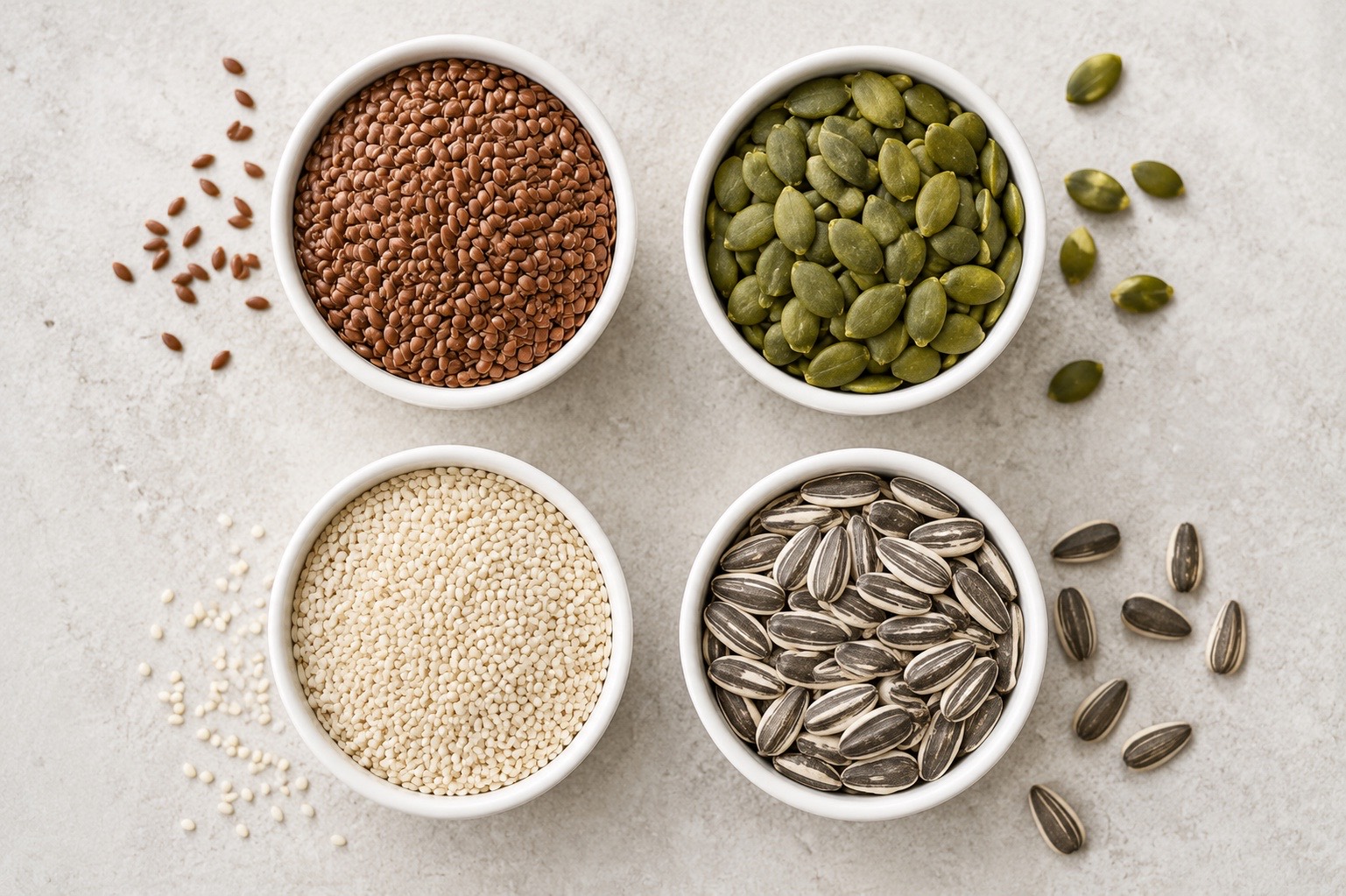
- There are zero clinical trials of seed cycling itself. Search the literature for the protocol and you find no randomized test of "flax/pumpkin then sesame/sunflower, timed to the cycle, for hormone balance." The one published systematic review on it leans on a handful of small, low-to-moderate-quality studies and explicitly calls for proper RCTs.1
- The seeds are genuinely good food. Flax, pumpkin, sesame and sunflower deliver fiber, omega-3 ALA, lignans, magnesium, zinc and vitamin E. Eating them daily is harmless and mildly healthy — that part is real.
- The "hormone balancing" claim is borrowed, not proven. It is extrapolated from isolated-nutrient studies — flax lignans nudging estrogen metabolism, zinc and vitamin E supporting the luteal phase — not from any test of the cycle-timed protocol.26
- Who this is for: anyone who enjoys the ritual and wants a fiber-and-mineral boost. Who it is not for: anyone using it instead of real care for PCOS, irregular cycles, infertility or menopause.1
- What seed cycling actually is
- The claim, stated plainly
- The trial that doesn’t exist
- What the seeds genuinely deliver
- The flaxseed nuance — where credibility is borrowed
- The sesame half — same pattern
- PCOS, menopause, and irregular cycles
- Where it fits: a tiered view
- Grey areas and open questions
- What this article is not saying
- Common questions
- References
What seed cycling actually is
Seed cycling is a dietary ritual built around the menstrual cycle. The protocol is tidy enough to fit in a fifteen-second video, which is part of why it spread. For roughly the first fourteen days — the follicular phase, from the start of your period through ovulation — you eat about a tablespoon each of ground flaxseed and pumpkin seeds per day. For the second half — the luteal phase, from ovulation to your next period — you switch to a tablespoon each of sesame and sunflower seeds. People without a regular cycle (including postmenopausal women) are told to follow the moon: new-moon-to-full-moon as the "follicular" half, full-moon-to-new-moon as the "luteal" half.
The stated logic is that flax and pumpkin "support estrogen" in the first half, while sesame and sunflower "support progesterone" in the second — nudging the two hormones into the rise-and-fall rhythm of a textbook cycle. It is a clean story. It is also, as a hormone therapy, almost entirely unproven. The reason this article exists is that the seeds are good for you and the ritual is harmless, so the temptation is to wave it through — and the specific medical claim attached to it deserves the same scrutiny we would give any supplement.
The claim, stated plainly
Strip away the aesthetics and the load-bearing claim is this: timing these four seeds to the two phases of your cycle balances estrogen and progesterone. Everything downstream — clearer skin, lighter periods, easier PMS, better fertility, smoother menopause — hangs on that single premise. So that is the premise to test. Not "are seeds healthy" (they are), and not "do lignans do anything to estrogen" (they do, a little). The premise is that the cycle-timed sequence moves your hormones in a meaningful, measurable, beneficial direction.
That is a falsifiable claim. You could run it: randomize people to the seed-cycling protocol versus a control, measure serum estradiol and progesterone across the cycle, track symptoms, blind what you can. It would not even be an expensive trial. The striking thing is that, despite years of viral popularity, essentially nobody has run it — and the honest verdict turns entirely on that absence.
The trial that doesn’t exist
Here is the core finding of this whole piece, stated without hedging: there is no clinical trial of seed cycling as a protocol. Search the biomedical literature for the practice and you do not find a randomized test of "flax and pumpkin in the follicular phase, sesame and sunflower in the luteal phase, for hormone balance." You find plant-biology papers about literal seed dormancy, and you find studies of individual seeds in isolation — but not one trial of the actual cycle-timed sequence the trend prescribes.
The closest thing to an evidence base is a single 2025 systematic review in Cureus that set out to evaluate seed cycling for premenstrual syndrome (PMS) and PCOS.1 That review is worth reading honestly, in both directions. On one hand, its existence shows researchers are starting to look. On the other, its own conclusion is the tell: the authors report that any positive signal rests on small sample sizes and moderate-quality evidence, with no standardized protocol across the studies they could find, and they explicitly call for larger randomized controlled trials before anyone treats seed cycling as effective.1 A systematic review that concludes "we need real trials" is, in plain terms, telling you the real trials are not there yet. (PCOS — polycystic ovary syndrome — is a common hormonal and metabolic condition; PMS is the cluster of physical and mood symptoms in the luteal phase.)
So the situation is unusually clear-cut for a wellness topic. This is not a case of conflicting trials, or a small effect that some studies catch and others miss. It is the absence of any direct test of the protocol at all. Everything offered as evidence for seed cycling is borrowed from studies of single nutrients or single seeds — which is exactly where the credibility comes from, and exactly where it gets overstated.
It is not that seed cycling failed its trials. It is that seed cycling has never had one — and a protocol with zero direct tests is being marketed as if the hormones were settled.
What the seeds genuinely deliver
Now the fair part, because being honest cuts both ways. The four seeds are real food with a real nutritional profile, and nothing in this article should read as "don’t eat them." Eating a couple of tablespoons of ground seeds a day is a mildly healthy habit on its own merits, completely independent of any hormone claim.
Flaxseed is one of the richest plant sources of the omega-3 fatty acid ALA (alpha-linolenic acid), is high in soluble and insoluble fiber, and is the densest dietary source of lignans — the plant compounds at the center of the estrogen story below.6 Pumpkin seeds bring magnesium, zinc, iron and protein. Sesame contributes its own lignans (sesamin and sesamolin), calcium, and the vitamin E family.5 Sunflower seeds are notably high in vitamin E and contribute selenium and healthy fats. Magnesium, zinc and vitamin E genuinely matter for general health, and the fiber alone is a defensible reason to keep seeds in a diet.
This is the kernel of truth the trend is built on, and it is a legitimate one. If seed cycling gets someone eating two tablespoons of ground flax and a handful of pumpkin or sunflower seeds every day, they are getting more fiber, more minerals and more omega-3 than they were — and that is a good thing. The problem is not the food. The problem is the specific promise stapled to the food and the timing.
The flaxseed nuance — where credibility is borrowed
The single most defensible thread in the seed-cycling story runs through flaxseed lignans, so it deserves a careful, honest accounting — this is the nuance that gives the trend its scientific veneer.
Flaxseed is loaded with a lignan called secoisolariciresinol diglucoside (SDG). Your gut bacteria convert it into the "mammalian lignans" enterodiol and enterolactone, which are weak phytoestrogens — plant compounds that can loosely interact with the body’s estrogen signaling.6 That conversion is real and well documented: in a controlled crossover trial, women who added flaxseed powder to their diet excreted dramatically more enterodiol and enterolactone — on the order of a several-fold to (in some individuals) extreme increase — confirming that flax lignans are absorbed and metabolized into estrogen-like compounds.3 So the raw mechanism — flax lignans entering the body and engaging weakly with the estrogen system — is not made up.7
There is even a genuine menstrual-cycle signal. In a small randomized crossover study, eighteen normally cycling women ate their usual diet versus the same diet plus flaxseed powder across alternating multi-cycle blocks. Flaxseed cycles were associated with a modestly longer luteal phase (about 12.6 versus 11.4 days) and a higher progesterone-to-estradiol ratio, with no significant change in absolute estradiol.2 That is a real, measured, cycle-relevant effect of flaxseed — and it is almost certainly where seed cycling borrows its credibility. It is honest to say: yes, there is isolated human data that flaxseed can nudge a cycle measure.
But read the rest of the literature and the nuance sharpens. That study found no change in absolute estrogen levels, and it was a small open-label cohort of eighteen women — a signal, not a settled effect.2 When other researchers measured serum hormones directly, the picture was flatter still: in a randomized crossover trial of sixteen premenopausal women, flaxseed raised urinary lignan excretion sharply but produced no change in serum hormone concentrations or sex-hormone-binding globulin on any treatment.4 So the most you can fairly say is this: flax lignans are real phytoestrogens, they are reliably absorbed, and there is a single small study hinting at a luteal-phase effect — but the hormone changes are inconsistent and modest, and crucially, none of this tested flaxseed timed to a phase of the cycle. The studies fed flaxseed every day, not on a follicular-only schedule. The timing — the whole conceptual spine of seed cycling — is the part that has never been tested at all.
actual protocol
no cycle-timed RCT exists
key flax study
small, open-label, daily flax
phase on flax
12.6 vs 11.4 days
The sesame half — same pattern
The luteal-phase half of the protocol leans on sesame, and the pattern repeats: a real but isolated nutrient study, stretched to cover a claim it does not actually make. The relevant trial is a randomized, placebo-controlled crossover study in which postmenopausal women ate 50 grams of sesame seed powder daily for five weeks.5 Sesame improved blood lipids (total and LDL cholesterol each fell several percent), improved antioxidant markers (oxidized LDL dropped, vitamin E ratios rose), and showed some shift in sex-hormone-related markers — sex-hormone-binding globulin rose about 15% and a urinary estrogen metabolite increased.5
That is a legitimately interesting result — but notice what it is and is not. It used 50 grams a day (far more than a tablespoon), in postmenopausal women (not cycling women in a luteal phase), with no cycle timing whatsoever, and its standout findings were about cholesterol and antioxidant status, not progesterone. There is no mechanism in that study by which sesame "supports progesterone" in the second half of a menstrual cycle. The seed-cycling framing takes a postmenopausal lipid-and-antioxidant study and repackages it as luteal-phase progesterone support — which the data simply do not show. Sesame is nutritious; the specific role assigned to it in the protocol is invented.
PCOS, menopause, and irregular cycles
This is where the honest-but-harmless framing has to get firm, because here the stakes stop being trivial. Seed cycling is widely promoted for PCOS, for perimenopausal and menopausal symptoms, and for regulating irregular or absent periods. For each of these, the direct evidence is the same: none specific to the protocol. The one systematic review that examined seed cycling for PMS and PCOS concluded only that it might be a low-cost, safe adjunct, on small and moderate-quality data, and that larger trials are needed before drawing conclusions.1 "Safe, cheap, and unproven" is the accurate summary — not "effective treatment."
The risk is not that the seeds hurt you. It is opportunity cost. PCOS is a metabolic and hormonal condition that responds to evidence-based care — supplements like myo-inositol have genuine RCT support for ovulation and insulin sensitivity, which a timed seed schedule does not — and irregular or absent cycles can signal thyroid disease, elevated prolactin, perimenopause, or other conditions a clinician needs to identify. Treating any of these with timed seeds while delaying real evaluation is the genuine harm. A food ritual is a fine addition to a worked-up plan; it is a poor substitute for one. If your cycles are irregular, painful, or absent, or if menopausal symptoms are disrupting your life, that is a clinician conversation, not a seed schedule. Our overview of sex and hormone health sets the same expectation: food habits sit alongside real care, not in place of it.
Where it fits: a tiered view
It helps to place seed cycling honestly on a spectrum of what it can and cannot do.
Foundational — eat the seeds, skip the mythology. If you like the ritual, do it. Two tablespoons of ground flax and a handful of pumpkin, sesame or sunflower seeds a day is a small, genuine upgrade in fiber, omega-3 and minerals, and you do not need the calendar to get those benefits.6 The food is the real value here; the phase-timing is decoration. Other unglamorous basics — sleep, protein, resistance training, and minerals like magnesium where a deficit exists — do more for how a cycle feels than any seed schedule.
Research-curious — the flax-as-phytoestrogen experiment. If you are specifically interested in the lignan story, daily flaxseed has the most isolated human data of the four seeds: reliable lignan absorption and a small hint of a luteal-phase effect.23 Treat it as an experiment with modest, inconsistent expected effects — and note that the data are for daily flax, not follicular-only timing.
Experimental — treating it as a hormone therapy. Using seed cycling to "balance hormones," fix PCOS, regulate periods, or manage menopause is the weakest-supported use by a wide margin. There is no trial of the protocol, the mechanism is borrowed from unrelated isolated-nutrient studies, and the conditions it targets need real evaluation.1 This is the tier where the marketing lives, and the tier the evidence cannot support.
Seed cycling is the textbook case of a good food wearing a borrowed lab coat. The seeds earn their place in a diet on fiber and minerals alone — but the cycle-timed "hormone balancing" claim has no trial behind it, and the conditions it’s sold for deserve real care. The right question isn’t "seeds: yes or no" (yes, eat them). It’s "what actually moves my hormones, and where do food rituals rank against the things that genuinely shift estrogen, progesterone, and metabolic health?" The Manual maps the hormone-and-metabolic levers against each other — what each one’s evidence genuinely supports, who benefits, and which popular rituals are mostly vibes. See the Manual →
Grey areas and open questions
The missing trial. The whole topic turns on one absence: no randomized controlled trial has tested the cycle-timed protocol against a control while measuring serum estradiol and progesterone. Until one does, "seed cycling balances hormones" is a hypothesis, not a finding — and a cheap, easy hypothesis to test, which makes its absence all the more telling.1
Daily versus timed. Every supportive study fed seeds daily, not on a follicular-only or luteal-only schedule.245 There is no evidence that timing the seeds to a phase does anything the same seeds eaten every day would not. The timing is the trend’s signature move and its least supported one.
Dose mismatch. The studies that show any hormone-adjacent signal used meaningful quantities — 10 grams of flax powder in the lignan-excretion work, 50 grams of sesame in the postmenopausal trial.35 A tablespoon of each seed is a smaller dose than several of the studies the trend cites for support.
The phytoestrogen caveat. Flax and sesame lignans are weak phytoestrogens, which is generally benign in healthy people and is part of why the practice is safe.7 But anyone with a hormone-sensitive condition, or on therapies where estrogen activity matters, should treat large, deliberate phytoestrogen loading as a clinician conversation rather than a self-experiment.
What this article is not saying
This is not "don’t eat the seeds." Flax, pumpkin, sesame and sunflower are genuinely good food, and a daily seed habit is a small, real nutritional win. Eat them freely, enjoy the ritual if it helps you stay consistent — the food is not the problem.
This is not "the seeds do nothing." Flax lignans are real phytoestrogens with documented absorption and a small isolated signal on luteal-phase length; sesame has real effects on lipids and antioxidant status.25 Those are legitimate, if modest, findings — just not the same thing as "cycle-timed hormone balancing."
What this article is saying: the specific promise — that timing four seeds to your cycle balances estrogen and progesterone, fixes PCOS, regulates periods, or eases menopause — has never been tested and rests on borrowed, isolated-nutrient data. It is a pleasant, harmless, nutritious habit. It is not a proven hormone therapy, and it is not a reason to delay real care for a real hormonal problem.
Common questions
Is there any proof seed cycling balances hormones?
No direct proof. There is no clinical trial of the seed-cycling protocol itself. The one published systematic review found only small, moderate-quality studies and called for proper randomized trials before drawing conclusions.1 The "hormone balancing" claim is extrapolated from studies of individual seeds, not tests of the timed protocol.
Are the seeds at least good for me?
Yes. Flax, pumpkin, sesame and sunflower deliver fiber, omega-3 ALA, lignans, magnesium, zinc and vitamin E.6 Eating a couple of tablespoons of ground seeds a day is a harmless, mildly healthy habit on its own merits — just not because of the calendar.
Does flaxseed really affect the menstrual cycle?
There is one small signal. In a study of eighteen women, daily flaxseed was associated with a modestly longer luteal phase (about 12.6 vs 11.4 days) and a higher progesterone-to-estradiol ratio, without changing absolute estrogen.2 But a separate trial found no change in serum hormones at all from flaxseed,4 and neither study timed the flax to a phase. It is an emerging hint, not a reliable effect.
Can seed cycling treat PCOS or menopause?
No — there is no protocol-specific evidence it treats either. The available review rates it "safe and low-cost" but explicitly unproven, on weak data.1 PCOS, irregular cycles and disruptive menopause symptoms need clinical evaluation and evidence-based care, not a seed schedule in place of it.
Does the timing actually matter?
No evidence that it does. Every supportive study fed seeds daily, not on a follicular-only or luteal-only schedule.4 If the seeds help you nutritionally, eating them every day works just as well as cycling them — the phase-timing is the trend’s least supported feature.
References
- Nagarajan DR, Jacob DM, Mufti MM, Rajesh S, Dube R. Efficacy of seed cycling as an integrative therapy for premenstrual syndrome and polycystic ovary syndrome in reproductive-aged women: a systematic review. Cureus. 2025. PMID 41018334. (The only published synthesis of seed cycling; concludes evidence is small-N and moderate-quality, and calls for larger RCTs — i.e., no trial of the protocol exists.)
- Phipps WR, Martini MC, Lampe JW, Slavin JL, Kurzer MS. Effect of flax seed ingestion on the menstrual cycle. J Clin Endocrinol Metab. 1993;77(5):1215-1219. DOI · PMID 8077314. (Small open-label crossover, N=18; daily flax, not cycle-timed.)
- Lampe JW, Martini MC, Kurzer MS, Adlercreutz H, Slavin JL. Urinary lignan and isoflavonoid excretion in premenopausal women consuming flaxseed powder. Am J Clin Nutr. 1994;60(1):122-128. DOI · PMID 8017326.
- Frische EJ, Hutchins AM, Martini MC, Thomas W, Slavin JL. Effect of flaxseed and wheat bran on serum hormones and lignan excretion in premenopausal women. J Am Coll Nutr. 2003;22(6):550-554. DOI · PMID 14684762. (Randomized crossover, N=16; no change in serum hormones.)
- Wu WH, Kang YP, Wang NH, Jou HJ, Wang TA. Sesame ingestion affects sex hormones, antioxidant status, and blood lipids in postmenopausal women. J Nutr. 2006;136(5):1270-1275. DOI · PMID 16614415. (Randomized placebo-controlled crossover, N=24; 50 g/day, postmenopausal, not cycle-timed.)
- Mueed A, Deng Z, Korma SA, et al. Anticancer potential of flaxseed lignans, their metabolites and synthetic counterparts in relation with molecular targets: current challenges and future perspectives. Food Funct. 2023;14(5):2286-2303. DOI · PMID 36820797. (Review of flaxseed lignan SDG and its enterolignan metabolites.)
- Tułacz Z, Włodarczyk M. Comprehensive review of isoflavones and lignans in the prophylaxis and treatment of breast cancer. J Am Nutr Assoc. 2025. PMID 40827815. (Review of lignan/phytoestrogen activity and hormone modulation.)