Red light therapy: what the evidence actually shows for skin, hair, and pain
Red light therapy — the technical name is photobiomodulation (PBM), or in its laser form low-level laser therapy (LLLT) — is one of the rare wellness devices with a real, published evidence base. The catch is that the evidence is uneven. It is genuinely modest-but-real for skin collagen, for pattern hair loss, and for musculoskeletal pain; it is emerging for muscle recovery; and it is pure marketing for the fat-melting, detoxing, whole-body claims plastered across the panel aisle. Underneath it all sits a device-quality problem that quietly sinks most at-home results: get the dose or the distance wrong and even a mechanism that works does nothing. Here is the honest read on what the trials measured, which wavelengths do what, where the money is wasted, and what to expect if you buy a panel.
How this article was built: Primary sources: Hamblin’s 2017 mechanism review in AIMS Biophysics, the Avci/Hamblin 2013 skin review in Seminars in Cutaneous Medicine and Surgery, the Wunsch & Matuschka 2014 controlled skin trial in Photomedicine and Laser Surgery, the Jimenez et al. 2014 multicenter hair-loss RCT in the American Journal of Clinical Dermatology, the Liu et al. 2019 androgenetic-alopecia meta-analysis in Lasers in Medical Science, the Vanin et al. 2018 muscle-performance meta-analysis in Lasers in Medical Science, and the Chow et al. 2009 neck-pain meta-analysis in The Lancet — all retrieved and verified through PubMed.
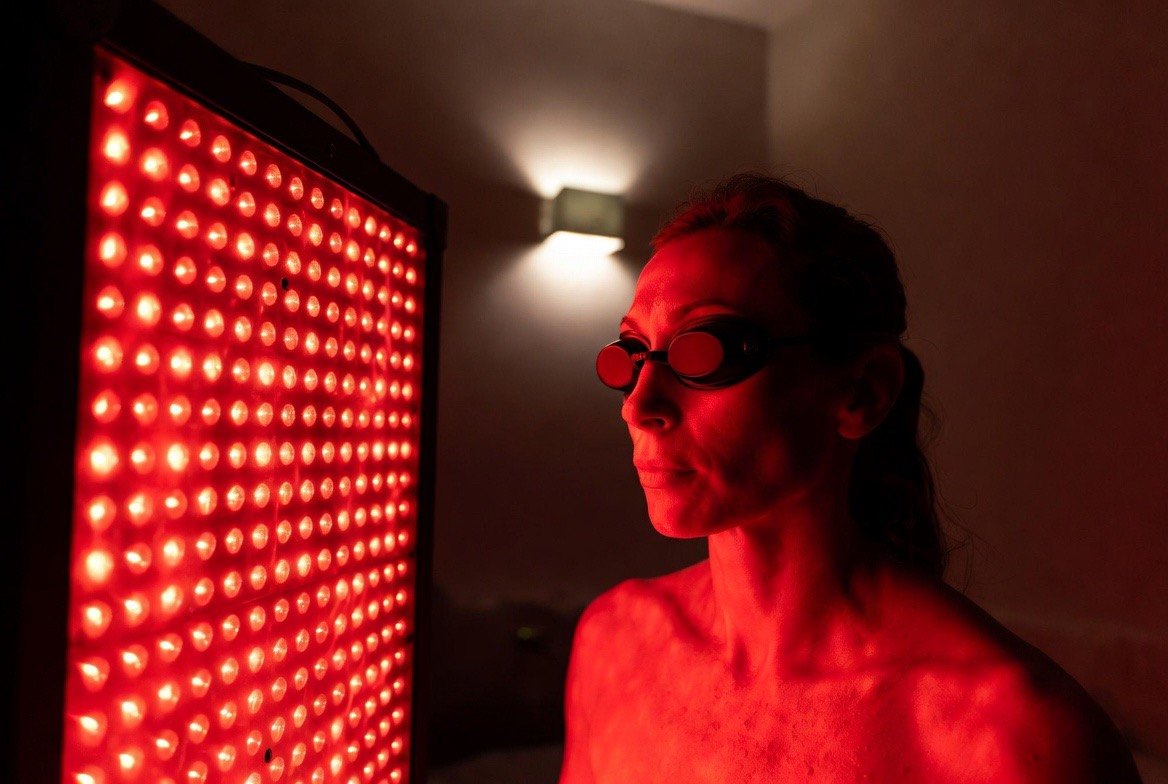
- The mechanism is legitimate. Red (~630–670 nm) and near-infrared (~810–850 nm) light are absorbed by cytochrome c oxidase, an enzyme in your mitochondria, nudging up cellular energy (ATP) and nitric-oxide signaling.1
- Real but modest for skin and hair. Controlled trials show measurable gains in collagen density and wrinkle reduction, and pooled data show increased hair density in pattern hair loss — on the order of a visible but unremarkable improvement, not a transformation.35
- Helpful for pain, emerging for recovery. Meta-analyses support red/near-infrared light for musculoskeletal pain and, more tentatively, for muscle fatigue and recovery — but the trials are small and heterogeneous.67
- The rest is hype. “Melts fat,” “detoxes,” and “whole-body wellness” are marketing, not findings. And a cheap panel used at the wrong distance delivers a dose too low to do anything — the device gap is the real story.
- What red light therapy actually is
- The mechanism: light into cellular energy
- Skin, wrinkles, and collagen
- Hair regrowth and pattern hair loss
- Pain, tendons, and muscle recovery
- Wavelength, dose, and the depth question
- The device-quality problem
- Where it’s overhyped
- Safety and eye protection
- Who it helps — and who’s wasting money
- Where it fits: a tiered view
- What this article is not saying
- References
What red light therapy actually is
“Red light therapy” is the consumer name for a family of treatments researchers call photobiomodulation (PBM — literally “changing biology with light”) or, when the source is a laser rather than a light-emitting diode (LED), low-level laser therapy (LLLT). All of it describes the same basic idea: shining specific wavelengths of red and near-infrared light on the body at a low enough intensity that it does not heat or damage tissue, in the hope of nudging cells to behave differently.
Two wavelength bands matter. Visible red light sits at roughly 630 to 670 nanometres (nm) — the deep red you can see. Near-infrared (NIR) light sits at roughly 810 to 850 nm — just past what the eye can detect, so a NIR panel can look dim or off while still delivering a strong dose. The intensity hitting your skin is called irradiance (measured in milliwatts per square centimetre), and the total energy delivered over a session is the dose, measured in joules per square centimetre (J/cm²). Those two numbers — irradiance and dose — are the whole ballgame, and they are exactly what the marketing tends to bury.
It is worth being precise about what red light therapy is not. It is not the ablative or fractional lasers a dermatologist uses to resurface skin (those work by controlled injury). It is not red-tinted infrared saunas (that’s heat). And it is not ultraviolet light. PBM is deliberately non-thermal and non-damaging — which is also why its effects are subtle rather than dramatic.
The mechanism: light into cellular energy
The mechanism is the most solid part of the whole story, and it is genuinely elegant. Inside nearly every cell sits the mitochondrion, the structure that generates most of your cellular energy in the form of ATP (adenosine triphosphate, the molecule cells spend to do work). One enzyme in the mitochondrial energy chain, cytochrome c oxidase, happens to absorb light most strongly in exactly the red and near-infrared bands PBM uses.1
When that enzyme absorbs a photon, the leading explanation is that light knocks a molecule of nitric oxide off the enzyme. Nitric oxide, in that spot, acts like a brake on energy production; displacing it lets the enzyme run faster, so the cell makes more ATP.2 The freed nitric oxide also becomes a signaling molecule that widens local blood vessels and shifts inflammatory signaling. So the signal red light pulls is not “heat” or “stimulation” in a vague sense — it is a specific, measurable nudge to mitochondrial output and to nitric-oxide-driven blood flow and inflammation.1
Two honest caveats keep this at MODERATE rather than STRONG. First, most of the fine mechanistic detail comes from cell and animal work, and translating a clean petri-dish result to a living human through skin, fat, and variable dosing is where a lot of the effect leaks away. Second, PBM shows a “biphasic” dose response: a little light helps, more light helps more — up to a point — and too much light can actually blunt the effect. That inverted-U is a big part of why identical devices produce different results in different hands.1
Red light doesn’t add energy to your body from outside. It flips a switch inside the cell’s own power plant — and only if the right amount of light reaches the right depth.
Skin, wrinkles, and collagen
Skin is where red light therapy has its most accessible evidence, for the obvious reason that the target is right at the surface where the light actually reaches. The mechanism fits neatly: nudge fibroblasts (the skin cells that build connective tissue) toward more collagen and elastin, and you would expect firmer skin and softer fine lines over weeks.
The most-cited human trial here is Wunsch and Matuschka’s 2014 controlled study of 136 volunteers. Participants treated twice weekly with red or red-plus-near-infrared light showed significant improvements versus untreated controls in patient satisfaction, fine lines and wrinkles, skin roughness, and — measured by ultrasound — intradermal collagen density.3 That last endpoint matters: it is an objective structural measurement, not just “subjects felt their skin looked better.” Hamblin and colleagues’ broad review of LLLT in skin reaches the same qualified conclusion — red and near-infrared light can improve skin appearance, wound healing, and collagen, with the strongest signal in rejuvenation and healing contexts.2
The honest framing is “modest and real.” This is a visible-but-unremarkable improvement that accrues over weeks of consistent sessions, not a resurfacing-laser result. It also stacks conceptually with topical collagen-signaling approaches rather than replacing them; if you are building a skin routine, our read on copper peptides in skincare covers a topical route to the same collagen goal, and the broader skin-aging evidence hub puts the options side by side. The trials that report benefit used disciplined dosing schedules — the part hardest to replicate with a panel on your bathroom counter.
Hair regrowth and pattern hair loss
Hair is the second area where the evidence clears the bar, specifically for androgenetic alopecia (AGA — pattern hair loss, the common thinning driven by genetics and hormones). Red-light caps, combs, and helmets are cleared by the US Food and Drug Administration for this use, and unlike a lot of the device world, that clearance rests on real randomized trials.
The anchor trial is Jimenez and colleagues’ 2014 multicenter, randomized, sham-controlled, double-blind study of a home-use laser comb, with 225 men and women randomized across its device trials for pattern hair loss. Over 26 weeks, the active-device groups gained significantly more terminal hair density than the sham-device group across device configurations.4 Pooling this kind of trial, Liu and colleagues’ 2019 meta-analysis found a significant increase in hair density with LLLT versus sham across randomized controlled trials, in both men and women and across comb- and helmet-type devices.5
The realistic expectation is a measurable bump in density and a slowing of loss — not the regrowth of a full head of hair, and not a match for the effect sizes of minoxidil or finasteride. In practice, red light is best thought of as an adjunct that can be layered onto proven treatments rather than a standalone replacement. If hair is your goal, it belongs in the same conversation as our evidence read on rosemary oil for hair growth, which sits at a different (and thinner) point on the same evidence spectrum. The compliance catch is real: these trials worked because participants used the device on a fixed schedule for months, and that consistency is exactly where at-home users drift.
Pain, tendons, and muscle recovery
Move from surface tissue to muscle and joint, and the target gets deeper and the evidence gets messier — but it does not vanish. For musculoskeletal pain, the strongest single piece of evidence is Chow and colleagues’ 2009 meta-analysis in The Lancet, which pooled 16 randomized trials of LLLT for neck pain and found it reduced pain immediately after treatment in acute cases and for up to 22 weeks in chronic neck pain versus placebo.7 That is a high-quality synthesis in a top journal — but the same authors were careful to flag wide variation in treatment parameters and possible bias in small trials, which is why this lands honestly as helpful-but-heterogeneous rather than settled.
For muscle recovery and performance, Vanin and colleagues’ 2018 systematic review and meta-analysis found that photobiomodulation applied around exercise can improve some measures of muscular performance and reduce fatigue in healthy people.6 The signal is real enough to take seriously and shaky enough to stay EMERGING: many of the included trials are small, dosing protocols differ enormously, and a chunk of the muscle-recovery research comes from groups with commercial ties to the devices — an industry-funding pattern that runs through this whole field and warrants a skeptical eye on effect sizes. Tendon conditions like Achilles tendinopathy and tennis elbow sit in the same bucket: some positive trials, some null, and a strong dependence on getting the dose right. If recovery is your interest, our recovery and pain evidence hub tracks where red light sits against the other options.
band
skin & surface targets
band
deeper muscle & joint
decides results
dose, not device price
Wavelength, dose, and the depth question
This is the section that separates people who get a result from people who get a warm glow. Two variables do most of the work.
Wavelength sets the depth. Visible red light (630–670 nm) is absorbed relatively near the surface, which makes it the right tool for skin. Near-infrared light (810–850 nm) penetrates deeper into tissue before it is absorbed, which is why it is the band used when the target is muscle, tendon, or joint underneath the skin.12 This is why serious panels combine both bands: red for the surface, near-infrared for depth. It also means a red-only device aimed at your knee is largely wasting its light before it reaches the joint.
Dose has a sweet spot, not a “more is better” curve. Because PBM is biphasic, there is a window of J/cm² that works, below which nothing happens and above which the benefit can fade.1 Dose is a product of three things you control: how intense the device is (irradiance), how close you sit, and how long you go. Irradiance falls off steeply with distance — doubling your distance from the panel can cut the intensity to a fraction — so the single most consequential number nobody prints on the box is how far away you should sit and for how long. Get the distance wrong and a perfectly capable panel underdoses you into placebo territory. This is not a supplement you can casually over- or under-take and expect the same result; it behaves more like a drug with a therapeutic range.
The device-quality problem
Here is the uncomfortable truth the industry glosses over: the gap between the clinic and your countertop is often the reason at-home red light disappoints. Trials that show benefit use devices with known, verified irradiance at a specified distance, applied on a controlled schedule. A budget consumer panel may publish an inflated irradiance number (frequently measured at the LED surface, not where your body actually sits), combine wavelengths that miss the effective bands, or simply be too weak to deliver a therapeutic dose at a comfortable distance.
The practical implications are unglamorous but decisive. First, the specification that matters is verified irradiance at a stated distance — not the number of LEDs, not the total wattage on the label, not the marketing copy. Second, at-home use demands the same discipline the trials used: consistent sessions, the right distance, several times a week for weeks to months, tracked rather than guessed. Third, a clinic device supervised by a professional will generally out-deliver a consumer panel, which is the honest trade-off between cost and convenience. None of this means at-home panels can’t work — the better ones can — it means the device and the protocol, not the concept, are where most people’s results are won or lost. When you compare products, our tools and evidence library and the wider devices and wearables hub are built to help you read past the spec-sheet theatre.
Where it’s overhyped
Now the part the panel ads won’t tell you. A cluster of claims sold alongside red light has no credible evidence and earns a flat HYPE grade.
“Melts fat” / body contouring. The idea that shining light on your abdomen dissolves fat is the boldest overreach. A handful of small, mostly industry-linked studies report centimetre-scale reductions in circumference, but the effect is tiny, poorly replicated, and dwarfed by ordinary diet and activity. Treating a red-light panel as a weight-loss tool is not supported by the weight of evidence.
“Detoxes the body.” “Detox” is a marketing word, not a physiological one. Your liver and kidneys handle clearance; no wavelength of light “detoxifies” anything. This claim should be treated as a red flag on any device page.
“Whole-body wellness / boosts everything.” The mechanism is local: light affects the tissue it actually reaches. Broad promises of systemic energy, immunity, mood, and longevity from a panel far outrun the data. Some of these areas (like transcranial PBM for cognition) are genuine active research questions — but “active research question” is not “proven benefit you can buy,” and the marketing routinely collapses that distinction.
The trap with red light therapy is that a single panel is sold against a dozen claims of wildly different quality — a MODERATE skin-and-hair story bundled with a HYPE fat-and-detox story, under one confident headline. The right question is never “does red light work, yes or no.” It’s “which specific claim, for which tissue, at what dose — and is that the claim I’m buying the device for?” Skin collagen and pattern hair loss have real trials behind them; pain and recovery are promising-but-mixed; fat loss and detox are marketing. Grade the claim, not the gadget. Our Evidence Radar library is built to keep those judgments separate.
Safety and eye protection
The safety profile of red and near-infrared light at PBM intensities is reassuring: it is non-ionizing, non-thermal at recommended settings, and the trials report few significant adverse events beyond occasional transient warmth or mild irritation.2 That is a genuine point in its favour compared with more aggressive cosmetic procedures.
The real caution is your eyes. Bright visible light triggers a natural squint-and-look-away reflex, but near-infrared is invisible — your eyes won’t warn you it is intense, yet the retina can still be stressed by high-power exposure. Wear the eye protection the manufacturer supplies, and never stare directly into the emitters. Beyond that, a few groups should check with a clinician first: anyone on a photosensitizing medication (some antibiotics, certain acne drugs, and others make skin or eyes more light-reactive), anyone with a personal or family history of skin cancer or an undiagnosed changing skin lesion, people with active skin conditions on the treatment area, and those who are pregnant. These are conservative cautions, not evidence of harm — but light therapy is easy to overuse precisely because it feels like nothing is happening.
Who it helps — and who’s wasting money
Strip away the marketing and the picture is clearer than the panel aisle suggests. Red light therapy is a reasonable, low-risk option for people targeting skin appearance (fine lines, roughness, tone), for people with early-to-moderate pattern hair loss who will use a properly specified device consistently — ideally alongside proven treatments — and, more tentatively, for people managing chronic musculoskeletal pain or chasing marginal recovery gains who understand the evidence is mixed and dose-dependent.357
It is mostly wasted money for anyone buying it to lose weight or “detox,” for anyone expecting a dramatic, laser-resurfacing-grade skin transformation, for anyone unwilling to commit to a consistent multi-week schedule, and for anyone buying a cheap, underpowered, or spec-inflated panel and using it at whatever distance feels comfortable. In that last case the concept isn’t failing you — the dose is. The honest summary: red light rewards the specific, disciplined user and quietly disappoints the casual one.
Where it fits: a tiered view
It helps to place red light therapy honestly on a spectrum of how settled the evidence is and who it is for.
Foundational — earn it first. No device substitutes for the basics that drive the same outcomes. For skin: sun protection, sleep, and not smoking outweigh any panel. For hair: proven treatments and addressing the underlying cause come first. For pain and recovery: load management, sleep, and progressive training do the heavy lifting. Red light is a thin margin on top of those, never a replacement for them.
Research-curious — the targeted trial. If your foundations are solid and you have a specific, evidence-backed target — skin rejuvenation or pattern hair loss above all — a properly specified device used on a disciplined schedule is a low-risk experiment with a modest, realistic upside.34 Set expectations at “measurable but subtle,” give it two to three months, and track it rather than trusting your memory.
Experimental — everything outside the evidence. Using red light for fat loss, “detox,” or broad systemic wellness is the weakest-supported use. The mechanism is local, the claims are systemic, and the money is better spent on interventions matched to the actual goal.
What this article is not saying
This is not “red light therapy is a scam.” For skin rejuvenation and pattern hair loss it has real, replicated, controlled-trial evidence and a strong safety record — better than most of the wellness-device category. Dismissing it outright is as wrong as overselling it.
This is not “red light therapy is a cure-all.” Its value is specific and modest. It helps particular tissues, at particular wavelengths, at particular doses — and it does nothing for the fat-loss and detox claims stapled to it in the marketing. The concept is sound; the hype around the concept is not.
And this is not a treatment prescription. The figures here describe what trials administered, not what you should do. Devices vary enormously, dosing has a real therapeutic window, and if you have a medical condition, take medication, or are treating a specific problem, that is a conversation to have with a clinician — not a panel. The point of this piece is to tell you what the trials show and where they stop, so your expectations and your spending can be honest ones.
References
- Hamblin MR. Mechanisms and applications of the anti-inflammatory effects of photobiomodulation. AIMS Biophys. 2017;4(3):337-361. DOI · PMID 28748217
- Avci P, Gupta A, Sadasivam M, Vecchio D, et al. Low-level laser (light) therapy (LLLT) in skin: stimulating, healing, restoring. Semin Cutan Med Surg. 2013;32(1):41-52. PMID 24049929
- Wunsch A, Matuschka K. A controlled trial to determine the efficacy of red and near-infrared light treatment in patient satisfaction, reduction of fine lines, wrinkles, skin roughness, and intradermal collagen density increase. Photomed Laser Surg. 2014;32(2):93-100. DOI · PMID 24286286
- Jimenez JJ, Wikramanayake TC, Bergfeld W, Hordinsky M, et al. Efficacy and safety of a low-level laser device in the treatment of male and female pattern hair loss: a multicenter, randomized, sham device-controlled, double-blind study. Am J Clin Dermatol. 2014;15(2):115-127. DOI · PMID 24474647
- Liu KH, Liu D, Chen YT, Chin SY. Comparative effectiveness of low-level laser therapy for adult androgenic alopecia: a system review and meta-analysis of randomized controlled trials. Lasers Med Sci. 2019;34(6):1063-1069. DOI · PMID 30706177
- Vanin AA, Verhagen E, Barboza SD, Costa LOP, Leal-Junior ECP. Photobiomodulation therapy for the improvement of muscular performance and reduction of muscular fatigue associated with exercise in healthy people: a systematic review and meta-analysis. Lasers Med Sci. 2018;33(1):181-214. DOI · PMID 29090398
- Chow RT, Johnson MI, Lopes-Martins RA, Bjordal JM. Efficacy of low-level laser therapy in the management of neck pain: a systematic review and meta-analysis of randomised placebo or active-treatment controlled trials. Lancet. 2009;374(9705):1897-1908. DOI · PMID 19913903