PRP injections: what the honest evidence really shows for knee arthritis, tendons, and hair loss
Platelet-rich plasma (PRP — a concentrate of your own blood platelets, spun down and injected back into an aching joint, tendon, or scalp) is one of the most heavily marketed treatments in modern medicine. It sounds elegant: draw your blood, concentrate the healing factors, put them where the damage is. It is autologous — made from your own body — so the safety bar is low and it is easy to try. Athletes have made it famous, clinics advertise it for everything from knees to hairlines, and it almost always costs you out of pocket. But the honest evidence is far messier than the pitch. For knee osteoarthritis (OA — the wear-related joint disease that is PRP’s single biggest use), the most rigorous placebo-controlled trials of the last few years are frankly disappointing. For chronic tendon problems like tennis elbow the picture is mixed. For hair loss the signal is real but rests on small, wobbly trials. And running under all of it is a problem that quietly poisons the whole literature: PRP is not one thing. Here is the cited, evidence-graded read on where it genuinely helps, where the best trials say it doesn’t, and why the marketing runs so far ahead of the data.
How this article was built: Primary sources: the Bennell et al. 2021 RESTORE placebo-controlled trial of PRP for knee OA in JAMA; the Filardo et al. 2021 meta-analysis in Cartilage and the Bensa et al. 2025 platelet-concentration meta-analysis in the American Journal of Sports Medicine; the Mishra et al. 2014 chronic tennis-elbow randomized controlled trial and the Fitzpatrick et al. 2017 tendinopathy meta-analysis, both in the American Journal of Sports Medicine; the Gupta & Carviel 2017 androgenetic-alopecia meta-analysis in the Journal of Dermatological Treatment; and the DeLong et al. 2012 PAW classification of PRP preparation in Arthroscopy — all retrieved and verified through PubMed and the Consensus research database.
- Knee OA is the disappointing headline. The most rigorous placebo-controlled randomized controlled trial (RCT — the study design that compares a treatment against a dummy injection with everyone blinded) to date, the 2021 RESTORE trial in JAMA, found PRP no better than saline for pain or cartilage over 12 months.1 Earlier meta-analyses were more positive, but they leaned on lower-quality, poorly-blinded trials.2
- Tendons are the more hopeful, still-messy story. For chronic tennis elbow (lateral epicondylitis) and some other tendinopathies, several trials favor PRP over corticosteroid at longer follow-up — but the trials are heterogeneous and the effect sizes modest.45
- Hair loss shows a moderate but shaky signal. Small trials in androgenetic alopecia (AGA — common pattern hair loss) mostly favor PRP, but they are tiny, varied, and poorly standardized.6
- PRP is not one product. Leukocyte-rich versus leukocyte-poor PRP (LR-PRP/LP-PRP — whether white blood cells are included), platelet concentration, activation, and spin protocol all differ so much that trials often aren’t testing the same thing.37 It is autologous and low-risk — but "low-risk" is not the same as "works."
- What PRP actually is
- Knee osteoarthritis: the disappointing headline
- Tennis elbow and tendons: mixed but hopeful
- Hair loss: a moderate, shaky signal
- The problem that poisons everything: PRP isn’t one thing
- Placebo, expectation, and the needle
- Cost and safety
- The hype: "regenerative cure"
- The honest verdict
- References
What PRP actually is
The concept is genuinely reasonable, which is part of why PRP has spread so fast. Blood platelets are not just clotting cells; when they activate, they release a shower of growth factors — signaling proteins that recruit repair cells, stimulate new blood vessels, and coordinate healing. The idea behind PRP is to harvest those platelets from a small blood draw, concentrate them several-fold above their normal level, and deliver that concentrate directly into an injured or degenerating tissue, in the hope of tipping the local environment toward repair.
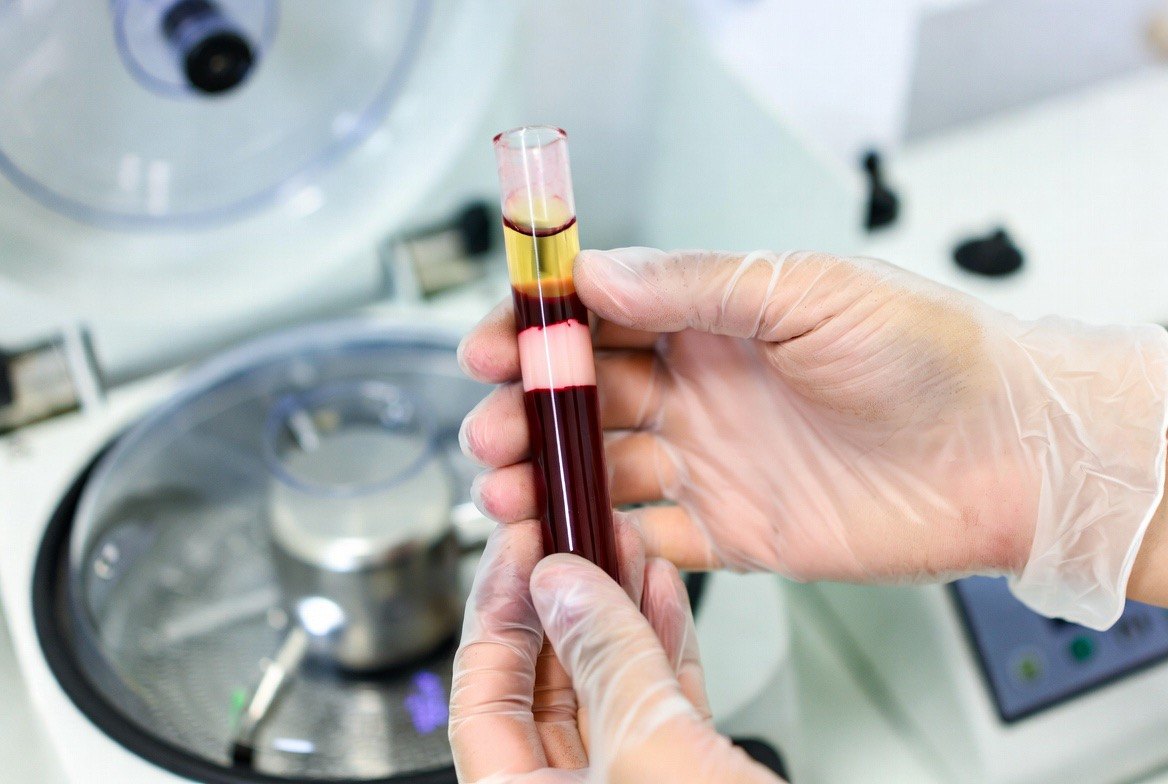
Mechanically, the process is simple. A clinician draws your blood, spins it in a centrifuge so it separates by density into layers — a dark red-cell layer at the bottom, a thin platelet-and-white-cell band in the middle, and a straw-colored plasma layer on top — and then draws off the platelet-rich portion to inject. That injection might go into a knee joint, around a tendon, or into the scalp, depending on what is being treated.
Here is the first honest caveat, and it matters for everything that follows. "Concentrate your own healing factors and put them where the damage is" is a plausible mechanism, and a plausible mechanism is not proof of a clinical effect. The body is full of interacting feedback loops; dumping growth factors into a degenerating joint does not automatically produce healing, and it may do nothing measurable. The only way to know whether PRP works for a given problem is a well-designed trial that compares it against a convincing placebo — and, as we will see, when those trials are run rigorously, the results are frequently humbling.
Knee osteoarthritis: the disappointing headline
Knee OA is PRP’s flagship use and the arena with the best data, so it is the right place to be blunt. For years, the story looked encouraging: multiple meta-analyses pooled dozens of trials and reported that PRP beat placebo and hyaluronic acid on pain and function, sometimes with benefits that grew over 6 to 12 months.2 Clinics quoted these papers, and the treatment boomed. But a pooled analysis is only ever as good as the trials feeding it — and many of the early PRP-versus-placebo trials were small, weakly blinded, and prone to exactly the kind of bias that inflates a subjective outcome like knee pain.
Then came the trial that changed the conversation. In 2021, Bennell and colleagues published the RESTORE trial in JAMA — a rigorously designed, placebo-controlled RCT that randomized 288 people with symptomatic mild-to-moderate medial knee OA to three weekly injections of either leukocyte-poor PRP (from a commercial system) or saline placebo, with participants, injectors, and assessors all blinded.1 The two co-primary outcomes were the 12-month change in knee pain and the change in medial cartilage volume measured by MRI (magnetic resonance imaging — a detailed scan that images soft tissue). The result was flat. Pain improved by 2.1 points with PRP versus 1.8 with placebo — a difference of 0.4 points that was not statistically significant and well below the threshold anyone would notice. Cartilage volume was essentially identical between groups. Of 31 secondary outcomes, 29 showed no meaningful difference. The authors’ conclusion was unambiguous: these findings do not support using PRP for knee OA.1
Why does RESTORE carry more weight than a stack of earlier positive trials? Because knee-OA pain is a soft, expectation-sensitive outcome, and PRP has an unusually powerful placebo profile — a blood draw, a high-tech centrifuge, a dramatic procedure, and a hefty out-of-pocket bill all prime a patient to feel better. In that setting, poor blinding does not just add noise; it systematically favors PRP. RESTORE’s strength is that it blinded everyone and used a saline placebo that felt like a real injection, stripping out that bias. When it did, the apparent benefit largely vanished.
The nuance worth keeping is that the debate is not fully closed. More recent meta-analyses that stratify by platelet dose argue that high-concentration PRP may still edge past placebo on some pain and function scores, while low-concentration preparations do not — a finding from Bensa and colleagues in 2025 that, if it holds up, points to a dose the early trials never controlled for.3 That is a real and interesting signal. But it is a hypothesis generated by pooling heterogeneous trials, not a verdict from a rigorous head-to-head; and it sits alongside RESTORE, the single most rigorous trial, showing nothing. The honest reading for knee OA today: the best placebo-controlled evidence is disappointing, the positive meta-analytic signal is fragile and dose-dependent, and anyone selling PRP as a reliable fix for an arthritic knee is running ahead of the data.
at 12 months in RESTORE
not significant; ~1.8 needed to notice
saline-controlled RCT
RESTORE, JAMA 2021
no meaningful difference
symptoms and MRI structure
A dramatic procedure with a big price tag is a placebo machine. That’s exactly why the rigorously blinded, saline-controlled trials matter more than the enthusiastic ones — and why they keep coming back flat.
Tennis elbow and tendons: mixed but hopeful
Move from cartilage to tendon and the story gets more interesting — and more genuinely unresolved. Chronic tendinopathies like lateral epicondylitis (tennis elbow — a degenerative, painful tendon at the outer elbow) are a plausible target for PRP because tendon has poor blood supply and heals slowly, so a local growth-factor boost is at least mechanistically coherent. And here some of the better trials are cautiously encouraging.
The most-cited is Mishra and colleagues’ 2014 multicenter RCT in the American Journal of Sports Medicine, which randomized 230 patients with chronic tennis elbow who had failed conservative care to a leukocyte-rich PRP injection or an active control (a needling procedure).4 At 12 weeks the difference was not significant, but by 24 weeks the PRP group reported meaningfully better pain and fewer patients with residual elbow tenderness. That "late separation" — no early advantage, a benefit that emerges months later — recurs across the tendon literature and fits a biological healing story better than an instant-relief one. Other trials have compared PRP against corticosteroid injection, a common tennis-elbow treatment, and while steroid often wins in the first weeks, PRP frequently pulls ahead at longer follow-up because steroid’s benefit fades and can even worsen tendon quality over time.
But the meta-analytic view forces honesty. Fitzpatrick and colleagues’ 2017 meta-analysis of PRP in tendinopathy found a real overall benefit — yet its central message was about heterogeneity: outcomes depended heavily on preparation and technique, with leukocyte-rich PRP and injection (rather than simple application) associated with better results.5 Trials that looked alike on the label were doing quite different things. So the tendon verdict is "emerging," not "strong": there is a defensible, repeated signal that PRP helps some chronic tendinopathies at longer follow-up, especially where other options have failed — but the trials are inconsistent, the preparations vary, and the effect sizes are moderate rather than transformative. It is the one area where a cautious clinician and a well-informed patient might reasonably try it, eyes open, after conservative care.
Hair loss: a moderate, shaky signal
PRP for androgenetic alopecia — injected into the scalp to thicken thinning hair — is one of the fastest-growing cosmetic uses, and the evidence follows the now-familiar pattern: a signal that is real but built on sand. Multiple small trials report that PRP increases hair density and thickness compared with baseline or placebo scalp, and a meta-analysis by Gupta and Carviel pooled the quantifiable trials and found a statistically significant effect favoring PRP.6
The catch is in the fine print of that same analysis. The included trials were tiny — the pooled quantitative estimate rested on only a few dozen patients — and the wider body of AGA trials is strikingly heterogeneous in how PRP was prepared, how often it was given, and how hair was measured.6 Some used objective phototrichograms; others relied on softer assessments. Session number, platelet concentration, and whether the scalp was activated all varied. When a positive result is assembled from small, methodologically varied studies, it can be genuine and still fragile — sensitive to publication bias (positive results are likelier to be published) and to the placebo dynamics that scalp injections share with joint injections. The fair grade is "emerging": promising enough that dermatology takes it seriously as an adjunct, especially alongside proven treatments like minoxidil, but not established enough to promise a specific result — and not a substitute for the therapies with far larger evidence bases behind them.
The problem that poisons everything: PRP isn’t one thing
Step back from the individual indications and one issue explains much of the mess: "PRP" is a category, not a standardized product. When a trial says it tested "PRP," that tells you almost nothing about what was actually injected. The variables are enormous and consequential:
Leukocyte content. Some preparations deliberately include white blood cells (leukocyte-rich PRP, LR-PRP); others deliberately exclude them (leukocyte-poor PRP, LP-PRP). This is not a minor detail: white cells drive inflammation, which may help a degenerative tendon that needs a repair stimulus but may irritate a joint that needs calming. RESTORE used leukocyte-poor PRP; Mishra’s tennis-elbow trial used leukocyte-rich. They are, in a real sense, different drugs.
Platelet concentration. Preparations range from barely above baseline to five-fold or more concentrated. The Bensa 2025 analysis suggests concentration may be the difference between a signal and nothing in knee OA — yet most trials neither standardized nor reported it precisely.3 A trial that injects weak PRP and finds no effect, and a trial that injects potent PRP and finds a benefit, may both be "true" and simply be testing different things.
Activation and preparation method. Whether platelets are chemically activated before injection, how many times the blood is spun, which commercial kit is used — all of it changes the final product. This variability is so well recognized that researchers built formal classification systems to try to tame it. The DeLong PAW system, published in Arthroscopy in 2012, grades PRP on the absolute number of Platelets, the manner of Activation, and the presence or absence of White cells — precisely because protocols varied so wildly that studies could not be meaningfully compared or pooled.7
The consequence is severe and is the strongest, best-documented claim in this article. When you pool trials of "PRP," you are averaging across products that differ in their active ingredients, doses, and biology — which inflates heterogeneity, muddies meta-analyses, and makes it genuinely hard to say whether a null result means "PRP doesn’t work" or "that particular PRP, at that dose, didn’t work here." Until preparations are standardized and reported, the field is partly arguing about the wrong thing. This is why a low grade on knee OA and a hopeful grade on tendons can coexist without contradiction: they may not be the same intervention.
If you are considering PRP, the single most useful question is one almost no marketing answers: which PRP? Leukocyte-rich or leukocyte-poor? What platelet concentration relative to baseline? Prepared with which system? Because the evidence splits along exactly those lines, "I got PRP" is about as informative as "I took a pill." The Manual maps the regenerative and recovery interventions against each other with the evidence graded and the preparation details pinned down — so a claim about "healing factors" gets held to the same standard as any drug. See the Manual →
Placebo, expectation, and the needle
PRP sits at the intersection of two potent placebo amplifiers, and understanding them explains why open-label enthusiasm and blinded trials so often disagree. The first is the injection itself: needle procedures produce large placebo responses even when the fluid is inert, and the more elaborate and clinical the ritual, the bigger the effect. The second is the story: PRP comes wrapped in compelling narrative — your own blood, your own healing factors, cutting-edge regenerative medicine — delivered by a clinician you paid a premium to see. Expectation is not a trivial confound here; it is arguably the main event in a poorly-controlled study.
This is exactly why the design of a trial determines its answer. An open-label study, or one with a weak placebo, will tend to show PRP "working," because the ritual and the expectation deliver real perceived relief regardless of the biology. A double-blind study with a convincing sham injection — RESTORE’s saline felt like a genuine procedure — strips that away and asks whether the platelets add anything beyond the theater. When the theater is controlled for, the specific effect of PRP in knee OA shrinks toward zero.1 None of this means patients’ relief is imaginary — a placebo response is a real experience — but it is not evidence that the platelets did the work, and it is not something you should pay thousands of dollars to obtain.
Cost and safety
Two practical facts round out the picture. First, cost. PRP is almost always out of pocket. Most insurers and public systems do not cover it for musculoskeletal or cosmetic use precisely because the evidence has not met their bar, and a course of injections — often several sessions — commonly runs into four figures. That matters not just for your wallet but for interpretation: the sunk cost itself feeds the placebo response, and it raises the standard of proof a rational buyer should demand. Paying a premium for a treatment whose best trial came back flat is a poor trade unless you have a specific, evidence-supported reason.
Second, and more favorably, safety. Because PRP is autologous — prepared from your own blood and injected back into you — the risk profile is genuinely low. There is no risk of disease transmission from a donor and no foreign drug. The realistic downsides are the ordinary ones of any injection: transient pain, swelling, bruising at the site, and the small infection risk inherent to breaking the skin. Serious adverse events are rare. This favorable safety profile is real, and it is the honest reason PRP is a defensible thing to try in the right context. But safety is not efficacy. "It probably won’t hurt you" is a low bar, and it is the bar the marketing quietly substitutes when the efficacy evidence won’t cooperate.
The hype: "regenerative cure"
Now the claim to reject outright. PRP is routinely marketed as regenerative — a treatment that regrows cartilage, rebuilds tendon, and reverses hair loss by tapping the body’s healing machinery. It is an intoxicating pitch, and it is not supported by the rigorous evidence. In RESTORE, PRP did not preserve or regrow cartilage any better than saline; the MRI-measured cartilage loss was essentially identical between groups.1 There is no trial showing that PRP reliably reverses established osteoarthritis, and the strongest joint data point the other way. Framing it as a proven regenerative cure is HYPE in the technical sense: a claim far beyond what any controlled evidence supports.12
The subtler version of the hype is the appeal to mechanism. "It’s your own growth factors, so of course it heals." But mechanism is not outcome — that is the whole reason placebo-controlled trials exist. A plausible biological rationale earns a treatment a fair test; it does not earn it a verdict. PRP was given its fair tests. In the setting with the best evidence, it came back empty; in the settings with hopeful evidence, the results are moderate and inconsistent. The correct posture is neither "miracle" nor "scam," but the unglamorous middle: a low-risk intervention with a real but narrow and unsettled evidence base, sold with a confidence the data have never earned.
The honest verdict
Put it together and PRP resolves into a treatment that is genuinely promising in a couple of places, genuinely disappointing in its biggest one, and everywhere held back by a lack of standardization. For knee osteoarthritis, the flagship use, the best placebo-controlled trial found no benefit over saline for pain or joint structure, and the positive meta-analytic signal is fragile and dose-dependent — so the marketing runs well ahead of the evidence.13 For chronic tendinopathies like tennis elbow, there is a real, repeated, but heterogeneous signal, strongest at longer follow-up and after conservative care has failed — the most defensible place to consider it.45 For hair loss, the signal is moderate but rests on small, variable trials and is best viewed as an adjunct, not a standalone answer.6
Underneath all three sits the fact that "PRP" is not one product, so a trial’s result may reflect its particular preparation as much as PRP as a concept.7 Add a powerful placebo profile and a high out-of-pocket cost, and the picture is clear: PRP is low-risk enough to be a reasonable experiment for a specific, well-chosen problem in the hands of a clinician who can tell you exactly what is in the syringe — and nowhere near proven enough to justify the "regenerative cure" language plastered across the field.
This is not medical advice, and PRP is a place where the boundary matters. Whether it is appropriate for your joint, tendon, or scalp, which preparation makes sense, and whether better-evidenced options should come first are clinical judgments that belong with a professional who can examine you and knows the trial literature — not with an advertisement or an article. Our related coverage of injectable recovery peptides and evidence-graded hair treatments makes the same point from other angles: promising mechanism plus thin, heterogeneous human data is a reason for measured curiosity, never for confident claims. Read PRP for what it is — an interesting, safe, oversold tool whose evidence has not caught up to its marketing — and let the trials, not the pitch, set your expectations. You can browse the wider evidence base on recovery and pain and our full Evidence Radar for how we grade claims like these.
References
- Bennell KL, Paterson KL, Metcalf BR, Duong V, et al. Effect of Intra-articular Platelet-Rich Plasma vs Placebo Injection on Pain and Medial Tibial Cartilage Volume in Patients With Knee Osteoarthritis: The RESTORE Randomized Clinical Trial. JAMA. 2021;326(20):2021-2030. DOI · PMID 34812863
- Filardo G, Previtali D, Napoli F, Candrian C, Zaffagnini S, Grassi A. PRP Injections for the Treatment of Knee Osteoarthritis: A Meta-Analysis of Randomized Controlled Trials. Cartilage. 2021;13(1_suppl):364S-375S. DOI · PMID 32551947
- Bensa A, Previtali D, Sangiorgio A, Boffa A, Salerno M, Filardo G. PRP Injections for the Treatment of Knee Osteoarthritis: The Improvement Is Clinically Significant and Influenced by Platelet Concentration: A Meta-analysis of Randomized Controlled Trials. Am J Sports Med. 2025;53(3):745-754. DOI · PMID 39751394
- Mishra AK, Skrepnik NV, Edwards SG, Jones GL, et al. Efficacy of Platelet-Rich Plasma for Chronic Tennis Elbow: A Double-Blind, Prospective, Multicenter, Randomized Controlled Trial of 230 Patients. Am J Sports Med. 2014;42(2):463-471. DOI · PMID 23825183
- Fitzpatrick J, Bulsara M, Zheng MH. The Effectiveness of Platelet-Rich Plasma in the Treatment of Tendinopathy: A Meta-analysis of Randomized Controlled Clinical Trials. Am J Sports Med. 2017;45(1):226-233. DOI · PMID 27268111
- Gupta AK, Carviel JL. Meta-analysis of efficacy of platelet-rich plasma therapy for androgenetic alopecia. J Dermatolog Treat. 2017;28(1):55-58. DOI · PMID 27152474
- DeLong JM, Russell RP, Mazzocca AD. Platelet-rich plasma: the PAW classification system. Arthroscopy. 2012;28(7):998-1009. DOI · PMID 22738751