NAC (N-acetylcysteine): the honest evidence for a compound that’s both a life-saving drug and an oversold supplement
NAC — N-acetylcysteine — is one of the strangest entries in the supplement aisle, because it isn’t really a supplement at all. It is a modified form of the amino acid cysteine and a precursor to glutathione (GSH), the body’s master antioxidant, and it has a genuinely rock-solid medical resume: it is the FDA-approved antidote for acetaminophen (paracetamol) overdose — a therapy that has saved countless livers and lives — and an established mucolytic that thins the mucus of respiratory disease. That is the strong half of the story. The middle half is promising but unsettled: adjunct signals in obsessive-compulsive disorder (OCD), hair-pulling and skin-picking, bipolar depression, addiction and craving, plus a role in PCOS and in reducing COPD flare-ups. And then there is the marketing half — NAC as a daily antioxidant, immune booster, liver “detox,” longevity pill, and hangover fix — where the evidence in healthy people thins out fast. Layered on top is a genuine regulatory saga: the FDA spent 2020 to 2022 arguing NAC may not even be a lawful dietary supplement, because it was approved as a drug first. Here is what NAC actually does, where the data is strong, where it’s emerging, and where the bottle gets ahead of the science.
How this article was built: Primary sources: the U.S. national multicenter study of oral NAC for acetaminophen overdose (Smilkstein et al. 1988, New England Journal of Medicine), a Cochrane review of mucolytic agents in chronic bronchitis and COPD (Poole et al. 2019, Cochrane Database of Systematic Reviews), a COPD meta-analysis of NAC (Fowdar et al. 2017, International Journal of COPD), a double-blind RCT of NAC for trichotillomania (Grant et al. 2009, Archives of General Psychiatry), a double-blind RCT of NAC for bipolar depression (Berk et al. 2008, Biological Psychiatry), a review of NAC in psychiatric disorders (Ooi et al. 2018, BioMed Research International), and a broad review of NAC’s uses (Mokhtari et al. 2017, Cell Journal) — all retrieved and verified through PubMed.
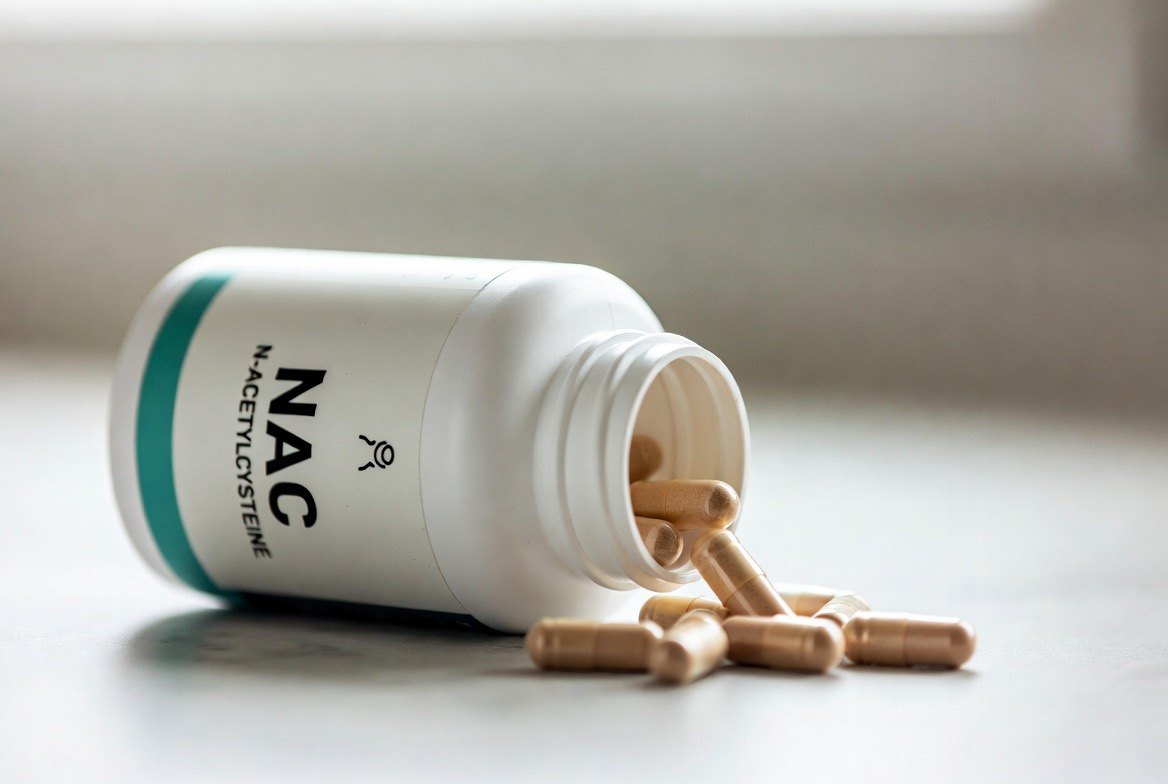
- The overdose antidote use is rock-solid. NAC is the FDA-approved antidote for acetaminophen (paracetamol) overdose, and given in time it dramatically cuts liver injury and death — a genuinely life-saving drug.1
- It is a real mucolytic. NAC thins mucus and, in chronic bronchitis and COPD (chronic obstructive pulmonary disease), modestly reduces exacerbations — a moderate but replicated effect.27
- The psychiatric-adjunct data is promising, not proven. Positive RCTs exist for trichotillomania and signals in OCD, addiction, and bipolar depression, but results are mixed and it’s an add-on, not a standalone treatment.345
- The daily-antioxidant story is thin. For otherwise healthy people, “glutathione boosting,” immune, liver detox, longevity, and hangover claims are weakly supported — the bottle promises more than the trials deliver.6
- It’s generally safe but not magic. Mostly GI (gastrointestinal) upset orally; the dramatic effects come from IV and inhaled hospital use, not a supplement capsule.6
What NAC actually is
NAC — N-acetylcysteine — is a small, modified version of the amino acid cysteine, dressed up with an acetyl group that makes it more stable and better absorbed than plain cysteine. That chemistry matters for one reason above all others: cysteine is the rate-limiting building block your cells need to manufacture glutathione (GSH), the tripeptide that most textbooks call the body’s “master antioxidant.” Glutathione is central to how cells neutralize reactive oxygen species, recycle other antioxidants, and detoxify certain reactive compounds. Give the body more usable cysteine, and — when it is genuinely running short — it can make more glutathione.6
That single mechanism is the seed of everything NAC is marketed for. It is also where the honesty has to start, because “raises glutathione” is not the same as “improves your health.” NAC most clearly helps when a specific problem is driven by glutathione depletion or by too-thick mucus — and those are exactly the settings where the evidence is strongest. The supplement industry has taken the glutathione headline and stretched it across immunity, aging, and detox, where the through-line from mechanism to measured benefit gets much thinner. Keep that distinction in mind for the rest of this piece: NAC has real pharmacology, but pharmacology is a hypothesis, not a result.
The rock-solid use: the acetaminophen overdose antidote
If NAC did nothing else, it would still be one of the most valuable molecules in medicine, because it is the antidote for acetaminophen (paracetamol) overdose — and acetaminophen overdose is one of the leading causes of acute liver failure in the developed world. This is NAC’s STRONG claim, and it is not close.
The mechanism ties directly back to glutathione. In overdose, the liver’s normal pathways for clearing acetaminophen get overwhelmed, and a toxic metabolite called NAPQI accumulates. Glutathione normally mops up NAPQI — but in overdose the glutathione stores are exhausted, and the unopposed metabolite attacks liver cells. NAC replenishes glutathione and provides sulfhydryl groups that detoxify NAPQI directly, which is why, given early enough, it can prevent liver injury almost entirely. The landmark U.S. national multicenter study of oral NAC, analyzed by Smilkstein and colleagues in the New England Journal of Medicine in 1988, showed that patients treated within roughly 8 to 10 hours of overdose had very low rates of liver injury, and that NAC reduced deaths even in those who presented late.1 It has been standard of care worldwide ever since, given orally or, more commonly in hospitals, intravenously (IV).
NAC didn’t earn its reputation as a wellness capsule. It earned it in emergency rooms, pulling people back from liver failure.
This is worth stating as bluntly as possible, because it is the single most important safety point in this article: if you or someone else may have taken too much acetaminophen, that is an emergency — call poison control or emergency services and go to a hospital. Do not buy NAC capsules and try to manage it at home. Hospital treatment is timed, weight-dosed, and monitored against blood levels on a validated nomogram; the over-the-counter supplement is not a substitute and self-treating a real overdose can be fatal. The strength of NAC as an antidote is precisely what makes casual self-use dangerous.
The other strong use: mucolytic and COPD
NAC’s second established role has nothing to do with antioxidants in the marketing sense and everything to do with chemistry you can almost feel. NAC breaks disulfide bonds in mucus — the molecular bridges that make phlegm thick and sticky — which physically thins mucus and makes it easier to clear. That is why an inhaled/nebulized form has long been used as a mucolytic in respiratory medicine, and why oral NAC has been studied in chronic bronchitis and COPD (chronic obstructive pulmonary disease).
The clinical payoff is moderate but real. A Cochrane systematic review of mucolytic agents (of which NAC is the most studied) in chronic bronchitis and COPD found that regular use produced a small reduction in exacerbations and days of disability, with a good safety profile — the kind of modest, replicated benefit that earns a place as an add-on rather than a headline therapy.2 A separate meta-analysis focused on NAC in COPD reached a similar conclusion: higher-dose oral NAC was associated with fewer exacerbations, particularly in patients with more frequent flare-ups.7
We grade the mucolytic/COPD claim MODERATE rather than STRONG for an honest reason. The direction of benefit is consistent across multiple randomized controlled trials (RCTs) and reviews, and the mucus-thinning mechanism is well characterized — but the size of the effect is modest, the biggest benefit clusters in specific subgroups (frequent exacerbators, sometimes only at higher doses), and it is a supportive measure layered on top of inhalers and standard COPD care, not a replacement for them. It is a genuine clinical tool; it is not a cure for lung disease.
The promising middle: NAC in psychiatry
Here is where NAC gets genuinely interesting — and where the honest grade drops from “established” to EMERGING. Beyond its antioxidant role, NAC appears to modulate glutamate, the brain’s main excitatory neurotransmitter, and it’s that glutamatergic action — not the antioxidant story — that psychiatry has focused on. The result is a scatter of small trials across compulsive and addictive conditions, with some striking positives and some frustrating negatives.
The most-cited positive is trichotillomania (compulsive hair-pulling). In a double-blind, placebo-controlled RCT, Grant and colleagues found that NAC significantly reduced hair-pulling symptoms compared with placebo — a rare bright spot in a disorder with few drug options.3 Related evidence points to benefit in excoriation (skin-picking) disorder, another body-focused repetitive behavior in the same family. In obsessive-compulsive disorder (OCD), NAC has been tested as an add-on to standard treatment, with mixed results — some trials suggest a modest augmentation effect, others show nothing, so the honest read is “possible adjunct, not confirmed.”
In bipolar disorder, Berk and colleagues ran a double-blind RCT of NAC added to usual treatment and reported improvement in depressive symptoms over the study period — an encouraging signal, though later and larger maintenance trials have been less consistent.4 There are also signals in addiction and craving — cannabis, cocaine, nicotine and gambling among them — again plausibly tied to NAC’s effect on glutamate in reward circuitry, and again mixed. A review of NAC across psychiatric disorders by Ooi and colleagues summarized the field fairly: biologically plausible, several promising RCTs, but heterogeneous results and a need for larger, better trials before NAC becomes standard.5
So the EMERGING grade is the accurate one. NAC is one of the more evidence-backed nutraceuticals in psychiatry, it is cheap and well tolerated, and for something like trichotillomania it may be worth discussing with a clinician. But “promising adjunct” is not “proven treatment,” and NAC is never a substitute for evidence-based care. If you’re exploring the broader landscape of mood and anxiety options, our anxiety & mood hub covers the rest with the same evidence-first lens, and our companion read on ashwagandha for anxiety is the natural next step for how to weigh a supplement’s trial data honestly.
where NAC
works best
& mucolytic
to moderate evidence
for healthy people
bottle overpromises
PCOS and fertility
NAC has a modest evidence base in PCOS (polycystic ovary syndrome), the common hormonal and metabolic disorder in people of reproductive age. Some trials suggest NAC can improve insulin sensitivity and ovulation-related markers, and it has been studied as an adjunct to ovulation-induction agents in fertility care, with a few comparisons showing benefit and others showing it lagging standard therapy.6 The plausible mechanism runs through NAC’s effects on oxidative stress and insulin signaling, both of which are disrupted in PCOS.
We grade this EMERGING. The signals are real and the safety profile is friendly, but the trials are small and heterogeneous, and NAC is not established first-line PCOS therapy. It belongs in the “discuss with your clinician as a possible adjunct” column — not the “proven fix” column that some supplement copy implies.
The supplement claims vs the evidence
Now the part the label doesn’t say out loud. Walk down any supplement aisle and NAC is sold for a sweeping list: general antioxidant support, glutathione boosting, immune health, liver “detox,” anti-aging and longevity, and even hangover relief. Each of these borrows credibility from NAC’s real medical uses — if it saves livers in overdose, surely it detoxes yours; if it raises glutathione, surely it slows aging. But that leap is exactly where the evidence thins out, and this is the article’s WEAK claim.6
The core problem is context. NAC most convincingly helps when glutathione is genuinely depleted — overdose, serious respiratory disease, some chronic conditions. In a healthy, well-nourished person whose glutathione system is working fine, topping up cysteine doesn’t have a clear, replicated payoff on immunity, energy, aging, or how your liver processes everyday life. “Liver detox” in particular is a marketing phrase, not a physiological one: a healthy liver is not clogged with toxins waiting for a capsule to flush them, and NAC’s liver-protective role is specific to poisoning, not daily maintenance. The hangover claim is thinner still — a handful of small, low-quality studies, nothing that would survive a serious review.
There is a subtler catch, too: antioxidants are not automatically good in unlimited supply. A modest amount of oxidative signaling is part of how healthy cells adapt to exercise and stress, and blunting it indiscriminately isn’t obviously beneficial. This is the same nuance we cover in our look at combined cysteine-glycine supplementation — see our deep dive on the GlyNAC aging-hallmarks trial, which is the most serious attempt yet to test whether glutathione precursors move real aging biology, and a useful reality check on how early that science still is. For the wider category, our supplements hub and longevity hub apply the same “mechanism is a hypothesis” standard across the board.
The persuasive engine behind most NAC marketing is a single silent assumption: that “raises glutathione” automatically means “improves health.” It doesn’t. Glutathione is genuinely important, and NAC genuinely feeds it — but a benefit only reliably shows up when a real deficit exists to correct. In a healthy person, more precursor doesn’t guarantee more health any more than pouring extra flour on a finished loaf makes better bread. The honest question is never “does NAC raise glutathione?” (often yes) but “does raising glutathione in this person, for this goal, produce a measured benefit?” For overdose and thick mucus, yes. For a healthy adult chasing longevity, the answer is mostly “we don’t have the evidence — a clinician-guided decision, not a marketing one.”
The FDA regulatory saga
NAC’s regulatory story is unusually messy, and it explains why the supplement version has an asterisk over it. Because NAC was approved as a drug decades before it was widely sold as a supplement, the U.S. Food and Drug Administration (FDA, the American regulator) took the position starting in 2020 that NAC may not lawfully be marketed as a dietary supplement at all — under a provision that generally bars selling as a supplement anything first approved and studied as a drug. The FDA sent warning letters to companies marketing NAC for hangovers, and for a stretch some major retailers pulled NAC products from their shelves.
The industry pushed back, arguing NAC had been sold as a supplement for years before the drug-exclusion clock supposedly started. In 2022 the FDA issued guidance signaling enforcement discretion — effectively saying it did not intend to object to NAC being sold as a supplement while it considered rulemaking — and NAC returned to wide availability. The practical upshot for a reader in 2026: NAC is broadly sold as a supplement again, but its status has been genuinely contested, and that history is a useful reminder that “available on the shelf” is not the same as “evaluated and blessed for the uses on the label.” The dietary-supplement framework does not require the FDA to verify a supplement’s marketed benefits before sale.
Dosing and safety
NAC is, on the whole, well tolerated, which is part of why it’s so widely used. Oral supplement doses commonly sit in the 600 to 1,800 mg per day range, often split, and the most frequent complaints are GI (gastrointestinal) — nausea, bloating, diarrhea — sometimes with an unpleasant sulfur smell or taste.6 That mild profile is reassuring, but it should not be confused with the dramatic hospital forms.
The route matters enormously. The life-saving overdose antidote is delivered intravenously (or as high-dose oral protocols) under monitoring, at doses far above any capsule, and IV NAC can cause anaphylactoid reactions that require medical management. The mucolytic is typically inhaled/nebulized in a clinical setting, where it can occasionally trigger bronchospasm. An over-the-counter oral capsule taken for “antioxidant support” is a completely different exposure from either — which is exactly why you cannot extrapolate the hospital drug’s dramatic effects to a daily supplement, and why you can’t use a supplement to do a hospital drug’s job.
A few specific cautions are worth flagging to a clinician or pharmacist: NAC has mild antiplatelet-type effects and could theoretically matter around surgery or with blood-thinning medication; anyone with asthma should be careful with inhaled forms; and, as always, pregnancy, chronic illness, and polypharmacy are reasons to check first rather than self-prescribe. None of this is a dosing recommendation — it is context for a conversation with a professional who knows your situation.
What this article is not saying
This is not “NAC doesn’t work.” It is one of the few supplement-aisle compounds with a genuinely elite medical resume: the FDA-approved antidote that rescues people from acetaminophen-induced liver failure, and a real mucolytic that measurably helps chronic lung disease. Its glutamatergic action has produced honestly promising psychiatric-adjunct data, most convincingly in trichotillomania. Dismissing NAC as “just another supplement” would be as wrong as overselling it.
This is also not “NAC is a proven cure-all antioxidant everyone should take.” That is the HYPE claim, and it fails on the evidence. The daily-antioxidant, immune, liver-detox, longevity, and hangover uses rest on far thinner data than the bottle implies, and the marketing works by borrowing credibility from the overdose and mucolytic uses and stretching it over settings where the through-line from mechanism to measured benefit largely disappears. A compound can be a life-saving drug in one context and an oversold supplement in another — NAC is both at once.6
And this is not medical advice. Every figure here describes what published trials reported, not what you should take. NAC is sold as both a hospital drug and a supplement, the two are not interchangeable, and the single most important sentence in this piece bears repeating: a suspected acetaminophen overdose is an emergency — call poison control or emergency services and go to a hospital; never try to treat it yourself. For any routine use, whether NAC belongs in your regimen is a decision for you and a physician or pharmacist who knows your full picture — your health history, your other medications, and your goals. For a related look at how supplement claims should be read against real trial data, see our full Evidence Radar.
References
- Smilkstein MJ, Knapp GL, Kulig KW, Rumack BH. Efficacy of oral N-acetylcysteine in the treatment of acetaminophen overdose. Analysis of the national multicenter study (1976 to 1985). N Engl J Med. 1988;319(24):1557-1562. DOI · PMID 3059186
- Poole P, Sathananthan K, Fortescue R. Mucolytic agents versus placebo for chronic bronchitis or chronic obstructive pulmonary disease. Cochrane Database Syst Rev. 2019;5(5):CD001287. DOI · PMID 31107966
- Grant JE, Odlaug BL, Kim SW. N-acetylcysteine, a glutamate modulator, in the treatment of trichotillomania: a double-blind, placebo-controlled study. Arch Gen Psychiatry. 2009;66(7):756-763. DOI · PMID 19581567
- Berk M, Copolov DL, Dean O, Lu K, et al. N-acetyl cysteine for depressive symptoms in bipolar disorder--a double-blind randomized placebo-controlled trial. Biol Psychiatry. 2008;64(6):468-475. DOI · PMID 18534556
- Ooi SL, Green R, Pak SC. N-Acetylcysteine for the Treatment of Psychiatric Disorders: A Review of Current Evidence. Biomed Res Int. 2018;2018:2469486. DOI · PMID 30426004
- Mokhtari V, Afsharian P, Shahhoseini M, Kalantar SM, Moini A. A Review on Various Uses of N-Acetyl Cysteine. Cell J. 2017;19(1):11-17. DOI · PMID 28367412
- Fowdar K, Chen H, He Z, Zhang J, et al. The effect of N-acetylcysteine on exacerbations of chronic obstructive pulmonary disease: A meta-analysis and systematic review. Heart Lung. 2017;46(2):120-128. DOI · PMID 28109565