Lion's Mane mushroom for cognitive health: what the RCTs actually show.
Hericium erinaceus stimulates nerve growth factor (NGF) synthesis in cell culture and animal models. Human trials show real but narrow gains — specific to response inhibition and attention, not a broad cognitive lift. The 2024–2025 data is the most useful lens we have. Here's what it says.
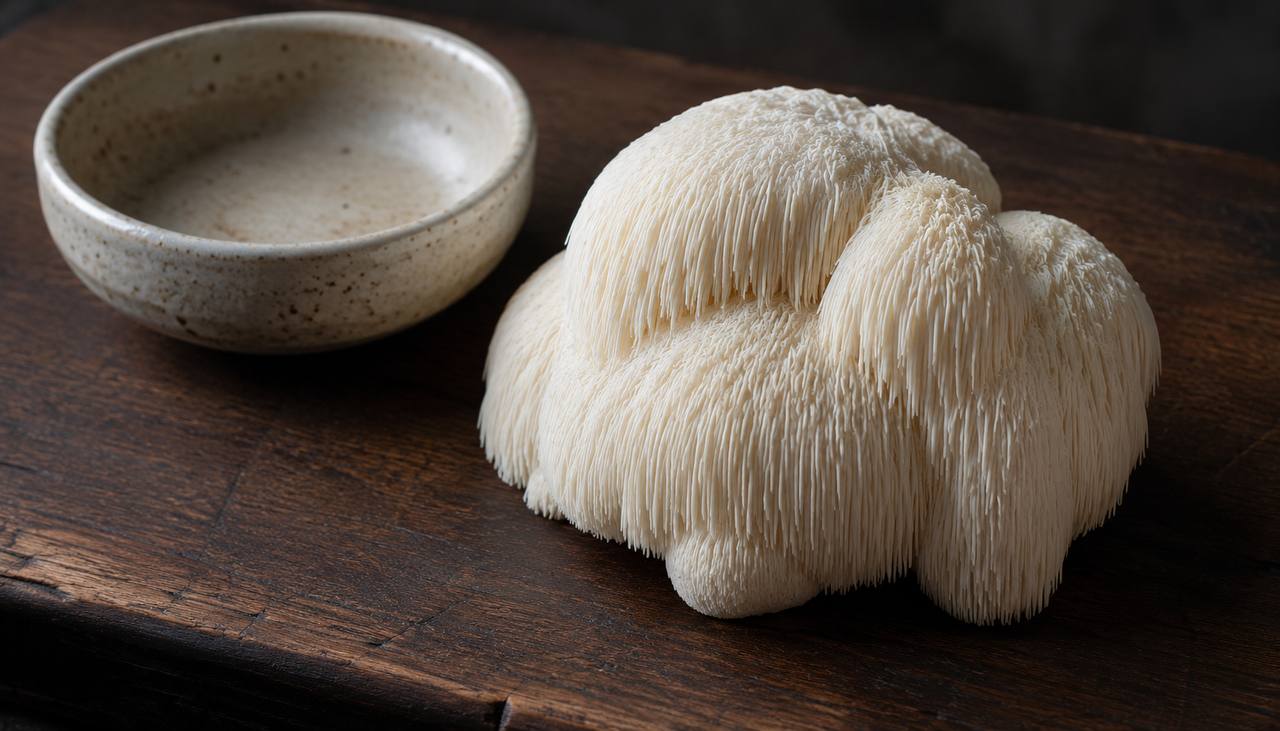
What Hericium erinaceus is — bioactive compounds
Hericium erinaceus — common name Lion's Mane — is a culinary and medicinal mushroom used for centuries in East Asian traditional medicine. It grows on hardwood, particularly beech and oak, and produces a distinctive white cascading fruiting body that makes it visually unmistakable. Unlike most mushroom supplements that circulate in the cognitive health space, Lion's Mane has a reasonably well-characterized bioactive profile.
The two compound classes most relevant to cognitive effects:
- Hericenones — found in the fruiting body; stimulate nerve growth factor (NGF) synthesis in vitro [1].
- Erinacines — found in the mycelium; cross the blood-brain barrier (BBB) more readily than hericenones and stimulate both NGF and brain-derived neurotrophic factor (BDNF) synthesis in rodent models [2]. Erinacine A in particular has been studied in Alzheimer's models.
The fruiting body vs. mycelium distinction matters for supplement quality. Products standardized only to fruiting body polysaccharides may contain fewer erinacines. This is not a minor formulation detail — the two fractions pull different signals through different pathways with different CNS penetration profiles.
Polysaccharides (beta-glucans) from Lion's Mane also have documented immune-modulating activity, but that is a separate topic from the cognitive-health mechanism addressed here.
The NGF/BDNF mechanism
Nerve growth factor (NGF) is a neurotrophin — a signaling protein that promotes neuronal survival, differentiation, and synaptic plasticity. It is particularly important for cholinergic neurons in the basal forebrain, which project to the hippocampus and cortex. Cholinergic dysfunction in the basal forebrain is one of the earliest observable changes in Alzheimer's pathology, which is why NGF-targeting strategies have a long research history in that field.
Brain-derived neurotrophic factor (BDNF) is the more abundant and broadly acting neurotrophin. It supports long-term potentiation (LTP) — the cellular correlate of memory consolidation — and has been consistently associated with depression, anxiety, and cognitive performance in human studies. Low BDNF is one of the more replicable biological correlates of cognitive decline.
The mechanistic case for Lion's Mane: H. erinaceus extract drives NGF gene expression via JNK signaling (a stress-activated kinase cascade) in astrocytoma cell lines. Notably, isolated hericenones C, D, and E did not independently promote NGF expression in the same cell model — the active fractions appear to be incompletely characterized [1]. Erinacines act through a distinct mechanism that includes direct central nervous system (CNS) penetration, producing NGF and BDNF induction in brain tissue rather than just peripheral circulation [2].
This is a credible mechanism. It is also worth noting that in vitro NGF induction in a cell line does not automatically translate to measurable cognitive improvement in a healthy 35-year-old taking a supplement capsule. The mechanism sets the hypothesis. The trials test it.
The mechanism is real. Whether it produces meaningful cognitive gains in healthy adults — not just cognitively impaired populations — is a narrower, less-settled question.
Human RCTs: what they show and don't
A 2023 double-blind, randomized, parallel-group trial by Docherty and colleagues (Nutrients) examined acute and chronic effects of 1.8 g/day Lion's Mane (three 600 mg capsules) in adults aged 18–45 (n=41–43) [3]. The key acute finding: the Stroop color-word task — a measure of response inhibition and cognitive control — showed significantly faster response time at 60 minutes post-dose (p=0.005) in the active arm. However, the 28-day chronic arm showed a trend toward reduced stress but — notably — worse delayed word recall compared to placebo (p<0.001). This chronic negative finding is underreported in the Lion's Mane literature and warrants attention: faster Stroop performance acutely does not guarantee broad cognitive benefit across time.
Olsson and colleagues published a separate double-blind, randomized, placebo-controlled crossover study in Frontiers in Nutrition (2025), examining acute effects of a standardized fruiting body extract (3 g of 10:1 extract, equivalent to ~30 g fresh fruiting body) in adults aged 18–35 (n=18) [12]. The significant acute finding was improved performance on the grooved pegboard test — a measure of psychomotor skill and manual dexterity — rather than a broad cognitive measure. Executive function, working memory, processing speed, and mood did not reach significance.
- Reference: Docherty S, Doughty FL, Smith EF. Nutrients. 2023;15(22):4842. PMC10675414. Open access.
- Design: Double-blind, randomized, parallel-group, placebo-controlled pilot trial.
- Population: Healthy adults aged 18–45 (n=41–43 across analyses), recruited in the UK.
- Intervention: 1.8 g/day Lion's Mane (three 600 mg capsules of Hericium erinaceus dual-extract powder, providing fruiting body + mycelium fractions).
- Duration: 28-day chronic arm, with acute assessments at 60 minutes post-first-dose.
- Acute outcome (60 min): Significantly faster Stroop color-word task response time vs. placebo (p = 0.005). Stroop tests response inhibition — suppressing the automatic word-reading response.
- Chronic outcomes (28 days): Trend toward reduced subjective stress. Significantly worse delayed word recall vs. placebo (p < 0.001). No significant change in other Cogtrack battery measures.
- What it does not show: A broad nootropic effect. It is a single-dose, pilot-scale trial, in young healthy adults, using one specific dual-extract formulation, with mixed chronic findings.
An earlier trial by Mori and colleagues used 0.8 g of dried Lion's Mane fruiting body powder four times daily (3.2 g/day total) in adults aged 55–65 over 12 weeks, reporting significant improvement on the Revised Hasegawa Dementia Scale (HDS-R) compared to placebo [4]. The HDS-R is primarily a screen for cognitive impairment — its ceiling effect limits utility for detecting gains in non-impaired people.
A 2024 8-week crossover RCT (n=33) examined Lion's Mane supplementation with multi-domain cognitive testing. After controlling for baseline cognitive scores, age, and gender, statistically significant improvement was found in a composite cognitive score. The effect size was modest and the study was underpowered to identify which cognitive domains drove the change [5].
The Stroop task measures the time and error rate for naming the ink color of a word when the word spells a different color (e.g., the word "RED" printed in blue). Faster and more accurate Stroop performance reflects stronger response inhibition — suppressing the automatic word-reading response in favor of the less-automatic color-naming response. This is a real cognitive function, related to prefrontal cortical efficiency. It is not the same as memory, processing speed, or overall intelligence. A significant Stroop improvement is meaningful but specific.
Why population matters: young vs. older adults
The most important source of inconsistency in the Lion's Mane literature is population heterogeneity. Results vary significantly depending on whether the study population is: healthy young adults, healthy older adults, or adults with mild cognitive impairment (MCI).
The mechanism suggests that NGF/BDNF induction would produce larger functional gains in populations where cholinergic basal forebrain neurons are already under stress — older adults and those with early neurodegenerative changes — compared to young healthy adults with intact neurotrophic support. This is consistent with the trial data: the more robust positive findings come from older and mildly impaired populations, while young-adult trials show narrower, task-specific effects.
The practical implication: if you are 28 and cognitively healthy, you are in the population where Lion's Mane evidence is thinnest. If you are 60 with some subjective cognitive complaints, the evidence base is slightly stronger — though still small-sample and heterogeneous.
Dosing also varies substantially across trials — from 1 g to 5+ g daily, using fruiting body, mycelium, or mixed preparations with different erinacine content. This heterogeneity makes meta-analysis results difficult to interpret at a product level.
The Alzheimer's data
The most rigorous Alzheimer's disease trial used erinacine A-enriched mycelium extract (1.05 g/day, standardized to 5 mg/g erinacine A) over 49 weeks in patients with mild Alzheimer's disease [6]. The result: the EAHE group showed significant improvement on the Mini-Mental State Examination (MMSE) compared to placebo. The active arm also showed significant improvement in the Instrumental Activities of Daily Living (IADL) scale — a functional outcome measure — and a significantly smaller rate of decline on the Cognitive Assessment Battery compared to placebo.
This is a genuinely interesting finding. Slowing functional decline in mild Alzheimer's is clinically meaningful, and the erinacine A mechanism (direct CNS penetration, BDNF induction in hippocampal CA1 and CA3 regions in prior animal work) provides a plausible pathway. It is also a single 49-week trial in a specific population with a specific extract formulation. Replication has not yet appeared in the published literature.
Interpreting this result as evidence for supplementation in healthy adults as a memory enhancement strategy is a significant inferential stretch. The relevant population, extract type, and outcome measure are all different.
Extract standardization — what you're actually buying
The Lion's Mane supplement market is poorly standardized. Most products are labeled by total extract weight (250 mg, 500 mg, 1 g capsules) without specifying hericenone or erinacine content. This matters because:
- Fruiting body products have documented hericenone content but limited erinacines
- Mycelium products may have higher erinacine content but can contain substantial grain substrate (wheat or rice) if not extracted properly, diluting the active fraction
- Dual-extract products claim to include both, but standardization practices vary widely
The studies showing the strongest cognitive effects used either: standardized fruiting body extracts at doses of 3+ g/day [4], or erinacine A-enriched mycelium at confirmed erinacine A concentrations [6]. Commodity capsules at 500 mg with no certificate of analysis specifying hericenone or erinacine content are not equivalent to these trial formulations.
Many Lion's Mane products are standardized to polysaccharide content (e.g., "30% polysaccharides") because polysaccharides are easy to measure with colorimetric assays. Beta-glucan polysaccharides from Lion's Mane have immune-modulating properties but are not the primary drivers of NGF induction — hericenones and erinacines are. A product standardized to polysaccharides with no hericenone specification may deliver immune support but not the neurotrophin signal the cognitive evidence is built on.
A tiered framework
We do not write protocols. These frameworks are starting points for a conversation with a clinician who knows your cognitive health context.
For cognitively healthy adults under 50 expecting broad memory improvement: the evidence does not support that expectation. Stroop-task response inhibition gains are real but narrow. If cognitive enhancement is the goal, exercise (particularly zone 2 aerobic training) has substantially stronger BDNF-induction evidence in healthy adults than any supplement currently does.
For adults 50+ with subjective cognitive concerns, or those optimizing for attentional function specifically. Choose a product with documented hericenone and erinacine content, not just polysaccharide standardization. The safety profile is clean — culinary mushroom, no significant drug interactions documented. Cost-benefit is reasonable in this population.
Doses matching the more positive human trials. Requires a product with actual extract standardization data — not a commodity supplement. This tier is most applicable to those with early cognitive concerns, family history of neurodegeneration, or a deliberate neuroprotective protocol under clinician supervision.
We will not tell you Lion's Mane is a proven cognitive enhancer in healthy adults. It is not. The mechanism is compelling and the safety profile is excellent. The human evidence supports specific, narrow cognitive gains in specific populations — not the universal nootropic effect that supplement marketing implies.
Frequently asked questions
Hericenones (from the fruiting body) and erinacines (from the mycelium) cross the blood–brain barrier and induce nerve growth factor (NGF) and brain-derived neurotrophic factor (BDNF) in cell-culture and animal models. NGF supports cholinergic basal forebrain neurons, and BDNF supports hippocampal synaptic plasticity — both relevant to learning, memory, and resistance to neurodegeneration. Erinacine A specifically has shown direct CNS penetration in rodent models. The mechanism is well-characterized preclinically. The translational question — whether this neurotrophin signal produces meaningful cognitive change in humans at supplemental doses — is what the RCT literature is still working out.
Direct human BDNF measurement under Lion's Mane supplementation is sparse. The strongest evidence is downstream: erinacine A-enriched mycelium slowed functional decline in mild Alzheimer's (Li et al. 2020, 49 weeks), consistent with BDNF-mediated hippocampal support. Acute Stroop improvement in healthy young adults (Docherty 2023) and grooved pegboard gains (Olsson 2025) are also consistent with prefrontal/motor-cortical neurotrophin effects. The mechanism is plausible; the human serum-BDNF data is still preliminary.
No. One placebo-controlled 49-week trial (Li et al. 2020, n=51) using a specific erinacine A-enriched mycelium extract showed slowed decline on MMSE, IADL, and a cognitive battery in mild Alzheimer's patients. That result is genuinely interesting but is a single trial with a single formulation in a specific population. It is not equivalent to commodity capsules, has not been replicated in the published literature, and does not establish Lion's Mane as a treatment. We treat it as a hypothesis-generating signal, not a clinical recommendation.
Both have evidence. Fruiting body is richer in hericenones; mycelium (when grown and extracted correctly) is richer in erinacines, including erinacine A. The strongest human trials used either standardized fruiting body extracts at 3+ g/day or erinacine A-quantified mycelium. Dual-extract products combine both but vary widely in actual standardization. The differentiator at retail is not "fruiting body vs. mycelium" — it is whether the product specifies hericenone and erinacine content, or only polysaccharide percentage.
The safety profile is clean. Hericium erinaceus is a culinary mushroom with centuries of dietary use, and no significant drug-drug interactions are documented at supplemental doses. Rare allergic reactions occur. Theoretical caution around antiplatelet effects has been raised but is not supported by clinical signal in the published trials. As always, discuss with a clinician if you take anticoagulants or have a known mushroom allergy.
References
- Mori K, et al. Nerve growth factor-inducing activity of Hericium erinaceus in 1321N1 human astrocytoma cells. Biol Pharm Bull. 2008;31(9):1727–32.
- Li IC, et al. Neurohealth properties of Hericium erinaceus mycelia enriched with erinacines. Behav Neurol. 2018;2018:5802634.
- Docherty S, Doughty FL, Smith EF. The acute and chronic effects of Lion's Mane mushroom supplementation on cognitive function, stress and mood in young adults: a double-blind, parallel groups, pilot study. Nutrients. 2023;15(22):4842. PMC10675414.
- Mori K, Inatomi S, Ouchi K, Azumi Y, Tuchida T. Improving effects of the mushroom Yamabushitake (Hericium erinaceus) on mild cognitive impairment: a double-blind placebo-controlled clinical trial. Phytother Res. 2010;24(3):367–72.
- Docherty S, et al. The cognitive-enhancing effects of lion's mane mushroom: a systematic review of human clinical trials. Nutrients. 2024;16(22):3836.
- Li IC, et al. Prevention of early Alzheimer's disease by erinacine A-enriched Hericium erinaceus mycelia pilot double-blind placebo-controlled study. Front Aging Neurosci. 2020;12:155.
- Mori K, et al. Improving effects of the mushroom Hericium erinaceus on mild cognitive impairment in a Japanese clinical trial. Biomed Res. 2009;30(4):227–32.
- Zhang J, et al. The neuroprotective properties of Hericium erinaceus in glutamate-damaged differentiated PC12 cells and an Alzheimer's disease mouse model. Int J Mol Sci. 2016;17(11):1810.
- Phan CW, et al. Therapeutic potential of culinary-medicinal mushrooms for the management of neurodegenerative diseases: diversity, metabolite, and mechanism. Crit Rev Biotechnol. 2015;35(3):355–68.
- Brandalise F, et al. Dietary supplementation of Hericium erinaceus increases mossy fiber-CA3 hippocampal neurotransmission and recognition memory in wild-type mice. Evid Based Complement Alternat Med. 2017;2017:3864340.
- Ratto D, et al. Hericium erinaceus improves recognition memory and induces hippocampal and cerebellar neurogenesis in frail mice during aging. Nutrients. 2019;11(4):715.
- Olsson E, et al. Acute effects of a standardised extract of Hericium erinaceus on cognition and mood in healthy younger adults: a double-blind randomised placebo-controlled crossover study. Front Nutr. 2025;12:1405796. PMC12018234.
The cognitive-support compounds and brain-signaling peptides discussed here get a full reference profile in The Peptide Manual.