Tirzepatide vs Semaglutide: the head-to-head
SURMOUNT-5 finally put the two market leaders in the same trial. The dual GIP/GLP-1 agonist won on weight by roughly six and a half percentage points. The follow-up question — whether that gap survives translation to cardiovascular outcomes, lean mass, and real-world cost — is messier than the press releases suggest.
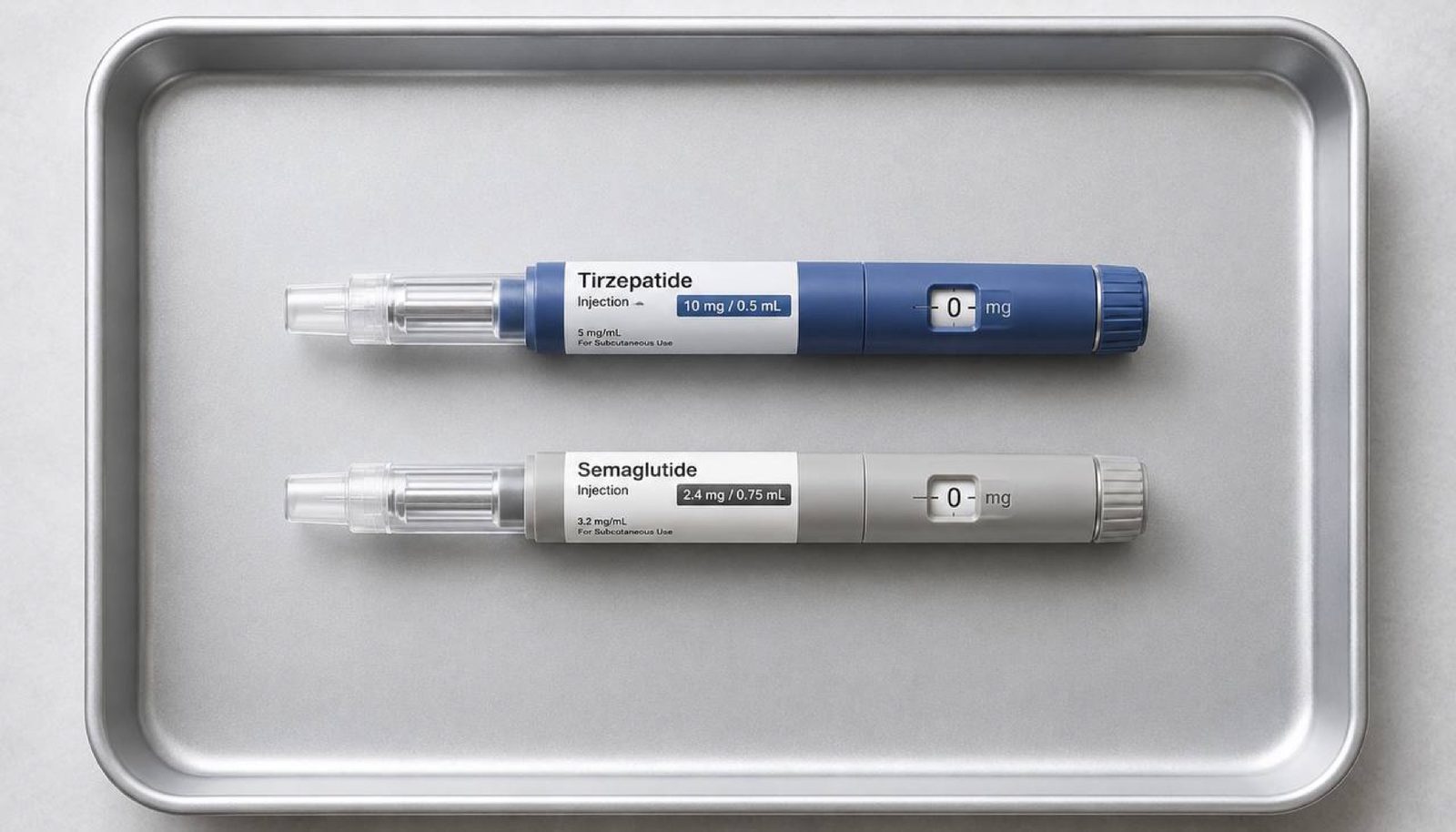
The framing — why this comparison matters in 2026
For most of the GLP-1 era — see our broader landscape piece — semaglutide and tirzepatide were compared indirectly. STEP-1 reported semaglutide at roughly −14.9% body weight at 68 weeks [Wilding 2021]. SURMOUNT-1 reported tirzepatide at roughly −22.5% at the 15 mg dose at 72 weeks [Jastreboff 2022]. Different trial populations, different durations, different placebo arms. The internet decided tirzepatide was simply better. The data, until recently, would not have stood up to a head-to-head.
That changed with SURMOUNT-5. Eli Lilly randomized tirzepatide against semaglutide directly at maximum approved obesity doses in adults without type 2 diabetes (T2D — diabetes mellitus type 2). The result is the cleanest comparison the class has produced, and it lands in the middle of an obesity-drug arms race that now includes oral GLP-1s, triple agonists, and amylin combos. The relevant question for 2026 is no longer "does GLP-1 work" — it is which molecule, at what cost, for which patient, with what trade-offs.
This article is comparison analysis, not a protocol. We tier nothing here. The drug that wins on a weight-loss curve does not necessarily win for a given patient — comorbidities, route of administration, cost, and side-effect tolerance all redistribute the answer.
Mechanism — mono-agonist vs dual agonist
Semaglutide is a GLP-1 (glucagon-like peptide-1) receptor mono-agonist. It mimics a single incretin hormone, activating GLP-1 receptors in the pancreas (glucose-dependent insulin secretion, glucagon suppression), the gut (delayed gastric emptying), the hypothalamus (satiety), and the brainstem (the nausea that limits titration). The acylated fatty-acid side chain extends its half-life to roughly 165 hours and supports once-weekly dosing [Lau 2015].
Tirzepatide is a dual agonist of GLP-1 and GIP (glucose-dependent insulinotropic polypeptide) receptors in a single 39-amino-acid peptide. GIP is the other major incretin — secreted by K-cells in the upper small intestine — and was historically dismissed as therapeutically uninteresting because GIP signaling appears blunted in T2D. The therapeutic insight behind tirzepatide is that GIP agonism, paired with GLP-1, produces additive effects on insulin sensitivity, adipose handling, and possibly tolerance to the nausea of GLP-1 alone [Frias 2021].
Whether that translates to a clinical advantage is an empirical question. The mechanism predicts a larger effect; the head-to-head trials test it.
Tirzepatide is not "semaglutide plus more semaglutide." It is a different molecule activating a different receptor pair, and the dual signal appears to do something the mono-agonist signal does not.
SURMOUNT-5 — the head-to-head trial
SURMOUNT-5 (Aronne et al., NEJM 2024-2025) enrolled 751 adults with obesity or overweight plus at least one weight-related complication, excluding T2D. Participants were randomized 1:1 to tirzepatide titrated to the maximum tolerated dose (10 or 15 mg weekly) or semaglutide titrated to its maximum approved obesity dose (2.4 mg weekly). The primary endpoint was percent change in body weight at 72 weeks [Aronne 2024].
The headline result: tirzepatide produced a mean weight reduction of roughly 20.2% versus roughly 13.7% for semaglutide — a treatment difference of approximately 6.5 percentage points favoring the dual agonist. Secondary endpoints reinforced the gap: 31.6% of tirzepatide participants reached ≥25% weight loss, versus 16.1% on semaglutide. Waist circumference, systolic blood pressure, and triglycerides all moved further on the dual agonist.
The numbers track the indirect comparison from SURMOUNT-1 versus STEP-1 almost exactly, which is the unusual feature here. When trial programs replicate within roughly two percentage points of one another, you are looking at a durable signal rather than a statistical fluke. The SURMOUNT-5 result is what the field expected, formalized in the right trial design.
T2D data — SURPASS-2 and the A1c gap
The weight-loss head-to-head followed a precedent set four years earlier in diabetes. SURPASS-2 (Frias et al., NEJM 2021) randomized 1,879 adults with T2D to tirzepatide 5, 10, or 15 mg weekly versus semaglutide 1 mg weekly at 40 weeks. At the 15 mg dose, tirzepatide reduced A1c (glycated hemoglobin — a three-month average of blood glucose) by 2.30 percentage points versus 1.86 points for semaglutide 1 mg, and produced 11.2 kg of weight loss versus 5.7 kg [Frias 2021].
The fair critique of SURPASS-2 is that semaglutide was dosed at 1 mg — the T2D dose at the time — rather than the 2.0 mg dose now approved for diabetes or the 2.4 mg dose used for obesity. The trial therefore overstates the head-to-head gap in T2D as it would be prescribed in 2026. But even at higher semaglutide doses, the directional finding has held in subsequent analyses: dual GIP/GLP-1 agonism produces larger reductions in A1c and weight than GLP-1 alone in T2D populations. The mechanism story and the trial story agree.
Side-effect profile and the lean-mass question
Both drugs are GI-dominant. Nausea, diarrhea, constipation, and vomiting are the four reliable complaints in every trial in the class, and SURMOUNT-5 was not an exception. Rates of any GI adverse event were comparable between arms (roughly 70% on tirzepatide, 65% on semaglutide), with most events graded mild to moderate and concentrated in the titration phase. Discontinuation for adverse events ran in the 5–6% range on both arms — not nothing, but well below the rate that would change a prescribing decision.
Real-world tolerability differs in the patient community use we hear most often: titration speed matters more than which molecule. Patients pushed through dose escalations on a manufacturer-set monthly schedule tolerate either drug worse than patients held at a sub-maximal dose for an additional 4–8 weeks. The trial titration protocols are aggressive by design.
The lean-mass question applies to both. Roughly 25–40% of mass lost during GLP-1 therapy is fat-free, including skeletal muscle [Wilding 2021]. Because tirzepatide drives more total weight loss, the absolute lean-mass loss is also larger — proportionally similar, numerically more. There is no published evidence that the dual agonist preserves muscle better than the mono-agonist. The countermeasures (protein intake at 1.6–2.2 g/kg reference body weight [Phillips 2016], resistance training, slower titration) are identical for both drugs.
Both tirzepatide and semaglutide carry an FDA boxed warning for the risk of medullary thyroid carcinoma (MTC — a rare thyroid cancer) based on rodent C-cell tumor signals. Personal or family history of MTC or multiple endocrine neoplasia type 2 is a contraindication for both. Acute pancreatitis, gallbladder events, and diabetic retinopathy progression in patients with pre-existing retinopathy are class-level concerns to surveil for either.
Cost, access, supply
US list prices in early 2026 sit at roughly $1,000–1,350 per month for both drugs at obesity-indication doses, with tirzepatide (Zepbound) priced modestly below semaglutide (Wegovy) at parity doses. Net prices after rebates run substantially lower, but commercial insurance coverage remains the binding constraint for most patients. Coverage for obesity indications is improving but still uneven; coverage for T2D indications is broad.
Both drugs spent meaningful portions of 2022–2024 on the FDA drug shortage list, which opened the regulatory door for 503A and 503B compounding pharmacies to produce versions for individual patients. By late 2024, the FDA had declared the semaglutide and tirzepatide shortages resolved, which legally constrained compounded supply going forward. Compounded versions still circulate, but the regulatory posture in 2026 is materially different from the wild-west period of 2023.
For the comparison: on a per-percent-of-body-weight basis, tirzepatide is modestly more efficient. On a per-month-out-of-pocket basis for patients without coverage, the two are close enough that the answer is determined by which one the patient's insurance prefers, or which one their clinician has more experience titrating. See our tirzepatide reference and semaglutide reference for the full dosing and contraindication breakdowns.
Where each still wins
SURMOUNT-5 did not end the conversation. Three areas still favor semaglutide.
Cardiovascular outcomes maturity. SELECT (Lincoff et al., NEJM 2023) enrolled 17,604 non-diabetic adults with obesity and established cardiovascular disease and demonstrated a 20% reduction in major adverse cardiovascular events with semaglutide 2.4 mg over a median 39.8 months (HR 0.80, 95% CI 0.72–0.90) [Lincoff 2023]. This is a hard-endpoint trial in a non-diabetic population. Tirzepatide's analogous trial — SURMOUNT-MMO — is still enrolling as of early 2026. Until that reads out, semaglutide is the only obesity-dose GLP-1 with cardiovascular-outcome data on the label for adults without diabetes.
Oral formulation. Rybelsus is once-daily oral semaglutide, approved for T2D at 3, 7, and 14 mg doses. It is not yet approved for obesity at higher oral doses (the trial program is reading out), but for patients with needle phobia or for whom weekly injection is a barrier, an oral GLP-1 exists on the semaglutide side and does not yet exist on the tirzepatide side.
Brand recognition and prescriber familiarity. Ozempic and Wegovy entered the cultural lexicon two years before Mounjaro and Zepbound. That translates into more prescribing experience, more troubleshooting knowledge for GI side effects, and — for now — more straightforward insurance pathways. This is not a clinical advantage; it is a logistical one. But logistical advantages move prescriptions.
Tirzepatide's wins are simpler: more weight loss at the maximum dose, more A1c reduction in T2D, and a modestly lower list price at parity doses. For a patient whose primary goal is weight reduction and who has no specific cardiovascular indication, the dual agonist is what the trial data supports.
The verdict — and what's coming
SURMOUNT-5 establishes tirzepatide as the more efficacious weight-loss agent at maximum approved doses, by a margin (~6.5 percentage points) that is clinically meaningful and statistically robust. SURPASS-2 establishes the same directionality in T2D, with the caveat that the semaglutide comparator was sub-maximally dosed. The side-effect profiles are comparable; the lean-mass concern applies equally; the cost difference is modest and is usually overwhelmed by what the patient's insurance prefers.
The grey areas are real. Tirzepatide does not yet have a SELECT-equivalent for cardiovascular outcomes in adults without diabetes. Neither drug has long-term (5+ year) durability data outside of T2D extensions. Lean-mass preservation strategies in GLP-1 cohorts are still under-studied. The anti-inflammatory reach of the class is only starting to be mapped — a psoriasis-remission result pairing tirzepatide with an IL-17 inhibitor is one of the more striking early signals. And the cost barriers — even with manufacturer programs — exclude the majority of patients who would benefit globally.
Two pipelines are about to complicate the comparison again. Retatrutide, Eli Lilly's GLP-1/GIP/glucagon triple agonist, reported −24.2% weight loss at 12 mg over 48 weeks in phase 2 [Jastreboff 2023]; phase 3 (TRIUMPH) is enrolling. CagriSema, Novo Nordisk's cagrilintide (amylin analog) plus semaglutide combination, reported −22.7% in REDEFINE-1 — below the company's pre-trial target, but still in the same range as tirzepatide. By 2027–2028, the head-to-head comparison that matters may be retatrutide versus CagriSema, with tirzepatide and semaglutide as the established baseline rather than the frontier.
For 2026, the honest summary is: tirzepatide wins on the weight-loss curve; semaglutide wins on cardiovascular-outcome evidence and oral formulation availability; the two are closer in real-world tolerability and cost than the trial data alone would suggest; and the next molecule in the queue may rearrange the entire comparison within 24 months. For patients who fail semaglutide outright — a population now confirmed by pharmacogenetics to be roughly 1 in 10 — tirzepatide's second receptor pathway is the mechanistic case for switching; see our piece on GLP-1 non-responders and what to do about it. For the broader class context, see our weight and metabolic topic page.
References
- Aronne LJ, et al. Tirzepatide as Compared with Semaglutide for the Treatment of Obesity (SURMOUNT-5). N Engl J Med. 2024-2025 (online ahead of print/in press).
- Frias JP, et al. Tirzepatide versus Semaglutide Once Weekly in Patients with Type 2 Diabetes (SURPASS-2). N Engl J Med. 2021;385:503-515.
- Wilding JPH, et al. Once-Weekly Semaglutide in Adults with Overweight or Obesity (STEP 1). N Engl J Med. 2021;384:989-1002.
- Jastreboff AM, et al. Tirzepatide Once Weekly for the Treatment of Obesity (SURMOUNT-1). N Engl J Med. 2022;387:205-216.
- Lincoff AM, et al. Semaglutide and Cardiovascular Outcomes in Obesity without Diabetes (SELECT). N Engl J Med. 2023;389:2221-2232.
- Lau J, et al. Discovery of the Once-Weekly Glucagon-Like Peptide-1 (GLP-1) Analogue Semaglutide. J Med Chem. 2015;58(18):7370-7380.
- Jastreboff AM, et al. Triple-Hormone-Receptor Agonist Retatrutide for Obesity — A Phase 2 Trial. N Engl J Med. 2023;389:514-526.
- Phillips SM, Chevalier S, Leidy HJ. Protein requirements beyond the RDA. Appl Physiol Nutr Metab. 2016;41(5):565-572.
- Drucker DJ. Mechanisms of Action and Therapeutic Application of Glucagon-like Peptide-1. Cell Metab. 2018;27(4):740-756.
- FDA Drug Shortage Database. Semaglutide injection products / Tirzepatide injection products — resolution notices. US Food and Drug Administration, accessed Q1 2026.