Thymosin alpha-1: the immune peptide that is a real drug abroad — and how far its reputation runs past its evidence
Most of the peptides we cover live entirely on the grey market, with names that promise more than the data delivers. Thymosin alpha-1 (Tα1) is different, and that difference matters. It is a genuine, approved medicine in roughly three dozen countries — sold as Zadaxin, generic name thymalfasin — with a real clinical file behind it: hepatitis B and C adjuvant trials, sepsis studies, a vaccine-adjuvant record, and cancer-immunotherapy work. It is also not FDA-approved in the United States, where it exists only as a compounded, grey-market peptide. So the honest question is not “is this real?” — it is real — but “real for what?” The signal Tα1 pulls is immune restoration: rebalancing an exhausted or paralyzed immune system back toward function, rather than blanket-boosting a healthy one. In the specific indications where that signal is needed, the evidence is genuine. As a general immune tonic for well people, it runs a long way ahead of what the trials actually show. This is the cited read on where the line sits.
How this article was built: Primary sources: Chien and colleagues’ 1998 randomized hepatitis B trial in Hepatology, the Yang et al. 2008 hepatitis B meta-analysis in Antiviral Research, Camerini and Garaci’s 2015 historical review in Expert Opinion on Biological Therapy, King and Tuthill’s 2016 mechanism review in Vitamins and Hormones, the Wu et al. 2013 ETASS sepsis RCT in Critical Care, the Liu et al. 2020 severe-COVID-19 study in Clinical Infectious Diseases, and the Dominari et al. 2020 comprehensive review in the World Journal of Virology — all retrieved and verified through PubMed and the Consensus research database.
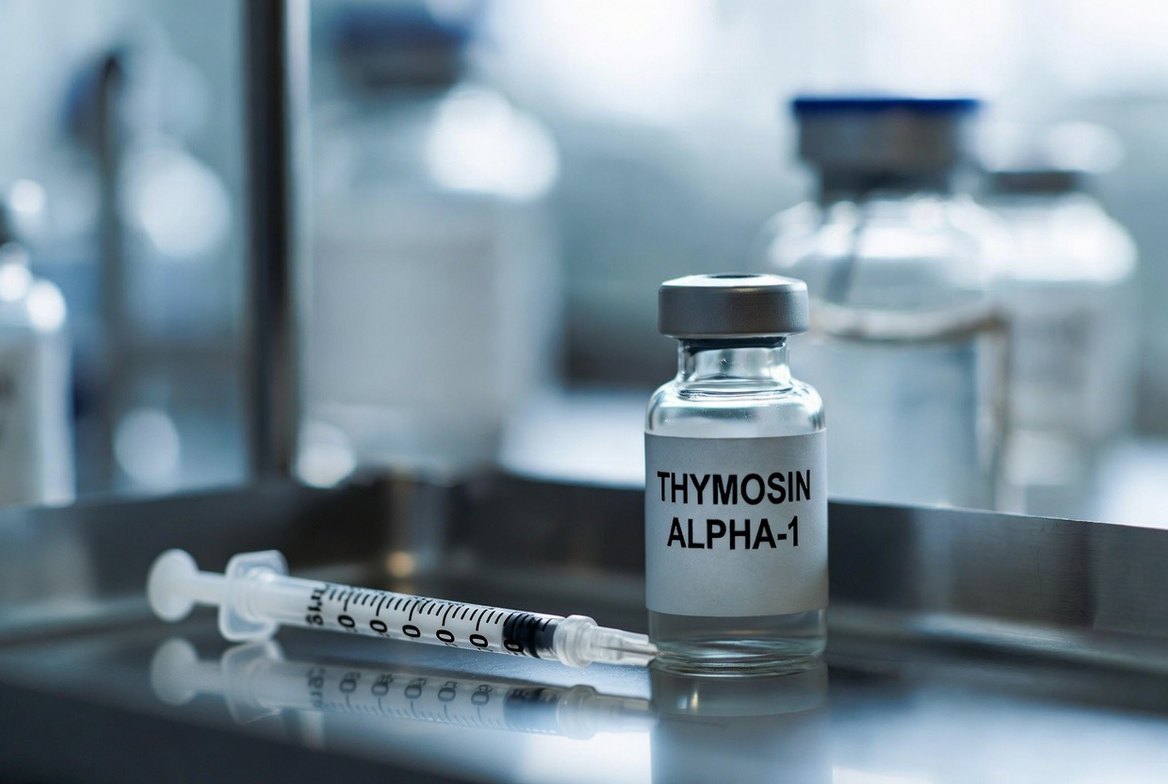
- It’s real — and actually approved. Thymosin alpha-1 (Tα1) is a 28-amino-acid peptide fragment derived from thymosin fraction 5 and produced by the thymus. Unlike most grey-market peptides, it is an approved drug in roughly 35 countries (Zadaxin / thymalfasin), including China, mainly as a hepatitis B and C adjuvant.3
- Hepatitis is its strongest file. Randomized trials and meta-analyses support Tα1 as an add-on for chronic HBV (hepatitis B virus), with delayed-but-durable virological responses — this is real clinical evidence, not marketing.12
- Sepsis and immunoparalysis are the frontier — and a cautionary one. In critically ill patients whose immune systems have collapsed, Tα1 aims to restore exhausted function; the early ETASS and severe-COVID data were promising, but the large 2025 TESTS phase-3 RCT found no overall sepsis mortality benefit, so the story is now “possibly real in specific subgroups, unproven in general.”58
- The healthy-person “immune booster” pitch is the weak link. There is little to no trial evidence that Tα1 benefits otherwise-healthy people, and in the US it’s not FDA-approved — only compounded and grey-market, with real sourcing risk.7
- What thymosin alpha-1 actually is
- Approved abroad, grey-market in the US
- The strongest file: hepatitis B and C
- Sepsis, immunoparalysis, and severe COVID-19
- Cancer and vaccine adjuvant data
- Mechanism: the signal it pulls
- The healthy-person “immune booster” gap
- Safety, sourcing, and the regulatory reality
- The hype: what the marketing skips
- The honest verdict
- What this article is not saying
- References
What thymosin alpha-1 actually is
Thymosin alpha-1 — Tα1 for short — is a small peptide: a chain of 28 amino acids, acetylated at one end, originally identified within a crude thymic preparation called thymosin fraction 5 (a partially purified extract of calf thymus glands that early immunologists used to study thymic hormones). The thymus is the small organ behind the breastbone where T cells — the immune system’s coordinating lymphocytes — mature. Tα1 is one of the biologically active fragments the thymus produces, and it behaves like a thymic hormone: a signal that helps immune cells finish developing and coordinate their response.
That origin is the whole reason to take Tα1 seriously. It is not a designer research chemical invented to be sold; it is a naturally occurring, endogenous peptide that the body already makes, isolated and characterized decades ago and then synthesized for clinical use. Its job, biologically, is immune coordination — helping T cells mature, nudging DCs (dendritic cells — the immune system’s antigen-presenting sentinels that decide which threats to raise the alarm on) toward activation, supporting NK (natural killer — the innate lymphocytes that kill virus-infected and tumor cells without prior sensitization) activity, and, importantly, dampening excessive inflammation when the response overshoots.
Hold on to that last part, because it is the key to reading everything downstream. Tα1 is not a one-directional stimulant. It behaves more like a rebalancer: it can push an under-functioning immune system back up and pull an over-inflamed one back down toward homeostasis. In our framework for immune peptides — where we sort them into those that CALM and REPAIR, those that RESTORE, and those that AMPLIFY — Tα1 sits squarely in the RESTORE column. The signal it pulls is not “more immune,” it is “correctly tuned immune.” That distinction is exactly where the marketing gets it wrong later.
Approved abroad, grey-market in the US
Here is what genuinely separates Tα1 from almost every other peptide we write about: it is an approved medicine. Under the brand name Zadaxin (generic thymalfasin), it has been approved and marketed in roughly 35 countries — including China, where it is widely used — primarily as an immune-modulating adjuvant for chronic hepatitis B and C, and as a vaccine adjuvant, with additional study in sepsis and cancer.3 That means it has passed regulatory review somewhere, carries a manufacturing standard in those markets, and has an established clinical dosing history. Very few grey-market peptides can say any of that.
But — and this is the fork in the road for most readers of this site — Tα1 is not FDA-approved (the FDA is the US Food and Drug Administration, the agency that must clear a drug for marketing in the United States). In the US it has orphan-drug history but no general approval, which means the version circulating there is either imported or, more commonly, compounded and sold through the same research-peptide grey market as everything else. So an American buyer and a Chinese hospital patient are, in effect, using two very different things: one a regulated pharmaceutical with release testing, the other a compounded or grey-market product with none of those guarantees. The molecule is identical; the accountability around it is not.
The molecule is a real, approved drug abroad. The vial someone buys online in the US is not the same thing — same peptide, none of the oversight.
The strongest file: hepatitis B and C
If you want to know what Tα1 can actually do, start where its evidence is strongest: chronic viral hepatitis. This is the indication that earned it approval abroad, and it is backed by randomized trials, not testimonials.
In a randomized, controlled trial published in Hepatology in 1998, Chien and colleagues treated patients with chronic HBV (hepatitis B virus) using Tα1 and followed their virological response. The result had an unusual and now-characteristic shape: the benefit was not obvious at the end of treatment, but it accumulated afterward, with a meaningfully higher rate of durable response building over the following months compared with controls.1 That delayed-response pattern is a fingerprint of an immunomodulator rather than a direct antiviral — Tα1 is not attacking the virus itself; it is helping the patient’s own immune system get organized enough to control it. The signal it pulls is restoration of a suppressed antiviral response, and it takes time to show.
A 2008 meta-analysis in Antiviral Research by Yang and colleagues pooled the head-to-head hepatitis B data comparing Tα1 with interferon-alpha and found the same story with more weight behind it: while Tα1’s advantage was not immediately significant at the end of therapy, virological and biochemical responses tended to rise and accumulate in the follow-up period.2 Later systematic reviews of Tα1 combined with interferon in HBV and HCV (hepatitis C virus) have broadly supported an adjuvant benefit, and the comprehensive literature review by Dominari and colleagues catalogues this hepatitis record as one of Tα1’s best-established uses.7 It is not a miracle — effect sizes are moderate and the design of some older trials is imperfect — but it is real, replicated, indication-specific clinical evidence. That is why we grade “approved and effective as a hepatitis adjuvant abroad” as STRONG.
Sepsis, immunoparalysis, and severe COVID-19
The most conceptually interesting use of Tα1 is also its most instructive, because it shows exactly what the peptide is for. Severe sepsis — the body’s catastrophic, dysregulated response to infection — is often thought of as pure runaway inflammation. But in many critically ill patients, the later and more lethal phase is the opposite: immunoparalysis, a state in which the immune system becomes exhausted and suppressed, T cells stop responding, and the patient can no longer clear infection. This is precisely the scenario Tα1’s RESTORE signal is built for.
The landmark test is the ETASS trial (Efficacy of Thymosin Alpha 1 for Severe Sepsis), a multicenter, single-blind, randomized controlled trial across six teaching hospitals in China, published by Wu and colleagues in Critical Care in 2013. It randomized patients with severe sepsis to Tα1 or control and looked at 28-day all-cause mortality and immune function. The trial reported a reduction in mortality that trended in Tα1’s favor (28-day mortality 26.0% vs 35.0%) along with improvements in immune-function markers — encouraging, biologically coherent, but not a slam-dunk: the primary mortality difference sat right at the edge of significance (P=0.062 unstratified; P=0.049 log-rank) and the design was single-blind.5 For years it was the strongest sepsis signal Tα1 had — exactly the sort of promising result that demands a larger, definitive, double-blind confirmatory trial. That trial has since been run, and its result reframes the whole file (below).
The COVID-19 pandemic became an accidental extension of that hypothesis. In a study published in Clinical Infectious Diseases in 2020, Liu and colleagues retrospectively reviewed severe COVID-19 patients in Wuhan and reported that Tα1 treatment was associated with reduced mortality, apparently by restoring depleted lymphocyte counts and reversing the exhaustion of T cells — the immune-restoration mechanism made visible.6 That is a compelling proof-of-concept for the RESTORE framing, but it must be read with care: it was retrospective and observational, not a randomized trial, and retrospective infection data are notoriously vulnerable to confounding.
And the definitive trial the sepsis file was waiting for has now landed — with a sobering result. In 2025, the same lead investigators published TESTS (Efficacy and Safety of Thymosin α1 for Sepsis), a large, multicenter, double-blind, placebo-controlled phase 3 RCT of 1,106 adults with sepsis in The BMJ — and it found no overall mortality benefit (28-day mortality 23.4% with Tα1 vs 24.1% with placebo; hazard ratio 0.99, P=0.93).8 Prespecified subgroups hinted at a possible benefit in older and diabetic patients (and possible harm in the under-60s), and a 2025 meta-analysis likewise found that once the highest-quality and multicenter trials are isolated, the pooled mortality signal loses significance.9 In other words: the earlier ETASS signal did not hold up when tested rigorously in the whole population, though a targeted, deficit-specific benefit remains an open question. Across sepsis and severe viral illness, the fair grade for “Tα1 improves outcomes in immunoparalysis by restoring immune function” is EMERGING — biologically plausible and possibly real in specific subgroups, but not confirmed as a general sepsis therapy, and now with a large negative phase-3 trial that any honest read has to put on the table.
Cancer and vaccine adjuvant data
Two smaller threads round out the legitimate evidence base. As a vaccine adjuvant, Tα1 has been studied to boost the response to immunization in populations that respond poorly — the elderly, dialysis patients, the immunocompromised — again leaning on its RESTORE property: helping an under-responsive immune system mount a proper reply to an antigen it would otherwise ignore. The historical review by Camerini and Garaci walks through this adjuvant record across influenza and hepatitis vaccination.3
In cancer immunotherapy, Tα1 has been explored mostly as an adjuvant alongside conventional treatment — chemotherapy, or other immune agents — in melanoma, hepatocellular carcinoma, and non-small-cell lung cancer, with the rationale that restoring immune competence in treatment-suppressed patients could improve response and tolerability. The comprehensive Dominari review summarizes this work as suggestive rather than established: real trials exist, some signals are positive, but none of it makes Tα1 a cancer therapy in its own right.7 The honest read on both cancer and vaccine adjuvancy is that they are legitimate, biologically consistent research areas — not proof of a general-purpose immune drug.
Mechanism: the signal it pulls
Unusually for a peptide in this space, Tα1’s mechanism is reasonably well characterized — which is part of why its evidence hangs together. The clearest synthesis is the 2016 review by King and Tuthill in Vitamins and Hormones, which describes Tα1 as a pleiotropic immunomodulator acting largely through TLRs (toll-like receptors — pattern-recognition sensors that immune cells use to detect pathogens and switch on a response) on both myeloid and plasmacytoid dendritic cells.4
Engaging those TLRs activates downstream signaling — NF-κB, TRAF6, p38 MAPK pathways — and drives dendritic-cell maturation and cytokine production, including IL-2, IL-12, and IFN-γ. That cytokine profile pushes the immune response toward a Th1 (T-helper 1 — the arm of adaptive immunity specialized for fighting viruses and intracellular pathogens, as opposed to the Th2 arm that handles antibody and allergic responses) pattern, supports T-cell maturation, and enhances NK-cell activity.4 In plainer terms: Tα1 helps the immune system recognize a threat, mature the right cells to fight it, and coordinate a virus-and-tumor-oriented response.
Crucially, this is restoration, not indiscriminate amplification. Tα1’s effects are most pronounced where the immune system is under-functioning — suppressed, exhausted, or aging — and it also helps rein in overshoot, which is why it can calm the damaging hyper-inflammation of severe infection while simultaneously reviving exhausted T cells. That dual action is the signal it pulls, and it is well enough described to grade the mechanistic claim as MODERATE: the pathways are characterized and biologically coherent, even if the exact contribution of each pathway in each disease is still being mapped.
The healthy-person “immune booster” gap
Now the pivot the marketing depends on you not noticing. Community use of Tα1 has migrated far from its clinical file. It is increasingly sold and discussed as a general “immune support” peptide for otherwise-healthy people — a tonic to take through cold season, an “autoimmune calming” agent, a post-illness or post-viral recovery aid, a longevity add-on. The pitch borrows the credibility of the hepatitis and sepsis data and quietly applies it to a completely different population.
The problem is structural, and it follows directly from the mechanism. Everything that makes Tα1 valuable — restoring exhausted T cells, reviving under-responsive dendritic cells, rebalancing a dysregulated response — presupposes that there is a deficit to correct. In a critically ill sepsis patient or a chronic-hepatitis carrier, there is. In a healthy adult with an intact, well-tuned immune system, the deficit Tα1 exists to fix is largely absent, so it is unclear what the peptide would even be restoring. Tellingly, the clinical literature that supports Tα1 is almost entirely in sick populations; there is little to no controlled trial evidence showing benefit in healthy people, and the comprehensive review frames its value squarely around immunocompromised and disease states rather than wellness use.7
The “autoimmune calming” narrative deserves its own caution. Tα1’s ability to dampen overshoot is real in the context of acute hyper-inflammation, but an autoimmune disease is a chronic, specific immune dysregulation — not the same target — and a peptide that pushes toward a Th1 response is not obviously benign in every autoimmune context. Nudging immune activity in someone whose immune system is already attacking their own tissue is precisely the kind of move that needs a clinician, not a vial from the internet. On balance, “Tα1 is a proven general immune booster for healthy people” earns a WEAK grade: the evidence for it is sparse-to-absent, and the mechanism actively predicts it should do less in people who don’t have a deficit to restore.
Safety, sourcing, and the regulatory reality
On safety, Tα1 has a genuinely reassuring profile in the trial literature. Across hepatitis, sepsis, and adjuvant studies it has been generally well tolerated, with a low rate of serious adverse events — unsurprising for a peptide that mimics a hormone the body already makes. That favorable clinical safety record is one of the real reasons it has kept researchers’ attention.
But — and the warning is now familiar — that safety data comes from pharmaceutical-grade Tα1 administered under medical supervision. It does not transfer automatically to a compounded or grey-market vial bought online. In the US, where Tα1 is not FDA-approved, several concrete risks stack up:
Purity and identity are unverified. Grey-market and compounded peptides are not subject to the assay and release testing that governs approved drugs. Independent testing across the research-peptide market has repeatedly turned up products that are under-dosed, over-dosed, degraded, contaminated, or simply not the peptide on the label. A clean clinical safety record means little if the vial doesn’t contain what it claims.
Sterility and injection risk. Tα1 is injected. Self-reconstituting and self-injecting a product whose sterility has not been verified carries infection and contamination risks that no amount of enthusiasm neutralizes. The delivery route that makes peptides work is also the route that makes sloppy sourcing dangerous.
Immune-modulating drugs are not casual. This is a compound that deliberately shifts immune function. In the wrong context — an undiagnosed autoimmune condition, an interaction with immunosuppressive therapy, an active malignancy —“modulating the immune system” is not a trivial thing to do to yourself unsupervised. The favorable safety data was generated in monitored patients, not in people self-experimenting without a diagnosis.
The hype: what the marketing skips
Tα1 is a case study in a specific kind of overreach: taking a compound with real, indication-specific approval and stretching that credibility over a much larger, unproven claim. The marketing loves to lead with “approved in 35 countries” and “used in hospitals” — both true — and then slide, without a seam, into “so it will boost your immune system,” which the evidence does not support.7
Three things the hype consistently omits. First, that the approval is indication-specific — hepatitis, immunocompromised states, adjuvant use — and does not include general wellness in healthy adults, and that in the US there is no FDA approval at all.3 Second, that the mechanism itself predicts diminishing returns in healthy people: you cannot restore a function that isn’t depleted. Third, that the product most people can actually buy is a compounded or grey-market injectable, not the release-tested pharmaceutical the trials used. Put those omissions back in, and “FDA-approved cure-all immune therapy you should be taking” collapses into “a real, approved-abroad immune-restoring drug for specific illnesses, being oversold as a tonic.” That final claim — Tα1 as a proven, FDA-approved immune cure-all for general use — is HYPE, not because Tα1 is fake, but because the claim inflates a legitimate, narrow drug into something it has never been shown to be.
Thymosin alpha-1 rewards one habit of mind that runs through everything we publish on immune peptides: know whether a compound amplifies, calms and repairs, or restores — because the answer tells you who it’s actually for. Tα1 restores exhausted, suppressed, or aging immune function; that is a real and valuable job in a sick patient, and a mostly-imaginary one in a healthy person chasing a “boost.” The Manual maps the immune peptides against each other on exactly this axis — RESTORE versus CALM+REPAIR versus AMPLIFY — with the approval status, the trial base, and the marketing stripped apart, so you can see which peptide fits which signal and which are trading on borrowed credibility. If you want the depth this article deliberately leaves on the table — dosing realities, sourcing red flags, and how Tα1 stacks up against the other immune peptides — that is where it lives. See the Manual → · Read a sample →
The honest verdict
Thymosin alpha-1 is one of the few peptides in this whole space that clears the highest bar we can set: it is a genuine, approved, evidence-backed medicine somewhere in the world. It is an endogenous 28-amino-acid immune peptide with a characterized mechanism, real randomized-trial support as a hepatitis adjuvant, a promising-if-unfinished sepsis and severe-infection file, and a reassuring clinical safety record. Read against the average grey-market peptide, that is an exceptional pedigree.
But “real drug” is not “right for everyone,” and this is the line the honest read has to hold. Tα1’s legitimacy lives in specific contexts — chronic hepatitis, immunoparalysis, immunocompromised patients — where its RESTORE signal has a deficit to correct. Applied to healthy people as a general immune tonic, it runs a long way ahead of the evidence, and the mechanism itself suggests it should do less where there is nothing to restore. Layer on the US regulatory reality — not FDA-approved, compounded and grey-market, with genuine sourcing risk — and the verdict is not “avoid a scam” (Tα1 is emphatically not a scam) but “respect what it is.” It is a targeted immune-restoration drug that belongs in a clinician’s hands for the illnesses it was built for — not an over-the-counter shield for a healthy immune system that doesn’t need rescuing.
What this article is not saying
This is not “thymosin alpha-1 is fake or useless.” It is a real, approved, well-characterized immune peptide with legitimate randomized-trial evidence in hepatitis and a serious research program in sepsis and severe infection.15 Dismissing it would be as wrong as over-hyping it. The issue is scope, not authenticity.
This is not “Tα1 definitely does nothing for immune function.” It clearly modulates immune activity — that is exactly why it works where it works.4 The honest position is that its benefit is conditional: strong where there is a deficit to restore, weak-to-unproven where there isn’t. That is a very different statement from the confident “immune booster for everyone” the marketing implies.
And this is not medical advice or an endorsement to use it. In the US, Tα1 is an unapproved, compounded, grey-market injectable with real sourcing, purity, and immune-safety considerations, and nothing here is a recommendation to obtain or self-administer it. If you have an infection, an autoimmune condition, a cancer diagnosis, or a compromised immune system, that is a conversation for a clinician — not a vial bought on the strength of an “approved in 35 countries” headline.
References
- Chien RN, Liaw YF, Chen TC, Yeh CT, Sheen IS. Efficacy of thymosin alpha1 in patients with chronic hepatitis B: a randomized, controlled trial. Hepatology. 1998;27(5):1383-1387. DOI · PMID 9581695
- Yang YF, Zhao W, Zhong YD, Yang YJ, Shen L, Zhang N, Huang P. Comparison of the efficacy of thymosin alpha-1 and interferon alpha in the treatment of chronic hepatitis B: a meta-analysis. Antiviral Res. 2008;77(2):136-141. DOI · PMID 18078676
- Camerini R, Garaci E. Historical review of thymosin alpha 1 in infectious diseases. Expert Opin Biol Ther. 2015;15 Suppl 1:S117-S127. DOI · PMID 26098768
- King R, Tuthill C. Immune Modulation with Thymosin Alpha 1 Treatment. Vitam Horm. 2016;102:151-178. DOI · PMID 27450734
- Wu J, Zhou L, Liu J, Ma G, Kou Q, He Z, Chen J, Ou-Yang B, Chen M, Li Y, Wu X, Gu B, Chen L, Zou Z, Qiang X, Chen Y, Lin A, Zhang G, Guan X. The efficacy of thymosin alpha 1 for severe sepsis (ETASS): a multicenter, single-blind, randomized and controlled trial. Crit Care. 2013;17(1):R8. DOI · PMID 23327199
- Liu Y, Pan Y, Hu Z, Wu M, Wang C, Feng Z, Mao C, Tan Y, Liu Y, Chen L, Li M, Wang G, Yuan Z, Diao B, Wu Y, Chen Y. Thymosin Alpha 1 Reduces the Mortality of Severe Coronavirus Disease 2019 by Restoration of Lymphocytopenia and Reversion of Exhausted T Cells. Clin Infect Dis. 2020;71(16):2150-2157. DOI · PMID 32442287
- Dominari A, Hathaway III D, Pandav K, Matos W, Biswas S, Reddy G, Thevuthasan S, Khan MA, Mathew A, Makkar SS, Zaidi M, Beas R, Castaneda V, Paul T, Halpern J. Thymosin alpha 1: A comprehensive review of the literature. World J Virol. 2020;9(5):67-78. DOI · PMID 33362999
- Wu J, Pei F, Zhou L, et al. The efficacy and safety of thymosin α1 for sepsis (TESTS): multicentre, double blinded, randomised, placebo controlled, phase 3 trial. BMJ. 2025;388:e082583. DOI · PMID 39814420
- Gu B, Zhou Y, Nie Y, et al. Efficacy of thymosin α1 for sepsis: a systematic review and meta-analysis of randomized controlled trials. Front Cell Infect Microbiol. 2025;15:1673959. DOI · PMID 40969554