Sulforaphane: the NRF2-activating compound in broccoli sprouts that 70+ clinical trials have now studied
There is a chemical in broccoli sprouts that researchers have tested in over 70 registered clinical trials — for cancer prevention, carcinogen detoxification, inflammation, blood sugar, airway disease, autism, and schizophrenia. That chemical is sulforaphane, and it works by flipping a master switch inside your cells called NRF2 (Nuclear Factor Erythroid 2-Related Factor 2). When NRF2 is activated, it turns on more than 50 downstream genes that neutralise reactive oxygen species (molecules that damage DNA and cell membranes), clear carcinogens, and damp down chronic inflammation. The biology is compelling. The human evidence is real but also genuinely uneven. Here is what the trial data actually shows.
Content reviewed by the Wellness Radar editorial team. Educational only — not medical advice. Always consult a clinician before changing any protocol.
- What sulforaphane is and how it forms
- The NRF2 mechanism: why this matters
- Bioavailability: why the source and preparation matter enormously
- Cancer prevention evidence in humans
- Inflammation and carcinogen detoxification
- Metabolic health and emerging brain evidence
- How to actually get meaningful sulforaphane
- Where the evidence stops
- Bottom line
- Citations
What sulforaphane is and how it forms
Sulforaphane is an isothiocyanate — a class of sulfur-containing compounds produced by cruciferous vegetables (broccoli, cauliflower, Brussels sprouts, kale, cabbage) as a chemical defence against insects and pathogens. Cruciferous plants do not actually store sulforaphane itself. They store its precursor, glucoraphanin, a glucosinolate that is stable and biologically inert in intact plant tissue. The conversion to active sulforaphane only happens when glucoraphanin contacts myrosinase — an enzyme stored separately in the plant's cell vacuoles and also produced by gut bacteria.
When you chew, crush, or blend a raw broccoli sprout, the cell walls break, glucoraphanin and myrosinase mix, and a rapid enzymatic conversion produces sulforaphane. The same reaction can occur further down the digestive tract when gut bacteria with myrosinase activity encounter unhydrolysed glucoraphanin. This dual-conversion pathway is why what you eat, how you prepare it, and what lives in your gut all affect how much sulforaphane you actually absorb.
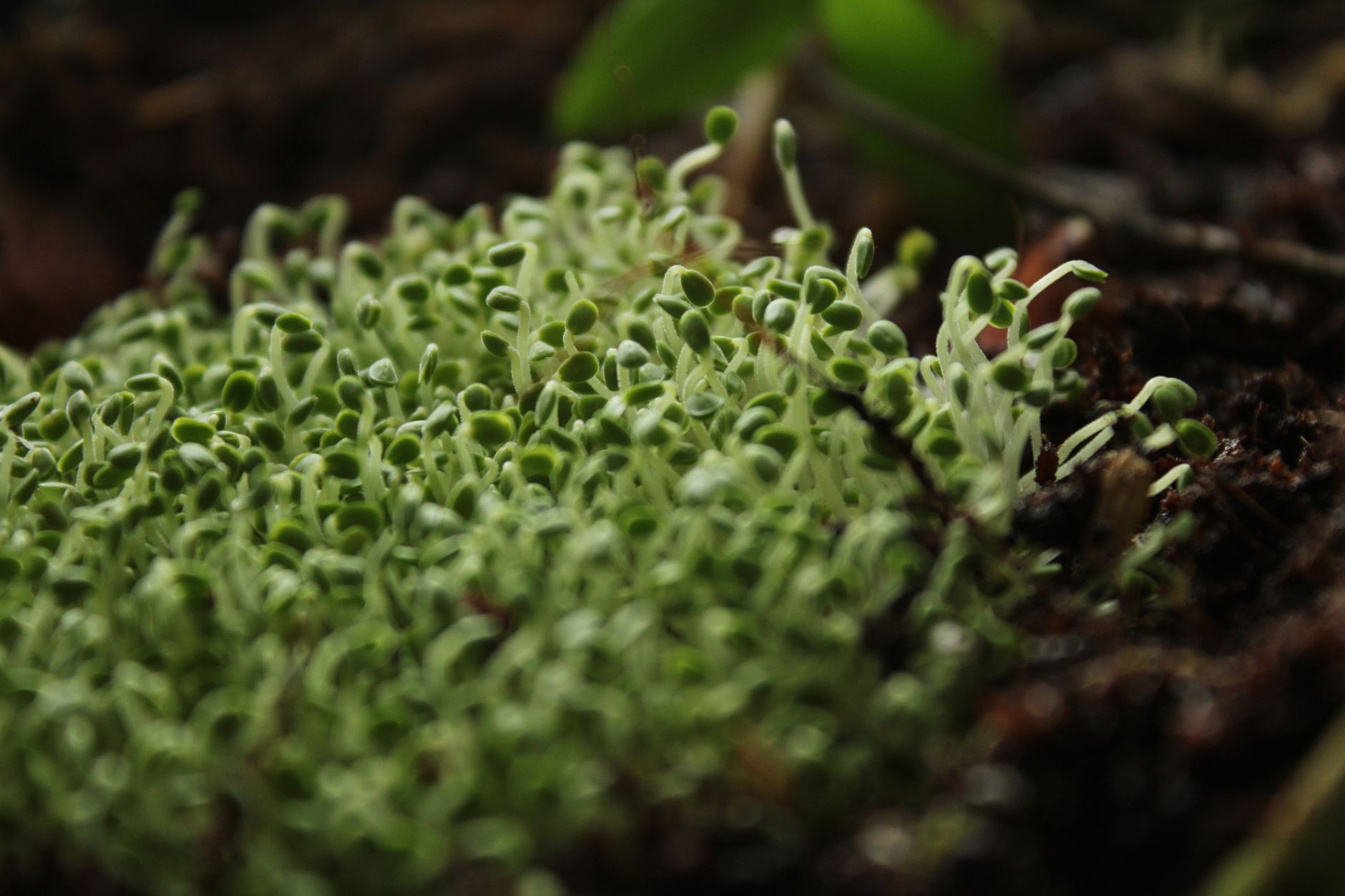
Broccoli sprouts — three-to-four-day-old germinated broccoli seeds — are by far the most concentrated dietary source. They contain 20 to 50 times more glucoraphanin per gram than mature broccoli florets. A small portion of broccoli sprouts (around 50–100 grams) can deliver a glucoraphanin load equivalent to eating a kilogram of mature broccoli. [5]
The NRF2 mechanism: why this matters
NRF2 is a transcription factor — a protein that, when activated, moves into the cell nucleus and switches on a large set of target genes. Under normal, resting conditions, NRF2 is held in the cytoplasm bound to a suppressor protein called KEAP1 (Kelch-like ECH-associated protein 1), which tags it for degradation. When the cell is under oxidative stress, or when certain compounds (including sulforaphane) interact with KEAP1, the NRF2–KEAP1 bond breaks. NRF2 travels to the nucleus and turns on genes encoding over 50 cytoprotective proteins, including:
- Glutathione S-transferases (GSTs) — enzymes that conjugate electrophilic carcinogens, making them water-soluble and excretable
- Heme oxygenase-1 (HO-1) — a potent anti-inflammatory enzyme
- NAD(P)H quinone oxidoreductase 1 (NQO1) — neutralises reactive quinone intermediates
- Thioredoxin reductase — maintains the cellular antioxidant pool
- Glutamate cysteine ligase — the rate-limiting enzyme in glutathione (GSH) synthesis
The result is a broad, coordinated upregulation of cellular defence. Sulforaphane is one of the most potent known dietary activators of NRF2 — in cell-culture models, it activates NRF2 at concentrations achievable through diet. This is not the case for most antioxidant supplements, which function as direct radical scavengers rather than as gene-expression activators. The distinction matters: a direct scavenger neutralises one oxidant molecule per molecule consumed. An NRF2 activator turns on a factory of endogenous antioxidant enzymes that can neutralise millions of oxidant molecules, persistently, for as long as the enzymes are expressed. [1]
Bioavailability: why the source and preparation matter enormously
The bioavailability of sulforaphane is one of the most practically important and widely misunderstood aspects of this compound. It varies by a factor of 10 or more depending on source and preparation.
A 2011 crossover clinical trial gave participants either a sulforaphane-rich sprout beverage (where sulforaphane had already formed via endogenous myrosinase) or a glucoraphanin-rich beverage (where glucoraphanin was present but myrosinase had been deactivated by heat). Mean bioavailability was 70% from the sulforaphane-rich preparation, versus 5% from the glucoraphanin-only preparation. [7] The difference was not marginal — it was fourteen-fold.
A 2026 randomised clinical study published in Scientific Reports found that adding exogenous myrosinase from mustard seed to a glucoraphanin-rich broccoli seed extract doubled bioavailability to 39.8% compared to 18.6% from glucoraphanin alone. [3] This is the basis for several supplement products that combine broccoli seed extract with mustard seed powder to supply the missing enzymatic step.
The critical practical implication: cooking broccoli at high temperatures (boiling, microwaving for extended periods, roasting) deactivates myrosinase, leaving glucoraphanin intact but unconvertible by plant enzymes. You are then dependent entirely on gut bacteria to do the conversion — and gut microbial myrosinase activity varies enormously between individuals. Lightly steaming (3–4 minutes, not longer) partially preserves myrosinase. Eating raw is best for conversion, but the texture and taste of raw broccoli sprouts (sharp, peppery) are their own barrier.
| Preparation | Myrosinase status | Approximate sulforaphane bioavailability |
|---|---|---|
| Fresh broccoli sprouts, raw | Active | ~40–70% |
| Lightly steamed (3–4 min) | Partially active | ~20–40% |
| Fully cooked / boiled | Deactivated | ~5–10% (gut bacteria only) |
| Glucoraphanin supplement alone | None | ~5–18% (gut bacteria only) |
| Glucoraphanin + mustard seed myrosinase | Exogenous | ~40% (trial-documented) |
| Sulforaphane-stabilised extract | Pre-converted | ~60–70% |
Cancer prevention evidence in humans
The cancer-prevention evidence for sulforaphane in humans is real but must be read carefully. Most of it is mechanistic and biomarker-based — it shows sulforaphane upregulates detoxification enzymes, increases carcinogen excretion, and induces apoptosis (programmed cell death) in cancer cell lines. Large, long-term randomised trials with hard endpoints (cancer incidence, cancer mortality) have not been completed. What exists falls into a few categories.
Carcinogen detoxification trials: The strongest and most directly human-relevant evidence. A 2022 randomised crossover trial enrolled current smokers in a carcinogen exposure study. Participants were given broccoli seed and sprout extract versus placebo. Urinary excretion of NNAL (a metabolite of the tobacco carcinogen NNK) increased significantly in the sulforaphane group, indicating accelerated carcinogen clearance via upregulated GST enzymes. Acrolein and benzene metabolite excretion also increased. [4] This is the clearest human demonstration of the NRF2-driven detoxification mechanism working in vivo.
Prostate cancer: A well-known phase II trial (PROSPER) gave sulforaphane-rich broccoli sprout extract to 78 men with biochemical recurrence of prostate cancer after radical prostatectomy. PSA (prostate-specific antigen) doubling time — a measure of cancer progression speed — was significantly longer in the sulforaphane group versus placebo (28.9 versus 15.5 months). This was a positive signal, but a single, modest-sized trial with a biomarker endpoint rather than survival. [1]
Breast cancer risk biomarkers: Small trials have shown sulforaphane reduces urinary estrogen metabolite ratios that are associated with breast cancer risk (specifically, increasing the 2-OHE1 to 16α-OHE1 ratio). Mechanistically plausible, but these are biomarker studies, not cancer incidence trials.
Helicobacter pylori (H. pylori) eradication: Several randomised trials, including a Qidong, China study of 50 people with H. pylori infection, found that daily consumption of broccoli sprout extract reduced urinary markers of H. pylori infection and reduced gastric inflammation markers. H. pylori is the leading cause of stomach cancer. This is one of the cleaner human signals in the sulforaphane literature. [7]
Inflammation and carcinogen detoxification
Beyond cancer specifically, sulforaphane has been studied for systemic inflammation and airway inflammation. A proof-of-concept clinical study published in 2016 enrolled people with asthma and gave them high-dose sulforaphane from broccoli sprout extract. The treatment significantly reduced neutrophilic airway inflammation and upregulated NRF2 target genes in bronchial lavage cells — demonstrating that orally consumed sulforaphane sends a measurable NRF2 signal to the lungs. [6]
Air pollution is another area with human trial evidence. People in high-pollution environments (industrial regions of China, specifically Qidong — an area with high aflatoxin and air pollution exposure) who consumed sulforaphane-rich broccoli sprout beverages showed significantly increased urinary excretion of benzene, acrolein, and crotonaldehyde metabolites versus controls — indicating enhanced detoxification of inhaled carcinogens. Excretion of benzene metabolites increased by 61% and acrolein metabolites by 23% in the higher-dose arm. [4] For people living in or near high-pollution environments, this is one of the more practically compelling applications of sulforaphane in the human trial literature.
The anti-inflammatory effect operates through NRF2 but also through direct NF-κB (nuclear factor kappa-light-chain-enhancer of activated B cells) inhibition. Sulforaphane reduces NF-κB activity, which decreases expression of pro-inflammatory cytokines (cell-signalling proteins) including IL-1β (interleukin-1 beta), IL-6, and TNF-α. In clinical practice, this translates to measurable reductions in CRP (C-reactive protein) in some trials, though the effect size is moderate and less consistent than in cell-culture models. [1]
Metabolic health and emerging brain evidence
Sulforaphane's metabolic effects in humans include reductions in fasting blood glucose, HbA1c, LDL cholesterol, and triglycerides in people with type 2 diabetes across a handful of randomised trials. A 2012 Iranian RCT (60 participants, 4 weeks) found that 5 grams per day of broccoli sprout powder significantly reduced oxidative stress markers, triglycerides, and LDL while increasing HDL. The improvements were attributed to the NRF2 activation reducing oxidative burden on insulin-secreting beta cells and vascular endothelium. [1]
Brain and neurological applications are an active area. Sulforaphane crosses the blood-brain barrier and upregulates NRF2 in brain tissue. Animal models of Alzheimer's and Parkinson's disease consistently show reduced protein aggregation and neuroinflammation with sulforaphane. Human trials are underway but most are small or early-phase. One exception is autism research: a 2014 Johns Hopkins randomised placebo-controlled trial (44 men with autism spectrum disorder, aged 13–27) found sulforaphane supplementation improved social interaction, verbal communication, and aberrant behaviour scores on validated scales compared to placebo. The effects diminished when supplementation stopped. This single trial has generated significant interest but requires replication in larger, more diverse cohorts before drawing strong conclusions. [1]
Schizophrenia is another area where sulforaphane has been trialled, based on the hypothesis that NRF2 activation reduces oxidative stress that contributes to psychosis. Early human data is suggestive but far from conclusive.
How to actually get meaningful sulforaphane
The question of how to obtain a meaningful dose from diet or supplements is more complicated than it appears, and the answer has changed as bioavailability research has matured.
Growing your own broccoli sprouts is the most cost-effective high-dose option. A standard sprouting jar, broccoli seeds, and four days of rinsing produces a dense, affordable batch. A 50-gram portion of sprouts consumed raw delivers roughly the sulforaphane equivalent of 500–1,000 grams of cooked mature broccoli. The peppery, sulfurous taste puts some people off; blending into a smoothie with fruit is the most common workaround.
Supplement formulations vary enormously in the actual sulforaphane delivered. Products selling “glucoraphanin” without active myrosinase rely entirely on your gut bacteria for conversion — and gut bacteria vary. Products that include mustard seed powder (as a myrosinase source) or that sell stabilised sulforaphane directly (rather than the precursor) have documented bioavailability advantages. Stabilised sulforaphane supplements (often as a cyclodextrin complex) are the most consistent but also the most expensive.
Clinical trials have used doses ranging from 30 μmol to 300+ μmol of sulforaphane equivalent per day. Translating this to a practical target: approximately 50–70 grams of raw broccoli sprouts daily is in the range used in trials with positive outcomes. For supplements, look for products with documented bioavailability data and third-party testing, and if using a glucoraphanin-only product, try adding a small amount of raw mustard or radish (both contain myrosinase) to the same meal.
Where the evidence stops
The sulforaphane evidence base has real limitations that are worth stating plainly. First, the majority of positive findings are from cell-culture and animal models that do not directly translate to human outcomes. The human trials are real but often small, short, and targeted at biomarkers (enzyme induction, metabolite excretion, tumour markers) rather than hard clinical endpoints. [2]
Second, cancer prevention at the cellular-mechanism level is not the same as demonstrated cancer-risk reduction in population-level trials. The biomarker signals are encouraging and mechanistically coherent, but whether consuming sulforaphane regularly actually reduces your lifetime cancer risk by a measurable amount has not been proven in a properly powered, long-term randomised trial.
Third, individual variation in outcome is high. Gut microbiome composition determines how efficiently glucoraphanin is converted in people who are not eating raw sprouts. GSTM1 and GSTT1 gene deletion polymorphisms (present in roughly 50% and 20% of people, respectively) affect how efficiently cells utilise sulforaphane once absorbed. This means two people eating identical sulforaphane doses may have very different biological responses — a confound that makes trial results harder to interpret and personalise.
Finally, there is an interaction concern for anyone on chemotherapy: sulforaphane is a CYP3A4 inducer, meaning it can accelerate the breakdown of drugs metabolised by this enzyme. Some chemotherapy agents are CYP3A4 substrates. If you are in active cancer treatment, this is not a compound to add without consulting your oncologist. [1]
Bottom line
Sulforaphane has one of the most mechanistically convincing stories in nutritional biochemistry. The NRF2 activation mechanism is well-characterised, the cell-level evidence for cancer prevention and carcinogen detoxification is strong, and the human trial base — while not complete — includes genuinely compelling signals: the smoking-carcinogen detoxification data, the H. pylori reduction studies, the PSA doubling time trial, and the air-pollution detoxification work in high-exposure populations.
The limits are real too. Hard clinical endpoints (cancer incidence, mortality) have not been demonstrated in large randomised trials. The autism finding is interesting but from a single small trial. Bioavailability is highly preparation-dependent, and many supplements on the market deliver a fraction of the glucoraphanin their labels suggest, let alone meaningful sulforaphane.
For a generally healthy person interested in supporting cellular defence against oxidative stress and environmental carcinogens, regular consumption of raw or lightly steamed broccoli sprouts is one of the most evidence-informed dietary interventions available — low cost, low risk, and backed by a mechanistic understanding that is genuinely impressive. For people in high-pollution environments or with a family history of certain cancers, the NRF2 activation signal is particularly worth understanding. For people in active cancer treatment, the interaction profile demands caution and clinical conversation first.
Eat the sprouts. Understand the mechanism. Don't conflate biomarker improvement with proven disease prevention.
Citations
- Fahey JW et al. “Sulforaphane as a potential therapeutic agent: a comprehensive analysis of clinical trials and mechanistic insights.” Journal of Nutritional Science 2025. PMC12451241
- Angelino D et al. “Broccoli or Sulforaphane: Is It the Source or Dose That Matters?” Molecules 2019. MDPI Molecules
- Tian S et al. “Exogenous myrosinase from mustard seed increases bioavailability of sulforaphane from a glucoraphanin-rich broccoli seed extract.” Scientific Reports 2026. Scientific Reports 2026
- Egner PA et al. “Randomized Crossover Trial Evaluating Detoxification of Tobacco Carcinogens by Broccoli Seed and Sprout Extract in Current Smokers.” Cancer Prevention Research 2022. PMC9105060
- Kowalczewski PL et al. “Broccoli Sprouts as Functional Food: Phytochemical Profile and Antioxidant Activity Linked to Human Health.” Applied Sciences 2025. MDPI 2025
- Wise RA et al. “A proof-of-concept clinical study examining the NRF2 activator sulforaphane against neutrophilic airway inflammation.” Respiratory Research 2016. PMC4957339
- Alumkal JJ et al. “Bioavailability of sulforaphane from two broccoli sprout beverages: Results of a short-term, cross-over clinical trial.” Cancer Prevention Research 2011. PMC3076202
- Madeo F et al. “Polyamines in Food.” Frontiers in Nutrition 2019. PMC6637774