Seed Oils: The Honest Case Against Them
Industrial seed oils — soybean, canola, corn, sunflower, safflower, grapeseed — went from near-zero in the human diet to the single most-consumed fat on Earth in about a century, and I don’t think that experiment has gone well. The internet argument about them is stupid on both sides: one camp calls them poison, the other calls them heart-healthy, and both are overclaiming. So here’s the honest version. The strongest case against seed oils is chemical — heat a polyunsaturated oil over and over, the way every fryer in every restaurant does, and it throws off cytotoxic aldehydes like 4-HNE that end up in your food.1 The second is displacement: linoleic acid now swamps our fat intake and has wrecked the omega-6-to-omega-3 balance.3 The third is that they are the biochemical fingerprint of ultra-processed food — the exact food matrix that big cohorts tie to heart disease and early death.4 And here’s where I stay honest: the claim that isolated linoleic acid directly causes heart attacks is not proven — the recovered-data trials cut against that too.6 My position is simple. The red flags are real, the marketing is overselling, and the prudent move is to avoid seed oils — especially heated and ultra-processed — and cook with real fats instead.
How this article was built: Primary sources: a controlled frying-oil aldehyde analysis (Moumtaz/Grootveld et al. 2019, Scientific Reports), a review of 4-HNE and lipid-peroxidation pathophysiology (Xiao et al. 2017, Free Radical Biology & Medicine), the omega-6:3 ratio review (Simopoulos 2002, Biomedicine & Pharmacotherapy), the ultra-processed-food cardiovascular cohort (Srour et al. 2019, BMJ, NutriNet-Santé), the Cochrane review of omega-6 fats and cardiovascular disease (Hooper et al. 2018, Cochrane Database), the recovered-data reanalyses of the Sydney Diet Heart Study and Minnesota Coronary Experiment (Ramsden et al. 2013 and 2016, both BMJ), and the American Heart Association dietary-fats advisory (Sacks et al. 2017, Circulation) — all retrieved and verified through PubMed.
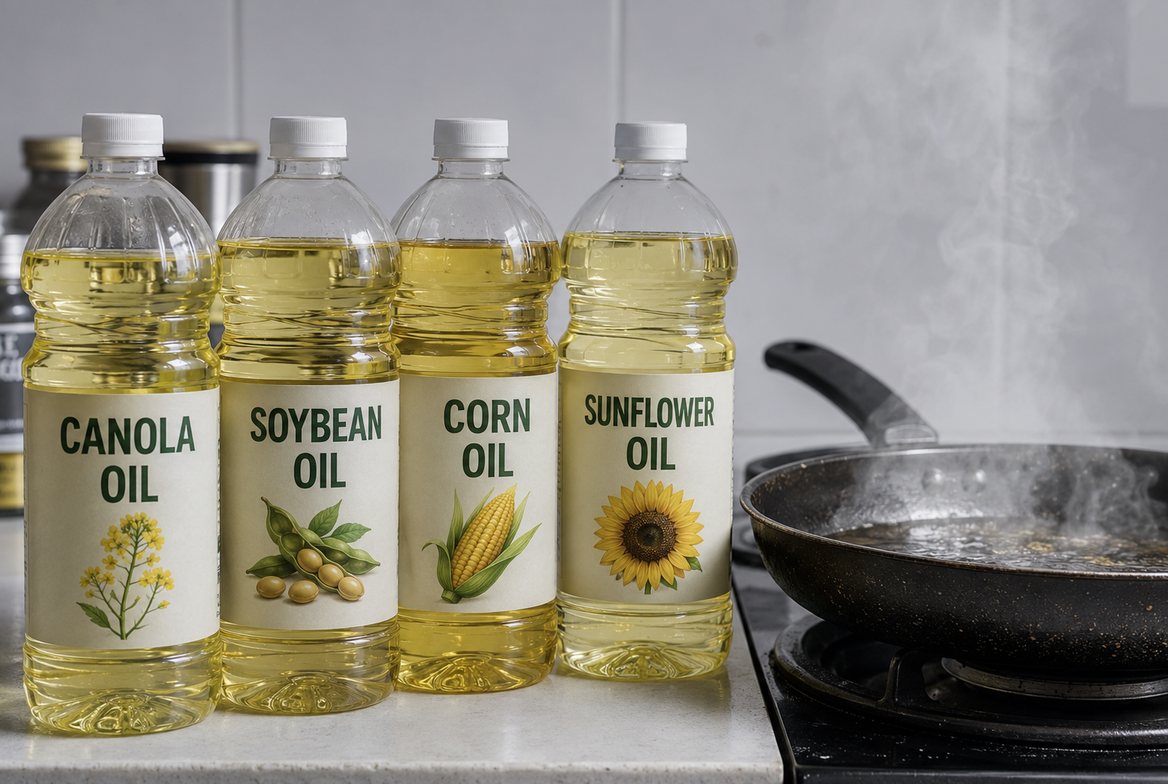
- The best argument against seed oils is heat. Repeatedly fried polyunsaturated oils generate cytotoxic, genotoxic aldehydes — 4-HNE, malondialdehyde, acrolein — that migrate into the food. That chemistry is well-established, so we grade it MODERATE.12
- Seed oils are the fingerprint of ultra-processed food — the food category most consistently linked to cardiovascular disease and early death in large cohorts. That’s the strongest real-world case, and it’s MODERATE.4
- Linoleic acid now dominates our fat intake and has pushed the omega-6:3 ratio to roughly 15:1 versus an ancestral 1:1. The imbalance is real; the direct harm is plausible but not nailed down — EMERGING.3
- The honest counterweight: cold linoleic acid lowers LDL cholesterol in trials, and mainstream bodies read that as protective.8 But when the buried data were recovered, the LDL drop did not translate to fewer deaths. So “linoleic acid directly causes heart disease” is WEAK — and so is the reverse claim that it clearly prevents it.675
- “Seed oils are proven heart-healthy and harmless” is HYPE. The Cochrane review found no clear cardiovascular benefit from omega-6 fats beyond a weak heart-attack signal. The marketing is ahead of the evidence.5
- What seed oils actually are — and how they’re made
- The strongest case: heat, oxidation, and aldehydes
- Seed oils are the signature of ultra-processed food
- The omega-6 problem: displacement and balance
- Oxidized LDL and why PUFA is fragile
- The counter-evidence — and how to read it honestly
- Where the marketing overclaims
- What I cook with instead
- The honest verdict
- What this article is not saying
- References
What seed oils actually are — and how they’re made
“Seed oil” is shorthand for the industrial vegetable oils extracted from seeds and grains: soybean, canola (rapeseed), corn, sunflower, safflower, grapeseed, cottonseed, rice bran. What unites them is a high content of polyunsaturated fatty acids (PUFAs), and specifically linoleic acid, an omega-6 fat. That chemistry — lots of double bonds in the fatty-acid chain — is the whole story, because double bonds are exactly the sites where fat is most vulnerable to oxidation and heat damage.
The other thing worth knowing is how they get from seed to bottle. You cannot press meaningful oil out of a soybean or a corn kernel the way you press it out of an olive. Industrial extraction typically means grinding the seed, then washing it with a petroleum solvent — usually hexane — to pull the oil out, followed by degumming, bleaching, and high-heat deodorizing to strip the color, smell, and off-flavors that the raw extract carries. The result is a cheap, shelf-stable, near-flavorless oil. It is a genuinely impressive feat of food engineering. It is also about as far from a whole food as a fat can get, and that distance is not nothing.
I want to be fair here: “heavily processed” is not automatically “toxic.” Refining removes some junk along with the flavor, and hexane residues in finished oil are low. But the processing matters for a specific reason — it produces a fragile, PUFA-dense oil and then sells it as a cooking fat, which is precisely the use that abuses its weakness. That’s where the real problems start.
The strongest case: heat, oxidation, and aldehydes
If I could only make one argument against seed oils, it would be this one, because it’s chemistry, not epidemiology. Polyunsaturated fats are unstable. Heat them — and especially heat them repeatedly, the way a deep-fryer holds oil at temperature for hours or days — and those double bonds break down through lipid peroxidation, spinning off a family of reactive breakdown products called aldehydes.
This isn’t hand-waving. In controlled frying experiments, Moumtaz, Grootveld, and colleagues heated culinary oils under realistic shallow- and deep-frying conditions and measured what came out. PUFA-rich oils like sunflower generated toxicologically significant concentrations of aldehydes, and those aldehydes migrated straight into the fried food — potato chips fried in sunflower oil carried measurable aldehyde loads that rose with each repeated frying episode.1 A monounsaturate-rich oil, by contrast, generated far less. The mechanism is not in dispute; the number of double bonds predicts the damage.
Why care about aldehydes? Because several of them — 4-hydroxynonenal (4-HNE), malondialdehyde (MDA), acrolein — are biologically reactive. 4-HNE in particular is one of the most-studied products of PUFA peroxidation, and the mechanistic literature ties it to oxidative stress, mitochondrial dysfunction, protein and DNA damage, and disease processes spanning cardiovascular disease, diabetes, and neurodegeneration.2 It reacts with proteins and forms adducts; it is not an inert byproduct.
Now the honest boundary. Most of the 4-HNE disease literature is mechanistic, cell, and animal work — it establishes that these compounds are harmful and that heated PUFA generates them, but it does not hand us a clean human trial saying “X servings of restaurant fries raise your cardiovascular risk by Y percent through aldehydes.” That trial doesn’t exist and probably never will. So I grade this MODERATE, not STRONG: the chemistry is solid and the toxicity of the products is well-characterized, but the dose-to-outcome link in living humans is inferred, not directly measured. Even at MODERATE, this is the single most defensible reason to avoid the worst-case seed-oil exposure — anything deep-fried in reused restaurant oil.
The bottle on your shelf isn’t the enemy. The same oil, held in a fryer at 180°C and reused all week until it’s dark and rancid, then poured over your food — that’s the exposure the chemistry warns about.
Seed oils are the signature of ultra-processed food
Here’s the argument I think actually matters most in the real world, even though it’s indirect. Seed oils are not usually consumed as a spoonful of oil. They are consumed inside the industrial food supply — the chips, the cookies, the frozen entrées, the fast food, the salad dressings, the packaged everything. Cheap PUFA oil is the structural fat of ultra-processed food. Where you find one, you almost always find the other.
And ultra-processed food is the part of the diet with the least ambiguous evidence of harm. In the NutriNet-Santé cohort of more than 100,000 people, higher intake of ultra-processed foods was associated with a significantly higher risk of cardiovascular, coronary, and cerebrovascular disease, and the association held up after adjusting for saturated fat, sugar, sodium, and overall diet quality.4 That’s a recurring finding across cohorts, not a one-off. Ultra-processed food tracks with worse cardiometabolic outcomes almost everywhere it’s studied.
So here is my honest framing, and I’ll grade it MODERATE: seed oils are the biochemical marker and vehicle of that food matrix. I am not claiming the oil is provably the toxic agent inside the cookie — the cookie also has refined flour, added sugar, and additives, and untangling which ingredient does the damage is genuinely hard. But that’s exactly why avoiding seed oils is a smart heuristic even if you’re agnostic on the pure biochemistry: you almost cannot cut seed oils out of your diet without also cutting out the ultra-processed food they live in. Avoiding them drags you toward whole foods by default. That’s a feature, not a coincidence.
The omega-6 problem: displacement and balance
The third strand of the case is about ratio. Linoleic acid, the dominant fat in seed oils, is an omega-6 PUFA. Omega-6 and omega-3 fats compete for the same enzymes and sit on opposite ends of an inflammatory seesaw — omega-6 derivatives lean pro-inflammatory, omega-3 derivatives lean resolving. Balance between them matters.
The problem is that the modern diet has blown that balance apart. As Simopoulos laid out, humans appear to have evolved on a diet with an omega-6:omega-3 ratio near 1:1, whereas Western diets now run around 15:1 to 17:1 — an enormous shift, driven overwhelmingly by the flood of cheap linoleic acid from seed oils.3 The review links that skewed ratio to the promotion of cardiovascular, inflammatory, and autoimmune disease processes, and notes that lowering the ratio is associated with benefit across several conditions.
I grade this one EMERGING, and I want to be precise about why it isn’t higher. The ratio shift is real and quantified — that part is not in doubt. What’s less settled is how much of modern chronic disease you can pin on the ratio specifically, versus everything else that changed alongside it (sugar, calories, sedentary life, ultra-processed food). Some researchers argue linoleic acid itself is fairly inert and that the real deficit is too little omega-3, not too much omega-6 — and that’s a fair critique. Either way, the practical conclusion points the same direction: dial down the seed-oil omega-6, and get more genuine omega-3. On that second half, see our read on omega-3, EPA, and where fish oil actually helps.
vs an ancestral ~1:1
Simopoulos, 2002
each repeated frying
Grootveld, Sci Rep 2019
omega-6 in the Cochrane review
Hooper, 2018
Oxidized LDL and why PUFA is fragile
There’s a fourth mechanistic thread that ties the first three together. When you eat a lot of linoleic acid, it doesn’t just pass through — it gets incorporated into your cell membranes and, importantly, into your LDL particles. The more polyunsaturated your LDL, the more oxidation-prone it is, because the same fragile double bonds that make seed oil go rancid in the pan make LDL cholesterol susceptible to oxidation in the artery wall.
This matters because it’s oxidized LDL, not native LDL, that drives much of the inflammatory cascade of atherosclerosis — the foam cells, the plaque. A PUFA-loaded LDL particle is, in principle, a more oxidizable LDL particle. It’s a mechanistically coherent reason to be skeptical of the “linoleic acid lowers LDL, therefore it’s heart-healthy” story: lowering the number on your lipid panel while making each particle more fragile is not obviously a win, and it may be part of why LDL-lowering by seed oil hasn’t reliably translated into fewer deaths (more on that next).
I’m holding this as supporting mechanism rather than giving it its own grade, because the human data on PUFA and LDL oxidizability are genuinely mixed — some studies find increased oxidizability, others don’t, and the antioxidant content of the diet muddies it. It strengthens the overall case; it doesn’t clinch it. For why the LDL number alone was always an incomplete story, see ApoB explained: why LDL isn’t enough.
The counter-evidence — and how to read it honestly
Now the part most anti-seed-oil takes skip, which is exactly why they don’t survive a serious argument. There is real evidence on the other side, and pretending it doesn’t exist is how you lose credibility.
The mainstream case goes like this: in controlled feeding trials, replacing saturated fat with polyunsaturated fat (mostly linoleic acid) lowers LDL cholesterol, and pooled analyses of some older trials associate that swap with fewer cardiovascular events. On the strength of this, the American Heart Association’s 2017 advisory concluded — forcefully — that replacing saturated fat with polyunsaturated vegetable oil lowers cardiovascular disease by roughly 30%, comparable to a statin.8 That is a real position held by serious people, and the LDL-lowering effect itself is not in question.
So why don’t I fold? Because when you pressure-test that case, it gets shakier than the headline suggests — and three specific things cut against it:
First, the recovered data. Two of the trials the diet-heart hypothesis leaned on had data that were collected but never fully published. When Ramsden and colleagues recovered and reanalyzed them, the story flipped. In the Sydney Diet Heart Study, men who swapped saturated fat for safflower-oil linoleic acid had higher rates of death from all causes and from heart disease, not lower.6 In the Minnesota Coronary Experiment — a large, rigorous, double-blind trial — the linoleic-acid group did lower cholesterol significantly, but got no mortality benefit; in fact each drop in cholesterol was associated with higher, not lower, risk of death.7 The authors’ conclusion is the key line: lowering cholesterol with linoleic acid did not translate into a lower risk of death. That is the difference between a surrogate marker and an outcome that matters.
Second, the Cochrane verdict. The most extensive systematic review of the question — Hooper and colleagues’ 2018 Cochrane review of 19 randomized trials — found that increasing omega-6 fats made little or no difference to all-cause mortality or cardiovascular events, with only a weak, low-quality signal toward fewer heart attacks (you’d need 53 people to increase omega-6 to prevent one heart attack).5 It confirmed the LDL drop and found essentially nothing robust downstream of it. That is not the profile of a proven heart-protective food.
Third, the confounds and the funding. Much of the favorable observational data carries the healthy-user problem: people who follow “heart-healthy” advice and use vegetable oil also tend to smoke less, exercise more, and eat fewer refined carbs — and association is not causation. A meaningful share of seed-oil research has also been industry-funded, which doesn’t make it wrong but does warrant the skepticism we apply to any funded science.
Here’s where honesty cuts both ways, and I won’t pretend otherwise. That same recovered-data literature — the strongest ammunition against seed oils — is exactly why I grade “isolated cold linoleic acid directly causes heart disease” as only WEAK. The trials showed linoleic acid failed to prevent death; they don’t cleanly prove it causes heart disease as an isolated nutrient. Both the strong pro claim and the strong anti claim overreach. The defensible reading is narrower and, I think, more damning to the marketing than to the skeptics: the benefit was oversold, and cold isolated linoleic acid in a trial is not the same substance as repeatedly-heated oil in ultra-processed food.
Where the marketing overclaims
Put the counter-evidence together and the claim that earns a HYPE grade is the one printed, in spirit, on the front of the bottle: seed oils are proven heart-healthy and harmless. They are not proven either. The best systematic review found no clear cardiovascular benefit beyond a weak heart-attack signal;5 the recovered trials found LDL-lowering without a mortality payoff.67 “Lowers your cholesterol” is true and “prevents heart disease and death” is the leap — and it’s the leap the label wants you to make.
This is the symmetry I’m trying to hold. The poison camp overclaims when it says seed oils are proven to kill you — they’re not. The heart-healthy camp overclaims when it says they’re proven to save you — they’re not either. But the burden of proof sits on the side asking me to consume something novel, fragile, industrially extracted, and heat-abused in enormous quantities. Absent strong evidence of benefit, and with several real mechanistic red flags, the prudent default is to avoid, not to embrace.
What I cook with instead
Skepticism is cheap; the useful question is what you actually pour into the pan. My answer is boring on purpose: whole-food fats that humans have eaten for a very long time and that don’t fall apart under heat.
Extra-virgin olive oil is my default for most cooking and everything cold. It’s mostly monounsaturated (far more heat-stable than PUFA), it’s a whole-food pressing rather than a solvent extraction, and it’s the fat with the deepest evidence base behind an actual dietary pattern — the Mediterranean diet the AHA itself recommends.8 For higher-heat cooking, I use stable saturated and monounsaturated fats: butter, ghee, and tallow for their heat-stability and because they’re real foods, and avocado oil where I want a neutral high-smoke-point oil. If you want the honest read on one of these, see our piece on beef tallow.
Note what I’m not doing: I’m not telling you butter is a superfood or that saturated fat is harmless in unlimited amounts. The saturated-fat question is more nuanced than either camp admits, and total dietary pattern matters more than any single fat. The point is narrower — when choosing a cooking fat, a heat-stable whole-food fat beats a fragile industrial PUFA oil, and the trade is easy to make.
Cut the heated and ultra-processed seed oils first — that’s where the case is strongest. Skip deep-fried restaurant food and the packaged aisle built on soybean and canola oil, because that’s where the aldehydes and the ultra-processed matrix live. Cook with whole-food fats — olive oil, butter, ghee, tallow, avocado. Don’t lose sleep over trace canola in one restaurant meal; do change what fills your own kitchen. For how these evidence tiers work, see the full Evidence Radar.
The honest verdict
Line the claims up and the picture is coherent, if less cinematic than either side wants. On heated oxidation, the chemistry is real and the aldehydes are genuinely toxic — MODERATE, and the best reason to avoid fried and reused oil. On ultra-processed food, seed oils are the fingerprint of the diet most clearly tied to disease — MODERATE, and the strongest real-world case. On the omega-6 imbalance, the ratio shift is real but the direct harm is still being pinned down — EMERGING. On direct causation of heart disease by cold linoleic acid, honestly, WEAK — unproven in either direction. And on the heart-healthy marketing, HYPE — the benefit was oversold and the buried data undercut it.
So where do I land? Clearly against routine seed-oil use — and I’ll say that plainly — but for reasons I can defend rather than slogans I can’t. Not because they’re “proven poison,” but because they’re a fragile, novel, industrially-extracted fat that is at its worst exactly where we consume it most: heated, reused, and buried in ultra-processed food. The alleged benefit is a cholesterol number that didn’t buy longer life in the trials that measured it. Set the real mechanistic red flags against the weak, conflicted benefit, and the prudent call isn’t neutral. It’s to cook with real fats and let the seed oils go — and you lose nothing you can’t get from olive oil, butter, and tallow. This isn’t a fearmongering verdict; it’s a “the burden of proof is on the industrial novelty, and it hasn’t met it” verdict.
What this article is not saying
This is not “seed oils are poison that will kill you.” That’s the mirror-image overreach, and the evidence doesn’t carry it. The direct-causation-of-heart-disease claim is WEAK, and the recovered-data trials that damage the pro-seed-oil case also refuse to convict linoleic acid as a lone toxin. One restaurant meal fried in canola will not harm you; the argument is about the habitual, heated, ultra-processed exposure, not a trace here and there.
This is not “saturated fat is now a health food, eat all the butter you want.” I’m making a narrow, comparative point about cooking fats and about avoiding a fragile industrial oil — not blessing unlimited saturated fat or ignoring total dietary pattern, which matters more than any single ingredient. Preferring tallow over sunflower oil in the pan is not the same as a green light on everything.
And this is not personalized medical advice. Every figure here describes what published studies reported, and every place I extended past the data into judgment, I flagged it as my stance. If you have heart disease, diabetes, a lipid disorder, or you’re managing your diet under a clinician, weigh your fat choices with someone who knows your full picture — not an article with a point of view, however cited. The goal here is to replace a shouting match with a defensible position, so your own choice can be a clear-eyed one. For the wider evidence-first view, browse the lifestyle hub and the full Evidence Radar.
References
- Moumtaz S, Percival BC, Parmar D, Grootveld KL, Jansson P, Grootveld M. Toxic aldehyde generation in and food uptake from culinary oils during frying practices: peroxidative resistance of a monounsaturate-rich algae oil. Sci Rep. 2019;9(1):4125. DOI · PMID 30858398
- Xiao M, Zhong H, Xia L, Tao Y, Yin H. Pathophysiology of mitochondrial lipid oxidation: Role of 4-hydroxynonenal (4-HNE) and other bioactive lipids in mitochondria. Free Radic Biol Med. 2017;111:316-327. DOI · PMID 28456642
- Simopoulos AP. The importance of the ratio of omega-6/omega-3 essential fatty acids. Biomed Pharmacother. 2002;56(8):365-379. DOI · PMID 12442909
- Srour B, Fezeu LK, Kesse-Guyot E, et al. Ultra-processed food intake and risk of cardiovascular disease: prospective cohort study (NutriNet-Santé). BMJ. 2019;365:l1451. DOI · PMID 31142457
- Hooper L, Al-Khudairy L, Abdelhamid AS, et al. Omega-6 fats for the primary and secondary prevention of cardiovascular disease. Cochrane Database Syst Rev. 2018;7(7):CD011094. DOI · PMID 30019765
- Ramsden CE, Zamora D, Leelarthaepin B, et al. Use of dietary linoleic acid for secondary prevention of coronary heart disease and death: evaluation of recovered data from the Sydney Diet Heart Study and updated meta-analysis. BMJ. 2013;346:e8707. DOI · PMID 23386268
- Ramsden CE, Zamora D, Majchrzak-Hong S, et al. Re-evaluation of the traditional diet-heart hypothesis: analysis of recovered data from Minnesota Coronary Experiment (1968-73). BMJ. 2016;353:i1246. DOI · PMID 27071971
- Sacks FM, Lichtenstein AH, Wu JHY, et al. Dietary Fats and Cardiovascular Disease: A Presidential Advisory From the American Heart Association. Circulation. 2017;136(3):e1-e23. DOI · PMID 28620111