Rucking and weighted-vest walking: a real fitness upgrade, or just a heavy backpack?
Strap weight to your back and walk, and you have done something deceptively simple: you have turned an easy aerobic activity into a harder one without changing your pace, your route, or your knees-on-pavement risk profile. That is the honest appeal of rucking and weighted-vest walking, and most of it holds up. Adding load reliably increases how hard your heart and muscles work and how many calories you burn — that part is settled physiology. The part that has gotten ahead of the evidence is bone density, especially the claim that a vest rebuilds the skeleton of a postmenopausal woman. Here is what the load actually does, where the signal is strong, and where the popular story is running on hope.
How this article was built: Primary sources: the Huang & Kuo 2014 load-carriage energetics study in the Journal of Experimental Biology, the Looney et al. 2022 heavy-backpacking metabolic-cost model in Medicine & Science in Sports & Exercise, the Snow et al. 2000 weighted-vest hip-BMD study in The Journals of Gerontology: Series A, the Beavers et al. 2025 INVEST in Bone Health randomized trial in JAMA Network Open, and the Watson et al. 2018 LIFTMOR resistance-and-impact trial in the Journal of Bone and Mineral Research. Each citation’s authors, journal, and year were verified against the PubMed-indexed record via web before publication, because the Consensus and PubMed research tools were offline at the time of writing.
- The calorie and cardio upgrade is real. Metabolic energy expenditure rises roughly linearly with load — on the order of ~7.6 watts for every extra kilogram you carry at a constant walking speed.1 You burn more and train your heart harder at the same pace.
- It builds load-bearing work capacity, not maximal strength. Carrying weight is a legitimate low-impact endurance and postural stimulus, but it will not replace lifting for building peak strength or muscle.
- The bone-density claim is the weak link. A small vest-plus-jumping study preserved hip bone over five years,3 but the largest recent randomized trial found a weighted vest did not protect hip bone during weight loss.4 Plausible, not proven — especially for vests alone in older women.
- Who this is for: anyone who wants a harder walk without running. Start light (around 10% of body weight), fit the pack well, and progress slowly — the load that helps your heart also stresses your back, knees, and shoulders.
- What rucking actually is — and why it spread
- The calorie and cardio case — the strongest evidence
- Why load costs energy — the mechanics
- Strength, posture, and work capacity — what it does and doesn’t
- The bone-density claim — where the story gets ahead of the data
- The joint and injury caveat — load is a stressor
- Where it fits: a tiered view
- Grey areas and open questions
- What this article is not saying
- References
What rucking actually is — and why it spread
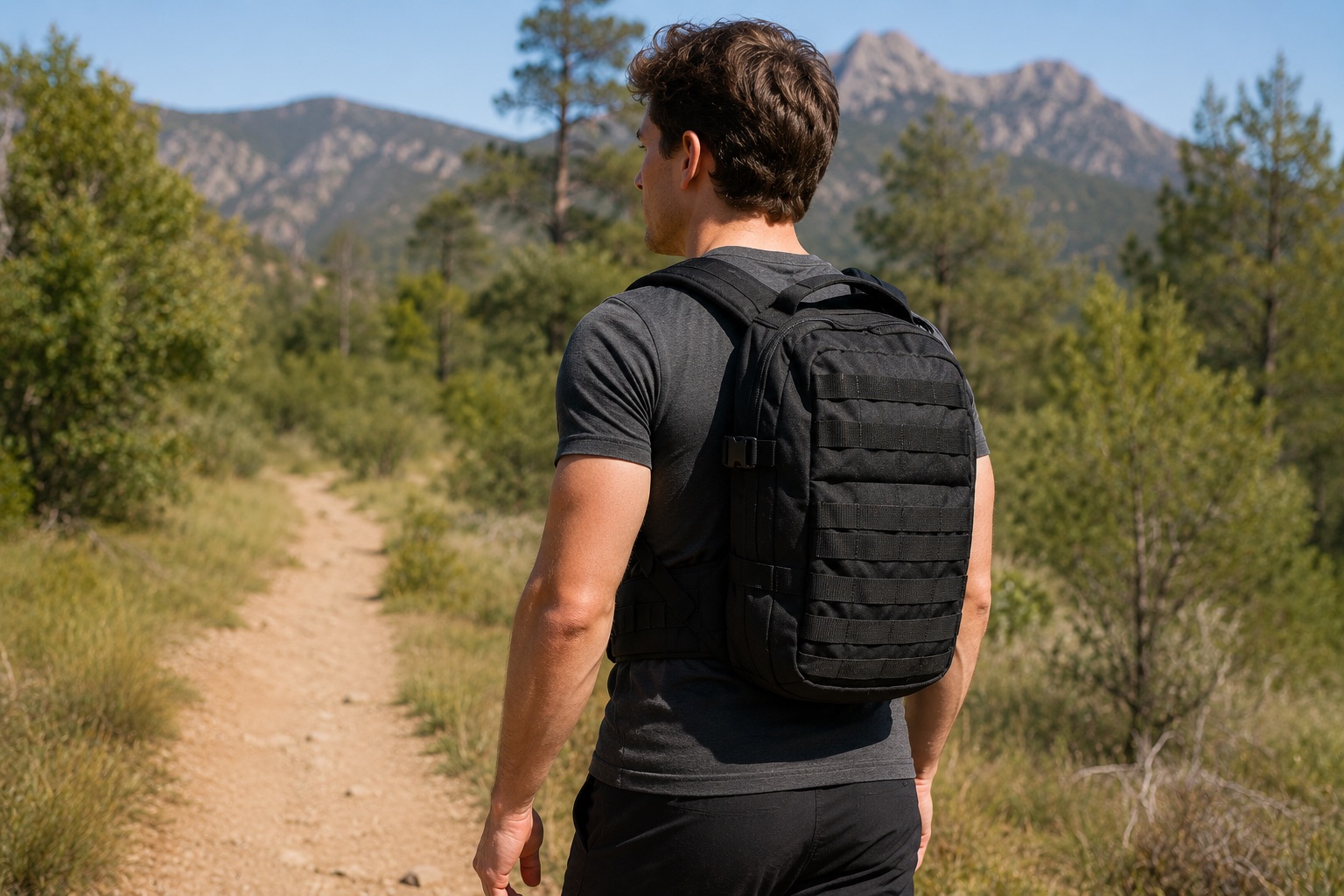
Rucking is walking with weight on your back. The word comes from military training, where loaded marches under a rucksack are a core conditioning tool, and the civilian version is the same idea stripped down: a pack with plates or sandbags, or a weighted vest, worn on an ordinary walk. The appeal is that it slots a resistance element into something almost everyone already does, with none of the joint pounding of running and none of the equipment or intimidation of a gym.
The reason it has spread so fast in the last few years is that it sits in a genuinely useful gap. Plenty of people will walk who will never run, and plenty who walk daily are well below the intensity that drives meaningful cardiovascular adaptation. Adding load is a lever that raises the demand of a walk without raising the speed — a way to push a low-intensity habit up toward something that actually trains the system. That framing is sound. The question is which of the specific promises — cardio, calories, strength, bone — the evidence actually supports, and at what grade. They are not all equal.
The calorie and cardio case — the strongest evidence
Start with the claim that is hardest to argue with, because it falls out of basic energetics: carrying weight costs energy, and it costs it predictably. When Tzu-Wei Huang and Arthur Kuo measured the metabolic cost of walking with added load in a controlled laboratory study in the Journal of Experimental Biology, they found that the rate of metabolic energy expenditure rose approximately linearly with load — by roughly 7.6 watts for every additional kilogram carried at a constant walking speed.1 That is a clean, near-proportional relationship: each kilo you add is paid for in measurable extra energy, every minute you walk.
Translate that out of the lab. A person carrying 9 kilograms (about 20 pounds) is steadily spending meaningfully more energy than the same person walking empty-handed at the same pace, and the heart rate climbs to match. That is the whole point of the practice: you have raised the intensity of the walk without speeding up. For someone who finds an unloaded walk too easy to drive adaptation — the exact problem the step-count evidence keeps running into — this is a direct, efficient fix.
At heavier loads the picture stays consistent but gets a little less tidy. David Looney and colleagues, building a metabolic-cost model for heavy military backpacking in Medicine & Science in Sports & Exercise, showed that energy expenditure during loaded marching is high and that older prediction equations had been under-estimating it — their newer model fits the real oxygen cost of carrying heavy loads more accurately.2 The signal an extra pack pulls on the cardiovascular system is, if anything, larger than the simple linear rule of thumb suggests once the loads get serious. The honest grade here is STRONG: that load raises calorie burn and cardio demand is settled, well-measured physiology, not a wellness talking point.
If you want to see how that extra demand stacks against other ways of raising aerobic intensity, our piece on zone 2 cardio and the mitochondria covers the low-intensity end of the spectrum that loaded walking nudges you up out of, and you can sanity-check your own baseline burn with the TDEE calculator before deciding how much load is worth adding.
Why load costs energy — the mechanics
The reason load is so reliably expensive comes down to where the extra mechanical work happens in the gait cycle. In the Huang and Kuo analysis, the added cost of carrying weight was concentrated at two moments: the ankle during push-off, as it drives the heavier body-plus-load forward, and the knee in the rebound just after the foot collides with the ground.1 Every step has to accelerate more mass, and the muscles spanning those joints do more positive work to make it happen. Notably, the efficiency of that extra work stayed roughly constant at about 16%, which is why the cost scales so cleanly with the load you add.
Two practical points follow. First, the signal a pack pulls is metabolic and muscular, not impact-based: rucking does not slam the joints the way running does, because you are still walking — foot contact stays controlled and there is no flight phase. That is exactly why it appeals to people who want intensity without pounding. Second, where you carry the weight matters. Load held close to the body’s center of mass, in a well-fitted pack high on the back, is more economical and more stable than the same weight slung low or off to one side, which is the mechanical argument for a proper ruck pack or vest over an improvised bag.
The load reliably raises how hard your heart and muscles work. What it does to your skeleton is a separate question — and a much less settled one.
Strength, posture, and work capacity — what it does and doesn’t
Between the well-supported cardio claim and the shaky bone claim sits a middle category: loaded carrying as a strength and postural stimulus. Here the honest grade is MODERATE, and the nuance is in what kind of strength we are talking about.
Carrying weight under a pack is a sustained, low-grade demand on the muscles that hold you upright: the spinal erectors and deep trunk musculature that resist the forward pull of a loaded back, the shoulders and upper back that manage the straps, and the legs and hips that move the extra mass step after step. Over time, that is a real stimulus for postural endurance and lower-body work capacity — the ability to keep producing force for a long time under load. Loaded carries are a recognized tool for exactly this reason. The mechanism is plausible and the practice is sound; what is thinner is head-to-head trial evidence isolating rucking’s effect on these outcomes from general activity, which is why this stays MODERATE rather than STRONG.
What rucking will not do is replace progressive resistance training for building maximal strength or muscle size, and the contrast with the bone literature makes the point sharply. In the LIFTMOR randomized trial, postmenopausal women who did heavy, progressively loaded resistance and impact work — deadlifts, squats, and overhead presses at greater than 85% of their one-rep maximum — built measurable strength and bone.5 That is a fundamentally different stimulus from walking under a fixed, sub-maximal load. Rucking trains endurance under load; it does not deliver the high mechanical tension that drives maximal strength and hypertrophy adaptation. Treating it as a substitute for lifting is a WEAK claim — the loads and the rep-quality the strength literature requires simply are not there in a walk. The two are complements, not interchangeable.
The bone-density claim — where the story gets ahead of the data
This is the claim driving most of the current enthusiasm, especially the version aimed at women approaching and past menopause: that wearing a weighted vest, or rucking, will build or protect bone. The reasoning is appealing — weight-bearing exercise is genuinely good for the skeleton, and adding external load should, in theory, increase the mechanical strain that signals bone to remodel. The theory is sound. The direct evidence that vests or rucking specifically raise bone mineral density is limited, and where the best trials exist, it is mixed.
The optimistic anchor is an old, small study. Christine Snow and colleagues followed eighteen postmenopausal women over five years; nine did a program combining a weighted vest with jumping exercise three times a week, and nine served as controls. The exercisers preserved hip bone density — the femoral neck held roughly steady while controls lost about 4% — and the authors concluded the program prevented significant hip bone loss.3 That is a real, encouraging result, but read the design honestly: it is a tiny sample, the intervention bundled the vest with jumping (an impact stimulus in its own right), and it measured prevention of loss, not a gain in density. It tells you a vest-plus-impact program may help hold bone in place; it does not tell you a weighted walk builds it.
The skeptical anchor is far larger and far more recent. The INVEST in Bone Health trial, published by Kristen Beavers and colleagues in JAMA Network Open in 2025, randomized 150 older adults with obesity into three groups during deliberate weight loss: weight loss alone, weight loss plus a weighted vest worn eight hours a day with weight titrated to the body weight they lost, and weight loss plus three-times-weekly supervised resistance training. The primary outcome was change in hip bone density by CT over twelve months. The result was sobering for the vest hypothesis: all three groups lost hip bone at roughly the same rate — neither the weighted vest nor resistance training prevented the weight-loss-associated decline.4 This is the largest, most rigorous direct test of a weighted vest for bone to date, and it came up null.
Earlier work points the same direction when the load is modest. A randomized trial of weighted vests worn at just 3–5% of body weight in ambulatory older adults found no improvement in bone turnover or strength — the load was almost certainly below the threshold needed to signal bone to adapt.4 Put the pieces together and a consistent picture emerges: weight-bearing and loaded exercise broadly support bone health and are worth encouraging, but the specific claim that a weighted vest or a rucking habit raises bone mineral density — particularly in postmenopausal women, the group it is most often sold to — is EMERGING at best. The mechanism is plausible; the direct trial evidence is small, mixed, and headlined by a null result. If bone is your primary goal, the trial that actually moved density used heavy, supervised lifting,5 not a walk with a pack.
EMERGING. Weight-bearing exercise is broadly good for bone, and a small five-year program of weighted vest plus jumping preserved hip density in postmenopausal women.3 But the largest and most recent randomized trial — 150 older adults, CT-measured hip BMD — found a weighted vest did not prevent bone loss,4 and low-load vest trials show nothing.4 The density gains the headlines promise belong, on current evidence, to heavy resistance and impact training,5 not to vests or rucking specifically. Plausible, not proven.
The joint and injury caveat — load is a stressor
The same physics that make rucking effective make it a genuine stressor, and this is the part the “just a walk” framing tends to skip. The extra mechanical work concentrated at the ankle and knee is, by definition, extra load through those joints, and a pack adds compressive and shear demand to the lower back and shoulders that an empty walk does not. Done sensibly that demand is a feature; done abruptly it is how people end up with sore knees, an aggravated lower back, or shoulder and neck strain from poor strap fit.
The practical guardrails are unglamorous and they matter. Start light — around 10% of body weight is a reasonable entry point, not the 20%+ loads used in some research or military contexts. Fit the pack properly so the weight rides high and close to the spine rather than dragging low. Progress gradually, in load and in distance, the way you would with any training stimulus, and give your joints and connective tissue time to adapt — they remodel more slowly than your cardiovascular system does. If you carry an existing back, knee, hip, or balance issue, that is a conversation to have with a clinician before you load up, not after.
Where it fits: a tiered view
We don’t hand out prescriptive protocols, but it helps to place the claims on a spectrum of how settled they are and how to act on each.
Foundational — use it for what it’s proven to do. If your goal is more cardiovascular work and more energy burned out of the same walk, loaded walking delivers, and the evidence is strong.12 Start light, build the habit, treat it as an intensity dial on walking you already do.
Research-curious — the work-capacity and posture layer. Carrying load is a legitimate, low-impact stimulus for postural and lower-body endurance.5 Reasonable to pursue; just hold it as a complement to, not a replacement for, actual strength training if maximal strength or muscle is the aim.
Experimental — chasing bone density with a vest. The weakest-supported reason to ruck. The direct trial evidence in older adults is mixed and headlined by a null,4 so treat any bone benefit as a hopeful maybe, not the reason to do it. If bone is the priority, the density gains live in supervised heavy resistance and impact work.5
Loaded walking is a real, accessible, low-risk way to raise the intensity of an activity most people will actually keep doing — but it sits inside a much larger toolkit, and the mistake is treating any single habit as the whole answer. The right question is rarely “is rucking good?” It’s “what actually moves cardiovascular fitness, body composition, strength, and bone for someone like me, and where does loaded walking rank against structured cardio, real lifting, and the interventions with strong human data?” The Manual maps those levers against each other — what each one’s evidence genuinely supports, observational versus trial, who benefits and who’s wasting effort. See the Manual →
Grey areas and open questions
The bone trials we don’t have. There is no large, long randomized trial of rucking — loaded outdoor walking specifically — with bone density as the primary outcome in postmenopausal women. The vest trials we have either bundle the vest with jumping, use loads too light to matter, or, in the cleanest recent case, come up null.34 The honest statement is “weight-bearing exercise helps bone; this particular delivery method is unproven.”
How much load, for how long, for cardio. The energetics of load are well-characterized,12 but the dose-response for health outcomes — how much weight, how often, over what duration produces the best cardiovascular and body-composition return for a general-population walker — has not been mapped at the resolution the practice deserves. Most loading guidance is extrapolated from military and laboratory data, not from trials in everyday ruckers.
Injury rates in civilians. Much of what we know about load-carriage injury comes from military populations carrying heavy loads over long distances. How that translates to a 40-year-old adding 15 pounds to a neighborhood walk — the real-world failure modes, the safe progression rates — is under-studied. Start conservative until that gap closes.
What this article is not saying
This is not “rucking doesn’t work.” For raising the cardiovascular and metabolic demand of a walk, it works, the physiology is clean, and it is one of the more accessible intensity upgrades available to people who won’t run. If a loaded walk gets you training harder and more often, that is a real win and you should keep doing it.
This is not “weight-bearing exercise is useless for bone.” It is not — loaded and impact exercise broadly support skeletal health, and heavy resistance training measurably builds bone in the women most at risk.5 The narrow point is that a weighted vest or a rucking habit, on the direct evidence we have, is not the proven bone intervention it is often sold as.
And this is not a protocol. It’s a grade-by-grade read of a popular practice: strong where it claims cardio and calories, moderate where it claims work capacity and posture, weak where it claims to replace lifting, and emerging — hopeful but unproven — where it claims to rebuild bone. Use it for what the evidence actually supports, start light, and don’t let the heaviest promise carry the lightest data.
References
- Huang TWP, Kuo AD. Mechanics and energetics of load carriage during human walking. J Exp Biol. 2014;217(Pt 4):605-613. DOI: 10.1242/jeb.091587. PMID: 24198268.
- Looney DP, Lavoie EM, Vangala SV, et al. Modeling the metabolic costs of heavy military backpacking. Med Sci Sports Exerc. 2022;54(4):646-654. DOI: 10.1249/MSS.0000000000002833. PMID: 34856578.
- Snow CM, Shaw JM, Winters KM, Witzke KA. Long-term exercise using weighted vests prevents hip bone loss in postmenopausal women. J Gerontol A Biol Sci Med Sci. 2000;55(9):M489-M491. DOI: 10.1093/gerona/55.9.M489. PMID: 10995045.
- Beavers KM, Lynch SD, Fanning J, et al. Weighted vest use or resistance exercise to offset weight loss-associated bone loss in older adults: a randomized clinical trial. JAMA Netw Open. 2025;8(6):e2516772. DOI: 10.1001/jamanetworkopen.2025.16772. PMID: 40540267.
- Watson SL, Weeks BK, Weis LJ, Harding AT, Horan SA, Beck BR. High-intensity resistance and impact training improves bone mineral density and physical function in postmenopausal women with osteopenia and osteoporosis: the LIFTMOR randomized controlled trial. J Bone Miner Res. 2018;33(2):211-220. DOI: 10.1002/jbmr.3284. PMID: 30861219.