Passionflower for anxiety and sleep: the honest, cited evidence for the gentle GABAergic herb
Passionflower (Passiflora incarnata) is one of the oldest calming herbs in the Western botanical cabinet — a climbing vine with an almost improbably ornate flower, traditionally brewed as a tea for “nerves” and restless sleep. Modern interest hangs on a plausible idea: that its flavonoids nudge the same inhibitory GABA system in the brain that benzodiazepines act on, but far more softly, without the sedation, dependence, and next-day fog. That’s an appealing story, and there is real human evidence behind parts of it — small double-blind trials in the tense minutes before surgery, a much-cited pilot that put a standardized extract head-to-head with the benzodiazepine oxazepam for generalized anxiety, and a handful of sleep studies. But “real evidence” and “strong evidence” are not the same thing, and passionflower’s trials are small, varied in their preparations, and easy to over-read. Here is what those studies actually found, how the proposed mechanism holds up, how the tea/tincture/extract forms differ, where the safety edges are, and exactly where the science stops.
How this article was built: Primary sources: the preoperative-anxiety RCT (Movafegh et al. 2008, Anesthesia & Analgesia), the generalized-anxiety pilot versus oxazepam (Akhondzadeh et al. 2001, Journal of Clinical Pharmacy and Therapeutics), the herbal-tea sleep study (Ngan & Conduit 2011, Phytotherapy Research), the insomnia polysomnography RCT (Lee et al. 2020, International Clinical Psychopharmacology), the Cochrane review of passionflower for anxiety (Miyasaka et al. 2007, Cochrane Database of Systematic Reviews), and a real-world benzodiazepine-tapering study (Zanardi et al. 2023, Pharmaceuticals) — all retrieved and verified through PubMed.
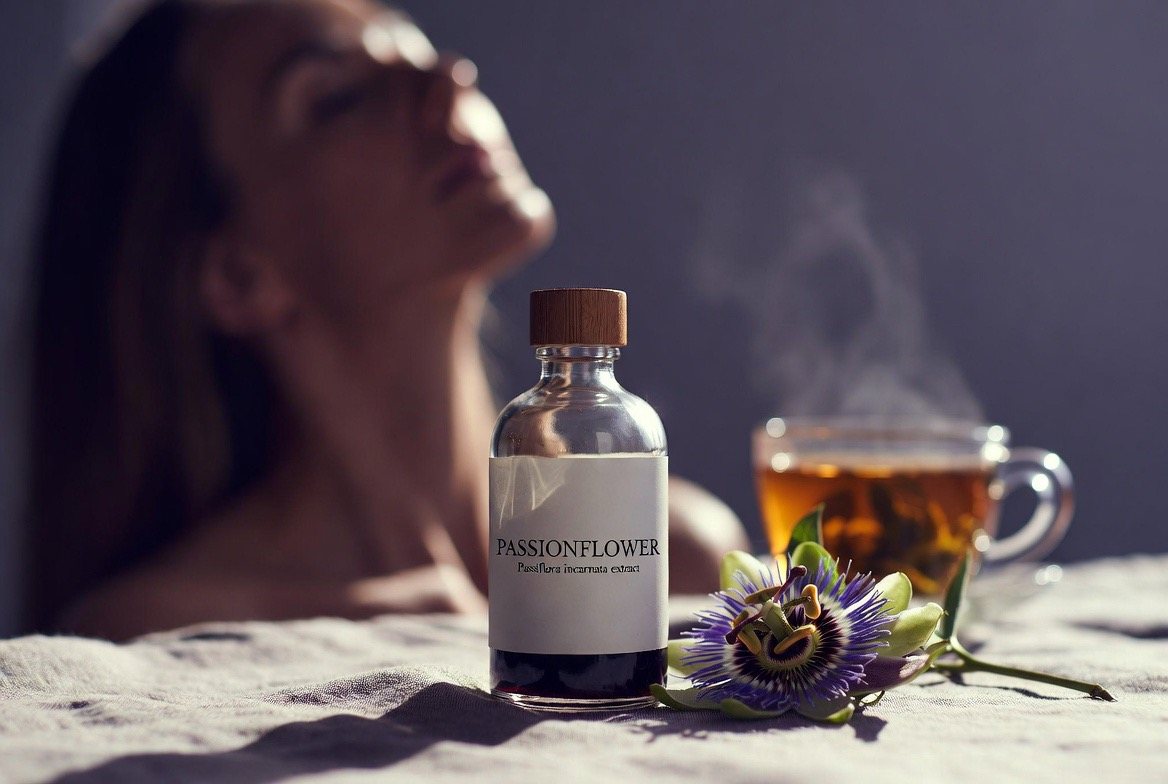
- The best human signal is short-term, situational anxiety. Small double-blind randomized controlled trials (RCTs — the gold-standard design where patients are randomly assigned to herb or placebo) show passionflower lowered anxiety in the tense window before surgery.1
- The proposed mechanism is GABAergic. Its flavonoids (notably chrysin) appear to nudge the brain’s calming GABA-A receptor — the same system benzodiazepines hit — but the human-level proof of that mechanism is thin and rests largely on animal work.5
- One famous pilot matched it against a benzodiazepine. A 4-week trial found a standardized extract performed about as well as oxazepam for generalized anxiety disorder, with less next-day job impairment — but it enrolled only 36 people.2
- Sleep help is modest and preliminary. A tea study improved subjective sleep quality; a later insomnia RCT nudged some objective sleep measures. Both were small.34
- It’s a low-risk calming herb, not a proven medicine. Generally well tolerated, but it adds to alcohol/benzodiazepine sedation, and the trials are too small and varied to call it a treatment for a clinical disorder.5
What passionflower actually is
Passionflower is the common name for Passiflora incarnata, a perennial climbing vine native to the southeastern United States and now grown widely. The part used medicinally is the aerial herb — the leaves, stems, and flowers — dried and prepared as a tea, an alcohol tincture, or a concentrated extract. It has a long history in traditional and folk use as a mild sedative and calming remedy, and it appears in official herbal monographs in Europe for “nervous restlessness” and tension. That traditional pedigree is real, but it is not the same as clinical proof; plenty of long-used herbs have failed modern trials, and a few have surprised us by passing. The point of a piece like this is to separate the tradition from the tested.
Chemically, Passiflora incarnata is a mix rather than a single active drug. It contains flavonoids (plant pigments and antioxidants, including vitexin, isovitexin, and chrysin), small amounts of alkaloids, and other compounds. Because the plant is a blend and because the flavonoid content varies with the growing conditions, harvest, and preparation method, two passionflower products can differ substantially in what’s actually in the cup or capsule. This chemical variability is not a footnote — it is one of the central reasons the trial evidence is hard to pool, and why a result from a standardized extract in one study doesn’t automatically transfer to a supermarket tea bag.
The proposed mechanism: gentle GABA
The dominant theory for how passionflower calms is GABAergic modulation. GABA (gamma-aminobutyric acid) is the brain’s main inhibitory neurotransmitter — the “brake” that quiets neural activity. The GABA-A receptor is the docking site that, when activated, produces the calming, anti-anxiety, and sedating effects that benzodiazepines like diazepam and oxazepam are famous for. The hypothesis is that passionflower’s flavonoids interact with this same system — either at the receptor itself or by influencing GABA availability — nudging the brake gently rather than slamming it, which would explain a calming effect without the heavy sedation and dependence risk of a benzodiazepine.
The strongest thread of that story runs through chrysin, a flavonoid found in passionflower. In animal studies, chrysin has shown anxiety-reducing behaviour, and — importantly — that effect was blocked by flumazenil, a drug that specifically antagonizes the benzodiazepine site on the GABA-A receptor, which points to a genuinely benzodiazepine-like mechanism at that receptor. That is a satisfying, mechanistically coherent finding. But it is animal and cell-level work, and the whole-plant extract is more complicated than any single flavonoid. We grade the mechanism claim EMERGING for an honest reason: the GABAergic direction is plausible and supported by preclinical data, but it has not been cleanly demonstrated in humans, and the exact molecules and receptor interactions responsible in a real passionflower preparation remain incompletely mapped.5 The theory is good; the human-level proof is not yet there.
The appeal of passionflower is a benzodiazepine-shaped mechanism without the benzodiazepine-shaped problems — a plausible story that the small human trials only partly test.
Situational anxiety: the strongest signal
The clearest human evidence for passionflower is not for chronic anxiety disorders but for a very specific, measurable moment: the anxiety patients feel just before surgery. Pre-operative anxiety is a useful test bed because it’s intense, time-limited, easy to rate on a numerical scale, and relevant to real anesthetic practice, where clinicians want to calm patients without the psychomotor hangover that blunts recovery.
The most-cited trial here is Movafegh and colleagues’ 2008 study in Anesthesia & Analgesia. It was a double-blind, placebo-controlled RCT in which 60 ambulatory-surgery patients received either oral Passiflora incarnata (a 500 mg preparation) or placebo about 90 minutes before their procedure.1 The passionflower group reported significantly lower anxiety scores than placebo before surgery — and, notably, without measurable impairment of psychomotor function or delayed recovery, which is exactly the profile you’d want from a “gentle” anxiolytic. Later work in the same surgical setting has compared passionflower with low-dose benzodiazepine premedication and found broadly comparable anxiety reduction. It is a consistent, plausible, mechanistically coherent signal.
So why does this earn only an EMERGING grade rather than something stronger? Because the trials are small (tens, not hundreds, of patients), they use different preparations and doses, and the outcome — acute situational anxiety in a healthy-ish surgical population — is a narrow slice of what people actually reach for passionflower to do. The direction of effect is encouraging and reasonably repeatable across the pre-op literature, but the evidence base is not yet large, standardized, or diverse enough to promote. This is a promising early signal, honestly labeled as one. For the broader picture of how calming botanicals stack up, our anxiety & mood hub keeps the same evidence-first standard across the category.
randomized
Movafegh pre-op RCT, 2008
before surgery
~90 min pre-procedure
oxazepam pilot
4-week GAD trial, 2001
The oxazepam pilot and clinical anxiety
The single study that did the most to put passionflower on the map for clinical anxiety is Akhondzadeh and colleagues’ 2001 pilot in the Journal of Clinical Pharmacy and Therapeutics. It was a double-blind, randomized trial in patients with generalized anxiety disorder (GAD) — the chronic, excessive-worry condition — diagnosed by formal criteria. Over four weeks, one group took a standardized passionflower extract (45 drops per day) plus a placebo tablet, and the other took the benzodiazepine oxazepam (30 mg/day) plus placebo drops.2
The headline result was striking: both treatments reduced anxiety, and there was no significant difference between them at the end of the trial. Oxazepam worked faster in the first few days, but the passionflower group had significantly fewer problems with impairment of job performance — the classic benzodiazepine trade-off of sedation and reduced daytime function. On its face, that’s a remarkable finding: a herb roughly matching a real benzodiazepine on a diagnosed disorder, with a cleaner daytime side-effect profile.
Here is why we grade this claim WEAK rather than STRONG, and it’s a matter of honesty about study design. The trial enrolled only 36 people, which is small enough that a “no significant difference” result can partly reflect the study’s limited power to detect a difference rather than true equivalence. It was a single pilot, run at one center, and — the authors themselves said so — explicitly framed as justification for a larger trial, which the field has never fully delivered at scale. A Cochrane review of passionflower for anxiety concluded that the studies were too few and too small to draw firm conclusions, and called for rigorous RCTs.5 So the oxazepam pilot is a genuinely interesting, frequently over-cited result: it is a reason to take passionflower seriously and study it properly, not a license to treat it as a proven benzodiazepine substitute. One separate line of real-world data is also worth noting cautiously — a 2023 study reported that adding passionflower helped patients taper off long-term benzodiazepines more successfully, which fits the calming story but was retrospective and not a blinded trial.6
“Passionflower works as well as a benzodiazepine for anxiety” is a real trial finding — and also one of the most over-extended claims in herbal medicine. It comes from a 36-person pilot designed to justify a bigger study, not from the large confirmatory trial that would settle it. A small trial that fails to find a difference between two treatments has not proven they’re equal; it may simply have been too small to tell. Take passionflower seriously as a low-risk calming option worth researching — but if you have a diagnosed anxiety disorder, the responsible move is a treatment plan built with a clinician, where a herb can be one considered piece and not the whole strategy. For how evidence tiers work on this site, see the full Evidence Radar.
Sleep: modest and preliminary
Passionflower’s reputation as a sleep aid is ancient, and the same GABAergic, calming mechanism that would ease anxiety could plausibly help sleep — the two are deeply linked, since a racing, anxious mind is one of the commonest reasons people can’t drop off. The human data are encouraging but light.
A well-designed small study by Ngan and Conduit, published in Phytotherapy Research in 2011, used a double-blind, placebo-controlled crossover design in 41 healthy adults with mild sleep fluctuations. Participants drank a cup of passionflower tea (or a matched placebo tea) nightly for a week, kept sleep diaries, and a subset underwent overnight polysomnography (PSG — the lab gold standard for measuring sleep). Of the sleep-diary measures, subjective sleep quality was rated significantly better on passionflower than placebo — a real, if modest, signal from a genuinely low dose in tea form.3 A later, larger step came from Lee and colleagues (published 2020 in International Clinical Psychopharmacology): a double-blind, placebo-controlled RCT in 110 adults with diagnosed insomnia disorder, using a passionflower extract for two weeks with overnight PSG. It found total sleep time increased significantly versus placebo on objective polysomnography, though several other measures improved within the passionflower group without clearly beating placebo.4
We grade the sleep claim EMERGING. The direction is consistent and now includes some objective, not just self-reported, benefit — which is more than many sleep supplements can show. But these remain small, short studies, the effects are modest rather than dramatic, and the preparations differ. Passionflower is a reasonable, low-risk thing to try for light, occasional sleep trouble tied to a busy mind; it is not established as a treatment for chronic insomnia, and it shouldn’t displace the foundational sleep-hygiene and, where needed, clinical care that a real sleep disorder requires. Our sleep hub covers where the better-studied options fit.
Forms and dosing context
This is context, not a prescription. Passionflower reaches people in three main forms, and they are not interchangeable. Tea is the gentlest and most traditional — a cup of dried herb steeped in hot water delivers a relatively low, variable dose, and was the form used in the sleep-quality study. Tinctures are alcohol-based liquid extracts dosed by the dropper in drops or millilitres; the oxazepam pilot used a standardized extract at 45 drops per day. Standardized dry extracts in capsules or tablets aim for a defined flavonoid content and are what most of the anxiety and insomnia trials used, often in the range of a few hundred milligrams; the pre-op studies used around 500 mg.
Two practical realities matter. First, because the plant’s active content varies, a product that lists a standardized extract with a stated flavonoid percentage is more likely to resemble what was actually studied than an unstandardized tea or bulk powder. Second, passionflower is generally used acutely — before a stressful event or at bedtime — rather than as a lifelong daily drug, and the trials were short (a single dose to a few weeks), so long-term daily use is largely unstudied. The specific form, dose, and timing that make sense for any individual — especially alongside other medications — belong to a conversation with a pharmacist or physician, not to a number lifted from a trial.
Safety and drug interactions
For most healthy adults, passionflower is generally well tolerated, and its side effects in trials have been mild and uncommon — occasional drowsiness, dizziness, or mild gastrointestinal upset. The tolerability profile is, in fact, part of its appeal: unlike benzodiazepines, it hasn’t shown the dependence, tolerance, and withdrawal that make those drugs problematic for long-term anxiety. But “gentle” is not “risk-free,” and there are specific situations that call for caution.
Sedative drug interactions. The most important practical concern flows straight from the mechanism. If passionflower does act on the GABA/sedation system, then it can add to the sedative effect of other CNS depressants — alcohol, benzodiazepines, sleep medications, certain antihistamines, opioids, and some other sedating drugs. Combining them could produce more drowsiness or impairment than intended. Anyone taking a sedative or anti-anxiety medication should treat adding passionflower as a decision to run past a physician or pharmacist, not a casual stack.
Surgery, pregnancy, and breastfeeding. Because of the sedative overlap, passionflower is generally advised to be stopped before scheduled surgery unless an anesthesiologist directs otherwise (its calming effect can interact with anesthetic agents). It is also generally not recommended in pregnancy — some traditional sources associate Passiflora species with uterine activity, and safety data in pregnancy are inadequate — and evidence in breastfeeding is likewise insufficient, so caution is the default in both. And as a sedating agent, it can impair the alertness needed for driving or operating machinery, particularly when first tried.
The honest limits
Passionflower is a plausible, low-risk calming herb — and a bounded one. The central limitation runs through every section above: the human trials are small, few, and heterogeneous. The pre-op studies enrolled dozens of patients each; the landmark GAD trial had 36 people; the sleep studies were short and modest. Different studies used tea, tincture, and extract at different doses, which makes the results genuinely hard to pool into a confident overall estimate. A Cochrane review looking at passionflower for anxiety reached exactly this conclusion — too little high-quality evidence to draw firm conclusions, and a call for larger rigorous trials.5
There is also a mechanism-versus-proof gap. The GABAergic story is coherent and supported by animal data, but it hasn’t been cleanly nailed down in humans, and the whole-plant extract is more complicated than the single flavonoid that animal studies lean on. None of this makes passionflower a bad choice for its realistic use case — mild, situational anxiety and light sleep support in an otherwise healthy adult. It makes it an honest maybe: worth trying for the right, low-stakes purpose, worth researching properly at scale, and not yet earning the confident language that clinical treatments require. The gap between “traditionally used and plausibly helpful” and “proven treatment” is exactly where passionflower sits.
What this article is not saying
This is not “passionflower doesn’t work.” There is real, repeated human evidence that it lowers acute situational anxiety, a much-cited pilot suggesting it can match a benzodiazepine for generalized anxiety with less daytime impairment, and small studies pointing to modest sleep benefit. For mild nerves and light sleep trouble, it’s a reasonable, well-tolerated, low-risk thing to try — and dismissing it outright would ignore the data that does exist.
This is not “passionflower is a proven, benzodiazepine-strength treatment for clinical anxiety and insomnia that works for everyone.” That’s the HYPE claim, and it fails on the size and quality of the evidence. The trials are small and varied; the flagship GAD result comes from 36 people; the mechanism is inferred more than proven in humans; and a formal review concluded the evidence is too thin to be firm.5 It is also not risk-free — it adds to the sedation of alcohol and benzodiazepines, and warrants caution around surgery, pregnancy, and driving. Any marketing that strips out those caveats is selling a certainty the science hasn’t earned.
And this is not a treatment recommendation. Every figure here describes what published trials reported, not what you should take. Whether passionflower belongs in your routine — and in what form, at what dose, and alongside which of your other medications — is a decision for you and a clinician who knows your full picture. The point of this piece is to tell you what the trials show and exactly where they stop, so that conversation can be an honest one. For the wider evidence-first view of calming and sleep botanicals, browse the anxiety & mood hub and the full Evidence Radar.
This is the surface. The Manual is the depth.
This article stays deliberately at the level of the published human trials. The calming, GABAergic, and recovery mechanisms that herbs like passionflower borrow from — and how the peptide and signaling toolkit approaches anxiety, sleep, and stress with far more precision — is where The Peptide Manual lives: full profiles, dosing frameworks, and the honest signal-versus-hype read on each.
Explore The Manual →References
- Movafegh A, Alizadeh R, Hajimohamadi F, Esfehani F, Nejatfar M. Preoperative oral Passiflora incarnata reduces anxiety in ambulatory surgery patients: a double-blind, placebo-controlled study. Anesth Analg. 2008;106(6):1728-1732. DOI · PMID 18499602
- Akhondzadeh S, Naghavi HR, Vazirian M, Shayeganpour A, Rashidi H, Khani M. Passionflower in the treatment of generalized anxiety: a pilot double-blind randomized controlled trial with oxazepam. J Clin Pharm Ther. 2001;26(5):363-367. DOI · PMID 11679026
- Ngan A, Conduit R. A double-blind, placebo-controlled investigation of the effects of Passiflora incarnata (passionflower) herbal tea on subjective sleep quality. Phytother Res. 2011;25(8):1153-1159. DOI · PMID 21294203
- Lee J, Jung HY, Lee SI, Choi JH, Kim SG. Effects of Passiflora incarnata Linnaeus on polysomnographic sleep parameters in subjects with insomnia disorder: a double-blind randomized placebo-controlled study. Int Clin Psychopharmacol. 2020;35(1):29-35. DOI · PMID 31714321
- Miyasaka LS, Atallah AN, Soares BG. Passiflora for anxiety disorder. Cochrane Database Syst Rev. 2007;(1):CD004518. DOI · PMID 17253512
- Zanardi R, Poletti S, Prestifilippo D, Attanasio F, Barbini B, Colombo C. Add-On Treatment with Passiflora incarnata L., herba, during Benzodiazepine Tapering in Patients with Depression and Anxiety: A Real-World Study. Pharmaceuticals (Basel). 2023;16(3):426. DOI · PMID 36986524