Mouth taping for sleep: does it actually work, or is it just a viral hack?
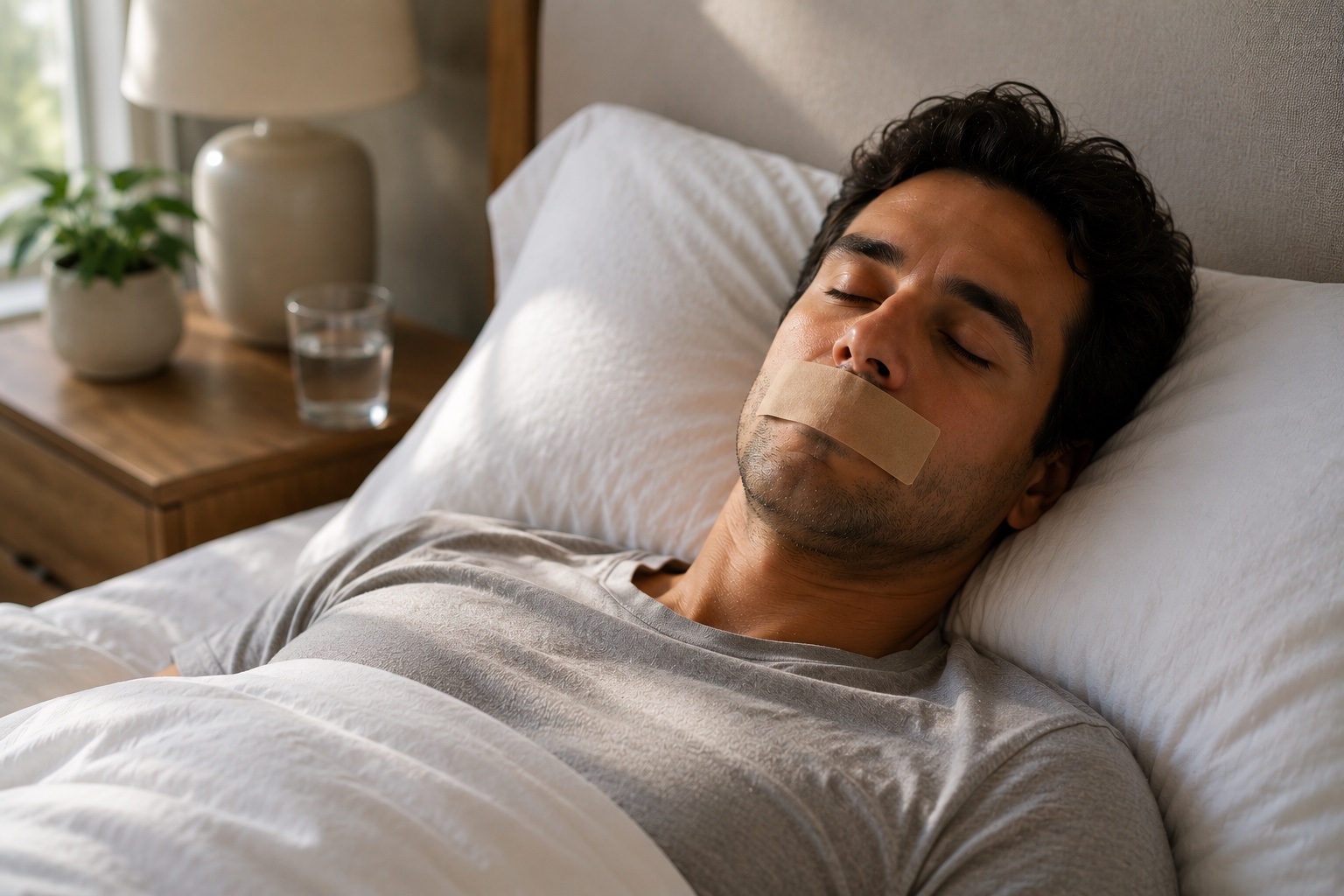
Taping your lips shut at night blew up as a sleep-and-jawline hack, and the videos make it look like a free upgrade. Here’s the honest split: the idea underneath it — that nose breathing beats mouth breathing — is real physiology. But the evidence for the tape itself is thin, small, and mostly limited to people who already have a breathing problem. And there’s a genuine danger the trend buries: if you have undiagnosed sleep apnea or a blocked nose, sealing your mouth can make your night worse, not better. This is what the science says, what it doesn’t, and who should never put tape on their face.
How this article was built: Primary sources: the Rhee et al. 2025 systematic review in PLOS One, the Lee et al. 2022 mild-OSA mouth-taping study in Healthcare, the Fangmeyer et al. 2025 scoping review in the American Journal of Otolaryngology, the Anderer 2024 and Chadwick & Huang 2024 sleep-medicine commentaries in JAMA and JAMA Otolaryngology–Head & Neck Surgery, the Conboy & Jones 2000 nasal nitric-oxide review in Clinical Otolaryngology, and the Feștilă et al. 2025 oral-breathing review in Children — all retrieved and verified through PubMed.
- The kernel is real. Nose breathing genuinely beats chronic mouth breathing — it filters and humidifies air, raises airway nitric oxide, and chronic mouth breathing is tied to dry mouth, snoring, and dental and craniofacial problems.67
- The tape evidence is thin. A 2025 systematic review of 213 patients across 10 studies found only 2 showed a real apnea or oxygen benefit, and most were small — there is no good trial showing taping improves sleep in healthy adults.1
- The safety risk is the part the videos skip. If you have undiagnosed sleep apnea or a blocked nose, sealing your mouth can impair an already-struggling airway. Sleep physicians have publicly warned against the trend.35
- Who should never do it: anyone with sleep apnea, nasal congestion or obstruction, who’s been drinking, or who uses sedatives — and the “jawline transformation” claim is fiction.
The real kernel: nose beats mouth
Let me give the trend its due first, because the thing that made it spread is true. Your nose is not a backup airway — it is the airway you are built to use. Air drawn through the nose gets filtered, warmed, and humidified before it reaches your lungs, instead of arriving cold, dry, and unfiltered through an open mouth. The nasal passages and sinuses also release nitric oxide, a gas that helps open blood vessels and supports oxygen uptake; breathing through the nose carries that signal down into the lungs in a way mouth breathing does not.6 (Nitric oxide is a small signaling molecule your body makes; here the relevant point is simply that the nose produces it and the mouth doesn’t.)
Chronic mouth breathing, by contrast, has a real downside list. It dries the mouth and throat, which is tied to morning dry mouth, sore throat, and worse dental health, and it’s associated with snoring and disrupted sleep. In children especially, long-term mouth breathing is linked in the orthodontic literature to changes in jaw posture and craniofacial development — the “adenoid facies” pattern of a longer, flatter face and dental crowding.7 So the premise the trend rides on — that habitual mouth breathing is a problem worth fixing and nasal breathing is the healthier default — is not internet folklore. It’s mainstream physiology.
Here’s the catch that the viral clips quietly skip over: “nasal breathing is better” does not automatically mean “taping your mouth shut is the way to get there.” Those are two different claims, and the trend collapses them into one. The first is well-supported. The second is where the evidence thins out fast.
It’s worth naming why people feel like it works even when the trials are quiet. Going to bed having decided to fix your sleep, lying still, paying attention to your breathing — that’s a ritual, and rituals genuinely lower arousal before sleep. The morning-after “I slept so much better” testimonial may be the tape doing nothing while the intention does the work. That’s not a knock on anyone; it’s exactly the kind of effect that makes a trend feel undeniable in personal experience while staying invisible in controlled data. The plural of anecdote isn’t evidence — especially for an outcome as suggestible as “how rested do I feel.”
What the taping evidence actually shows
Strip away the testimonials and look at what has actually been measured, and the picture is small and narrow. The most rigorous look we have is a 2025 systematic review that pooled 10 studies covering 213 patients. Its conclusion is the headline you won’t hear on TikTok: only 2 of those studies showed a statistically significant improvement in sleep-apnea markers — the apnea–hypopnea index (AHI, the number of breathing interruptions per hour) or oxygen desaturations — while others showed no benefit and several flagged potential harm.1 The reviewers explicitly warned of “a potentially serious risk of harm for individuals indiscriminately practicing this trend.”1
The one study people point to as the win is real, but read the fine print. Lee and colleagues in 2022 taped the mouths of 20 patients with mild obstructive sleep apnea who were confirmed mouth breathers, and the median AHI dropped from 8.3 to 4.7 events per hour — a 47% reduction — with the snoring index falling by a similar margin.2 That sounds impressive until you notice the boundaries: 20 people, all of them already diagnosed with mild OSA, all screened so their noses worked, and even then only about 65% responded.2 The authors called it a “preliminary study” for a reason. It is a small, single-center signal in a specific patient group — not a green light for the general public, and not yet trial-tested at scale.
A separate 2025 scoping review reached the same flavor of conclusion from a different angle: the literature is “markedly heterogeneous,” the most common social-media claims (better sleep, better oral health) have mostly never been formally evaluated, and there’s “little consensus on mouth-taping’s benefits.”4 Put plainly: the modest benefit that exists shows up in people who already snore or have mild apnea and can breathe through their nose. For a healthy adult with no breathing complaint, there is no good evidence the tape does anything for sleep quality at all. That claim is running on vibes.
“Nasal breathing is better” is true. “Therefore tape your mouth shut” is a leap the trend makes for you — and the data don’t follow it across.
The danger the videos skip
This is the part I want to spend the most ink on, because it’s the part the viral version erases. The whole pitch of mouth taping is “force the airway you want.” But if your airway is already compromised at night and you don’t know it, you are not optimizing — you are removing an emergency exit.
In obstructive sleep apnea, the airway collapses repeatedly during sleep and the body briefly arouses to reopen it. For many people, mouth breathing during those events is a compensation — an escape valve when the nasal route isn’t enough. Tape over it without first ruling out apnea, especially on a congested or obstructed nose, and you can prolong those events and deepen the oxygen drops. That is exactly why the clinical studies that did show benefit carefully excluded people with nasal obstruction and screened for it — the researchers knew the risk.1 When the trend strips out that screening, it strips out the only thing that made it safe.
Sleep medicine has put this in print: a 2024 JAMA news report cautioned directly against mouth taping for people with sleep apnea, and a JAMA Otolaryngology commentary the same year argued the practice and the unregulated devices around it deserve scrutiny rather than blind adoption.35 Do not tape your mouth shut at night if you: have diagnosed or suspected obstructive sleep apnea; snore loudly, gasp, or wake unrefreshed; have nasal congestion, allergies, a deviated septum, or any blocked nose; have been drinking alcohol or take sedatives, sleeping pills, or muscle relaxants; or have any condition (reflux, nausea) where being able to open your mouth fast matters. If you snore or wake unrested, the answer is a sleep evaluation — not tape over the symptom.
The logic here is simple and worth saying bluntly: snoring and unrefreshing sleep are symptoms. Taping the mouth can mute a symptom while leaving the cause — possibly apnea — untreated and undiagnosed. That’s the worst of both worlds: you feel like you did something, and the real problem keeps running in the dark. I’d rather you find out what’s actually happening at night than successfully silence the one alarm pointing at it.
Common questions, answered straight
Does it fix snoring? Maybe modestly, in the right person. In confirmed nasal breathers with mild apnea, taping cut the snoring index by roughly half in that 20-person study.2 But across the broader literature the effect is inconsistent, and snoring loud enough to bother you or a partner is itself a reason to get screened for apnea before reaching for tape.1
Will it change my face or jawline? No. This is the claim I have the least patience for. The orthodontic link between mouth breathing and facial development is about chronic, years-long breathing patterns during childhood growth, when the face is still forming.7 There is no evidence that taping an adult’s mouth overnight reshapes a finished skull, sharpens a jawline, or does anything the “mewing” videos promise. That part is fiction sold next to a real idea, which is exactly what makes it convincing.
Is it safe? Only if you can definitely breathe through your nose all night and you do not have sleep apnea — and the honest way to know the second part is to be evaluated, not to assume. For anyone with congestion, a known nasal obstruction, or untreated apnea, it is not safe, full stop.13
What about the tape itself? The products range from full lip-seal strips to small vertical “mouth dots.” Ordinary tape on facial skin can cause irritation, and ripping adhesive off lips and the delicate skin around them every morning is its own small misery. Many of these devices are sold without the kind of oversight you’d expect for something marketed for a breathing problem — part of why clinicians have called for closer regulation.5 If you and a clinician decide it’s appropriate, a skin-safe, easily-removable product matters far more than the brand on the box.
Where it fits: a tiered view
It helps to place mouth taping honestly on a spectrum of who it’s for and how settled the evidence is. None of this is a dosing or treatment instruction — it’s a map of the risk-to-evidence terrain.
Foundational — fix the breathing problem, not the symptom. If you breathe through your mouth because your nose is blocked — allergies, chronic congestion, a deviated septum — the highest-yield move is treating that. A clear nose makes nasal breathing the default on its own, with no tape required, and it’s the prerequisite that makes everything downstream even theoretically safe.
Research-curious — the screened, low-stakes trial. If you’re a confirmed nasal breather, you’ve been evaluated and apnea is ruled out, and you’re a habitual mouth breather who snores mildly, then mouth taping is the kind of low-cost thing a clinician might let you try and watch. The mild-OSA data suggest a subset benefits.2 Judge it over weeks, not one night, and stop if anything about your sleep feels worse.
Experimental — the healthy adult chasing energy or a jawline. This is the weakest-supported use and the one the trend is actually built on. There’s no good evidence taping improves sleep in people without a breathing complaint, the facial claims are unsupported, and you take on the small-but-real risk of taping over an undiagnosed problem for a benefit the data don’t back.14
The right question is rarely “tape: yes or no.” It’s “what is actually wrecking my sleep, and where does any single hack rank against an apnea workup, a clear nose, light timing, and temperature?” The Manual maps the sleep-and-recovery interventions against each other — what each one’s evidence genuinely supports, who benefits and who is wasting their time, and how to stack them without fooling yourself. See the Manual →
What to do instead
If the thing driving your interest is “I snore” or “I wake up tired,” here is the order of operations that actually addresses the cause rather than the symptom. First, rule out sleep apnea — a home sleep test or a clinic study is the single most useful thing on this list, because apnea is common, underdiagnosed, and the one scenario where taping is outright dangerous.3 Second, treat the nose: manage allergies and congestion, and get a deviated septum or chronic obstruction assessed, so nasal breathing is even possible. Third, the unglamorous sleep foundations — consistent schedule, cool dark room, morning light, capping late caffeine and alcohol — move sleep more than any overnight gadget, every time.
And if you want to spend energy on supplements or compounds for sleep, spend it on the ones with actual human trials behind them rather than a strip of tape. We’ve put glycine and magnesium through the same what’s-real-versus-marketing lens, and walked through how an honest sleep stack ranks the options against each other. None of them is a cure either — but at least the evidence shows up to the conversation.
My verdict
Here’s where I land, plainly. The nose-breathing principle underneath this trend is sound — I believe it, the physiology backs it, and chronic mouth breathing is a genuine problem worth fixing.67 But mouth taping is mostly hype riding on that real idea. The benefit that exists is small, narrow, and confined to screened people who already snore or have mild apnea; for the healthy adult the videos are aimed at, the case is essentially empty.14 And the trend carries a real safety tail — the apnea risk — that the clips ignore precisely because it’s inconvenient.3
So no, I’m not going to tell you taping is the upgrade your feed says it is. If you snore or feel unrested, get evaluated for sleep apnea — don’t tape over a symptom and call it a biohack. The jawline thing is fiction. The breathing principle is real. The tape is the least important part of the whole story, and the only part anyone’s selling.
References
- Rhee J, Iansavitchene A, Mannala S, Graham ME, Rotenberg B. Breaking social media fads and uncovering the safety and efficacy of mouth taping in patients with mouth breathing, sleep disordered breathing, or obstructive sleep apnea: A systematic review. PLoS One. 2025;20(5):e0323643. DOI: 10.1371/journal.pone.0323643. DOI · PMID 40397877
- Lee YC, Lu CT, Cheng WN, Li HY. The Impact of Mouth-Taping in Mouth-Breathers with Mild Obstructive Sleep Apnea: A Preliminary Study. Healthcare (Basel). 2022;10(9):1755. DOI: 10.3390/healthcare10091755. DOI · PMID 36141367
- Anderer S. Study Cautions Against Mouth Taping for Patients With Sleep Apnea. JAMA. 2024;332(19):1602. DOI: 10.1001/jama.2024.21820. DOI · PMID 39453679
- Fangmeyer SK, Badger CD, Thakkar PG. Nocturnal mouth-taping and social media: A scoping review of the evidence. Am J Otolaryngol. 2025;46(1):104545. DOI: 10.1016/j.amjoto.2024.104545. DOI · PMID 39662104
- Chadwick JW, Huang AT. Should Mouth Taping and Obstructive Sleep Apnea Therapies Be Regulated? JAMA Otolaryngol Head Neck Surg. 2024;150(11):1020. DOI: 10.1001/jamaoto.2024.2564. DOI · PMID 39361319
- Conboy PJ, Jones NS. The nose and nitric oxide: a review. Clin Otolaryngol Allied Sci. 2000;25(5):337-341. DOI: 10.1046/j.1365-2273.2000.00378.x. DOI · PMID 11012643
- Feștilă D, Ciobotaru CD, Suciu T, Olteanu CD, Ghergie M. Oral Breathing Effects on Malocclusions and Mandibular Posture: Complex Consequences on Dentofacial Development in Pediatric Orthodontics. Children (Basel). 2025;12(1):72. DOI: 10.3390/children12010072. DOI · PMID 39857903