Matcha vs coffee: what the science says about the calmer caffeine
Matcha is the trendy coffee alternative, sold on a promise of “calm focus” — energy without the jitters, the crash, or the racing heart. Strip away the superfood marketing and there is a real, defensible reason it can feel smoother than coffee: matcha pairs a smaller dose of caffeine with L-theanine, the tea amino acid that takes the edge off a stimulant. That pairing has decent evidence behind it. The fat-burning, metabolism-revving, disease-curing claims stacked on top of it do not. Here is the honest split between the signal and the hype.
How this article was built: Primary sources retrieved and verified directly on PubMed and PubMed Central: the Payne et al. 2025 systematic review and meta-analysis of caffeine and L-theanine in Nutrition Reviews, the Camfield et al. 2014 acute meta-analysis of tea constituents in Nutrition Reviews, the Dietz et al. 2017 matcha cognition trial in Food Research International, the Baba et al. 2021 daily-matcha stress trial in Nutrients, the Hursel et al. 2011 catechin-caffeine energy-expenditure meta-analysis in Obesity Reviews, the Wang et al. 2023 green-tea-catechin meta-analysis in Heliyon, and the Kuriyama et al. 2006 Ohsaki cohort in JAMA. The Consensus and PubMed automated tools were offline during drafting, so every citation below was confirmed by hand on its live source page.
- The “calm focus” claim is the real one. Matcha delivers roughly 40–135 mg of caffeine per cup — usually less than coffee's ~95 mg — alongside L-theanine, and the caffeine-plus-theanine pairing has two meta-analyses showing small-to-moderate gains in attention over caffeine alone.12
- The “smoother than coffee” feeling is plausible but under-tested head-to-head. Matcha-specific trials show modest attention and stress-buffering effects; almost none directly pit matcha against an equal dose of coffee.34
- The catechins are real but oversold. Green-tea catechins nudge a few cardiometabolic markers and track with lower cardiovascular mortality in big cohorts — but “antioxidant superfood that cures disease” and “fat-burner” both overshoot the data badly.567
- Who it's for: anyone who likes coffee but hates the jitter. Matcha is a pleasant, lower-jitter swap with a legitimate mechanism — not a metabolism hack and not medicine.
- What matcha actually is
- The calm-focus claim: the strong one
- The mechanism: caffeine, L-theanine, and the brake pedal
- Matcha vs coffee, head to head
- Catechins, EGCG, and the “superfood” problem
- The metabolism and fat-loss claim
- The practical read — and the lead question
- Grey areas and open questions
- What this article is not saying
- References
What matcha actually is
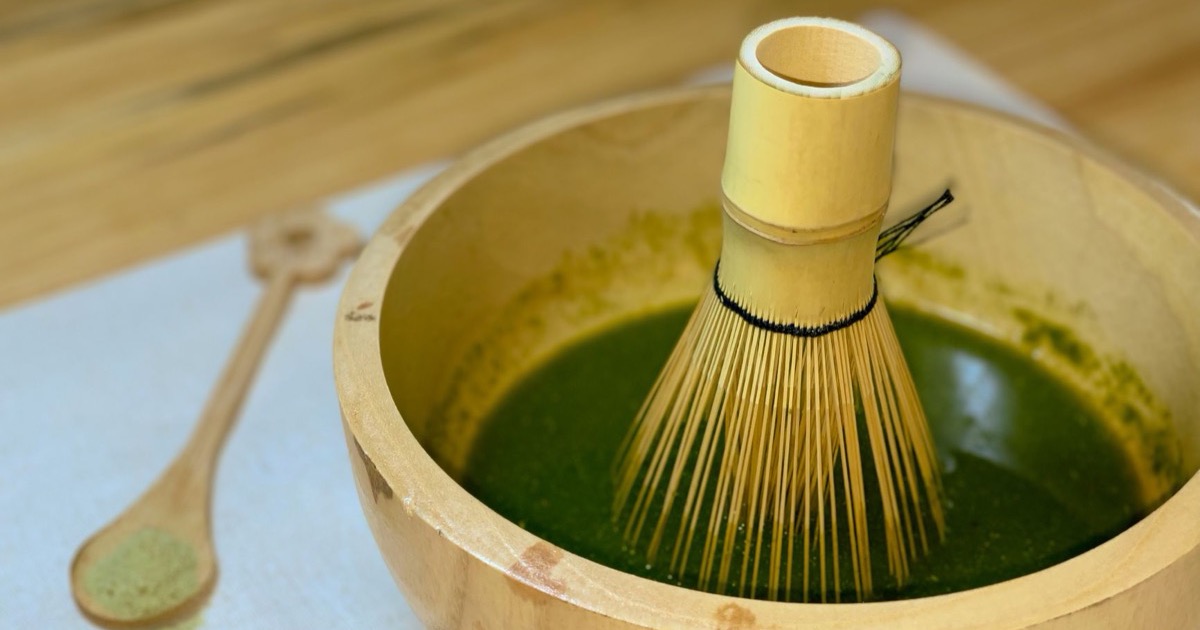
Matcha is whole green tea leaf, shade-grown and stone-ground into a fine powder, then whisked into water rather than steeped and strained. That one difference — you drink the leaf instead of throwing it away — is the whole story of why matcha behaves a little differently from a cup of brewed green tea or a cup of coffee. Whatever is concentrated in the leaf, you swallow: more caffeine, more L-theanine, more of the catechins that the marketing calls antioxidants.
The numbers matter because almost every claim downstream depends on them. Matcha runs roughly 19–45 mg of caffeine per gram of powder, so a typical 2–4 gram serving lands somewhere around 40–135 mg of caffeine per cup — usually below a standard 8-ounce coffee's ~95 mg, but with real overlap at the high end if you use a heaped scoop. It also carries on the order of tens of milligrams of L-theanine per serving. Hold those two facts together, because the gap between matcha and coffee is not really about the caffeine being lower. It is about what rides alongside it.
The calm-focus claim: the strong one
Start with the claim that actually holds up. “Calm focus” — alertness without the wired, jittery edge — is matcha's headline promise, and it has a legitimate basis. It does not come from matcha being magic. It comes from the same two-ingredient pairing that makes any good cup of tea feel different from straight coffee: caffeine for the lift, L-theanine to take the rough edges off.
The best summary is the 2025 systematic review and meta-analysis by Payne and colleagues, which screened 50 randomized controlled trials of tea and its components and pooled 15 of them. Comparing caffeine plus L-theanine against placebo, it found small-to-moderate improvements favouring the combination in the first one to two hours after a dose — better attention-switching accuracy (standardized mean difference 0.33), better digit-vigilance accuracy, and improved overall mood.1 An earlier acute meta-analysis by Camfield and colleagues, pooling 11 trials, reached the same verdict from a different dataset: moderate effect sizes favouring combined caffeine and L-theanine in the first two hours, especially for alertness and attention-switching.2 Two independent syntheses agreeing on both the direction and the rough size of an effect is about as good as nutrition evidence gets.
Matcha is, in effect, that pairing delivered in a drink. So the mechanism behind “calm focus” is graded MODERATE not because matcha itself has been tested to death, but because the active combination it carries has been. That is the honest version of the claim: the lever matcha pulls is well evidenced, even where matcha-branded trials are still thin.
The mechanism: caffeine, L-theanine, and the brake pedal
Caffeine is the accelerator. It blocks the receptors that adenosine — the molecule that builds up across a waking day and makes you feel tired — would otherwise dock into, so the brain reads itself as more awake. That is the lift you feel from coffee, and matcha delivers the same lift, just usually a smaller one per cup.
L-theanine is the more interesting half. It is an amino acid found almost only in tea, and the signal it pulls runs in the opposite direction to caffeine's: gently away from over-excitation and toward a quieter, settled baseline, without the knockout quality of a sedative. In controlled recordings it raises alpha-band brain activity — the electrical signature of a calm-but-awake mind — and that is the closest thing the field has to a fingerprint for “relaxed alertness.” The practical effect is subtractive rather than additive: theanine does not add stimulation, it removes the jitter around the stimulation already there.
Coffee is one pedal: more gas. Matcha is two — gas and a light touch on the brake at the same time. That is the whole pitch, and it is a real one.
If you want the deeper read on that amino acid on its own — the doses, the caffeine ratio, where the evidence stops — we covered it in detail in our piece on L-theanine and the calm-focus combo. The short version for matcha's purposes: the cleanest attention results show up around a modest caffeine dose paired with theanine, which is roughly the territory a normal cup of matcha occupies. You do not have to engineer the ratio; matcha bakes a reasonable one in.
Matcha vs coffee, head to head
Here is where honesty earns its keep. People say matcha feels smoother than coffee — fewer jitters, no hard crash, steadier energy across a couple of hours. The mechanism makes that plausible, and there is a second, simpler reason: a cup of matcha usually carries less caffeine than a cup of coffee, and lower caffeine alone produces less jitter and a gentler comedown. Some of the “matcha is smoother” experience is just “less caffeine is smoother.”
The matcha-specific evidence is encouraging but modest, and it is graded EMERGING for a reason. Dietz and colleagues gave participants matcha (as a drink or a snack bar) or a placebo version and tested them an hour later. The matcha drink produced significant improvements in basic attention and psychomotor speed — reacting accurately to stimuli over time — though the effect barely registered on other cognitive tasks and mood did not move.3 Baba and colleagues ran a daily-intake trial in middle-aged and older adults and found that sustained matcha did something single-dose caffeine did not: it raised the “amount of work” completed under a stress-inducing arithmetic task and supported executive function, which the authors attributed to theanine and catechins working alongside the caffeine rather than caffeine alone.4
Notice the gap, though. Almost none of these trials pit matcha against an equal dose of coffee. They compare matcha to placebo, or matcha to plain caffeine. So “matcha beats coffee” is, strictly, not what the data show — what they show is that the matcha package (caffeine + theanine + catechins) edges out caffeine on its own, and that the calm-alertness experience is real. The clean head-to-head against a matched cup of coffee is the trial nobody has properly run. That is exactly why the “smoother than coffee” claim sits at EMERGING and not MODERATE.
vs ~95 mg in 8 oz coffee
accuracy (SMD)
caffeine + theanine vs placebo
attention effect shows
acute, then it fades
Catechins, EGCG, and the “superfood” problem
Matcha's other big selling point is antioxidants — specifically catechins, and above all epigallocatechin gallate (EGCG), the most abundant and most studied of them. Because you drink the whole leaf, matcha delivers more of these than a strained cup. The marketing then makes a leap the evidence does not support: from “rich in catechins” to “superfood that fights cancer, heart disease, and aging.” The first part is true. The second part is where it falls apart.
Here is the grounded version. In large observational cohorts, green tea drinkers tend to have modestly lower cardiovascular mortality. The landmark Ohsaki study followed more than 40,000 Japanese adults for up to 11 years and found green tea consumption inversely associated with death from cardiovascular disease and all causes, the link most pronounced in women.7 That is a real, repeatedly observed association — but it is observational, meaning green tea drinkers may simply live differently in ways that protect their hearts, and it cannot prove the tea itself did the work.
When you move to controlled trials, the effect on hard markers is small and inconsistent. A 2023 meta-analysis of green-tea-catechin trials in overweight and obese people found catechins reduced waist circumference and triglycerides and raised HDL (“good”) cholesterol — but produced no significant change in body-mass index, blood pressure, total cholesterol, or LDL.5 A handful of markers nudge; most do not. That is a genuine, if modest, cardiometabolic signal, which is why this claim earns EMERGING. It is also a long way from “cures disease,” which earns HYPE, because no trial shows matcha preventing or treating any disease in humans. The honest line: catechins are a plausible small helper, not a treatment, and certainly not a reason to skip anything a clinician actually recommends.
The metabolism and fat-loss claim
“Matcha boosts your metabolism and burns fat” is the claim most likely to sell a tin and least likely to change your body. There is a real kernel: catechins plus caffeine do produce a measurable thermogenic effect. The Hursel meta-analysis found that catechin-caffeine mixtures raised 24-hour energy expenditure by roughly 4–5% and, unlike caffeine alone, significantly increased fat oxidation.6 So the mechanism is not invented.
But scale it honestly. A few percent of daily energy expenditure is a small number, the effect blunts as the body habituates to caffeine, and the downstream weight-loss data are underwhelming — larger reviews of green-tea catechins on body weight find changes that are modest at best and often not clinically meaningful. There is no published evidence that matcha specifically drives fat loss in any amount that matters. Treating matcha as a fat-burner is mistaking a rounding error for a strategy, which is why this claim sits at WEAK. If your goal is body composition, the levers that actually move it — the protein floor, the calorie math, resistance training — are the ones we cover in the lifestyle hub, and matcha is not on that list.
The practical read — and the lead question
Put together, matcha is a reasonable, pleasant, lower-jitter swap for coffee with a legitimate calm-focus mechanism and a small bonus of catechins. It is not magic, and it does not need to be to be worth drinking. If coffee leaves you wired or you crash hard mid-morning, the lower caffeine plus the theanine brake is a sensible trade. If you simply prefer the taste and the ritual, that is reason enough; the modest cognitive edge is a bonus, not the point.
Two honest caveats keep this from being a sales pitch. First, the “steadier energy” only goes so far — the attention effect is acute, showing up in the hour or two after a cup and then fading, so matcha is a dose for the task in front of you, not a state you bank for the day. And because it still carries caffeine, an afternoon cup can reach your bedtime — our caffeine cutoff calculator shows how late is too late for your last one. Second, the whole-leaf advantage cuts both ways. Because you consume the entire ground leaf, you also consume whatever the leaf absorbed from its soil, and tea plants can take up heavy metals such as lead. Independent testing of popular matcha brands has generally found them low in lead and other contaminants — reassuring — but the principle stands: with matcha you are not discarding the leaf, so sourcing and quality matter more than they do for a steeped-and-strained cup. Buy from brands that publish contaminant testing, and treat “ceremonial grade” as a flavour label, not a safety certificate.
A smoother caffeine source with a small cognitive edge is genuinely nice to have — but the worst mistake is treating any single drink as a health strategy. The right question is rarely “matcha: yes or no,” it is “what actually moves my energy, focus, and metabolic health, and where does a cup of matcha rank against sleep, caffeine timing, training, and the foundational stuff?” The Manual maps the everyday compounds — caffeine, theanine, the green-tea catechins and the rest — against each other: what each one's evidence genuinely supports, the dose and timing windows, and how to use them without fooling yourself. See the Manual →
Grey areas and open questions
How much is just less caffeine? The single hardest thing to untangle is how much of matcha's “smoothness” is the theanine and how much is simply a smaller caffeine dose. Both push in the same direction, and the matcha trials are not designed to separate them. A clean study would match caffeine exactly and vary only the theanine — and that study, for matcha specifically, has not been run.3
Matcha versus coffee, properly. Almost every trial compares matcha to placebo or to isolated caffeine, not to an equal-caffeine cup of coffee. Until someone runs that head-to-head, “matcha is better than coffee for focus” remains a reasonable hypothesis, not a finding.4
Cohorts are not proof. The lower cardiovascular mortality in green-tea drinkers is real and repeated, but it is observational; the trial-level marker changes are small and patchy. The gap between “associated with living longer” and “makes you live longer” is the whole grey area, and matcha marketing routinely paves over it.57
Variability and sourcing. Caffeine sensitivity, habitual intake, the grade and grams you use, and the brand's contaminant profile all shift the picture, and none of the trials are powered to tell you how it lands for you specifically. The honest answer to “will matcha feel smoother for me?” is “probably a little, more so if coffee makes you jittery — and the only way to know is a careful, sober self-test.”
What this article is not saying
This is not “matcha is hype.” The calm-focus mechanism is real, the caffeine-plus-theanine pairing has two meta-analyses behind it, and matcha is a perfectly good, lower-jitter way to take your caffeine. Dismissing it entirely is as wrong as overselling it.
This is not “matcha is a superfood.” It does not burn meaningful fat, it does not cure or prevent disease, and its catechins move only a few markers a modest amount. The antioxidant-miracle and fat-burner framings are exactly the parts the evidence supports least and the marketing pushes hardest.
And this is not a recommendation to switch, or a dosing prescription. Matcha and coffee both deliver a real stimulant with real interactions, and the right call depends on your caffeine sensitivity, your medications, and your health history. If you are pregnant, take cardiovascular or psychiatric medication, or have a heart or anxiety condition, make this a clinician conversation. The point here is to tell you what the trials show and where they stop, so your expectations — and your next cup — can be honest ones.
References
- Payne ER, Aceves-Martins M, Dubost J, Greyling A, de Roos B. Effects of tea (Camellia sinensis) or its bioactive compounds L-theanine or L-theanine plus caffeine on cognition, sleep, and mood in healthy participants: a systematic review and meta-analysis of randomized controlled trials. Nutr Rev. 2025;83(10):1873-1891. DOI · PMID 40314930
- Camfield DA, Stough C, Farrimond J, Scholey AB. Acute effects of tea constituents L-theanine, caffeine, and epigallocatechin gallate on cognitive function and mood: a systematic review and meta-analysis. Nutr Rev. 2014;72(8):507-522. DOI · PMID 24946991
- Dietz C, Dekker M, Piqueras-Fiszman B. An intervention study on the effect of matcha tea, in drink and snack bar formats, on mood and cognitive performance. Food Res Int. 2017;99(Pt 1):72-83. DOI · PMID 28784536
- Baba Y, Inagaki S, Nakagawa S, Kobayashi M, Kaneko T, Takihara T. Effects of daily matcha and caffeine intake on mild acute psychological stress-related cognitive function in middle-aged and older adults: a randomized placebo-controlled study. Nutrients. 2021;13(5):1700. DOI · PMID 34067795
- Wang Y, Xia H, Yu J, Sui J, Pan D, Wang S, Liao W, Yang L, Sun G. Effects of green tea catechin on the blood pressure and lipids in overweight and obese population — a meta-analysis. Heliyon. 2023;9(11):e21228. DOI · PMID 38034724
- Hursel R, Viechtbauer W, Dulloo AG, Tremblay A, Tappy L, Rumpler W, Westerterp-Plantenga MS. The effects of catechin rich teas and caffeine on energy expenditure and fat oxidation: a meta-analysis. Obes Rev. 2011;12(7):e573-e581. DOI · PMID 21366839
- Kuriyama S, Shimazu T, Ohmori K, et al. Green tea consumption and mortality due to cardiovascular disease, cancer, and all causes in Japan: the Ohsaki study. JAMA. 2006;296(10):1255-1265. DOI · PMID 16968850